When you’re trying to figure out where to focus your energy, Google Reviews or Yelp, it really boils down to a classic dilemma: reach versus reputation. For almost any local business, Google Reviews is the undeniable starting point. Its massive audience and direct line to your search ranking make it a non-negotiable.
That said, Yelp still carves out a powerful niche, especially for industries like restaurants and home services, where its dedicated community can make or break a business.
Understanding The Core Differences
The Google vs. Yelp debate is a cornerstone of any local business’s online strategy. While they both let customers share their thoughts, their core philosophies and the way people use them are worlds apart. Getting a handle on these nuances is the first step to building a review strategy that actually brings in new customers and builds real trust.
Google’s sheer size is hard to overstate. In 2025, Google holds a staggering 88% of the U.S. search engine market share, making it the go-to for pretty much everyone looking for anything. This tight integration means your reviews show up right in Google Maps and the local search results, giving you instant visibility. The numbers back this up: a recent survey found that 83% of consumers check Google Reviews, while only 44% look at Yelp. You can read more about these consumer trends to see the full picture.
Yelp, on the other hand, operates more like a curated social community for local spots. It has a loyal following of “Yelpers” who are known for writing incredibly detailed and thoughtful reviews. Its audience might be smaller, but they’re highly engaged and carry a lot of weight, particularly in dense, competitive city markets.
This infographic breaks down the key differences in review volume, SEO impact, and who’s using each platform.
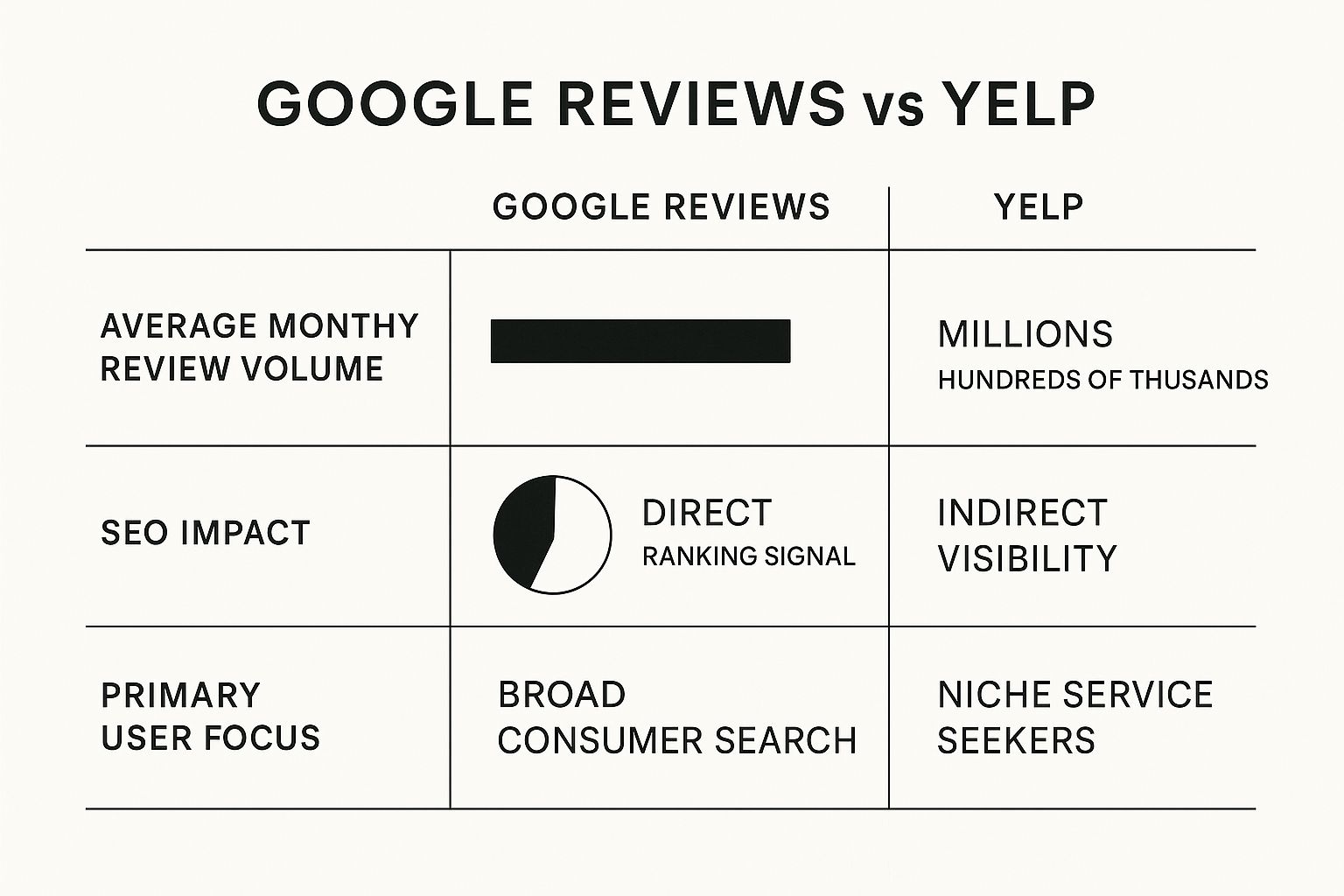
The data makes it clear: Google wins on sheer volume and direct SEO power, but Yelp holds its own by attracting specific, service-focused customers who are ready to buy.
Quick Comparison Google Reviews vs Yelp
To make the decision a bit easier, let’s put their core features side-by-side. Each platform has a distinct take on how reviews should be gathered, who they’re for, and how businesses should interact. These differences are what will ultimately guide your strategy.
| Feature | Google Reviews | Yelp |
|---|---|---|
| Primary Philosophy | Open, accessible information for all searchers. | Curated, community-driven recommendations. |
| Review Solicitation | Encouraged and easy to ask for. | Strictly forbidden and can get you penalized. |
| Audience Reach | Massive; built right into search and maps. | Smaller, but highly engaged and ready to spend. |
| SEO Impact | Direct and significant impact on local SEO. | Indirect impact via a high-ranking Yelp profile. |
| Best For | Nearly all local businesses needing visibility. | Restaurants, home services, and other niche businesses. |
This table shows that while both are review platforms, they serve very different purposes in your marketing toolkit.
The key takeaway is simple: Google builds your visibility, while Yelp builds your niche reputation. Neglecting Google is a major SEO mistake, but ignoring Yelp in the right industry means missing out on a valuable stream of motivated customers.
In the end, the smartest approach is usually a balanced one. Start by absolutely mastering your Google Business Profile to capture the biggest audience possible. From there, you can figure out if Yelp’s dedicated community is a good fit for your specific customer base.
Where Your Customers Are and What They’re Looking For

To really get a handle on the Google vs. Yelp debate, you have to start with the people using them. It all boils down to where your customers hang out online and, more importantly, what’s on their minds when they’re there. The platforms are worlds apart in both their sheer size and the mindset of their users.
Think about it. When someone needs a fast answer—like “plumber open now” or “best coffee near me”—their first instinct is to pull up Google. It’s become a reflex. This makes Google a massive discovery engine, catching people right at the start of their search when reviews pop up directly in Maps and search results.
Yelp, on the other hand, is more of a destination. People go to Yelp with a mission. They’re looking for the perfect restaurant for an anniversary dinner or carefully vetting contractors for a big home project. The intent is completely different.
Google: The King of Discovery
Google’s biggest advantage is its undeniable scale. We’re talking billions of searches every single day across every industry you can imagine. This firehose of traffic means more eyeballs on your business and, by extension, a much higher potential for a steady stream of reviews.
The mindset behind a Google search is often broad. A customer is usually in the early stages, just starting their research and weighing a few options. Your Google reviews act as a quick, powerful stamp of approval that can instantly elevate your business from just another name on the list to a serious contender.
The numbers don’t lie. As of 2024, Google is home to nearly three-quarters of all online reviews, completely dwarfing the competition. The average business rating on Google has climbed to a respectable 4.11 stars, likely boosted by Google’s own prompts to leave feedback. For comparison, Yelp sees about 26,830 new reviews per minute, but that’s just a drop in the bucket compared to Google’s overall volume.
Yelp: The Community for Deliberate Decisions
While Yelp’s audience is smaller, it’s an incredibly engaged and influential one. “Yelpers,” as they call themselves, are known for writing detailed, novel-like reviews, often complete with photos and specific stories. They aren’t just browsing; they’re researching and contributing to a community.
This creates a user who is much further down the path to making a purchase. Someone meticulously reading through a dozen in-depth Yelp reviews for a moving company is probably ready to book a truck.
Here’s the core difference: Google is where customers discover you exist. Yelp is often where they decide if you’re the right choice, especially for service-based businesses where trust and detail are everything.
This is why a few glowing, detailed Yelp reviews can sometimes pack more punch in certain industries than a hundred short-and-sweet Google reviews. That in-depth feedback gives potential customers the confidence they need to pull the trigger.
User Intent and Volume: A Head-to-Head Look
Let’s break down how a typical user on each platform behaves. Understanding this is key to figuring out where to focus your reputation management efforts. It’s one thing to get listed on the top business listing websites in the USA, but it’s another to know why your customers are on each site.
The Google User:
- Their Goal: Quick discovery, instant answers, and location-based searches (“near me”).
- Their Behavior: They skim star ratings and the first few recent reviews to get a fast impression.
- The Result: High traffic that leads to a higher quantity of reviews, which are often brief.
The Yelp User:
- Their Goal: In-depth research, careful vetting, and finding a trusted service provider.
- Their Behavior: They read multiple long-form reviews, study customer photos, and look for a community consensus.
- The Result: Lower traffic, but the reviews they leave are typically more detailed and carry more weight in their niche.
At the end of the day, Google’s colossal reach makes sure you’re seen by the widest audience possible when they start looking. Yelp, however, captures a smaller but far more motivated slice of that audience—the people who are done looking and are ready to choose.
Comparing Review Policies and Generation

When you dig into the Google Reviews vs. Yelp debate, the real difference isn’t just user numbers—it’s their completely opposite philosophies on how a review should even come to exist. Google has an open-door policy, actively encouraging you to ask every single customer for their feedback. Yelp, on the other hand, stands firm against any kind of solicitation, believing that the only authentic review is one that’s given freely.
This fundamental clash directly impacts your strategy. What’s considered a smart move on Google can get you in hot water with Yelp. Understanding these rules is the absolute key to building a strong online reputation without accidentally breaking them.
Google’s Strategy: Volume and Accessibility
Google’s approach is simple: more reviews mean a more accurate snapshot of a business. They make it incredibly easy for businesses to get that feedback, offering tools like direct review links you can share via email, text, or even a QR code at your checkout counter. The whole system is built to make it as frictionless as possible for customers to share what they think.
This openness leads to a much higher volume of reviews. By actively and ethically asking for feedback, you can create a steady stream of fresh social proof. That’s a powerful signal to both potential customers and Google’s local search algorithm. For a deeper dive, our guide on asking for a review lays out some great strategies you can use right away.
Yelp’s Policy: Curation and Authenticity
Yelp has built its entire brand on being a trusted, community-driven guide. To protect that image, they enforce a strict no-solicitation policy. This is non-negotiable: you cannot ask customers to leave you a Yelp review. If you do, you risk getting slapped with a penalty, like a consumer alert on your profile that tells everyone you’ve been breaking the rules.
“Don’t ask customers, mailing list subscribers, friends, family, or anyone else to review your business.” – Yelp’s Official Policy
The goal here is to stop businesses from only asking their happiest customers for feedback and creating a skewed, overly positive profile. Yelp is all about organic, spontaneous reviews from its active community. While this purist stance can be a headache for business owners, it’s exactly why many people trust Yelp reviews so deeply.
This trust is especially important in certain industries. Yelp is famous for detailed, photo-heavy reviews that paint a vivid picture of a business, which is invaluable for restaurants where ambiance and food presentation are everything. Even though it gets fewer eyeballs than Google, Yelp still draws nearly 180 million monthly visitors, making it a powerhouse for specific types of businesses.
The Controversial Yelp Filter
Adding another layer of complexity is Yelp’s automated recommendation software, better known as the “Yelp filter.” This algorithm sifts through every review and decides if it gets featured on your main page or hidden away in a “not currently recommended” section. Its job is to showcase what it believes is the most helpful and reliable content.
Here are a few things that can trigger the filter:
- User Activity: A review from a seasoned Yelper with a long history of contributions is more likely to stick than one from a brand-new account.
- Review Quality: Vague or overly emotional reviews often get filtered.
- Suspicious Patterns: A sudden flood of five-star reviews, especially from new profiles, looks fishy and can get your reviews hidden.
This means that even a perfectly legitimate, glowing review can get buried if the customer isn’t a regular Yelp user. It’s a huge source of frustration for businesses, but it just reinforces Yelp’s commitment to what it considers trustworthy feedback. You can’t control the filter, but you can respond professionally to every review—recommended or not—to show you’re engaged and value all customer input.
How Each Platform Impacts Your Local SEO

This is where the rubber really meets the road. When we talk about Google Reviews vs. Yelp, their effect on your local search ranking is where the two platforms couldn’t be more different. One is like putting rocket fuel in your SEO tank, while the other gives you a powerful—but more indirect—push.
Knowing how this works is the key to deciding where to spend your time and energy.
Google Reviews: A Direct Line to Higher Rankings
Let’s be blunt: Google Reviews are a massive, direct ranking signal for Google’s own local algorithm. There’s no mystery here. The more high-quality, recent reviews you get, the more Google trusts your business and shows you off in local search results.
This is most obvious in the all-important Google Local Pack—that box of three businesses that shows up at the top of the page for local searches. Landing a spot there is like getting prime real estate, and it’s where the vast majority of clicks go.
Google’s algorithm is looking for real-world proof that your business is relevant and trustworthy. Your reviews provide exactly that. Several key metrics play a direct role:
- Review Quantity: More reviews tell Google you’re a popular, active business.
- Review Velocity: A steady stream of new reviews shows you’re currently relevant.
- Review Quality: A high average star rating is a clear sign of quality that Google rewards.
- Keyword Presence: When customers naturally use keywords in their reviews (like “best emergency plumber”), it reinforces your expertise in that area.
The connection between your reviews and your search performance is undeniable. For a deeper dive, our guide explains exactly do Google reviews help SEO with some practical tips.
Pro Tip: Don’t forget to respond to your Google Reviews. It’s also a ranking signal. It shows Google (and potential customers) that you’re engaged and care about feedback, which can give your local visibility an extra nudge.
Yelp’s Indirect SEO Power
Yelp’s role in your SEO is more subtle, but you’d be foolish to ignore it. While Yelp reviews aren’t a direct ranking factor for Google, a strong Yelp profile often ranks on the first page of Google all by itself.
Think about it. When someone searches for “best sushi in Chicago,” a Yelp page listing top-rated restaurants is almost always one of the first results. If your business is sitting pretty at the top of that Yelp list, you’re essentially borrowing Yelp’s incredible domain authority to get in front of customers on Google.
This creates a powerful second path to discovery. A great Yelp profile acts as a major vote of confidence and a trusted source that can drive serious, ready-to-buy traffic to your door—even if they found you through a Google search that led them to Yelp first.
SEO Impact Analysis
Let’s break down how Google and Yelp reviews really influence your ability to show up in local search. The table below compares their direct and indirect effects, showing how each contributes to your overall online footprint.
| SEO Factor | Google Reviews Impact | Yelp Impact |
|---|---|---|
| Direct Ranking Signal | High. Directly influences your spot in the Google Local Pack and Maps. | None. Does not directly affect your ranking in Google’s algorithm. |
| Local Pack Visibility | Critical. Your review count, rating, and recency are primary drivers. | Indirect. Has no bearing on your Google Business Profile’s rank. |
| SERP Visibility | Very High. Your profile and reviews appear directly in search and Maps. | High. Strong Yelp pages often rank on page one of Google organically. |
| Keyword Relevance | High. Keywords in reviews boost your topical authority with Google. | Low. Keywords in Yelp reviews have minimal impact on Google SERPs. |
At the end of the day, a smart local SEO strategy needs both. Online reviews are a massive piece of the puzzle, so mastering the essential steps for dominating Local Maps SEO is a must for any local business. Prioritize Google for the direct ranking benefits, but don’t sleep on Yelp—it’s your secondary channel for building trust and getting discovered.
Business Tools and Advertising: Where to Focus Your Efforts
Beyond the reviews themselves, both Google and Yelp give you tools to connect with customers. But this is where their philosophies really diverge. Google offers a powerful, free toolkit that’s deeply woven into its search ecosystem. Yelp, on the other hand, is built around a premium advertising model.
This fundamental difference presents a clear choice for business owners. Should you pour your time and energy into mastering the free, high-visibility features of Google Business Profile? Or is it worth investing in Yelp’s targeted ads to reach its dedicated user base?
The Free Toolkit in Your Google Business Profile
Google gives you an impressive suite of tools for free, right inside your Google Business Profile (GBP). These aren’t just add-ons; they work together with your reviews to turn your listing into a dynamic storefront on the search results page. Think of your GBP less as a simple listing and more as a mini-website that Google wants to promote.
A few key features you should be using:
- Google Posts: You can share updates, special offers, and company news directly on your profile, almost like a social media feed. These posts show up in search and can get people to act immediately.
- Q&A Feature: Customers can ask questions right on your profile, and you can jump in with official answers. Over time, this builds a helpful, public FAQ that addresses common concerns.
- Messaging: This feature lets customers send you a direct message straight from your GBP listing, creating an easy way to handle quick questions and capture new leads.
These tools help paint a complete, up-to-date picture of your business, with your reviews serving as the social proof that backs it all up.
The real magic of Google’s toolkit is how seamless it is. A potential customer sees your 4.8-star rating, reads a couple of great reviews, spots a recent Post about a weekend special, and messages you to ask a question—all without ever leaving the Google search page.
Yelp’s Focus on Paid Ads and Enhanced Profiles
Yelp runs on a freemium model. You get a basic profile for free, but the platform definitely steers you toward its paid advertising products to get noticed. This has been a sore spot for many business owners over the years, but for certain businesses, the investment can be worthwhile.
To get the most out of your efforts here, integrating specialized tools for managing Google reviews can also streamline how you handle customer feedback across platforms.
Yelp’s main paid features include:
- Enhanced Profiles: This upgrade strips competitor ads from your page and lets you add a prominent call-to-action button, a photo slideshow, and even a business video.
- Targeted Ads: Your business ad appears on the pages of your direct competitors and in relevant Yelp search results, getting you in front of users who are actively looking for what you offer.
- Verified License: A simple badge that proves to customers you hold the necessary trade licenses, which can be a huge trust-builder for plumbers, electricians, and other service pros.
A Practical Cost-Benefit Breakdown
So, where should your money go? For the vast majority of businesses, the answer is straightforward: master the free tools on Google first. Optimizing your Google Business Profile delivers a massive return on your time without costing a cent. The direct SEO impact and sheer volume of users make it the most powerful and efficient use of your resources.
Yelp Ads require a more strategic decision. If you’re in a hyper-competitive local market—think restaurants, home services, or salons—Yelp’s targeted advertising can connect you with customers who have high intent and are ready to buy. But be warned, the cost can be significant, and the return on investment isn’t always a sure thing.
Before you pull the trigger on Yelp Ads, ask yourself these three questions:
- Is my ideal customer genuinely active on Yelp?
- Have I completely optimized my free Yelp profile and gathered some organic reviews?
- Can I commit to a consistent ad budget long enough to actually see results?
Ultimately, Google provides the non-negotiable foundation for your local online presence. Yelp offers a paid shortcut to a very specific, motivated audience.
Which Platform Should Your Business Prioritize?
So, after digging into the Google vs. Yelp debate, we get to the real question: where should you actually spend your time and money? This isn’t about crowning a single winner. It’s about being smart and strategic with your efforts, based on what your business actually does.
Let’s cut right to the chase. For almost every local business out there, the answer is simple: start with Google. Its sheer dominance in search, direct tie-in with local SEO, and integration with Google Maps make it the bedrock of your online reputation. Ignoring your Google Business Profile is like trying to build a house without pouring the foundation first—everything else will be shaky at best.
This isn’t to say you should write off Yelp entirely. It just means your first and most important job is to build a rock-solid presence on Google to get in front of the largest possible audience.
Google: The Non-Negotiable Starting Point
Think of your Google Business Profile as your digital storefront. It’s the first place the vast majority of potential customers will find you. A consistent flow of positive Google reviews is one of the most powerful marketing tools you can have, impacting everything from your search ranking to a customer’s final decision.
- Who is this for? Literally everyone. Whether you run a small bakery, a dental practice, or a multi-state law firm, a strong Google presence is table stakes.
- What’s the first step? Before you even think about another platform, make sure your Google Business Profile is completely filled out, you have a process for asking customers for reviews, and you’re responding to every single one—good or bad.
When Yelp Deserves Equal Billing
While Google is the universal priority, some businesses absolutely cannot afford to treat Yelp as an afterthought. For certain industries, Yelp is a primary decision-making tool where serious, high-intent customers go to do their final research.
Here’s the key takeaway: If your customers rely heavily on trust, detailed experiences, and community word-of-mouth, then Yelp is a critical battleground for you. A great Yelp rating can be the one thing that sets you apart from the competition.
So, when does Yelp demand just as much attention as Google?
1. Restaurants, Cafes, and Bars: This is Yelp’s home turf. Diners flock to Yelp for in-depth reviews on food quality, atmosphere, and service. They scroll through customer photos to decide where they’re eating tonight, making it a hugely influential platform in the hospitality world.
2. Home and Local Services: Think about it—when you hire a plumber, electrician, or moving company, you’re letting them into your home. Trust is paramount. Customers do their homework, and Yelp’s long, detailed reviews offer the kind of social proof they need before making a call.
3. Beauty and Wellness: Salons, spas, and massage therapists trade on personal trust and visible results. Before booking an appointment, a new client is going to pore over Yelp reviews and photos to make sure they’re making the right choice.
For businesses in these categories, a dual-platform strategy is the only way to go. You need Google’s massive reach to get discovered, but you need Yelp’s deep-seated community trust to seal the deal. It’s about building your foundation on Google while also actively cultivating your reputation on Yelp.
Frequently Asked Questions
When you’re in the trenches managing your business’s reputation, you run into the same questions again and again. Let’s tackle some of the most common ones about Google Reviews and Yelp to help you build a strategy that actually works.
Is Yelp’s Review Filter Biased?
Ah, the infamous Yelp filter. This is hands-down one of the biggest headaches for business owners. Yelp uses an automated filter to hide reviews it thinks are less reliable, and it often comes down to the reviewer’s history. A review from someone who just signed up is far more likely to get buried than one from a seasoned “Yelper” with a long track record.
Yelp stands by its system, arguing it’s just trying to show the most authentic and helpful content. But from a business owner’s perspective, it can feel like your hard-earned positive reviews are vanishing into thin air for no good reason. The hard truth is you can’t control the filter. Your best bet is to focus on creating an experience that wows your customers, especially the ones who are already active on Yelp.
What Is the Best Way to Handle Negative Reviews?
The core strategy is the same for both platforms: respond quickly and professionally. A public response within 24 hours is the gold standard—it shows potential customers you’re on top of things and genuinely care.
But there are some subtle differences in how you should tailor your response:
- On Google: You can be a bit more direct. Acknowledge the problem, apologize sincerely, and offer to take the conversation offline to fix it. This approach sends a strong, positive signal to both future customers and Google’s algorithm.
- On Yelp: The community here really values a thoughtful, detailed response. Your tone should be empathetic and professional, never defensive. You’re not just replying to one person; you’re performing for an audience of every potential customer reading those reviews.
A quick pro-tip for any platform: never, ever get into a public back-and-forth. The real goal is to showcase your professionalism and commitment to making things right. You can turn a bad review into a net positive for your business’s image.
Are Yelp Ads Worth the Investment?
This one truly depends on your industry. If you’re in a competitive, local service field—think restaurants, home repair, or beauty salons—Yelp Ads can be incredibly effective. They put your business right in front of people who are ready to open their wallets.
For businesses outside those key areas, the return on investment can be a lot murkier. My advice? Before you spend a dime, make sure your free Yelp profile is completely filled out and you have a good foundation of organic reviews. Honestly, for many businesses, mastering the free tools that come with a Google Business Profile will give you a much bigger bang for your buck.