You open your Google Business Profile in the morning and see a fresh one-star review. By lunch, a prospect in [City] has compared you to two competitors and picked the business with newer reviews, better responses, and cleaner listings. Online reputation management services solve that problem by turning reviews, listings, and response workflows into a system that drives more calls, messages, bookings, and tours.
For local operators, reputation isn't branding fluff. It's conversion infrastructure. If someone searches for “dentist near me in [Neighborhood]” or “HVAC repair near me in [City],” your rating, review recency, response quality, and profile completeness all affect whether they contact you or move on.
Table of Contents
- Your Digital Reputation Is Your Bottom Line
- The Core Components of Reputation Management
- How Reputation Drives Local SEO and AI Search Visibility
- Your 7-Day Review Program Launch Plan
- Essential Templates and Scripts for Your Team
- Measuring Success and Calculating ROI
- How to Choose the Right Reputation Management Partner
- Frequently Asked Questions
- How long does it take to improve a star rating
- Can a business remove fake or defamatory reviews
- What's the difference between full-service help and reputation software
- Do single-location businesses need online reputation management services
- What should a healthcare practice avoid in review responses
- Which platforms matter most for local businesses
- Should staff ask every customer for a review
Your Digital Reputation Is Your Bottom Line
A homeowner searches for an HVAC company at 8:15 p.m. A parent looks up a dentist between appointments. A family compares senior living options after work. In each case, the decision often happens before anyone calls your office.
That is why reputation work ties directly to revenue. Reviews, ratings, response quality, listing accuracy, and what shows up across search, maps, and AI-generated answers all influence whether a prospect calls, books, or keeps scrolling. Analysts at Chatmeter found that 95% of consumers read online reviews before choosing a business, and 87% trust online reviews as much as personal recommendations, based on Chatmeter’s review analysis.
For a local business, that affects lead flow one location at a time. For a multi-location brand, small reputation problems spread fast. One office with stale hours, weak recent reviews, or slow responses can depress conversion across an entire market because buyers compare locations side by side.
Owners often treat reputation as a branding issue. In practice, it is an operations issue with sales consequences. If your public profiles create doubt, your ad spend works harder, your website converts worse, and your front desk ends up handling objections that should have been settled before contact. That is why the importance of online reputation for local businesses shows up in booked appointments, not just star ratings.
Practical rule: If a prospect can find conflicting information, unanswered complaints, or a pattern of weak recent feedback in under a minute, you need a repeatable system.
Key Facts
- Reviews influence the first decision: Prospects often decide whether to call, message, or book before they visit your website.
- Trust starts before the conversation: Strong recent feedback lowers hesitation and shortens the path to contact.
- Multi-location brands need governance: One poorly managed profile can affect regional performance, especially when searchers compare nearby locations.
- AI platforms now shape perception: If Google, Apple Maps, Bing, ChatGPT, or other AI-driven tools pull outdated or negative signals, the wrong summary of your business can spread faster than a single bad review.
- The business impact is measurable: Better reputation management can improve call volume, form fills, appointment rates, and close rates when teams track the right conversion points.
The Core Components of Reputation Management
The easiest way to think about ORM is this. It acts like a digital storefront manager. It doesn't just clean up after problems. It keeps every visible part of your business presentable, current, and responsive.
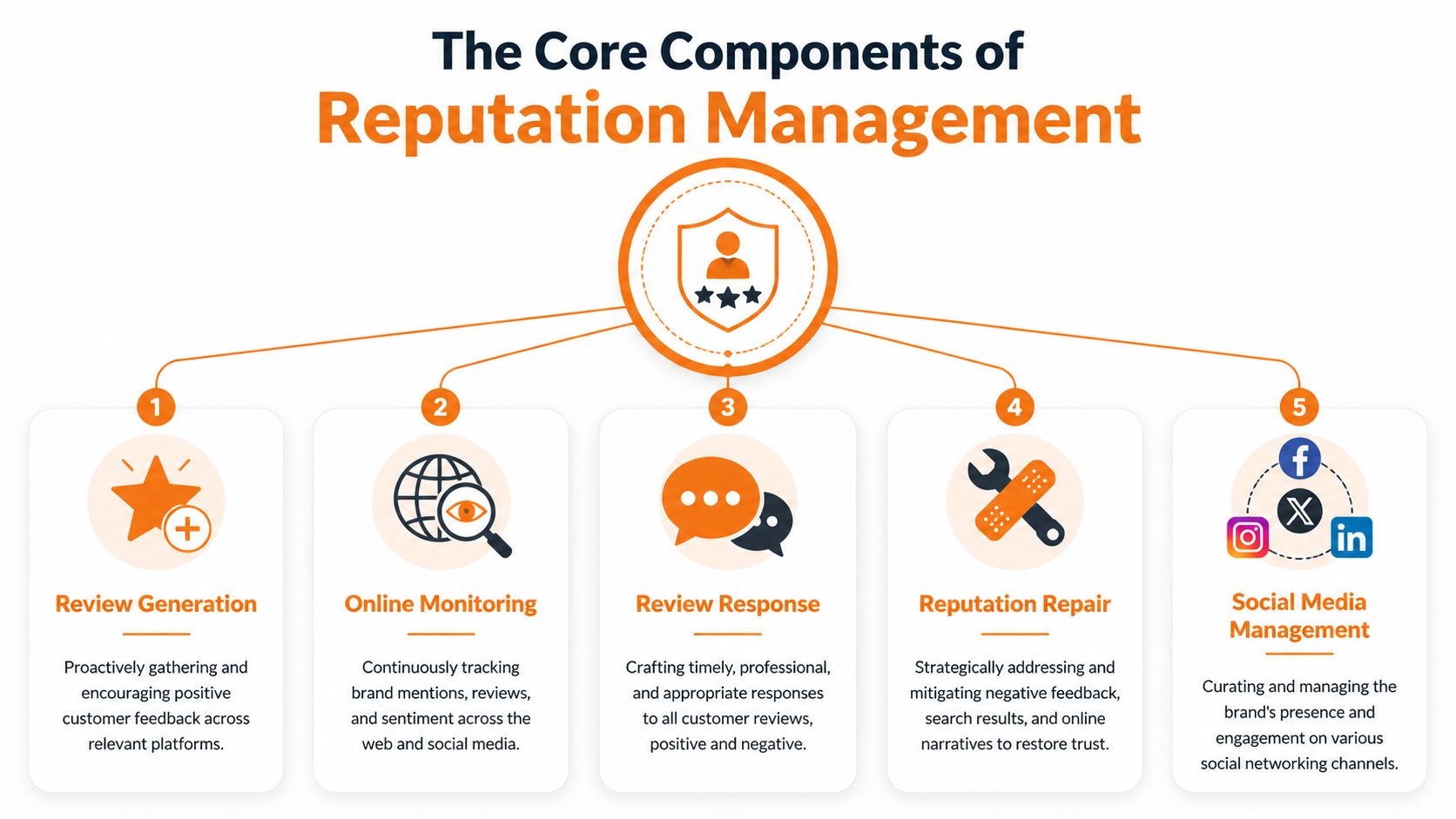
What ORM actually includes
Review generation and management comes first because silence is expensive. If you only hear from upset customers, your public profile won't reflect the actual general customer experience. A good service sets up review requests after the right moments, routes customers to the right platform, and keeps asks consistent across locations.
Business listing accuracy sounds boring until it costs you leads. Wrong hours, duplicate listings, bad phone numbers, and incomplete services make buyers hesitate. For local search, accuracy matters because a clean Google Business Profile, Apple Maps listing, Bing profile, and directory footprint reduce confusion and improve trust.
Social and web monitoring catches issues before they spread. This includes review sites, social mentions, map listings, and branded search results. For a franchise or regional group, monitoring also means knowing which store, practice, or office needs attention now, not next week.
What good execution looks like
Response strategy is where many businesses either build trust or waste it. Fast, calm, human replies show prospects that someone is paying attention. According to Sprinklr’s ORM benchmarking, an average response time of under 24 hours for 95% of reviews can boost customer retention by up to 35% and raise average star ratings by 0.3 to 0.5 points, and AI-assisted replies can reduce manual effort by 70%. The trade-off is straightforward: AI can speed the workflow, but staff still need approval paths for sensitive issues.
A dental group, for example, shouldn't let every office improvise review replies. One location might sound warm and professional, another might sound defensive, and a third might accidentally disclose too much. That inconsistency weakens trust. A better setup uses templates, role-based permissions, and escalation rules.
Sentiment analysis and reporting matter because owners need to know what keeps coming up. Are customers praising technicians but complaining about scheduling? Are reviews in [City] mentioning wait times while [Neighborhood] reviews mention billing confusion? That pattern tells you what to fix operationally.
A strong ORM program usually includes these five jobs in one workflow:
- Requesting feedback: Ask at the right moment, with the right channel, after service is complete.
- Watching every channel: Monitor Google, Yelp, Facebook, industry sites, and branded mentions in one place.
- Responding quickly: Use drafts or AI assistance, but keep human review for edge cases.
- Repairing visible issues: Report fake or policy-violating reviews, clean up duplicates, and correct listings.
- Reporting by location: Separate performance by store, office, or territory so weak spots don't hide.
For operators comparing tools and agencies, this is the benchmark. If a vendor only sells software seats and leaves process, governance, and follow-through to your staff, you're buying a dashboard, not a system. A more useful standard is outlined in a solid reputation management guide for local businesses.
How Reputation Drives Local SEO and AI Search Visibility
Local SEO, short for local search engine optimization, isn't just about keywords on a website. For businesses that depend on map visibility, reviews and profile quality affect whether you appear when someone searches “urgent care near me,” “best vet in [City],” or “brake repair in [Neighborhood].”

How Google decides who shows up locally
Google’s local model is usually explained with three factors: proximity, relevance, and prominence.
| Factor | What it means in plain English | What you can control |
|---|---|---|
| Proximity | How close the searcher is to your location | You can't change the searcher’s location, but you can make sure each location has a correct address and service area |
| Relevance | How well your profile matches the search | Categories, services, business description, photos, FAQs, and complete profile fields |
| Prominence | How established and trusted your business appears online | Reviews, recency, responses, citations, mentions, and overall brand presence |
For most local businesses, proximity is fixed. The bigger opportunity sits in relevance and prominence. That's where reputation work directly supports visibility. If your auto shop in [City] has complete services listed, recent customer reviews, and active responses, you're sending cleaner signals than a competitor with stale feedback and half-filled profiles.
Review freshness isn't cosmetic; it's part of how search platforms interpret whether a business is active and trusted. If you've wondered whether Google reviews help SEO, the practical answer is yes, especially for local intent.
A short Google Business Profile checklist
Your Google Business Profile, or GBP, should be treated like a conversion page, not a directory listing.
- Choose the right primary category: Don't force broad categories if a more precise one exists.
- Complete every service field: Include actual services people search for, such as “emergency plumber,” “dental implants,” or “AC repair.”
- Keep NAP consistent: NAP means name, address, and phone. Match it across your site and directories.
- Upload current photos: Show the location, team, vehicles, rooms, signage, or products buyers expect to see.
- Use booking and website links carefully: Add UTM tags so traffic from GBP can be measured in analytics.
- Review and answer questions: Q&A often influences undecided buyers more than owners realize.
- Check hours before holidays: Incorrect special hours create negative reviews that were easy to prevent.
Most local SEO problems aren't technical. They're operational. The listing says one thing, the website says another, and the customer gets caught in the gap.
Why AI search changes the job
AIO means Artificial Intelligence Optimization. In practice, it means shaping the brand signals, content, and public evidence that large language models use when summarizing your business.
That matters now because people increasingly ask tools like ChatGPT or Perplexity questions that used to go to Google. They don't just search “pediatric dentist near me.” They ask which practice in [City] has strong reviews, flexible scheduling, and a good reputation with parents. If your digital footprint is thin, inconsistent, or skewed by unresolved complaints, those summaries can go sideways.
Meltwater points to a major gap here: optimizing brand portrayal in LLMs like ChatGPT is still missing from most ORM guidance, and proactive narrative shaping is largely unaddressed by current agency playbooks, as noted in Meltwater’s review of ORM providers. For local businesses, the practical takeaway is simple:
- Publish clear service pages: One page per core service and location helps both search engines and AI systems.
- Build factual FAQs: Answer common buyer questions in plain language.
- Keep review themes current: New, specific reviews create better public evidence than generic praise.
- Correct inaccuracies early: If your hours, services, or policies changed, update every major profile.
- Use consistent brand language: The same business facts should appear on GBP, your site, and major directories.
Your 7-Day Review Program Launch Plan
A review program doesn't need to be complicated. It needs to be disciplined. Most businesses fail here because they rely on memory, mood, or whichever staff member happens to care that week.

The urgency is real. 95% of consumers share negative experiences, while only 47% share positive ones, according to CMG Local Solutions’ review behavior summary. If you don't ask happy customers to speak up, your public reputation will tilt toward the unhappy minority.
Day 1 through Day 3
Day 1. Set goals and claim profiles
Pick the locations and platforms that matter most. For most local operators, that starts with Google Business Profile and then one or two vertical-relevant sites. Claim ownership, confirm NAP accuracy, update hours, and assign one accountable owner for each location.
Day 2. Choose the ask method
Decide whether you'll request reviews by SMS, email, or both. Home services often perform well with SMS sent shortly after the job is closed. Dental, med spa, and senior living often benefit from a more polished email follow-up. Keep the ask short and make the link easy to tap.
Day 3. Train the front line
Front-desk teams, technicians, advisors, and care coordinators need one simple script. They shouldn't beg for reviews or pressure customers. They should invite feedback at the moment of satisfaction and know what to say if a customer raises a concern instead.
Field note: The best time to ask is right after the customer expresses relief, appreciation, or satisfaction. Not days later, and not before the service is actually complete.
Day 4 through Day 7
Day 4. Build your first outreach list
Pull a recent batch of completed customers. Filter out cases with unresolved issues, refunds, disputes, or sensitive situations. Healthcare teams should stay HIPAA-aware and never include protected health information in any outreach.
Day 5. Send the first wave
Launch requests in a manageable batch. Watch delivery, click behavior, and first responses. If the message feels awkward or too long, edit it fast. For Google requests, use a direct review link and keep the path friction-free. If you need a practical walkthrough, this guide on how to request a Google review covers the mechanics.
Day 6. Set alerts and response rules
Turn on notifications for new reviews and assign who responds. Decide which replies can use templates and which ones must be escalated. Complaints involving billing, safety, staff conduct, or regulated industries should go to a manager before posting.
Day 7. Review the first signals and lock the habit
Look at volume, quality, speed, and response workflow. Then put the program on a repeating schedule. Weekly execution beats occasional bursts.
Use this launch checklist to stay organized:
- Confirm ownership: Every location should have a claimed profile and a designated internal owner.
- Prepare links: Create direct review links for each location and label them clearly.
- Approve scripts: Finalize one SMS and one email version by vertical.
- Train staff: Give staff a spoken ask, a send process, and an escalation rule.
- Set alerts: Route new reviews to the right inbox or owner.
- Create templates: Draft positive and negative response templates before volume picks up.
- Schedule reporting: Review results weekly so the program stays active.
Essential Templates and Scripts for Your Team
Templates help because staff freeze when they're unsure what to say. The point isn't to sound robotic. It's to reduce hesitation, keep the brand voice consistent, and avoid careless responses.
Review request scripts
SMS review request for a plumbing company
Use SMS when the job is complete and the customer has confirmed the issue is fixed. Keep it brief.
Hi [First Name], thanks for choosing [Company Name] for your plumbing service today. If you have a minute, would you leave a quick Google review about your experience with [Technician Name]? Your feedback helps other homeowners in [City] find us. [Review Link]
Email review request for a med spa
For healthcare-adjacent businesses, stay polished and privacy-aware. Don't reference treatments or outcomes in a way that creates compliance risk.
Subject: Thank you for visiting [Practice Name]
Hi [First Name],
Thank you for visiting [Practice Name]. We appreciate the opportunity to care for you. If you'd be willing to share your experience, we'd be grateful for a quick review here: [Review Link]
Your feedback helps future clients in [City] feel more confident when choosing a provider.
Thank you,
[Practice Name]
Review response templates
A strong positive response should sound appreciative, specific, and short.
Positive review response template
Thank you, [First Name]. We appreciate you taking the time to share your experience with [Business Name]. We're glad our team could help, and we look forward to serving you again.
Negative responses need more restraint. In healthcare and dental especially, don't confirm someone is a patient or discuss details publicly.
Negative review response template for a dental practice
Thank you for your feedback. We're sorry to hear that your experience didn't meet expectations. Because we respect privacy, we can't discuss specifics here, but we'd like the chance to learn more and address your concerns directly. Please contact our office at [Phone] and ask for [Manager Name].
This approach does three jobs. It acknowledges the concern, avoids a public argument, and moves resolution offline. If your team needs more language options, these customer service response templates are a useful starting point.
Measuring Success and Calculating ROI
Reputation work gets dismissed as soft because too many businesses measure the wrong things. Star rating alone doesn't tell you whether the program is improving lead flow. You need operational metrics tied to search visibility and conversion behavior.
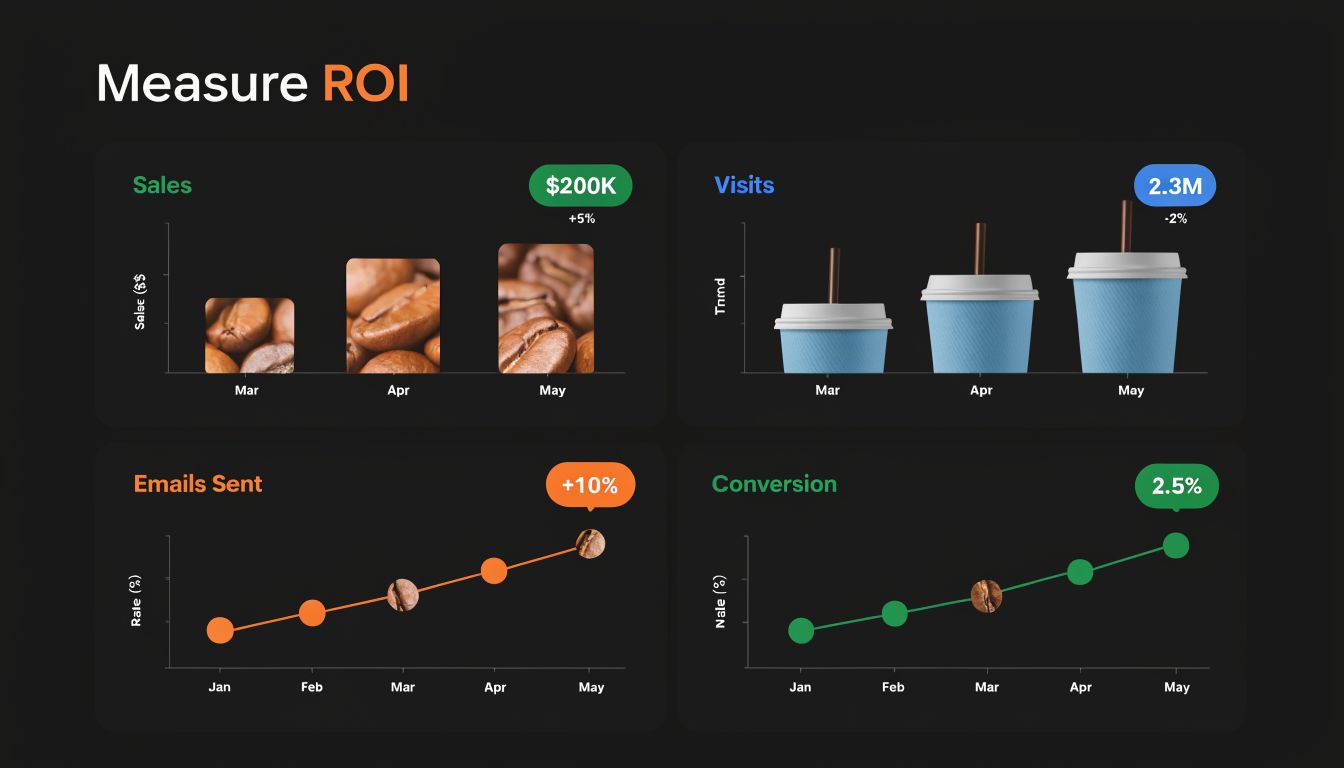
The KPIs that matter
Start with five core measures.
| KPI | What to watch | Why it matters |
|---|---|---|
| Review volume | New reviews by location and platform | More review activity gives buyers more evidence and supports local visibility |
| Review recency | How recently reviews were posted | Fresh feedback reassures buyers that the business is active now |
| Star rating | Average rating by location | It shapes first impressions and click behavior |
| Response rate | Share of reviews receiving a reply | It shows attentiveness and protects trust |
| Response time | How quickly the team replies | Faster replies reduce public neglect and improve customer perception |
For local SEO, one metric deserves special attention: review velocity, meaning the rate of new reviews per month per location. According to ALM Corp’s ORM guide, businesses that maintain more than 20 new reviews per month per location can achieve 15% to 30% higher visibility in Google’s Local Pack. That's why stale profiles often lose ground even when their historical rating looks fine.
For practical targets, use thresholds rather than perfection:
- Review volume: Aim for a steady monthly flow at every active location.
- Recency: Avoid long review gaps.
- Response time: Keep replies fast enough that no complaint sits ignored.
- Star rating: Protect consistency by fixing root causes, not by chasing optics.
- GBP actions: Watch views, calls, direction requests, messages, bookings, and website clicks.
- Lead-to-sale conversion: Compare conversion quality from GBP-originated traffic against other channels.
How to track GBP to calls and bookings
Organizations often falter in making this key connection. They can see more reviews coming in, but they can't connect that to revenue.
Use UTM parameters, which are tracking tags added to URLs. Add them to the website link and appointment link on your Google Business Profile. That way, analytics can identify traffic coming from GBP separately from organic site visits.
A simple setup looks like this in practice:
- Website link: point to your main location page with UTM tags
- Booking link: point to your scheduler with its own UTM tags
- Call tracking: use call reporting inside GBP where available and match it against CRM or phone logs
- Form tracking: create a source grouping for GBP traffic in analytics
- Location reporting: build separate tagged URLs for each office or store
Track the path, not just the profile. A review program is working when better visibility leads to more qualified actions, and those actions turn into booked jobs, appointments, or tours.
A simple ROI framework
You don't need a complex finance model. Use a plain-language scorecard:
- Measure GBP-driven calls, bookings, and website visits before the program.
- Measure the same outcomes after review requests, responses, and profile cleanup are in place.
- Check whether lead quality improves, not just lead count.
- Compare closed revenue from GBP-originated opportunities against the cost of software, labor, or agency support.
For multi-location operators, do this by region or store. That lets you spot whether one district manager is enforcing the process while another isn't.
How to Choose the Right Reputation Management Partner
A bad partner creates more work for your staff. A good one gives you control, clear accountability, and reporting that shows whether reputation work is producing calls, bookings, and qualified leads.
That distinction matters even more for local and multi-location businesses. One location manager may respond well, another may ignore reviews for weeks, and corporate may have no clean view of what is helping or hurting revenue. The right partner closes that gap with process, permissions, and location-level reporting.
Questions to ask before you sign
Ask direct questions. If the answers stay vague, keep looking.
- How do you tailor the program by industry and location type? A vet clinic, med spa, HVAC company, and senior living community need different response rules, review request timing, and escalation paths.
- How do you handle governance across multiple locations? Look for role-based permissions, template controls, approval workflows, and service standards by store or region.
- What does AI do in your workflow? AI can speed up drafts and categorization. Unsupervised posting on sensitive reviews is often a mistake.
- How do you connect activity to business outcomes? If the report stops at rating, review count, and sentiment, you still will not know what is driving phone calls or booked appointments.
- How do you manage listings accuracy alongside reviews? Strong reviews do less for the business if hours, categories, booking links, or phone numbers are wrong.
- What is your process for fake, duplicate, or policy-violating reviews? They should be able to document the issue, submit a proper challenge, and track the outcome.
- How do you monitor AI search platforms and large language models? Customers now ask ChatGPT, Gemini, and Perplexity who the best provider is nearby. Your partner should have a method for checking how your brand and locations appear there.
- Who owns execution each month? Get clarity on approvals, response coverage, escalation handling, reporting cadence, and who fixes problems when a location falls behind.
A strong provider will also be honest about trade-offs. Negative reviews usually cannot be removed just because they are inconvenient. The better path is to fix service issues, increase the flow of real recent reviews, respond well in public, and escalate removals only when a review clearly breaks platform policy.
What a strong partner does differently
For a vet clinic in [City], a capable partner does more than raise review volume. They help standardize response language for emotional situations, keep hours and services accurate, make sure booking paths work, and flag patterns that point to front-desk or follow-up problems. That work improves trust before the first call and reduces drop-off after someone finds the listing.
For an auto shop in [Neighborhood], the same partner should report by location, not just at the brand level. Otherwise one high-performing shop can hide another location with weak review generation, inconsistent responses, or poor listing maintenance.
The best partners usually share a few traits:
- Operational discipline: They build a process your staff can follow under real workload, not just in a kickoff meeting.
- Local search judgment: They understand how reviews, response coverage, listing accuracy, and location data affect visibility.
- Compliance awareness: They know where healthcare, housing, legal, and other regulated categories need tighter review and response controls.
- Reporting managers can use: Reports should show location performance, missed SLAs, review themes, and whether activity is leading to revenue-producing actions.
- Scalable governance: They can support one office today and twenty locations later without turning every approval into a bottleneck.
- Flexible accountability: Month-to-month support is often a better fit than a long contract if you need responsiveness and proof of performance.
Software is fine if your team already has an owner, a process, and time to enforce it. If you want reputation work to influence booked business, choose a partner who can run the workflow, support AI platform visibility, and show how the work connects to customer actions. Start by comparing providers that offer real reputation management support for your business type, then ask them to show exactly how they measure results by location.
Frequently Asked Questions
How long does it take to improve a star rating
It depends on your current review base, how consistently you ask for new reviews, and whether service issues are still happening. In practice, rating improvement comes from steady, real feedback over time, not from one campaign burst.
Can a business remove fake or defamatory reviews
Sometimes. If a review clearly violates platform policy, you can report it and document why. But many negative reviews stay live unless the platform agrees there's a policy issue. Plan for response and recovery, not just removal.
What's the difference between full-service help and reputation software
Software gives you tools. Full-service support adds strategy, setup, governance, templates, monitoring, response help, reporting, and follow-through. If your team is already stretched, the difference matters.
Do single-location businesses need online reputation management services
Yes. In some ways, they need them more because one bad review cluster or one inaccurate listing can affect the entire business. A single location also has less room to hide operational issues.
What should a healthcare practice avoid in review responses
Don't confirm someone is a patient, don't reference treatment details, and don't argue publicly. Keep the response general, respectful, and private. HIPAA-aware communication matters even when the review feels unfair.
Which platforms matter most for local businesses
Google Business Profile usually comes first. After that, it depends on the category. Restaurants, healthcare, home services, legal, hospitality, and automotive all have their own review patterns and secondary platforms.
Should staff ask every customer for a review
No. Ask consistently, but use judgment. Skip active complaints, unresolved billing disputes, and sensitive situations. The goal is a reliable process, not a blunt script used without context.
If you want help building a disciplined review and listing program without adding more work to your front desk or field team, Reviews To The Top offers month-to-month support for local and multi-location businesses. We help operators turn real customer feedback into stronger visibility, faster responses, and measurable growth, and you can book a strategy call when you're ready.