Managing your online reputation well is a two-part job: you have to be out there building a positive story around your brand while also being ready to handle any negative feedback that comes your way. It all starts with a thorough audit of your current digital presence. From there, you can build a system for getting more great reviews and creating content that puts you in control of your brand’s narrative.
Conduct a Deep Dive Into Your Digital Footprint
Before you can fix or improve your reputation, you need a brutally honest look at where you stand right now. This isn’t just about a quick Google search of your company name. We’re talking about a full-scale digital audit to really understand what people are saying about you online, everywhere.
Think of this initial audit as setting the baseline for your entire strategy. It will show you recurring complaints, highlight specific problem areas, and even uncover opportunities you didn’t know you had. Without this foundation, you’re just guessing.
Start With the Basics: Brand Monitoring
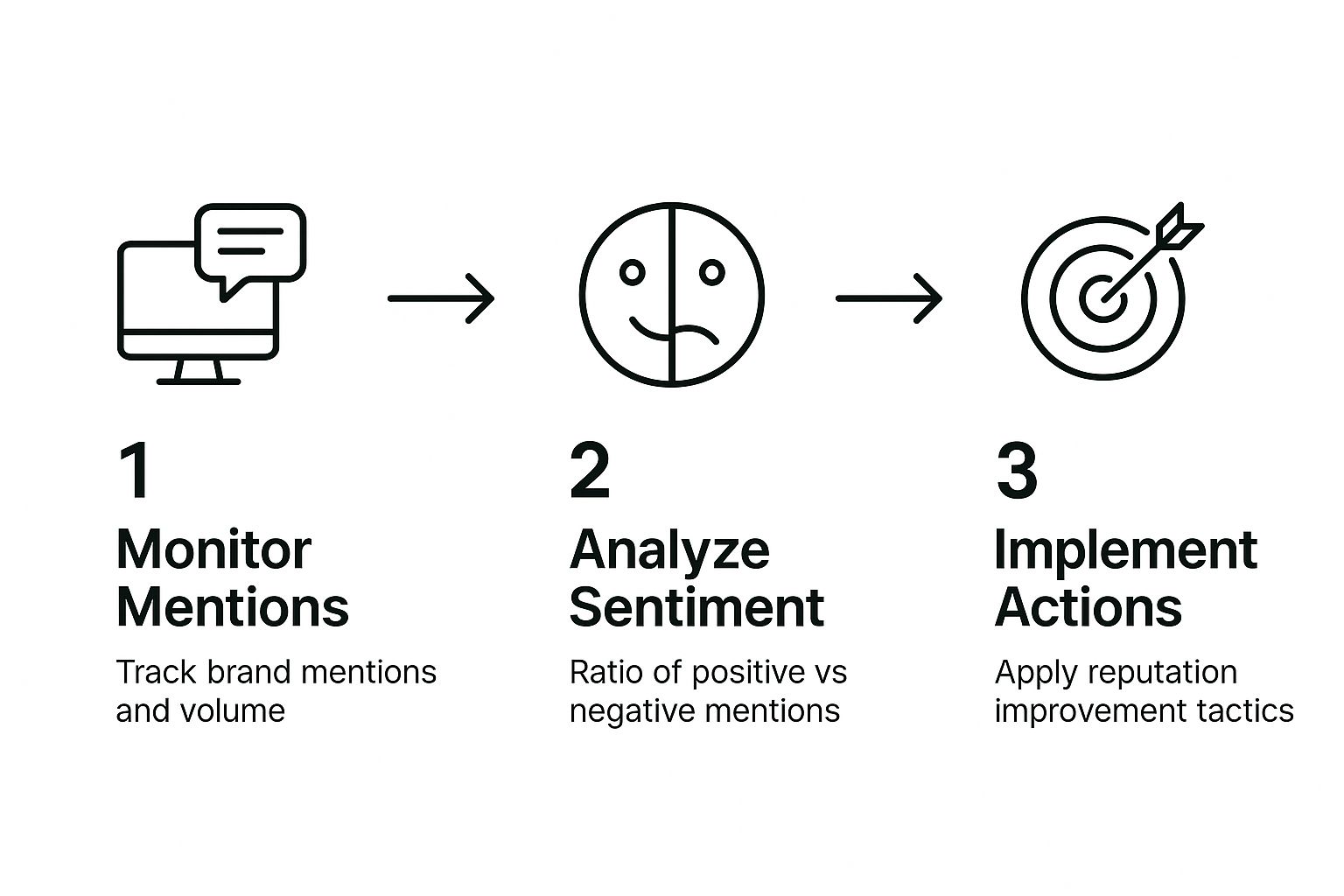
The easiest way to get started is to set up automated alerts. These tools are like your personal watchdogs, pinging you the moment your brand gets mentioned anywhere on the web.
A fantastic—and free—place to start is Google Alerts. You can set up alerts for your business name, your flagship products, and even the names of your key executives. This way, you’ll know almost immediately when a new blog post, news story, or forum thread pops up with your name in it.
Setting one up is straightforward. Here’s what the creation page looks like:
This simple dashboard lets you track keywords and choose how often you get notified. It’s an essential first step for anyone serious about monitoring their reputation.
Go Beyond Google: Expand Your Search
Automated alerts are great, but they won’t catch everything. You need to roll up your sleeves and dig into the specific platforms where your customers are actually hanging out. This process has a lot in common with the early stages of a local SEO audit, where the goal is to uncover every potential issue.
Your digital audit should systematically cover these key areas:
- Review Aggregators: Don’t just stop at Google and Yelp. Check industry-specific sites. Are you a software company? Look at G2. In hospitality? TripAdvisor is a must. A home services business? Check Angi.
- Social Media Platforms: Use the native search functions on X (formerly Twitter), Facebook, Instagram, and LinkedIn. Search for your brand name, related hashtags, and even common misspellings to see what you find.
- Niche Forums and Communities: Where does your target audience go to talk? It could be specific subreddits on Reddit, niche industry forums, or local community groups on Facebook. Find those places and listen in.
A big piece of your digital footprint is Google’s own real estate. That’s why it’s so important to learn how to claim and optimize your Google Knowledge Panel. For many potential customers, this is the very first thing they’ll see about your business.
To make this process systematic, I recommend using a checklist. It keeps you organized and ensures you don’t miss anything critical.
Digital Reputation Audit Checklist
| Area to Audit | Key Platforms and Tools | What to Look For |
|---|---|---|
| Search Engine Results | Google, Bing, DuckDuckGo | Top 10-20 results, Google Knowledge Panel, “People also ask” section, image and video results. |
| Major Review Sites | Google Maps, Yelp, Trustpilot, Better Business Bureau | Overall rating, volume of reviews, recurring themes (positive and negative), response rate. |
| Industry-Specific Sites | G2 (SaaS), TripAdvisor (Travel), Avvo (Legal), Healthgrades (Medical) | Niche feedback, comparisons to competitors, expert opinions. |
| Social Media | X (Twitter), Facebook, Instagram, LinkedIn, TikTok | Direct mentions (@), hashtag usage, user-generated content, comments on your posts, direct messages. |
| Online Forums | Reddit, Quora, industry-specific forums | Unfiltered customer conversations, product/service questions, brand sentiment, common complaints. |
| Blogs & News Media | Google Alerts, BuzzSumo, Mention | Press coverage, guest post mentions, blogger reviews, inclusion in listicles or roundups. |
Running through this checklist gives you a complete, 360-degree view of what the world is saying about you.
Remember, a thorough audit isn’t just a hunt for bad reviews. It’s about understanding the entire conversation—the good, the bad, and the neutral. This holistic view is the only way to build a reputation management strategy that actually works. In fact, for many companies today, 70% to 80% of their market value comes from intangible assets like brand equity. A poor online reputation directly threatens that value.
Build a Proactive Review Management System
Let’s be honest: online reviews are the new word-of-mouth. They shape a potential customer’s opinion long before they ever think about picking up the phone or visiting your website. Just keeping an eye on your digital presence isn’t enough anymore. Real progress happens when you stop being a passive observer and start actively participating in the conversation.
This is where a proactive review management system comes in. It’s all about creating a consistent, repeatable process for generating new, positive feedback and mastering the art of the reply. The numbers don’t lie. Research shows that a staggering 85% of consumers trust online reviews as much as a recommendation from a friend. What’s more, 92% won’t even consider a business unless it has at least a four-star rating.
A steady stream of positive feedback isn’t just a “nice-to-have”—it’s a critical part of a healthy business.

Ethically Solicit Feedback from Happy Customers
So, how do you get more positive reviews? The simplest method is often the one people forget: just ask. Your happy customers are usually more than willing to share their great experiences, but life is busy. They just need a gentle, well-timed nudge. The trick is to make it incredibly easy for them.
You can weave review requests right into your existing customer journey. A home services company, for instance, could send an automated SMS with a direct Google review link 24 hours after a successful job. A local coffee shop could slip a small card with a QR code into every takeout bag, sending customers straight to their Yelp page. Simple. Effective.
Here are a few proven ways I’ve seen work wonders:
- Email Sequences: After a customer makes a purchase, send a simple email asking how everything went. If you get a positive signal, a follow-up with direct links to your review profiles is a natural next step.
- SMS Prompts: Text messages have insane open rates. A short, friendly text asking for a quick review can be a game-changer, especially for service-based businesses where you have a customer’s number.
- In-Person Requests: For brick-and-mortar businesses, a casual ask at the checkout counter can be incredibly powerful. Train your team to spot happy customers and say something like, “So glad you enjoyed your visit! If you have a moment, we’d be grateful if you could share your experience on Google.”
Pro Tip: Timing is everything. The absolute best time to ask for a review is right after a positive interaction or when you’ve successfully solved a problem for them. That positive feeling is at its peak, and they’re most likely to take action.
If you want to get into the nitty-gritty of what to say and when, our guide on the best ways of asking for a review has you covered.
Master the Art of the Reply
Replying to reviews—both the glowing ones and the painful ones—is non-negotiable. Every response shows you’re engaged, that you listen, and that you actually care about your customers. Silence, on the other hand, just looks like indifference.
Having a game plan is key. You don’t need to write a novel for every reply. Creating a few solid response templates for common situations saves a ton of time and keeps your brand voice consistent.
Responding to Positive Reviews
It’s tempting to see a 5-star review and just move on, but that’s a huge missed opportunity. Thanking a happy customer makes them feel great about their decision and shows potential customers that you value your community.
A solid response to a positive review should do three things:
- Thank them by name. A personal touch goes a long way.
- Mention a specific positive point from their review. This shows you actually read it.
- Invite them back. Give them a reason to think of you again.
For example: “Hi, Sarah! Thanks so much for the kind words. We’re thrilled you loved the quick service. We can’t wait to see you again soon!”
Responding to Negative Reviews
This is where you can really turn a bad situation around. A thoughtful, professional reply to a 1-star review can transform a public complaint into a public showcase of your excellent customer service. You’re not just replying to one person; you’re showing every future customer how you handle problems.
Here’s a clear formula for tackling negative feedback:
| Action | Example Text | Objective |
|---|---|---|
| Acknowledge and Apologize | “Thank you for bringing this to our attention, Mark. We’re truly sorry your experience didn’t meet expectations.” | Validates their feelings and shows you’re listening without immediately admitting fault. |
| Show Empathy | “We understand how frustrating it must be when a delivery is delayed.” | Builds a human connection and helps de-escalate the tension. |
| Take it Offline | “We want to make this right. Could you please email our support manager at [email] so we can investigate this for you?” | Moves the specifics to a private channel while publicly showing your commitment to a solution. |
| Do Not Get Defensive | Avoid excuses or blaming the customer. Ever. Even if you think they’re wrong. | Keeps you looking professional and focused on solving the problem, not winning an argument. |
By consistently following these steps, you turn your review profiles from a potential headache into one of your most powerful marketing assets. You’re not just managing feedback—you’re building a public record of your commitment to making customers happy.
Take Control of the Conversation with Positive Content
While you absolutely have to manage feedback, the real game-changer in online reputation management is getting on the offense. Instead of constantly playing defense against negative comments, you can proactively build a wall of positive content that defines your brand on your own terms.
The strategy is simple: create and promote so much valuable, positive content that it dominates your search results. Think about it. When someone Googles your brand, you want them to see your website, your blog, your social media, and glowing press—not one-off negative reviews. This strategy effectively buries any negative items, pushing them to the second page of Google where only 0.63% of searchers ever venture.
Create Content That People Actually Trust
This isn’t about churning out generic articles. Your content needs a purpose. You should be creating assets that genuinely help your audience, showcase your expertise, and reflect your company’s core values. Each piece you publish becomes another brick in your digital fortress.
A good content mix is key. You need different types of content to tell a complete and compelling story. Here are a few ideas that really work:
- Expert-Led Blog Posts: Write authoritative articles that solve a real problem for your target customer. If you’re a local accounting firm, a post on “The Top 5 Tax Mistakes Small Businesses Make” isn’t just content; it’s a credibility-builder that can rank for important search terms.
- In-Depth Customer Success Stories: These go way beyond a simple quote. A detailed case study that walks through a customer’s problem and highlights how you delivered a solution is pure gold. It provides powerful social proof and turns a happy client into your best marketing asset.
- Behind-the-Scenes Glimpses: People want to do business with people, not faceless corporations. Share short videos or photos of your team volunteering or celebrating a big win. This kind of content humanizes your brand and builds an emotional connection that’s tough for a negative review to break.
- Share Your Wins: Did you win an award, hire a respected leader, or launch a new community program? Announce it! A press release and a follow-up blog post create positive, third-party validation that search engines and potential customers love to see.
When you diversify your content, you’re not just hoping a customer finds one positive article. You’re building a rich ecosystem of helpful, authentic material that tells a consistent and positive story about your brand.
Use SEO to Amplify Your Best Stuff
Great content is useless if no one sees it. That’s where search engine optimization (SEO) becomes your most important reputation management tool. The goal is to make sure your positive, brand-owned assets outrank everything else when people search for your business.
Start with the basics. Every piece of positive content should be optimized for branded keywords—that is, any search that includes your company’s name. Think of terms like “[Your Company Name] reviews” or “is [Your Company Name] any good?” Your customer success stories and positive press should be fine-tuned to rank for these exact phrases.
But on-page optimization is just the beginning. To truly dominate the search results, you need to build a strong backlink profile. Backlinks from other websites are essentially votes of confidence. When a reputable site links to your content, it tells Google that your material is trustworthy, which helps it rank higher.
Here are a few proven ways to earn those valuable links:
- Guest Posting: Write a helpful article for a well-known blog in your industry and include a link back to a relevant resource on your own site.
- Digital PR: Have a great case study or an original research report? Share it with journalists and bloggers in your niche who are always looking for compelling stories.
- Strategic Partnerships: Team up with a non-competing business on a piece of co-branded content, like a webinar or an ebook, and promote it to both of your audiences.
By combining high-quality content creation with smart SEO, you stop reacting to the conversation and start leading it. You get to ensure the story people find about your brand online is the one you want them to hear.
Use Social Media to Shape Your Reputation
Think of social media as less of a billboard and more of a town square. It’s a live, public conversation where your reputation gets built—or torn down—in real-time. If you’re not participating, you’re letting everyone else tell your story for you. But with a smart strategy, you can turn these platforms into your greatest asset for building a trusted brand and a loyal following.

This goes way beyond just scheduling a few posts. It’s about showing up and actively listening. With 60% of consumers spending nearly 2.5 hours on social media every single day, it’s one of the main places they’re forming opinions about you. Being present and engaged isn’t just a good idea anymore; it’s essential.
First, Listen More Than You Talk
Before you can manage your reputation on social media, you have to know what people are actually saying. This is where social listening comes in—it’s the practice of tracking mentions of your brand, your competitors, and key industry topics. It gives you a direct line into raw, unfiltered customer conversations.
You can start simply by setting up keyword notifications right inside platforms like X (formerly Twitter) or dive deeper with dedicated tools like Brand24 or Mention. By keeping an ear to the ground, you can catch potential fires when they’re still just sparks. Imagine seeing a couple of tweets complaining about your website loading slowly. You can jump in, address the issue, and thank them publicly before it snowballs into a major complaint.
Key Takeaway: Social listening is your early warning system. It delivers real-time feedback that helps you spot reputational threats and understand what your audience genuinely cares about.
Turn Customer Complaints Into Public Wins
Seeing a negative comment pop up on your Facebook page can make your stomach drop, but how you handle it is what truly defines your brand. A quick, empathetic, and professional response can actually turn an unhappy customer into a loyal fan. More importantly, it shows everyone else watching that you care and take responsibility.
The goal isn’t to win an argument; it’s to solve a problem and be seen doing it. Forget getting defensive. Focus on showing you’re there to help.
To navigate these tricky situations, it’s wise to have a clear protocol in place. Your team needs to know how to react to different types of feedback to maintain a consistent and professional front.
Social Media Response Protocol
| Comment Type | Recommended Initial Action | Key Objective | Escalation Path |
|---|---|---|---|
| Positive Feedback | Like, reply with a personalized thank you, and consider sharing. | Amplify positivity and encourage engagement. | Tag the user in a future “customer spotlight” post (with permission). |
| Neutral Question | Answer publicly and promptly with helpful information. | Demonstrate helpfulness and expertise. | If the question is complex, provide a link to a blog or FAQ page. |
| Minor Complaint | Acknowledge publicly, apologize, and offer to help via DM. | Show accountability and move to a private channel. | If unresolved in DMs, escalate to a customer support manager. |
| Major Issue | Immediately apologize publicly and ask to connect offline. | De-escalate the public situation quickly. | Immediately flag for a senior manager or PR team member to handle. |
| Trolling/Spam | Ignore or hide the comment. Do not engage. | Maintain a clean and constructive community space. | Block the user if behavior is repetitive or violates platform rules. |
A framework like this ensures your responses are not just fast, but also strategic. It protects your reputation by turning potentially damaging situations into opportunities to showcase your excellent customer service to the public.
Develop a Voice People Trust
Finally, what you post proactively is just as important as how you react. Every tweet, story, and comment should reinforce who you are as a brand. Are you the witty expert? The warm, community-focused friend? The reliable professional? Pick a lane and stay in it.
Share content that pulls back the curtain and shows your company’s values in action. For instance, a local coffee shop could post behind-the-scenes videos of baristas learning latte art or feature the local dairy farm that supplies their milk. This kind of genuine content builds an emotional connection, creating a foundation of goodwill that makes your brand far more resilient when negative feedback inevitably comes along.
Navigate Negative Feedback and Crisis Moments
Let’s be honest: negative feedback is going to happen. It’s an unavoidable part of being in business. Whether it’s a stinging one-star review, a critical blog post, or a social media firestorm, how you respond says more about your brand than the complaint ever will.
Handling these moments with a clear head and a solid plan is where real reputation management happens. You can either fan the flames and turn a small issue into a catastrophe, or you can use it as a chance to show everyone you’re accountable. The latter approach not only fixes the problem but can actually win over people who are just watching to see how you’ll react.

When your reputation takes a hit, it directly impacts consumer trust and your bottom line. Getting this right is not just good PR; it’s essential for survival.
First, Take a Breath and Assess the Damage
When you see a negative comment, the first instinct is to jump in and defend yourself. Don’t. A knee-jerk reaction almost never ends well. The first real step is to pause and figure out what you’re actually dealing with. Not all negative feedback is created equal, and your response needs to match the situation.
Before you type a single word, ask yourself:
- Who’s talking? Is this a real customer with a legitimate gripe, or a troll just trying to stir up trouble?
- Where is this happening? A complaint on a high-traffic site like Google or Yelp is a much bigger deal than a nasty comment on a small, private forum.
- How far could this spread? Is this a single comment that a few people might see, or was it posted by an influencer with the potential to go viral?
Thinking through these questions helps you decide whether to go all-in or just let it go. A calm, measured approach stops you from blowing a minor issue out of proportion or, even worse, underestimating a real crisis.
Have a Game Plan for Your Response
Once you’ve sized up the situation, it’s time to decide how to engage. The goal is always to de-escalate, show that you care, and move toward a real solution.
Here’s a practical way to think about it:
- Go Public When It Makes Sense: For legitimate complaints on public forums, you need to respond publicly. It shows other potential customers that you’re paying attention. The key is to acknowledge their frustration, apologize for their experience, and offer to take things offline to sort out the details.
- Move the Conversation to a Private Channel: After that initial public reply, give them a direct line—an email, a manager’s phone number, anything. This pulls the nitty-gritty details out of the public square while proving you’re serious about making it right.
- Know When to Stay Silent: Sometimes, the best response is no response at all. If a comment is obviously from a troll, is abusive, or makes no sense, engaging just gives them the attention they want. In these cases, it’s often better to ignore it or, if it violates platform rules, just report it. You can even take formal action in some cases; our guide on how to dispute a review on Google walks you through the process.
The Golden Rule: Never, ever get into a public argument. Your goal isn’t to prove you’re right; it’s to show everyone that you’re reasonable. Winning an online shouting match means losing the reputation war.
Turn a Crisis Into a Growth Opportunity
Beyond a few bad comments, a full-blown crisis demands a more organized approach. Having a plan ready before things go wrong is critical. It’s worth digging into some crisis communication best practices to get your team prepared. A pre-defined plan helps you communicate clearly and quickly when the pressure is on.
And if you need motivation, just look at the numbers. A BrightLocal study found that 87% of people will actively avoid businesses with bad reputations. On the flip side, 68% are willing to pay up to 15% more for a similar service from a company with a better one. This isn’t just about damage control—it’s about driving real business growth.
Got Questions About Reputation Management? We’ve Got Answers
Even with a great plan, a few questions always pop up when businesses start taking their online reputation seriously. Let’s dig into some of the most common ones I hear from clients. Getting these details right is what separates a good strategy from a great one.
“How Long Until I See Results?”
This is the big one, and the honest answer is: it depends on what you’re trying to do.
If you’re building a positive presence from the ground up—think generating a steady flow of great reviews—you can see a difference pretty quickly. With a consistent push to get happy customers talking, you could see your average star rating and overall brand sentiment climb in just one to three months.
On the other hand, if you’re in damage control mode, you need to play the long game.
Trying to bury a negative search result isn’t an overnight fix. The goal is to create a wave of high-quality, positive content that eventually pushes the bad stuff off of page one. Realistically, you’re looking at a six to twelve-month commitment, sometimes even longer, before you see that kind of major shift in Google search results. Patience is key.
“Can I Just Delete a Bad Review?”
This is probably the most frequent—and most critical—question. Everyone wants to know if they can just make a negative review disappear.
The short answer is almost never. You can’t just delete a bad review from a third-party site. The only time a review gets taken down is if it blatantly violates the platform’s rules (like using hate speech or spamming) or if you can legally prove it’s defamatory, which is a high bar to clear.
So, what do you do? The professional strategy isn’t removal; it’s suppression. You essentially drown out the negative with an overwhelming amount of positive. By generating a constant stream of great reviews and positive content, that one bad apple gets pushed so far down the page that it becomes practically invisible.
“How Do I Know if This Is Actually Working?”
You can’t just go by gut feeling. You need to track the right numbers to see if your hard work is paying off. Don’t get lost in a sea of data; focus on the metrics that truly matter for your reputation.
Here’s what I recommend keeping a close eye on:
- Average Star Ratings: Are your scores on Google, Yelp, and other key sites trending upward? This is your most visible KPI.
- Sentiment Analysis: Use a monitoring tool to see what percentage of your brand mentions are positive, negative, or neutral. The goal is to shrink that negative slice of the pie.
- Branded Search Results: What do people see when they Google your company’s name? The first page should be dominated by assets you control—your website, social media, and positive news.
- Review Volume: Are new reviews coming in consistently? A profile with recent feedback looks much more credible than one with reviews that are a year old.
Watching these specific numbers turns reputation management from a guessing game into a clear, data-driven strategy. You’ll know exactly where you stand and where you need to focus your efforts next.
Ready to take control of your online narrative? Reviews To The Top is a platform designed to help you generate positive reviews, keep an eye on feedback everywhere, and connect with customers instantly. Don’t just react to your reputation—build it. See how we can help you today.