When a customer complains, your first instinct might be to get defensive. It’s only natural. But the best way to handle it is to listen actively, acknowledge their frustration with real empathy, and immediately take ownership of finding a solution. It’s not just about fixing a single problem; it’s about rebuilding trust and showing that you genuinely care.
This single interaction can turn a negative experience into a powerful moment of loyalty.
Why Customer Complaints Are a Hidden Gift

Let’s be real—nobody likes getting a complaint. But what if you saw that negative feedback not as an attack, but as a gift? Each complaint is a free, unfiltered look into your business’s blind spots.
Think about it. This feedback shines a light on exactly what your customers value and where you’re falling short. It might reveal a hidden flaw in a product, a gap in your service, or an unmet expectation you never even knew existed.
Turning Feedback Into Action
I once saw a local coffee shop constantly getting hammered with complaints about its chaotic morning rush. The line was always out the door, and people were getting frustrated. Instead of just apologizing, the owner saw the pattern. This feedback became the direct catalyst for launching a simple mobile ordering app.
The results were almost immediate. Wait times plummeted, sales actually increased from pre-orders, and customer satisfaction went through the roof. That “problem” was a golden opportunity in disguise. Getting good at this is one of the most powerful ways to build a stronger, more resilient business.
“Each complaint is a gift. It’s a chance to get a free consultation on how to improve your product, service, and overall customer experience directly from the people who matter most.”
The stakes are incredibly high here. A staggering 57% of customers will jump ship to a competitor after just one bad experience. That doesn’t leave much room for error.
As you can see, complaints really are opportunities. For more in-depth strategies, check out this great guide on handling customer complaints and turning them into positive experiences. The companies that truly thrive are the ones that lean into negative feedback, listen hard, and use it as fuel for real, meaningful growth.
Your First Response Matters More Than You Think
Those first few moments after a customer complaint lands in your inbox or on your phone line are absolutely critical. Your initial interaction does more than just kick off a problem-solving process; it sets the entire tone for what happens next. A canned, robotic apology can make a bad situation worse, making the customer feel dismissed. But a genuine, empathetic response can immediately lower the temperature and start rebuilding the trust that’s been shaken.
This is your golden opportunity to turn a negative experience into a constructive conversation. It all starts by showing them you’re not just hearing their words, but you’re actually listening to the frustration behind them.
The Power of Genuinely Listening
I’ve seen it time and time again: a customer who is already fired up can be completely disarmed by simply feeling heard. Active listening isn’t just about waiting for your turn to talk. It’s about making a real effort to understand the full picture—the facts, the feelings, and the impact the problem has had on their day.
One of the most effective ways to do this is through reflective listening. It’s a simple but powerful technique where you paraphrase the customer’s issue back to them.
Let’s say a customer complains, “My delivery was three days late, and when it finally showed up, the box was crushed!”
Instead of jumping straight to a solution, you reflect: “So, not only did the package arrive much later than you expected, but it was also damaged when it got to you. I can absolutely see why you’re upset.”
This small step does two huge things: it validates their feelings and confirms you’ve grasped the problem. It instantly shifts the conversation from a confrontation into a collaboration.
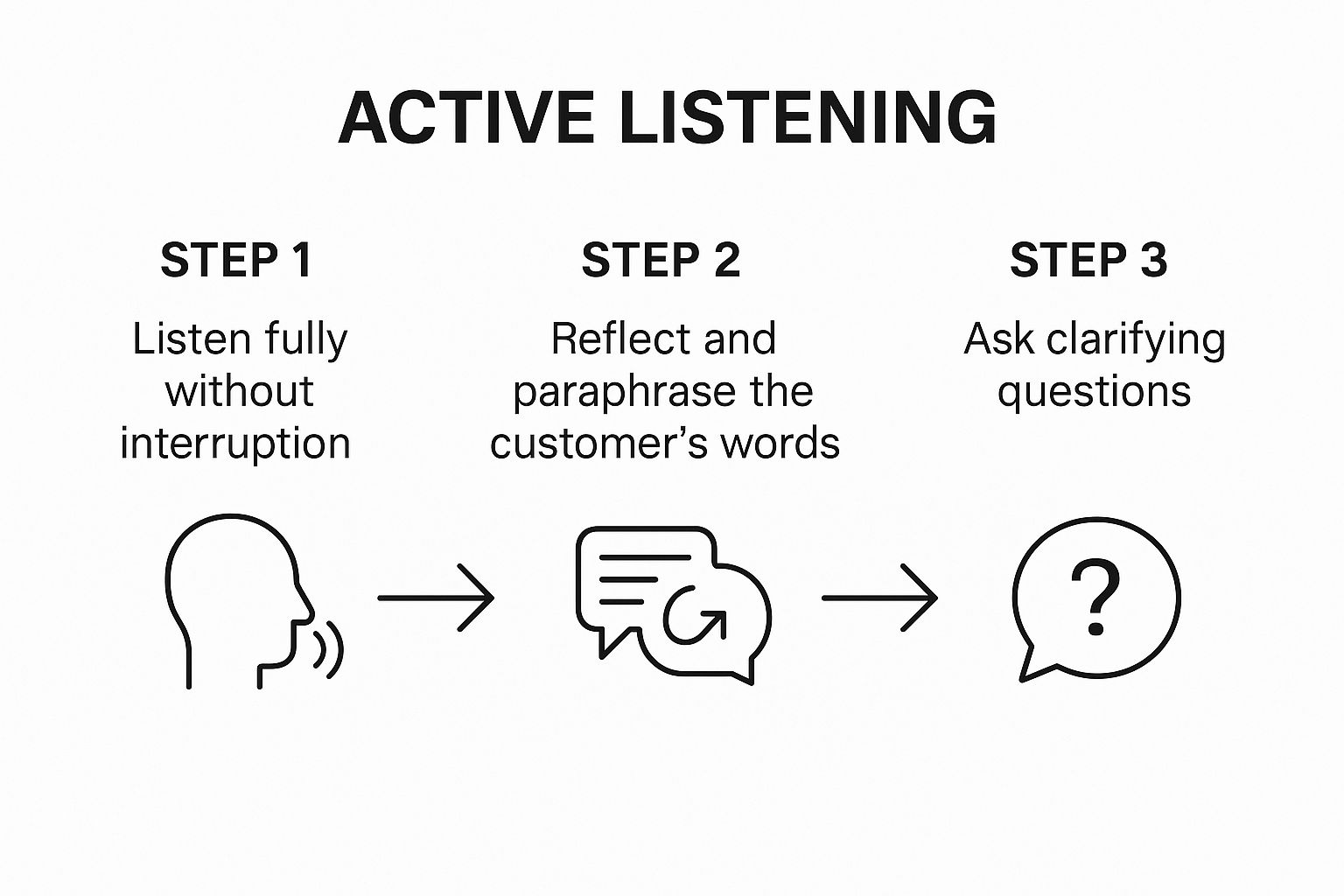
As you can see, it’s a natural flow—you hear them out, confirm you’ve understood correctly, and then ask questions to clarify any details. This prevents misunderstandings from derailing the entire process.
Choose Your Words Carefully
The specific words you use in that first reply can either build a bridge or put up a wall. It’s smart to have a few go-to empathetic phrases that feel authentic and not like they came from a script.
When you’re in the hot seat, having a good starting point can be a lifesaver. We’ve actually put together a whole guide with practical examples you can adapt in our post on customer service response templates.
The wrong phrase can sound dismissive, even if you don’t mean it to. Here’s a quick look at some common missteps and how to fix them.
Effective vs. Ineffective First Response Phrases
| Common Ineffective Phrase | Why It Fails | Effective Alternative |
|---|---|---|
| “I understand.” | This can sound generic and is often said without truly understanding. It can feel like a brush-off. | “That sounds incredibly frustrating. Thank you for telling me about this.” |
| “We’re sorry for the inconvenience.” | This phrase is overused and minimizes the customer’s actual experience. It lacks sincerity. | “I’m so sorry for the trouble this has caused. Let’s get this sorted out for you.” |
| “Company policy states…” | Quoting policy right away makes you sound like a gatekeeper, not a helper. It creates a barrier. | “Let me see what I can do to help you with this.” |
| “There’s nothing I can do.” | Even if true, this is a dead-end statement that offers no path forward and shows a lack of ownership. | “I can’t do that, but here’s what I can do…” |
Choosing words that convey empathy and a willingness to help is the foundation of a successful resolution.
A few more quick tips based on the channel:
- On the Phone: Your tone is everything. Speak calmly and reassuringly. A simple, “Thank you for bringing this to my attention,” shows you respect their time and feedback.
- Via Email: Start by directly acknowledging their frustration. Something like, “I’m so sorry to hear about the trouble you’ve had with your order,” is a solid start.
- On Social Media: The key is to respond publicly first to show you’re on top of it, then immediately move the conversation to a private channel. Try, “We’re sorry to see this and want to help. Please send us a DM with your order number so we can look into this right away.”
Your goal in the first response isn’t to have the perfect solution ready to go. It’s to make the customer feel seen, heard, and confident that you’re on their side and will take ownership of the problem.
Getting this right has a massive impact on your business. Did you know that 67% of customer churn is preventable if their issue is resolved during the first interaction? It just goes to show how much that initial contact is worth.
Dig Deeper to Find the Real Problem

Alright, you’ve sent that first, empathetic response and made a genuine connection. Now, it’s time to put on your detective hat. Acknowledging a customer’s frustration is the first step, but actually solving their problem means you have to figure out what really went wrong.
This is where you shift from offering comfort to gathering facts. Your goal is to get to the root of the issue without making the customer feel like they’re on trial or stuck in limbo. It’s a delicate balance between being thorough and being fast.
Gather Your Clues Systematically
Before you can offer a real solution, you need the full story. This means digging deeper than the initial email or phone call and pulling together all the relevant details from your end. A scattered, disorganized approach will only make a bad situation worse, so having a clear game plan is essential.
I always recommend starting with these key sources:
- Customer Relationship Management (CRM) History: Pull up their record. Look at past purchases, prior support tickets, and any notes from previous interactions. Is this a fluke, or is it part of a recurring issue for this person?
- Team Member Interviews: Have a quick, respectful chat with any employees who were involved. If the complaint is about a late delivery, a two-minute conversation with your fulfillment team can provide invaluable context.
- System and Log Data: Dive into your backend. Check for any technical errors, hiccups in order processing, or other digital breadcrumbs that could explain what happened.
This internal fact-finding mission needs to be quick. Customers are already frustrated; making them wait while you launch a week-long investigation will undo all the goodwill you just built.
Don’t let the investigation become a black hole where customer tickets disappear. Your responsibility is to own the problem from start to finish, and that includes keeping the customer in the loop while you work behind the scenes.
Empower Your Team to Be Problem Solvers
One of the biggest roadblocks I see in resolving complaints is a lack of team empowerment. If your frontline support staff has to run to a manager for approval on every little thing, the entire process grinds to a halt. It’s frustrating for your team and maddening for your customers.
Think about companies like Zappos—they built their legendary reputation on this very principle. They trust their agents to make on-the-spot decisions to make things right, whether that’s overnighting a replacement pair of shoes or issuing a refund without a 20-question interrogation. This doesn’t just speed things up; it shows customers you trust your own people to do the right thing.
Empowerment isn’t about giving everyone a blank check. It’s about providing:
- Clear Guidelines: Define what your team can offer, like refunds up to a certain amount, store credit, or future discounts.
- The Right Tools: Give them access to the information and systems they need to solve problems on their own.
- Solid Training: Build their confidence to handle tough situations without immediately escalating.
At the end of the day, speed and availability are what customers remember. Research shows that 63% of customers see a fast response time as the most important part of good service. You can find more stats like this over at Salesmate.io.
A streamlined investigation shows you’re efficient and that you respect the customer’s time. Centralizing all this information is a huge help, and a dedicated platform can make all the difference. If you’re looking for ways to get more organized, our guide on customer feedback management software is a great place to start.
Delivering a Solution That Rebuilds Trust

Alright, you’ve listened, you’ve dug into the issue, and you know what went wrong. Now comes the moment of truth: delivering the solution. This is where you can either cement a customer’s frustration or turn a bad experience into a story they’ll tell about your great service.
Finding the right fix is only half the battle. The real magic happens in how you present it. Your job isn’t just to close a support ticket; it’s to restore the customer’s faith in your brand. A clear, confident explanation of the problem and your plan to fix it shows you’re taking ownership. Ditch the vague promises and give them a concrete plan.
Choosing the Right Resolution
Not every complaint warrants a full refund, but a simple “sorry” won’t cut it for a major screw-up. The art is in matching the solution to the severity of the problem and the customer’s frustration.
Think of it like having a toolkit. You wouldn’t use a sledgehammer to hang a picture frame.
- A Sincere Apology: Never underestimate the power of a genuine apology. Sometimes, that’s all a customer really wants—to be heard and to have their frustration acknowledged. In fact, research shows 45% of customers will forgive a company after an authentic apology, which often means more to them than money.
- A Full Refund or Replacement: If a product was defective or a service completely failed to deliver, this is the baseline. It’s a non-negotiable move that proves you stand behind your quality. Don’t fight it; just do it.
- Store Credit or a Future Discount: For smaller bumps in the road, this is a fantastic option. It compensates the customer for their trouble while giving them a good reason to come back and try again. It’s a win-win for retaining their business.
Often, the best resolution is a combination. For a late delivery that ruined a birthday surprise, you might refund the shipping cost and offer a 20% discount on their next order.
The most effective solution is one that feels fair to the customer and makes them feel valued. It’s less about the monetary cost and more about the message it sends: “We messed up, and we are committed to making it right.”
The Follow-Up That Secures Loyalty
This is the step that separates the good companies from the truly great ones. So many businesses drop the ball here. Once they’ve issued the refund or shipped the replacement, they mark the ticket “resolved” and move on.
Big mistake. The single most powerful thing you can do to rebuild trust is to follow up. It’s a non-negotiable part of the process.
A quick email or phone call a few days later shows you’re still thinking about them. It accomplishes two huge things: it confirms the fix actually worked, and it proves you care about their experience, not just their money. This simple act turns a transactional fix into a genuine, relationship-building moment.
Feel free to adapt this simple script:
Subject: Just checking in on your recent order
“Hi [Customer Name],
I wanted to personally follow up and make sure the replacement [Product Name] arrived okay and that you’re happy with it.
We really appreciate you giving us the chance to make things right. Let me know if there’s anything else at all we can do for you.
Thanks again,
[Your Name]”
It’s a small gesture, but it’s so rare that it leaves a massive impression. A customer who has a problem resolved well often becomes more loyal than a customer who never had a problem in the first place. They’ve seen you at your worst, and they’ve seen your commitment to fixing it. That builds a bond that’s tough to break.
Turn Complaints Into Your Greatest Growth Strategy
Fixing a customer’s problem is the immediate goal, but the real power play is using that experience to improve your entire operation. Think of it this way: you’re not just closing a support ticket, you’re gathering priceless intelligence to prevent the next ten tickets from ever being created.
Every single complaint is a breadcrumb. It shows you exactly where there’s friction in your customer’s journey. Once you start collecting and analyzing these breadcrumbs, you stop reacting to problems and start proactively engineering them out of your business.
Build a Simple, Effective Feedback Loop
The best way to make this happen is by building a feedback loop. It doesn’t have to be complicated. It’s just a consistent process for getting insights from your frontline support staff to the people who can actually make changes—like your product, marketing, or operations teams.
This simple shift puts the customer’s voice right where it belongs: at the center of every business decision.
A quick weekly or bi-weekly meeting can work wonders. Have your support team come prepared to share the top 3-5 recurring problems they’ve heard about.
- Are customers constantly getting stuck on the same page during checkout? That’s a direct message for your web team.
- Is that shiny new product feature causing more confusion than it solves? The product developers need to know, and fast.
- Did your latest marketing email create a wave of questions about pricing? That’s gold for the marketing department.
This system turns customer support from a reactive team into a proactive intelligence hub. It ensures all that hard-won knowledge from talking to real customers doesn’t just vanish after a ticket is marked “resolved.” Companies that get this right often see their revenue grow much faster than competitors who ignore this feedback.
“A single complaint might be a one-off. But a pattern of them is a roadmap telling you exactly what to fix. Your job is to spot the trend before it snowballs into a crisis.”
Having a dashboard, like this one from Reviews To The Top, gives you a bird’s-eye view of feedback and sentiment as it comes in.
Visualizing the data like this makes it so much easier to catch those patterns in real-time. You can quickly see what’s going on, categorize the issues, and get the information to the right people who can take action.
Categorize and Act on What You Learn
For a feedback loop to be truly effective, you need a way to organize what you’re hearing. This can be as simple as using tags in your help desk software or even just maintaining a shared spreadsheet.
Start with some basic categories:
- Product Flaw: A feature is broken or not working as expected.
- Usability Issue: Something is confusing or difficult for customers to figure out.
- Billing Problem: Any issue related to payments, invoices, or subscriptions.
- Shipping Delay: Problems with getting the product to the customer.
By tagging every complaint, you can pull reports and instantly see where your biggest headaches are coming from. This data-driven approach takes the guesswork out of prioritizing fixes. You’ll know exactly which improvements will deliver the biggest bang for your buck in terms of customer satisfaction.
This entire process is a cornerstone of building a rock-solid online reputation. For a deeper dive, you can explore the long-term benefits of reputation management in our comprehensive guide.
Common Questions About Handling Complaints
Even with a solid game plan, you’re going to run into tricky customer situations. Let’s be real—every person is different, and some complaints just don’t fit into a neat little box. Knowing how to handle these gray areas is what separates the good support teams from the great ones.
I’ve been in the trenches, and I’ve seen it all. This section breaks down some of the most common questions I hear from managers and frontline teams. From dealing with a customer who has their facts completely mixed up to knowing when it’s time to cut ties, these are the real-world answers you need.
What If the Customer Is Wrong?
This is a classic. It’s a delicate dance, for sure. Your gut reaction might be to jump in and correct them, but trust me, that’s a surefire way to escalate a tense situation into a full-blown argument.
Remember, the goal isn’t about being right; it’s about resolving the issue and, hopefully, keeping a customer.
Instead of hitting them with a blunt, “That’s not what happened,” you have to guide them to the right information gently. You can reframe the situation without making them feel foolish or defensive.
Try something like this: “I can totally see why you’d think that. I took a look at our system logs, and it seems the update went through around 10 PM, which probably explains the downtime you experienced. Let’s figure out how we can make sure this is clearer next time.”
This approach acknowledges their reality while gently steering the conversation back to the facts and, more importantly, toward a solution. It’s about respect. You’re keeping the focus on solving the problem, not on who’s right or wrong.
When a customer is factually incorrect, your job isn’t to prove them wrong. It’s to guide them toward the right information with empathy and find a path forward together.
When Is It Okay to Say Goodbye to a Customer?
Knowing when to fire a customer is one of the toughest calls a manager has to make. It should always, always be the last resort. But sometimes, it’s the only move you have left to protect your business and your team’s sanity.
You’ve probably reached this point when a customer’s behavior becomes abusive, their demands are consistently impossible to meet, or the resources you’re spending on them just aren’t sustainable.
Before you even think about making this decision, you absolutely must have your ducks in a row:
- Document Everything: I mean everything. Keep a detailed log of every interaction, every attempted resolution, and every instance of abusive or unreasonable behavior.
- Give Clear Warnings: The customer needs to know their behavior is out of line. Let them know what’s unacceptable and what will happen if it continues.
- Involve Management: This is never a decision for a frontline agent to make alone. It needs to be reviewed and approved by leadership, period.
Parting ways with a customer is never pleasant, but protecting your team from harassment is a non-negotiable part of leadership. If you’re looking for more on this topic, this a comprehensive guide on how to handle customer complaints offers some great additional perspectives.
Should We Offer Compensation Every Time?
Absolutely not. In fact, doing so can create a really bad precedent. Compensation is a powerful tool when you’ve had a major service failure, but if you start handing it out for every minor hiccup, the gesture loses all its meaning.
Worse, you might start attracting people who complain just to get a freebie.
The trick is to match the solution to the scale of the problem. A small inconvenience? A heartfelt apology and a quick fix are often all that’s needed. A massive screw-up that caused a customer real problems? That’s when you break out the bigger guns, like a refund, a service credit, or something else of value.
Use compensation strategically to rebuild trust after you’ve legitimately dropped the ball, not as a knee-jerk reaction to every complaint that comes in.
Ready to turn customer feedback into your greatest asset? Reviews To The Top gives you the tools to monitor, manage, and respond to customer complaints in one place, helping you build a stellar reputation and drive business growth. Learn more about how we can help.