Getting a negative review can feel like a punch to the gut. But instead of seeing it as an attack, I want you to reframe it. Think of it as a golden opportunity—a chance to show everyone what your business is really made of. A thoughtful, public response can do more than just smooth things over; it can turn a frustrated customer into one of your biggest fans.
Why You Absolutely Cannot Ignore Negative Reviews
Let’s get one thing straight: ignoring bad feedback is one of the worst mistakes you can make. In an age where savvy customers actively hunt for negative reviews to see how you handle pressure, your public response becomes a massive marketing asset. It’s a live demonstration of your commitment to your customers.
When you reply to a harsh comment, remember your audience isn’t just that one unhappy person. You’re speaking to every single potential customer who will ever read that exchange. A great reply not only defuses the immediate situation but also showcases your problem-solving skills, building trust with people before they even think about buying from you.
The Real-World Impact on Your Bottom Line
The numbers don’t lie—engagement matters. A whopping 72% of consumers say that when a business responds to reviews, it proves they actually care. This isn’t just about warm fuzzies, either. That simple act of replying makes 45% of consumers more likely to actually visit that business.
This all translates directly into revenue. Research consistently shows that responding to reviews can significantly increase your earnings. In fact, every additional star on your overall rating can boost revenue by 5% to 9%.
By addressing recurring issues and acknowledging your fixes publicly in your review responses, you show future guests that you stay on top of what’s happening and are ready to ensure an ideal customer experience.
Turning Criticism Into Your Best Growth Hack
Think of negative reviews as free, unfiltered market research. They’re a direct line into what’s not working in your business, pointing out weaknesses you might have completely missed.
- Operational Blind Spots: Are people constantly complaining about slow shipping? That’s your cue to take a hard look at your logistics.
- Product Problems: Is a specific feature in your app driving users crazy? Your dev team just got some priceless, direct feedback.
- Training Gaps: If you see multiple reviews mentioning a rude employee, you know exactly where your next training session needs to focus.
By systematically tracking this feedback, you can make smart, data-driven decisions that lead to real, tangible improvements. For a deeper look into handling this kind of feedback, check out these effective tips for dealing with customer complaints.
At the end of the day, responding to negative reviews isn’t about damage control. It’s a fundamental part of building a resilient, customer-focused business.
The Anatomy of an Effective Review Response
To make this easier, I’ve broken down the key ingredients of a solid response. Think of this table as your quick-reference guide for turning a negative into a positive.
| Component | Why It Matters | Example Snippet |
|---|---|---|
| Acknowledge & Apologize | Shows you’ve heard them and validates their feelings. An apology isn’t an admission of guilt; it’s an expression of empathy. | “Hi [Name], I’m so sorry to hear you had a frustrating experience with your recent order.” |
| Thank Them for the Feedback | Positions their complaint as helpful criticism, not an attack. It shows you value their input. | “Thank you for bringing this to our attention. We genuinely appreciate the feedback.” |
| Show Ownership | Take responsibility for the situation. This builds trust and shows you’re not just passing the buck. | “This is certainly not the standard of service we aim to provide, and we’re looking into what went wrong.” |
| Explain (Briefly) & Solve | Offer a concise explanation if needed, but focus on the solution. Tell them what you’re doing to fix it. | “We’ve identified the issue with our booking system and have already implemented a fix to prevent this from happening again.” |
| Take It Offline | Provide a direct contact to resolve the specifics of their issue privately. This protects their privacy and shows you’re serious. | “I’d like to personally make this right. Could you please email me at [email protected] so I can get more details?” |
Crafting the perfect response takes a bit of practice, but by following these steps, you’ll be well on your way to mastering the art of reputation management.
A Practical Framework for Your Response Strategy
Let’s move from theory to action. When a negative review pops up, our first instinct is often to get defensive. That initial sting of criticism can make you want to fire back immediately. The single best thing you can do? Hit pause.
Don’t ever reply when you’re feeling emotional. Give yourself some time to cool off and look at the feedback for what it is. This moment of clarity is what lets you separate the raw emotion from the actual facts of the situation. Before you can even respond, though, you have to know the review exists. This is where active social media reputation monitoring becomes invaluable, helping you catch feedback the moment it’s posted.
Once you’ve taken a breath, your first public move is to acknowledge the customer’s experience and give a real, human apology. This is where so many businesses get it wrong.
Acknowledging and Apologizing with Empathy
An apology isn’t about admitting you were totally in the wrong. It’s about showing empathy and validating that the customer had a bad experience. A cookie-cutter response like “Sorry for the inconvenience” feels robotic and dismissive. It can actually pour fuel on the fire because it shows you haven’t really heard them.
You want your language to connect. Think about the difference between these two approaches:
- Weak Response: “We apologize for any issues you had.”
- Empathetic Response: “We’re truly sorry your experience didn’t meet your expectations, and we appreciate you bringing this to our attention.”
See the difference? The second one is personal. It shows you’re actually listening, which, frankly, is what most upset customers are looking for.
This image really breaks down how to build that initial response to show you’re on their side from the get-go.
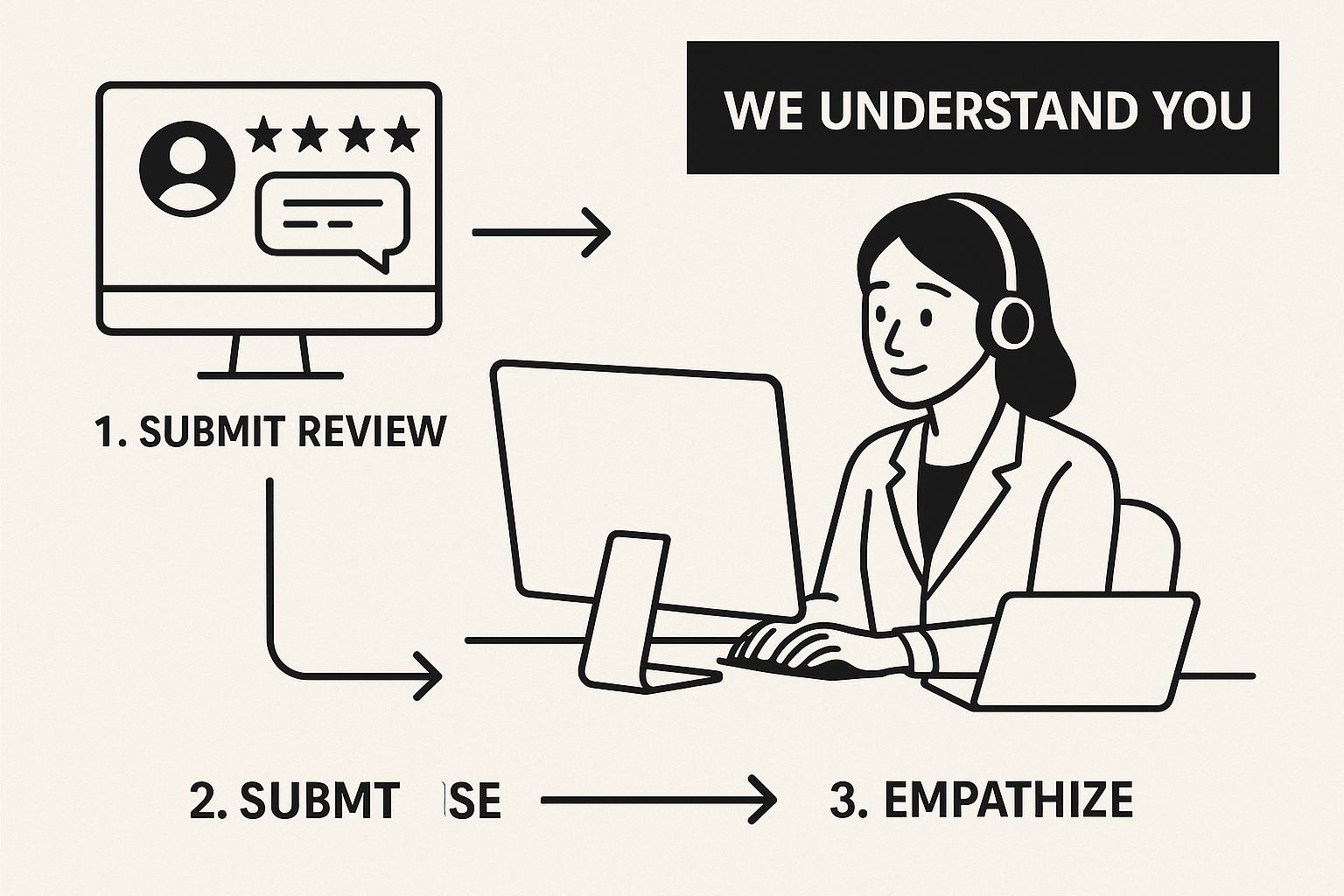
Starting with empathy just sets a completely different tone. It makes a real resolution feel possible.
Taking the Conversation Offline
After you’ve posted your public reply—the one with the apology and thank you—the next goal is to get the conversation out of the public eye. This is non-negotiable. It protects the customer’s privacy and, just as importantly, prevents you from getting into a long, messy back-and-forth for the whole world to see.
Think of your public reply as a bridge to a private one.
Key Takeaway: Your public response is for everyone, but the solution is for the individual customer. Address the problem publicly, but solve it privately.
Give them a clear, direct way to contact someone who can actually fix the problem. This shows you’re taking ownership. A few phrases I’ve seen work really well are:
- “I want to personally look into this for you. Could you please email me directly at [[email protected]] at your convenience?”
- “We are committed to making this right. Please give our support lead, Sarah, a call at [phone number] so we can find a solution together.”
This strategy looks great to anyone else reading the reviews, but it lets you get into the nitty-gritty details with the customer one-on-one.
Of course, dealing with negative reviews is only half the battle. You also need to be actively building up a cushion of positive ones. A strong base of great feedback makes the occasional bad review sting a lot less. For some solid tactics, check out our guide on how to ask for reviews without sounding pushy. Combining a proactive approach with a smart response plan is the key to building a reputation that can weather any storm.
Response Examples for Common Scenarios
Knowing the theory behind handling negative reviews is one thing. Actually putting it into practice when you’re staring at a one-star rating is a completely different ballgame.
The trick is to have a few solid starting points you can quickly adapt to your brand’s voice and the specifics of the complaint. Forget the rigid, corporate-sounding templates. Let’s look at some examples that sound like a real person wrote them.
Remember, your goal is to show the upset customer—and just as importantly, every potential customer who reads the exchange—that you’re reasonable, you care, and you’re committed to doing things right.
The Customer with a Valid Complaint
This is the most common and, frankly, the easiest type of negative review to handle. A customer had a genuinely bad experience, and their feedback gives you a clear picture of what went wrong. Your job here is simple: validate their frustration, offer a sincere apology, and show them how you’re going to fix it.
Here’s a great starting point:
Hi [Customer Name],
Thank you for taking the time to share your feedback. I am so sorry to hear that your experience with [Specific Issue] wasn’t what it should have been. That’s definitely not the standard we hold ourselves to, and I appreciate you bringing this to our attention.
We’re looking into what happened to make sure this doesn’t happen again. I’d really appreciate the chance to connect with you directly and make this right. Please reach out to me at [[email protected]] whenever you have a moment.
Sincerely,
[Your Name]
[Your Title]
This response works because it hits all the right notes. It’s personal, it takes immediate ownership of the problem, and it strategically moves the conversation offline to find a real solution.
The Vague or Unfair Review
Every so often, you’ll get hit with a one-star review and a frustratingly vague comment like “terrible” or “don’t bother.” These sting because you have almost nothing to go on.
The goal here isn’t necessarily to solve a problem you don’t understand, but to demonstrate your professionalism to the public. You want to show everyone else that you’re open to feedback, even when it’s not delivered constructively.
Here’s how you can approach it:
- Acknowledge their feeling: Start by recognizing their dissatisfaction, even if you can’t validate the reason.
- Gently ask for more: Politely invite them to provide more detail so you can understand what went wrong.
- Offer a direct line: Give them a specific contact person to show you’re serious about listening.
Let’s see that in action:
Hello [Customer Name],
We’re very sorry to see you were disappointed with your recent experience with us. Our team is committed to making sure every customer is happy, and it’s clear we missed the mark in your case.
We would be grateful for the opportunity to learn more about what happened. If you’re open to it, please contact me directly at [[email protected]] so we can better understand your feedback.
Thank you,
[Your Name]
[Your Title]
This response masterfully avoids getting defensive. Instead, it positions your business as one that’s always trying to improve, which builds a massive amount of trust with anyone reading.
Navigating the nuances of different complaints is key. Each type of review calls for a slightly different mindset and approach, as shown in the table below.
Comparing Response Strategies for Different Review Types
| Review Type | Primary Goal | Key Action | Tone to Adopt |
|---|---|---|---|
| Valid Complaint | Resolve the issue and retain the customer. | Apologize, take ownership, and offer a concrete solution. | Empathetic & Accountable |
| Vague/Unfair Review | Demonstrate professionalism to other readers. | Acknowledge their feeling and invite a private discussion. | Calm & Professional |
| Misunderstanding | Gently correct the record without being defensive. | Clarify the facts politely and offer further assistance. | Helpful & Informative |
| Spam/Fake Review | Get the review removed and minimize its impact. | Report the review through the platform’s official channels. | (No Public Response) |
Ultimately, having a clear strategy for each scenario ensures your responses are consistently constructive and brand-positive, turning a potential negative into a display of excellent customer service.
How to Handle Inauthentic and Fake Reviews
Let’s be honest, not every bad review you get is from a real customer. Sometimes you’ll read a review and just get a gut feeling that something’s off. It could be a competitor trying to drag you down, a bitter ex-employee, or even a flat-out scammer. When you suspect a review isn’t genuine, the game plan for responding has to change.
And you’re right to be suspicious. The online world is swimming in bogus feedback. Some recent data suggests that a staggering 30% of all online reviews might be fake. This problem is so out of control that 82% of consumers say they’ve spotted a fake review in the last year. People are becoming wary, and for good reason. You can dig into more of the numbers in these reputation management statistics.
Identifying the Red Flags of a Fake Review
Before you jump into action, you need to be fairly certain you’re dealing with a fake. Even the angriest, most dissatisfied customers usually leave specific details about what went wrong. Phony reviews, on the other hand, often have some tell-tale signs that give them away.
Keep an eye out for these red flags:
- Vague but Dramatic Language: The review is full of over-the-top words like “horrible,” “disaster,” or “worst ever,” but it’s completely missing any specific details about their experience.
- No Record of the Customer: You’ve checked your CRM, sales records, and appointment book. There’s simply no one with that name or any matching details in your system. This is a big one.
- A Sketchy Reviewer Profile: Click on their profile. Do they have a generic name, no profile picture, and this is the only review they’ve ever left? Or maybe it’s the opposite—they’ve left a trail of one-star reviews for dozens of other businesses in a short amount of time.
- A Plug for the Competition: The review trashes your business and then conveniently happens to mention how much better a specific competitor is. It’s a classic, sneaky tactic.
One of these signs alone might not be enough to call it, but if you see a couple of them together, you can be pretty confident you’re not dealing with a real customer.
Reporting and Responding to Fake Reviews
Once you’re convinced a review is fake, your first move shouldn’t be to reply. It should be to report it.
Every major review platform, from Google to Yelp, has a process for flagging reviews that violate their terms of service. Gather up your evidence—like the fact that you have no record of the customer—and submit a report through their official channels.
Now, while you’re waiting for the platform to do its thing (which can take a while), you might still need to post a public response. The trick is to do it without getting defensive or starting an online brawl.
Your goal isn’t to win an argument with a fake reviewer. It’s to show everyone else reading the reviews that you’re a reasonable business owner who takes feedback seriously.
Here’s a simple, professional template you can adapt:
“Hello [Reviewer Name], we appreciate you taking the time to leave feedback. We take these matters very seriously, but we can’t seem to find any record of a customer with your name or details in our system. We’d love the chance to look into this further. Could you please reach out to us directly at [[email protected]] so we can get more information?”
This response works perfectly. It calmly and professionally calls the review’s legitimacy into question without being accusatory. More importantly, it shows potential customers that you’re proactive and willing to solve real problems.
Turning Negative Feedback into Business Growth

Replying to a bad review is just the beginning. The real growth happens when you start treating that feedback like the goldmine of business intelligence it is. Every single complaint, no matter how small, is a breadcrumb showing you exactly where your customers are running into trouble.
The goal is to shift from just putting out individual fires to fixing the underlying issues that cause them in the first place.
You don’t need a fancy system to get started. A simple spreadsheet is perfect for logging each negative review and tagging the core complaint. I’ve seen businesses make massive improvements just by tracking a few key categories.
- Product/Service Flaws: The product broke, the service didn’t deliver, etc.
- Customer Service Issues: Complaints about rude staff, slow support, or unhelpful answers.
- Operational Gaps: Problems with shipping delays, long wait times, or store cleanliness.
- Communication Problems: Customers felt misled about pricing, policies, or features.
After a month or so, you’ll start to see patterns jump out. Those patterns are your playbook for making impactful, long-term improvements. If three people in one week complain about a confusing checkout process, you know exactly what to tell your web developer to fix.
From Feedback to Actionable Insights
Once you’ve spotted a recurring theme, it’s time to dig in. To really use this feedback, you need to know how to analyze customer feedback for business growth and turn those raw complaints into a concrete action plan.
I once worked with a local cafe that kept getting comments about slow service on Saturdays. Instead of just apologizing in their review responses, they used that data. They scheduled one extra barista for the weekend rush, and like magic, the “slow service” complaints vanished and were replaced by praise for their efficiency.
Think of it this way: Your unhappy customers are acting as free consultants, pinpointing the precise weaknesses your paid staff might have missed.
The impact of acting on this kind of feedback is huge. Some studies show that 85% of customers are willing to leave a one-star review based on a single bad interaction with an employee. When you see a pattern of complaints about a specific person or process, you can step in with targeted training. This protects your reputation and makes your entire team stronger.
Ultimately, this whole process is about more than just damage control. It’s a powerful loop of continuous improvement, fueled by your most vocal critics.
While fixing the negatives is critical, don’t forget the other side of the coin. You also need a steady stream of positive feedback. Learn more about how to increase google reviews to build a well-rounded and resilient online reputation.
Common Questions About Negative Reviews
Working through the finer points of handling negative reviews can definitely feel like a minefield. While every situation has its own quirks, I’ve seen the same questions come up time and time again from business owners. Let’s break down some of the most common ones with some straightforward, practical advice.
One of the first things people want to know is about timing. It’s more important than you might think.
How Quickly Should I Respond?
You should aim to reply within 24 to 48 hours. This isn’t an arbitrary number. A fast response immediately shows the unhappy customer (and everyone else reading) that you’re paying attention and you genuinely care about their feedback.
Think about it: more than half of all consumers expect a business to get back to them within a week. By responding in a day or two, you’re not just meeting expectations—you’re exceeding them. This simple act can cool down a tense situation before it has a chance to escalate.
Should I Offer a Refund in My Public Response?
This is a big one, and my answer is almost always no. It’s a bad idea to offer refunds, discounts, or any specific compensation right there in your public reply.
Why? Because it can create a really dangerous precedent. You risk signaling to others that leaving a bad review is an easy way to get a freebie. Your public response is your stage to show accountability and professionalism, not a place to negotiate.
The smarter move is to acknowledge the problem publicly and then immediately shift the conversation to a private channel.
A great way to phrase this is: “We’re very sorry this happened and we’re committed to making it right. Could you please reach out to our manager, [Name], at [email/phone]? We want to work with you directly to find a solution.”
This approach strikes the perfect balance. You look proactive and fair to the public, but you handle the specific resolution privately.
What if the Review Is About the Wrong Business?
It happens more often than you’d think. A customer leaves a scathing review meant for the shop down the street right on your profile. The key is to respond with professionalism, not defensiveness.
If it’s a clear case of mistaken identity, a simple, polite correction is all you need.
- “Thank you for taking the time to leave feedback. Based on your description, it sounds like there might be a mix-up, as we don’t offer [the service/product mentioned]. We suspect this review may have been intended for another local business.”
This gets the point across without embarrassing the reviewer.
Now, if the review is about your business but contains claims that are just plain false, you need to state the facts calmly and without emotion. Once you’ve responded, go ahead and flag the review for removal with the platform. Be sure to provide any evidence you have to back up your claim.
For more detailed advice on handling unique review situations, our FAQ page has a ton of extra insights.
At Reviews To The Top, we believe every piece of feedback is a chance to get better. Our platform makes it easy to manage all your reviews in one place, so you can monitor, respond, and build an incredible online reputation that brings new customers through the door. Learn how we can help you climb the rankings.