If you're running a restaurant and bouncing between Google Business Profile, Instagram, review sites, your POS, and a texting tool, you don't have a marketing strategy. You have a workflow problem. A restaurant marketing platform matters because it brings discovery, reputation, messaging, and reporting into one place so more guests call, message, book, order, and show up.
Table of Contents
- What Is a Restaurant Marketing Platform?
- Core Features Every Restaurant Platform Needs
- How a Marketing Platform Drives Restaurant ROI
- Choosing the Right Platform For Your Restaurant
- Templates and a 7-Day Review Program Launch Plan
- How to Measure Your Marketing Platform's Success
- Frequently Asked Questions
- Do small restaurants need a restaurant marketing platform?
- Is this different from hiring a social media manager?
- Can I use a platform for one restaurant in [City]?
- What matters most for multi-location groups?
- Will AI help my restaurant team?
- Where does Reviews To The Top fit?
- How long does setup take?
What Is a Restaurant Marketing Platform?
Friday at 5:30, a district manager is fielding the same complaints from three stores. One location has the wrong holiday hours on Google. Another has unanswered reviews from last week. A third is paying for ads, but nobody can tell whether those clicks turned into calls, bookings, or online orders. The problem is not effort. The problem is that marketing work is spread across too many tools, too many owners, and too little visibility.
A restaurant marketing platform puts that work in one operating system. It gives restaurant teams a single place to manage listings, reviews, guest messaging, campaign automation, and performance reporting across one location or fifty. The value is operational control. Brand standards stay consistent, local teams have clear workflows, and leadership can see which actions are producing revenue.
That matters more as a brand grows. Multi-location restaurants rarely fail because they stopped posting on social media. They lose ground because store data drifts, response times slip, guest records sit in separate systems, and no one at the home office has a clean view of what is happening market by market.
A strong platform fixes those gaps. It standardizes location data, routes reviews and messages to the right team, connects marketing activity to guest behavior, and gives operators a usable record of what changed and what worked. If you want a broader example of this type of centralized workflow, restaurant teams often use tools similar to customer communication management software to keep guest conversations organized across channels.
Key Facts
According to restaurant marketing statistics from Restroworks, nearly 44% of consumers turn to social media for restaurant recommendations, more than 38% rely on review sites, and 41% use social media to research where to eat. The pattern is even stronger among younger diners, with 67% of Gen Z and 57% of Millennials using social platforms to help decide where to go. Restroworks also reports that 55% of Gen Z diners use Instagram for restaurant reviews and 44% use TikTok.
Those numbers matter, but they do not mean restaurants need another posting tool. They mean discovery, trust, and conversion are happening across channels your operators must manage with discipline.
Here is the practical rule I use with clients: if your hours, photos, review responses, offers, and contact paths vary by platform or by store, guests experience confusion before they ever reach the host stand.
The biggest mistake operators make is buying software for publishing, then expecting it to solve governance and reporting problems. A restaurant marketing platform should do more than schedule content. It should help corporate teams control brand data across locations, help store teams execute repeatable tasks without chasing spreadsheets, and help leadership connect visibility to revenue. That reporting layer is what makes later ROI analysis possible, especially when teams need to understand how to measure campaign profitability by location, channel, and offer.
Core Features Every Restaurant Platform Needs
It starts with guest data, not posting tools
The strongest platforms don't begin with social scheduling. They begin with first-party data. When the platform pulls transaction data from the POS, it can automatically tie purchase history, visit frequency, average spend, and menu preferences to a guest profile, as explained in Upside's overview of restaurant marketing software.
That changes the quality of your outreach.
A first-time lunch guest can get a welcome offer. A regular Friday family order can get a reminder before their usual window. A lapsed catering customer can get a targeted reactivation message. That's better than blasting the same coupon to everyone on your list.
If you're evaluating integrations, don't stop at email sync. Look at whether the platform can connect your guest records to calling and messaging workflows. That's where tools tied to CRM and VoIP integration become useful for restaurants handling reservations, events, and follow-up across locations.
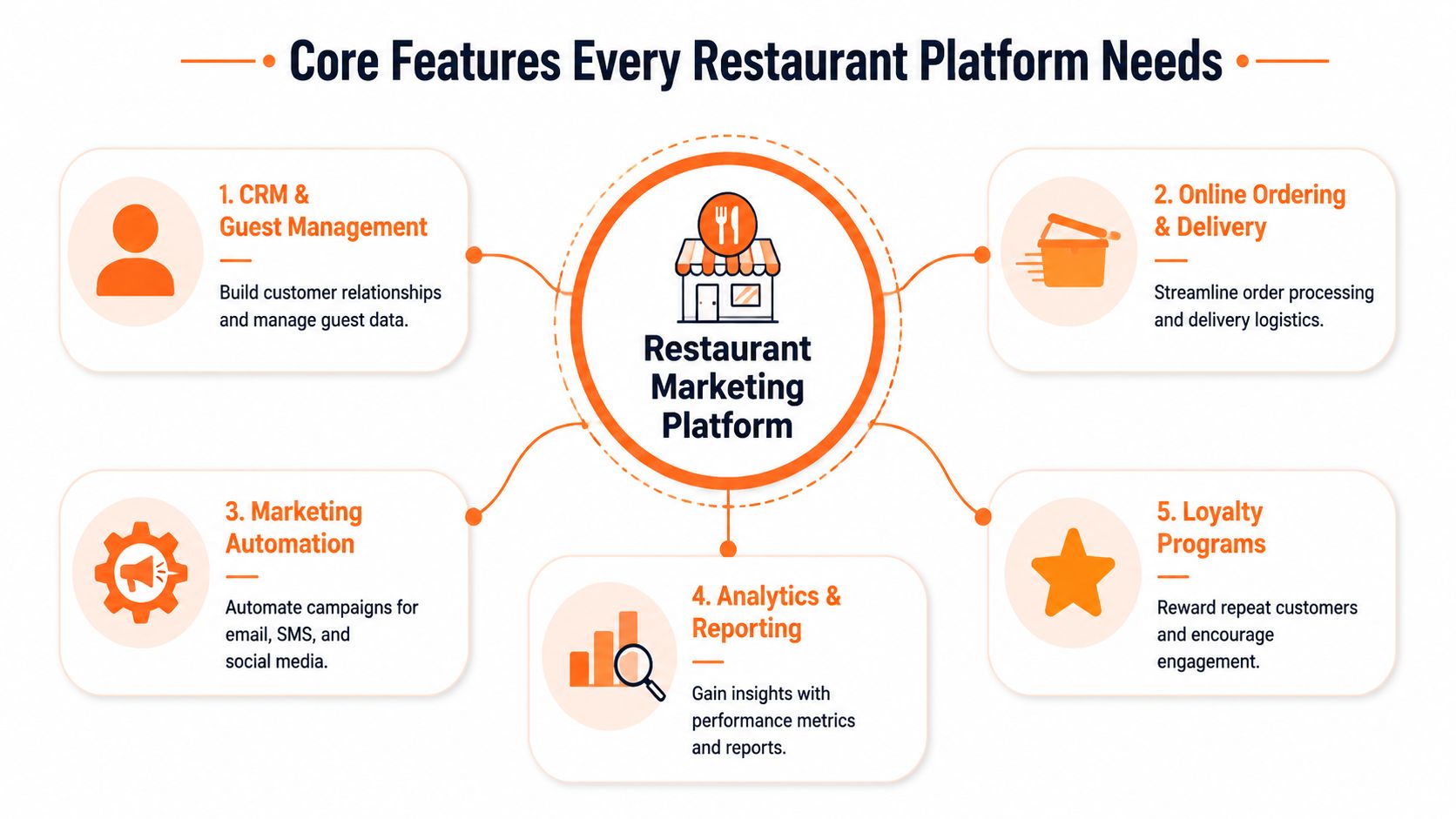
The five capabilities that matter
Not every feature deserves equal weight. These five do.
Reviews and reputation management
Restaurants win trust before a guest ever sees the host stand. A useful platform sends review requests, monitors major sites, routes complaints, and gives teams response templates that don't sound canned.Listings management
Your hours, phone number, menu link, reservation link, attributes, and photos need to match across Google, Apple, Bing, and directory surfaces. This is basic, but it's where many operators lose "near me" traffic.Customer messaging
SMS, email, web chat, and direct outreach matter most when they are tied to a real workflow. Think waitlist updates, event follow-up, review requests, birthday offers, and service recovery after a poor experience.POS and channel integrations
This is the engine. Without it, your platform is mostly manual. With it, you can segment based on behavior and connect review, social, delivery, and ordering activity into one attribution view.Analytics and automation
Olo describes a stack that combines real-time segmentation, orchestration across email, SMS, and push, analytics, and predictive models so operators can identify what drives activity and spot churn risk in a closed loop, in its restaurant marketing product overview. That closed loop matters because campaigns shouldn't end when a message is sent. They should end when you know what happened next.
A good platform doesn't just help you publish. It helps you decide who should get what message, when they should get it, and whether it led to orders, bookings, or repeat visits.
One more practical point. Brand marketing isn't limited to screens. For cafes, smoothie bars, and quick-service concepts, physical packaging often supports digital recall. If you're working on in-store brand consistency, these design tips for branded coffee cups are a useful complement to digital profile and creative standards.
How a Marketing Platform Drives Restaurant ROI
A restaurant marketing platform earns its budget when it improves visibility, raises conversion rates, and cuts manual work. If it only gives you prettier dashboards, it isn't doing enough.
Deloitte Digital reported that in 2024 restaurants saw an average 9.9% increase in B2C revenue directly attributable to social media strategies, while social-first brands saw an average 14.1% increase. The same summary notes that 90% of restaurants said social media is very or extremely important to their digital marketing approach, and 88% of consumers are more likely to use a business that replies to all reviews, according to Deloitte Digital's restaurant social media analysis.
Visibility first, then conversion
Most ROI starts with local discovery. For restaurants, that means showing up when someone searches for "pizza near me," "best brunch in [Neighborhood]," or "private dining [City]."
Google local visibility usually comes down to three factors:
- Proximity means how close the searcher is to your location.
- Relevance means how well your profile matches the search intent.
- Prominence means how strong your digital reputation and authority appear.
A platform helps with the two parts you can influence most. Relevance improves when your Google Business Profile, menu links, attributes, categories, and photos are complete. Prominence improves when you collect fresh reviews, respond consistently, and keep brand information accurate. That's why local visibility work belongs next to local SEO benefits, not in a separate silo.
If your [City] store has the right category, current hours, recent photos, and active review responses, it gives Google more confidence than a neglected profile down the street.
Where the return actually comes from
The return usually shows up in four places:
| ROI driver | What the platform changes | Why it matters |
|---|---|---|
| Search visibility | Keeps listings accurate and reviews fresh | More impressions in Maps and local search |
| Conversion rate | Reduces friction from discovery to action | More calls, bookings, directions, and orders |
| Labor savings | Automates requests, replies, and reporting | Less manager time spent on repetitive admin |
| Guest retention | Triggers behavior-based follow-up | More repeat visits and stronger loyalty |
If you're building the business case internally, it helps to pair platform reporting with a simple framework for how to measure campaign profitability so your team can connect spend, effort, and outcomes without overcomplicating it.
A short walkthrough can help your managers understand how these systems connect in practice:
The common failure mode is easy to spot. Operators invest in content creation, but not in review response, listing accuracy, attribution, or guest segmentation. That creates activity, not return.
Choosing the Right Platform For Your Restaurant
The right platform for a single cafe in [Neighborhood] is not always the right platform for a restaurant group spread across [City] and nearby markets. The core question isn't which vendor has the longest feature list. It's which system your team will readily use without creating more work for operators.
The multi-location issue gets ignored too often. According to Malou's write-up on restaurant marketing tools, 62% of U.S. chains say data visibility across locations is their top digital problem. The same piece reports that teams using centralized systems saw +74% organic traffic, +25% more Google reviews, and 2.5× higher discovery on Google Maps when listings and visuals were unified.
Single location versus multi location needs
A single-location operator usually needs speed and simplicity. A multi-unit group needs governance.
For one store, focus on:
- Ease of use so a GM can manage reviews and updates quickly
- Strong Google Business Profile controls because that's usually the most valuable local asset
- Basic guest messaging for review requests, offers, and service recovery
- A clean dashboard that shows calls, bookings, messages, and review activity
For several stores, add another layer:
- Role-based permissions so local teams can act without breaking brand standards
- Approval workflows for profile edits, offers, and responses
- Location-level reporting so corporate can compare stores without spreadsheet chaos
- Templates and SLAs for reviews, escalations, and recurring updates
- Cross-location visibility into what is working by region, concept, or manager
This is also where labor-saving automation matters. Emerging thinking in hospitality tech emphasizes background systems that handle orders, payments, rewards, personalization, and consistency with less manual effort. In plain English, the best platform is often the one that reduces staff clicks while keeping the guest experience smooth.
One practical option in this category is online reputation management software. For restaurant operators, that matters most when it centralizes review requests, replies, templates, permissions, and profile accuracy across stores.
Multi-location brands don't need more apps. They need clearer rules, cleaner data, and fewer exceptions.
Google Business Profile checklist
Before you shop for advanced automation, make sure the foundation is right. Use this short checklist for every location.
- Confirm core business data. Name, address, phone, hours, and website URL must match your real-world operation.
- Choose the best primary category. Be specific enough to match intent.
- Add service attributes. Dine-in, takeout, delivery, reservations, accessibility, and other relevant details should be filled in.
- Use current photos. Exterior, interior, team, menu highlights, and seasonal updates all help relevance.
- Check conversion links. Reservation, menu, ordering, and call buttons should go to the correct destination.
- Set a review response process. Decide who owns replies and how quickly they should be handled.
- Monitor location drift. Hours, holiday updates, and duplicate listings create avoidable friction.
For "near me" searches, this is still the front door.
Templates and a 7-Day Review Program Launch Plan
The easiest way to stall a review program is to overthink it. Start with one trigger, one message flow, one owner, and one response standard.
If you need the Google side set up correctly before launch, this guide on how to request a Google review is a useful reference for the workflow.
Copy and paste review request templates
SMS review request
Hi [First Name], thanks for visiting [Restaurant Name] today. If you enjoyed your meal, would you mind leaving a quick review for our [Neighborhood] location? Your feedback helps other guests find us: [Review Link]
Email review request
Subject: Thanks for dining with us at [Restaurant Name]
Hi [First Name],
Thank you for visiting [Restaurant Name]. We hope you had a great experience with our team and menu.
Would you take a minute to leave a review for our [City] location? We read every review and use guest feedback to improve service, food, and the overall experience.
Leave a review here: [Review Link]
Thank you again,
[Manager Name]
[Restaurant Name]
Send the request while the visit is still fresh. For restaurants, timing matters more than clever copy.
Review response templates
Positive review response
Hi [Reviewer Name], thank you for the kind words and for visiting us at [Restaurant Name]. We're glad you enjoyed your experience, and we'll share your feedback with the team. We look forward to welcoming you back soon.
Negative review response
Hi [Reviewer Name], thank you for sharing your feedback. We're sorry your experience didn't meet expectations. We take comments like this seriously and want to learn more. Please contact us at [Email or Phone] so we can follow up directly and address the issue with the right team member.
7-day review program launch checklist
| Day | Action Item | Goal |
|---|---|---|
| Day 1 | Connect Google Business Profile, review sites, and core location data | Centralize profiles and remove basic setup gaps |
| Day 2 | Choose the trigger for review requests, such as completed order, dine-in visit, or reservation follow-up | Define when requests should go out |
| Day 3 | Build one SMS template and one email template for all locations | Standardize outreach |
| Day 4 | Create response templates for positive and negative reviews | Speed up replies without losing brand tone |
| Day 5 | Assign who owns responses, escalations, and weekly reporting | Avoid confusion and missed reviews |
| Day 6 | Test links, timing, and location routing for every store | Make sure guests land on the right review page |
| Day 7 | Launch with one location or one region first, then review feedback and adjust | Start clean and scale with fewer mistakes |
A simple program run consistently beats a complicated one that sits half-finished.
How to Measure Your Marketing Platform's Success
Most restaurant teams look at activity first. Posts published. Messages sent. Reviews requested. Those are useful operational checks, but they don't tell you whether the platform is helping the business.
The metrics that deserve attention
Track the metrics that move from visibility to action.
- Review volume. Watch whether each location is earning a steady flow of new reviews month to month.
- Review recency. Fresh reviews matter more than a large but stale profile.
- Response time. Measure how quickly your team replies to both positive and negative feedback.
- Star rating trend. Look for movement over time, not just one snapshot.
- GBP views and actions. Track calls, clicks for directions, website visits, messages, bookings, and ordering clicks.
- Lead-to-sale conversion. For restaurants, this can mean reservation-to-seated rate, inquiry-to-event-booking rate, or click-to-order completion depending on the concept.
The useful dashboard is the one a regional manager can read in two minutes and act on the same day.
How to track GBP to bookings and calls
Use UTM parameters, which stands for Urchin Tracking Module, on the links you place in Google Business Profile, social bios, and email campaigns. That gives you cleaner attribution inside analytics tools.
A simple example looks like this in practice:
- Source = google
- Medium = organic
- Campaign = gbp_booking_button
- Location tag = downtown or westside
Then line that traffic up with what happened next. Did the guest call? Book? Start an order? Ask about a private event? If your reservation system and website analytics are separate, build a simple reporting sheet that ties these steps together weekly.
For phone-heavy locations, use trackable call routing where possible. For booking-heavy concepts, compare profile actions against completed reservations, not just booking page visits. For multi-location brands, review this by store, not only at the corporate level. That's how you find the outlier with weak photos, slow response times, or a broken menu link.
Frequently Asked Questions
Do small restaurants need a restaurant marketing platform?
Yes, if the current setup is split across too many tools. A single location can still lose revenue from missed reviews, outdated listings, slow guest follow-up, and no clear view of which channels drive calls, orders, or bookings. One platform fixes those handoff problems.
Is this different from hiring a social media manager?
Yes. A social media manager handles posting, comments, and creative execution. A restaurant marketing platform handles the operational layer behind local discovery and conversion, including listing control, review workflows, approval rules, guest messaging, and reporting that operators can use by location.
Can I use a platform for one restaurant in [City]?
Yes. Single-location restaurants often see value quickly because the owner or GM gets one place to manage reviews, Google Business Profile updates, and follow-up campaigns without chasing logins across different systems.
What matters most for multi-location groups?
Governance and visibility.
Multi-location brands need role-based permissions, brand-approved templates, location-level reporting, and automated workflows that keep every store aligned. Without that structure, each location starts doing its own thing, corporate loses visibility, and performance gaps stay hidden until revenue slips or guest complaints pile up.
Will AI help my restaurant team?
It can, if it saves labor and improves consistency. The strongest use cases are drafting review responses, routing tasks to the right store, personalizing outreach, and keeping business information aligned across channels. The better question is whether the tool reduces manual work and supports repeat visits.
Where does Reviews To The Top fit?
Reviews To The Top supports restaurants that need review generation, response workflows, listing accuracy, and multi-location governance, with month-to-month support and a single point of contact.
How long does setup take?
That depends on your location count, integrations, and approval process. The fastest rollouts usually start with Google Business Profile control, review requests, response templates, and one reporting view that regional and store leaders can read quickly.
If you want a practical plan instead of another software demo, book a strategy call with Reviews To The Top. We help local and multi-location restaurant teams centralize reviews, listings, and response workflows so more guests find the right location and take action. Support is month-to-month, which makes it easier to start with one region, prove the process, and expand.