Call tracking marketing attributes inbound phone calls to the specific ads, listings, or campaigns that generated them. For local businesses, this matters because businesses using call tracking achieved 4x higher conversion rates from calls, averaging 15-20% versus a 4% baseline, and 78% of customers buy from the first business to respond.
If you're managing a practice, shop, or multi-location brand, this is the situation you already know: the phone rings, appointments get booked, and nobody can say with confidence whether the call came from Google Ads, organic search, your Google Business Profile, or the reviews your team worked hard to earn. That blind spot makes it easy to overspend on the wrong channels and underinvest in the ones that bring in high-intent customers ready to book.
Table of Contents
- What Is Call Tracking and Why Local Businesses Need It
- How to Implement Call Tracking Step by Step
- Connecting Call Tracking to Reviews and Reputation
- Industry-Specific Call Tracking Playbooks
- Measuring Call Tracking ROI and Key Metrics
- Your Launch Kit Templates and Checklists
- Call Tracking Marketing FAQs and Next Steps
What Is Call Tracking and Why Local Businesses Need It
A local operator usually sees the symptoms before the cause. The schedule has gaps on some days, the phone blows up on others, and marketing reports still focus on clicks instead of booked appointments. Call tracking marketing fixes that by tying the call back to the source that made the customer dial.

Call tracking started becoming a serious marketing tool in the early 2000s, and dynamic number insertion, or DNI, arrived in 2003. That shift let marketers assign unique numbers to digital campaigns instead of relying on vague “how did you hear about us” answers. By 2025, businesses using call tracking achieved 4x higher conversion rates from calls, averaging 15-20% versus a 4% baseline, according to Mediahawk's State of Call Tracking Report.
For a busy operator, the takeaway is simple. Phone calls are often the closest thing to purchase intent you'll get from a local prospect.
Key Facts
- Call tracking marketing connects calls to channels: It shows whether the caller came from SEO, PPC, your Google Business Profile, reviews, or another source.
- DNI changed attribution: Dynamic number insertion arrived in 2003 and made campaign-level call attribution much more precise.
- Calls convert strongly: Businesses using call tracking achieved 4x higher conversion rates from calls, averaging 15-20% versus a 4% baseline in the Mediahawk report linked above.
- Speed matters: 78% of customers buy from the first business to respond, based on the same verified data set discussed earlier.
- Reviews matter too: Strong reputation and fast response work best when you can measure which calls came from your listings and review activity.
If you're working on lead attribution across channels, a practical companion read is this guide on how to unlock growth for your cleaning business. The concept applies well beyond cleaning companies because the operational problem is the same: connect lead source to revenue, not just activity.
How call tracking fits local search
Local search isn't only about ranking. It's about whether the right person in [City] or [Neighborhood] sees your business, trusts what they see, and decides to call now.
Google's local visibility usually comes down to proximity, relevance, and prominence:
- Proximity: How close the searcher is to your business.
- Relevance: How well your profile and website match what the person searched, such as “dentist near me” or “AC repair near me.”
- Prominence: How established and trusted your business appears online through reviews, profile completeness, mentions, and overall visibility.
Call tracking doesn't directly improve those factors by itself. What it does is tell you which visibility efforts are producing real conversations. That matters because a listing that generates calls and bookings is more valuable than one that only generates impressions.
Practical rule: If your reporting stops at clicks, you're still guessing.
Acronyms matter here because they get tossed around loosely. SEO means search engine optimization, which helps you appear in unpaid search results. PPC means pay-per-click advertising, such as Google Ads. Call tracking marketing is the layer that tells you which of those efforts drove a human conversation.
What this means for booked appointments
The bottom-line question isn't “Did the campaign get traffic?” It's “Did it produce calls that turned into appointments, service visits, tours, or estimates?”
That's why this matters to med spas, dental offices, HVAC companies, veterinary clinics, auto repair shops, and senior living communities. In these categories, a phone call often means the customer is close to making a decision.
A strong starting point is to optimize your Google Business Profile and treat every profile action as measurable. Once you know which channels generate booked calls, budget decisions get easier. You stop funding noise and start funding response-ready demand.
How to Implement Call Tracking Step by Step
Most businesses overcomplicate setup at the start. They either try to track every edge case on day one or they install a tracking tool and never connect it to anything useful. The better path is narrower: get source attribution working first, then expand.
Start with dynamic number insertion
DNI uses a pool of temporary phone numbers to identify where a website visitor came from. When someone lands on your site from Google Ads, organic search, or another source, the site displays a trackable number tied to that session.
According to CallTrackingMetrics on conversion metrics, integrations with Google Analytics 4 and CRMs such as Birdeye can improve attribution accuracy by 20-40% over static numbers. That same verified data set includes a practical example: a $1,000 PPC spend on “HVAC repair [City]” can be tracked to 15 calls, and call scoring can identify qualified leads with 85% accuracy based on keywords like “schedule service.”
That tells you what works. Usually, the following does not:
- One phone number everywhere: Simple, but weak for attribution.
- Too many numbers too early: Hard to manage and confusing for staff.
- No call qualification rules: Spam, wrong numbers, and hang-ups muddy the picture.
Connect your Google Business Profile and website
Your website is only part of the local journey. Many high-intent customers skip the site and call directly from your Google Business Profile after searching for a service “near me.”
Use one approach for the website and another for your listings:
- Website: Use DNI so calls can be tied to source, campaign, and in some setups, keyword.
- Google Business Profile: Use a trackable primary or forwarding number setup that preserves a consistent local presence and lets you measure profile-generated calls.
- Landing pages: Make sure the displayed number matches the conversion path you want to measure.
- Front desk workflow: Teach the team how to answer consistently so the data isn't separated from the actual booking outcome.
If you're still working through number logistics, this Hosted Telecommunications business guide is a useful primer on getting a new number and understanding the operational side before rollout.
Google Business Profile call checklist
For local operators, this is the short checklist that matters most:
- Use a consistent business name: Match your real-world branding across your website and listings.
- Choose the best primary category: Don't guess. Pick the category that matches your highest-value service.
- Complete every service field you can: Relevance improves when Google can clearly understand what you do.
- Keep hours accurate: Missed expectation kills conversions.
- Add location-specific photos: Generic stock photos don't build trust.
- Monitor Q&A and reviews: Prominence grows when your profile stays active and useful.
- Use a call-ready number: Make sure the profile routes callers to a trained team member, not a dead end.
A lot of local businesses lose more value from poor handling than from poor marketing.
The campaign may be working perfectly. The phone just isn't being answered well enough to prove it.
Later in the setup, it helps to review the reporting and routing side in one place. That's where call management systems become useful, especially for multi-location teams that need cleaner routing, overflow handling, and centralized reporting.
Send call data into reporting and CRM systems
If call data stays trapped inside one dashboard, it won't change budget decisions. Push it into the systems your team already uses.
That usually means:
- Google Analytics 4 for conversion visibility.
- CRM records so each caller becomes a trackable lead.
- Booked appointment status so marketing can be judged on outcomes, not call counts.
- Location-level reporting for franchise or regional teams.
This walkthrough helps explain the setup visually:
For a practice manager, the test is straightforward. At the end of the month, can you answer which campaign produced booked appointments, which profile produced calls, and which location missed leads because response was slow? If not, your call tracking marketing setup is incomplete.
Connecting Call Tracking to Reviews and Reputation
Many local businesses separate reputation work from lead tracking. The marketing team monitors reviews. The front desk handles calls. Ownership sees two different reports and still can't tell whether better ratings produced more booked business.
That split is a mistake.
Why reviews create calls
Reviews influence whether a prospect trusts you enough to contact you. In local search, that trust usually appears before the call, not during it.
A major gap in marketing analysis is measuring calls generated by review platforms. Reviews can drive 15-20% of inbound calls for service businesses, and businesses with 4.5+ star ratings can see up to 27% more calls, according to this analysis of why call tracking matters for marketing.
If you're a dentist in [City], an HVAC company in [Neighborhood], or a vet with multiple locations, that's the actual-world sequence:
- A prospect searches for a service near them.
- They compare ratings, recency, and responses.
- They choose the listing that looks safest, fastest, or most trustworthy.
- They call.
The review-to-call funnel
The practical fix is to treat review generation and call tracking as one funnel.
You want to know:
- Which calls came from the Google Business Profile.
- Which locations get stronger call volume after review recency improves.
- Whether callers from high-rated listings book at a better rate.
- Which service lines get mentioned most in calls after review themes change.
Many operators finally see the ROI of reputation work at this stage. If your review response process gets tighter and your locations become more prominent in local results, you should expect more high-intent calls. But unless those calls are tracked separately, reputation still looks “important” instead of measurable.
A good operational model is to connect review activity and call reporting in the same workflow. Teams handling review responses and monitoring should be looking at call outcomes too, not just star ratings.
A five-star profile is helpful. A five-star profile that produces booked calls is defensible budget.
Where AI helps and where it does not
AI can help after the call, especially when you use transcripts and summaries to spot repeated pain points, service questions, and missed booking opportunities. It can also help identify whether positive reviews align with strong caller experiences.
What AI doesn't do on its own is fix weak operations. If staff miss calls, transfer badly, or answer inconsistently, sentiment tools won't rescue the result.
The best use of AI here is pattern recognition:
- repeated objections
- frequent missed service questions
- scheduling friction
- review themes that match successful calls
That creates a clean loop. Better reviews improve local visibility. Better visibility produces more calls. Better call analysis improves service handling. Better service handling leads to stronger reviews again.
Industry-Specific Call Tracking Playbooks
Some strategies look good in a dashboard but fall apart at the front desk. The businesses that win with call tracking marketing tailor it to how their buyers behave.

In 2025, integrating AI-driven sentiment analysis with call tracking can lift lead conversion rates by 35%, and 76% of consumers call a business after reading their reviews. The same verified data set also notes that multichannel integration can boost satisfaction by 40%, based on Teldrip's 2025 call tracking trends analysis. Those numbers matter most when applied by vertical.
Dental and healthcare in [City]
For dental, med spa, chiropractic, and similar healthcare settings, the priority is matching call source to higher-value service lines without exposing protected information. Stay HIPAA-aware. Don't request or publish anything that includes diagnosis details, treatment specifics, or other PHI.
A workable structure is to track calls from:
- cosmetic and elective service pages
- emergency-intent searches such as “dentist near me”
- Google Business Profile calls
- referral pages and review traffic
SMS review request script for dental or med spa
“Hi [First Name], thanks for visiting [Practice Name] today. If you'd like to share feedback about your experience, we'd appreciate a quick review here: [Review Link]. Please don't include private health information in your review.”
Email review request script for dental or med spa
Subject: Thanks for visiting [Practice Name]
“Hi [First Name], thank you for choosing [Practice Name]. Your feedback helps other patients in [City] find a provider they can trust. If you'd like to leave a review, you can do that here: [Review Link]. For privacy, please don't include personal health details.”
HVAC and home services in [Neighborhood]
Home services calls don't all mean the same thing. “No cooling” at 8 p.m. is different from a maintenance estimate. Emergency terms often justify faster routing and different staffing.
For HVAC, plumbing, electrical, and similar services, separate at least these buckets:
- Paid search emergency calls: Terms like “repair near me” or “same day.”
- Organic service calls: Broader discovery and comparison behavior.
- Google Business Profile calls: Often ready-to-book and local.
- Repeat customer calls: Important operationally, but not the same as net-new lead generation.
This is especially relevant for contractors and trades. If electrical work is part of your service mix, this page on marketing for electrical contractors is a useful example of how local lead generation and reputation signals intersect.
Route urgent calls faster than routine ones. Better attribution won't help if a hot lead sits in the same queue as a parts question.
Automotive repair and service
Auto repair shops often win or lose on trust and clarity. A customer searching “auto repair near me” or comparing shops after reading reviews is usually deciding fast.
The playbook here is practical:
- Use call tracking on service pages and GBP listings.
- Train advisors to log booked inspections, not just answered calls.
- Review transcripts for common concerns like timing, pricing clarity, and warranty questions.
- Compare review themes with call outcomes. If callers ask the same trust question repeatedly, your public-facing messaging is incomplete.
This also works for veterinary clinics and senior living communities, where reassurance drives the decision. The core lesson is the same. Don't stop at call attribution. Tie the conversation to the booking outcome.
Measuring Call Tracking ROI and Key Metrics
A dashboard full of phone activity can still hide the truth. High call volume isn't enough if the calls are low quality, unbooked, or mishandled. The best operators judge call tracking marketing by revenue signals, operational signals, and local visibility signals together.
What to measure beyond call volume
Start with a short list your team can review each month:
- Qualified calls: Calls that match your service area and service type.
- Booked appointments or estimates: The metric ownership cares about.
- Lead-to-sale conversion: Of the qualified calls, how many turn into revenue.
- Call source: Google Ads, organic search, GBP, review traffic, referral, direct.
- Missed calls: An operations problem disguised as a marketing problem.
- Response time: Especially important when quick follow-up wins the customer.
- Review and profile trend: Helps explain why call volume changes over time.
If you want a model for cleaner reporting, this guide to business call reporting is useful because it pushes the conversation beyond simple call counts.
Recommended Monthly Performance Targets for a Local Business
Use targets as management guardrails, not promises. What counts as good or excellent depends on category, location density, staffing, and average ticket size.
| Metric | Target (Good) | Target (Excellent) |
|---|---|---|
| Review volume | Steady monthly growth | Strong monthly growth with location consistency |
| Review recency | New reviews arriving regularly | New reviews arriving consistently across the month |
| Review response time | Respond promptly | Respond very quickly and consistently |
| Star rating | Strong, trustworthy rating | Outstanding, highly competitive rating |
| GBP views and calls | Upward trend month over month | Strong upward trend with clear booking impact |
| Qualified call rate | Most tracked calls are relevant | Very high share of tracked calls are relevant |
| Lead-to-sale conversion | Healthy and stable | Strong and improving |
| Missed call rate | Low and monitored | Very low with backup routing in place |
How to tag GBP traffic with UTMs
A UTM is a bit of tracking text added to a link so analytics tools know where the click came from. Use UTMs on the website link in your Google Business Profile so you can distinguish GBP traffic from other traffic inside Google Analytics 4.
A simple operating method looks like this:
- Add a tagged website URL to the website field in your GBP.
- Use clear naming conventions for source, medium, and campaign.
- Match those names to the same naming logic you use in paid and organic reporting.
- Review website sessions, conversions, and tracked calls together.
GBP call button activity and website clicks aren't the same thing, so don't merge them carelessly. Keep profile calls, website form fills, and tracked website calls distinct long enough to understand the actual path.
For multi-location operators, the smartest move is location-level reporting with the same source labels everywhere. That way regional teams can compare like with like inside local SEO reporting, instead of debating whether each manager named campaigns differently.
Your Launch Kit Templates and Checklists
Most launch problems aren't technical. They're process problems. The number is installed, but nobody knows which calls count, who follows up, or how to ask for reviews after a good interaction.
The future-facing angle is worth paying attention to. Call tracking data can reveal customer pain points from voice and conversational searches, and “near me” queries often convert 2x higher. Using transcript insights to improve your FAQ content and Google Business Profile Q&A can lead to an estimated 18% increase in calls from AI-driven referrals, based on PowerChord's discussion of why call tracking matters.
Review request scripts
Use these as operational templates, not robotic copy. Staff should sound human.
SMS review request script for home services
“Hi [First Name], thanks for choosing [Business Name] for your [service] in [City]. If you'd be willing to share your experience, we'd appreciate a quick review here: [Review Link]. Thanks again.”
Email review request script for automotive
Subject: Thanks for visiting [Shop Name]
“Hi [First Name], thanks for trusting [Shop Name] with your vehicle. If you'd like to share feedback, you can leave a review here: [Review Link]. Your comments help other drivers in [Neighborhood] choose a shop with confidence.”
Review response templates
Positive review response template
“Thank you, [First Name]. We appreciate your feedback and are glad you had a good experience with [Business Name]. Our team works hard to make every visit smooth and helpful, and we're grateful you took the time to share this.”
Negative review response template
“Thank you for your feedback, [First Name]. We're sorry your experience didn't meet expectations. We'd like the chance to learn more and address your concerns directly. Please contact our team at [Phone] or [Email] so we can follow up.”
Keep negative review replies calm, brief, and offline-focused. Never argue in public.
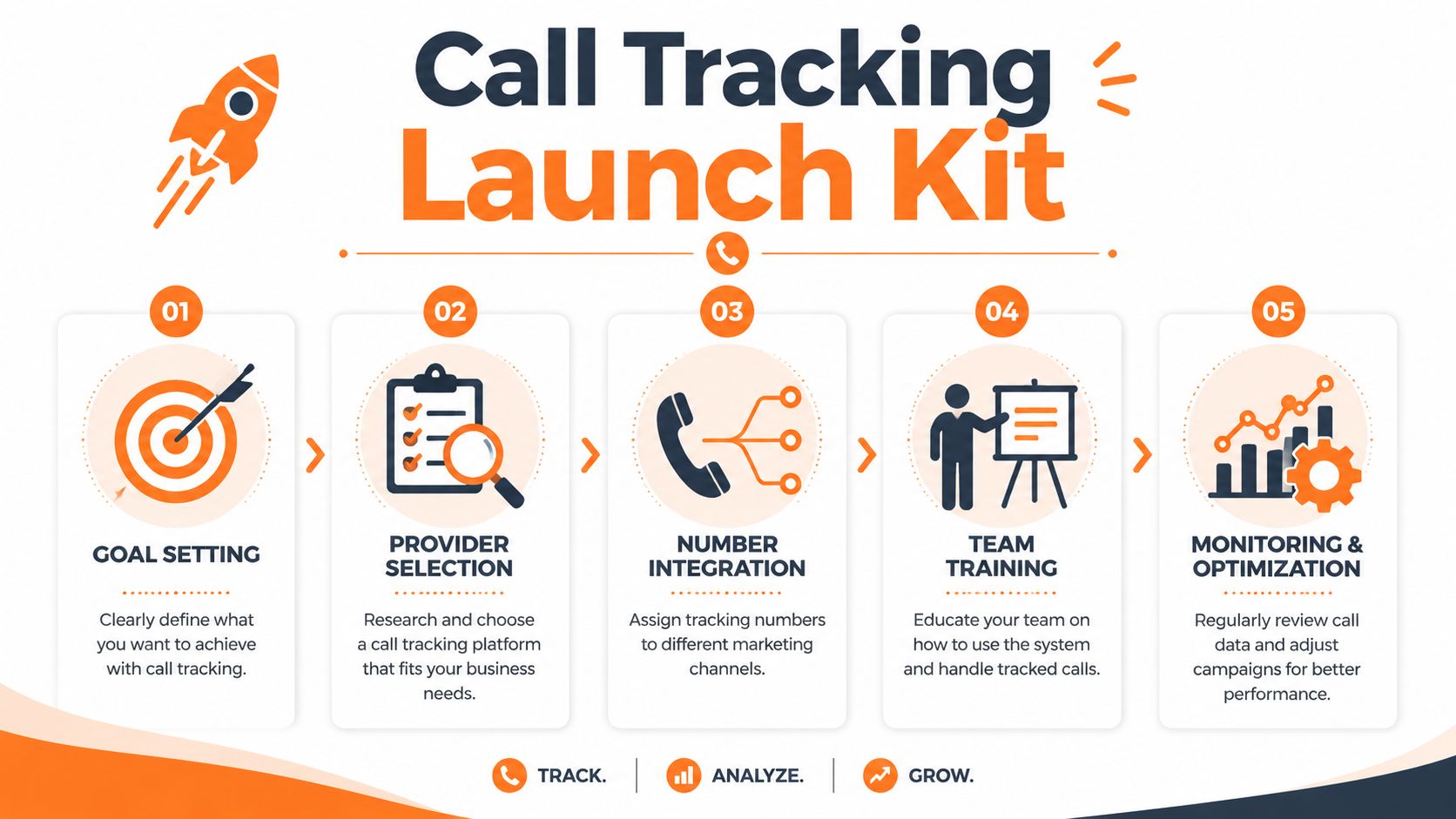
7-day launch checklist
This is the rollout sequence I recommend for busy teams because it keeps momentum without overloading the front line.
- Day 1. Set your goal: Decide what counts as success. Booked appointments, service calls, tours, or estimates.
- Day 2. Choose your tracking coverage: Assign numbers to your main channels and confirm routing.
- Day 3. Install and test: Check website number swaps, landing pages, and call flow across devices.
- Day 4. Train staff: Front desk, service advisors, or coordinators should know how calls will be handled and logged.
- Day 5. Prepare review workflows: Load SMS and email templates, and clarify when review requests should go out.
- Day 6. Build response templates: Approve positive and negative review replies so staff aren't improvising.
- Day 7. Review first signals: Look at call source, call quality, missed calls, and early booking outcomes.
For AIO, or Artificial Intelligence Optimization, the practical move is simple. Mine your call transcripts for recurring “near me” questions, service qualifiers, and trust concerns. Then turn those into better FAQs, service pages, and GBP Q&A entries.
Call Tracking Marketing FAQs and Next Steps
A practice manager usually asks this question after the same monthly meeting: "We improved our reviews, the phone is ringing more, but which part is producing booked appointments?" Call tracking answers that when it is tied to the actions that matter, especially calls coming from a high-rated Google Business Profile and the review work supporting it.
Common questions
How many phone numbers do I need?
Start with the fewest numbers that give you clean answers. For many local businesses, that means one tracking number for the website and one setup for Google Business Profile calls. Add channel-specific numbers only after you know what decision each number will support.
Can call tracking record calls?
Often yes. Legal and compliance rules differ by state and industry, so confirm consent requirements before recording anything. If recording is not a fit, use call outcomes and booking data to judge quality.
Will call tracking hurt local SEO?
A correct setup will not. The practical rule is simple. Keep your core business details consistent across listings, use call tracking in a way that preserves that consistency, and test your implementation before rolling it out widely.
Is call tracking marketing worth it for a small business?
It is if phone calls turn into revenue. Small practices, home service companies, and local clinics do not need a complicated reporting stack. They need to know which sources produce qualified callers, which staff members convert those calls, and where missed revenue is slipping away.
What should count as a conversion?
Use an outcome tied to revenue. Booked appointments, scheduled estimates, confirmed consults, and completed intakes are better than raw answered calls. That keeps reporting honest and prevents teams from chasing volume that never turns into business.
Can I connect call tracking to review strategy?
Yes. This is one of the most useful combinations in local marketing. When call tracking is connected to a review management process, you can see whether stronger ratings, review recency, and better Google Business Profile engagement are producing more high-intent calls. That is how reputation work stops being a vague brand activity and starts earning its budget.
What is AIO in this context?
AIO means Artificial Intelligence Optimization. Here, it means using real call questions, objections, and service language to shape content that appears in conversational search results, FAQs, and profile content.
The next step is operational, not theoretical. Pick one service line, one location, or one lead source. Track the calls, tag the booked outcomes, and compare them against your review activity. If your Google Business Profile rating improves and tracked calls from that profile produce more appointments, you now have a direct line between reputation work and revenue.
If you want help connecting reviews, local visibility, and call attribution into one system, Reviews To The Top offers month-to-month support for local and multi-location brands. You can book a strategy call to map out a practical setup that ties Google Business Profile activity, reputation management, and inbound calls back to bookings.