Getting a negative review feels like a punch to the gut. It’s a natural instinct to want to either fight back or just ignore it and hope it goes away. But letting a bad review sit unanswered is often more damaging than the review itself.
When you hit the “ignore” button, you’re sending a loud and clear message to everyone—the unhappy customer and all the potential customers reading it—that you don’t care about feedback or simply don’t know how to handle criticism. Neither of those looks good.

Think about it from the customer’s perspective. They took time out of their day to share their experience. They’re often just looking for some validation, a sign that what happened to them was an exception, not business as usual. Your silence creates a vacuum, and you can bet other potential customers will fill it with negative assumptions.
How It Shapes Your Brand’s Image
Every unanswered complaint is a small crack in your business’s foundation of trust. People aren’t just reading the bad review; they’re watching you. They want to see how you’ll react. A well-crafted, thoughtful response can completely neutralize a bad review. Sometimes, it can even impress a potential customer enough to win them over.
On the flip side, no response at all silently confirms the reviewer’s side of the story.
The data backs this up. According to Review Trackers, 53% of customers expect a business to reply to a negative review within just one week. Yet, a shocking 87% of businesses don’t bother responding at all. That’s a huge gap between customer expectation and business reality. It’s a massive missed opportunity, especially when 56% of consumers say that seeing a company’s response has changed their mind about that business.
Remember, your response isn’t just for the person who wrote the review. It’s a public statement about your values, your integrity, and how much you care about every single customer.
The High Cost of Silence
For every one person who leaves a negative review, there’s a whole group of others who had a similar bad experience and just walked away without a word. They are the “silent majority” of lost customers, the ones who quietly take their money to your competitors.
An unanswered bad review acts like a big, red warning sign for them, validating their decision to leave and telling others to stay away.
By choosing to respond, you’re doing more than just damage control for one complaint. You’re stepping into a public conversation that has a direct line to your bottom line. Once you understand this, you see why is online reputation important. A complaint is no longer just a problem; it’s a chance to show everyone what your brand is really made of.
A Practical Framework for Responding Effectively
Let’s be real—staring at a harsh review and trying to craft the perfect response on the spot is stressful. To make it easier, I always rely on a simple but powerful framework: Acknowledge, Connect, and Take Action. Think of it less as a rigid script and more as a mindset to keep your responses professional, human, and genuinely helpful.
This handy visual breaks down the flow of hearing the customer, showing you care, and then actually doing something about it.
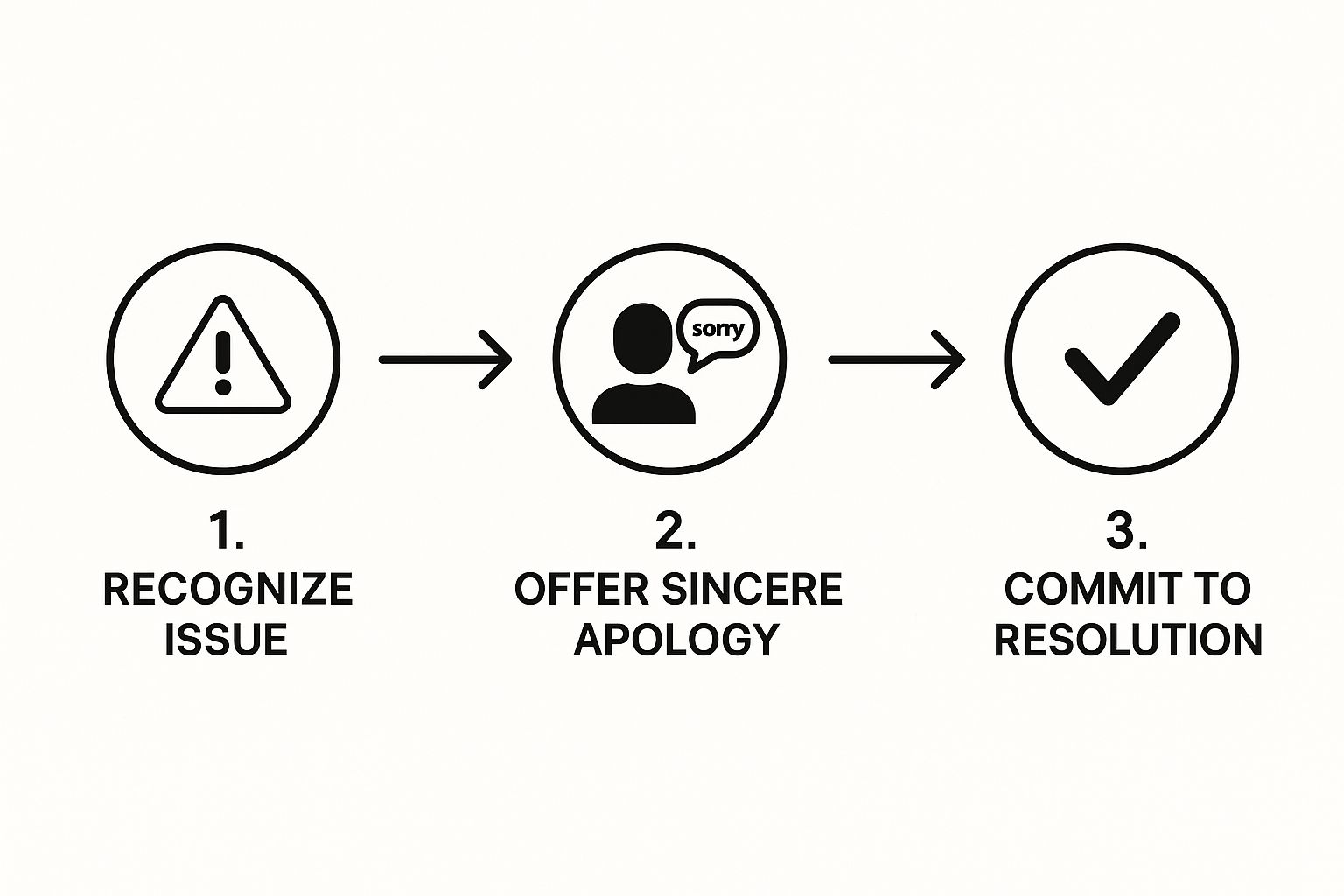
Following this flow ensures you’re focused on what actually matters to the customer, which is the key to turning a bad situation around.
Acknowledge Their Specific Problem
First things first, you have to acknowledge what went wrong. This is the most critical part of the entire response because it immediately shows the customer you’ve actually read and understood their complaint. Nothing is worse than a canned, generic opener like, “We’re sorry for your experience.”
Get specific. If a customer complained that their pizza was cold and arrived 30 minutes late, your opening line needs to mention that.
- “Hi [Customer Name], thanks for letting us know about this. I’m so sorry to hear your pizza arrived cold and that you had to wait an extra 30 minutes for your delivery.”
Just by repeating their issue back to them, you validate their frustration and set a completely different, more positive tone for the rest of the conversation.
Connect With Real Empathy
After you’ve acknowledged the issue, it’s time to connect on a human level. This is your chance to show there are real people behind your brand who actually care. Remember, an apology isn’t an admission of legal liability—it’s just you saying you’re sorry they had a bad time.
Show them you get it. A simple phrase like “I can completely understand how frustrating that must have been” or “That’s definitely not the experience we want for our customers” works wonders.
A genuine connection reassures not just that one customer, but everyone else reading the reviews. It proves you’re not just some faceless company trying to protect its image.
Take Clear, Decisive Action
Finally, you need to tell them what you’re going to do about it. Vague promises like “We’ll look into it” are meaningless. You have to provide a concrete next step that solves their problem and shows you’re committed to preventing it from happening again.
This is where you can truly turn a bad experience into a win.
- Offer a real solution: Invite them back for a meal on the house, offer a full refund, or send a replacement product. Make it right.
- Move the conversation offline: Providing a direct contact is a power move. Saying, “Please email me directly at [email] so I can personally sort this out for you,” shows accountability.
- Share your next steps: Briefly explain how you’ll use their feedback. Something like, “We’re going to use your feedback in our team meeting this week to improve our delivery times.”
To really master this, it helps to understand the bigger picture of problem-solving. Diving into an ultimate guide to issue management can provide a deeper understanding of the principles at play here. By consistently using the A.C.T. framework, you’ll have a reliable process for handling tough feedback with grace, protecting your brand every single time.
For a quick reference, here’s a breakdown of the framework with some clear do’s and don’ts to keep in mind for each step.
The A.C.T. Framework Explained
| Stage | What to Do | What to Avoid |
|---|---|---|
| Acknowledge | Mention the specific issue they raised (e.g., “cold food,” “long wait”). Use their name if possible. Thank them for the feedback. | Using generic, copy-pasted opening lines. Ignoring the core of their complaint. |
| Connect | Apologize sincerely. Use empathetic language (“I understand your frustration”). Show you care about their individual experience. | Making excuses or blaming the customer. Sounding defensive or robotic. |
| Take Action | Offer a concrete solution (refund, discount, etc.). Provide a direct contact to take the conversation offline. Explain how you’ll prevent it from happening again. | Making vague promises (“We’ll do better”). Leaving the resolution open-ended. |
This table serves as a great cheat sheet when you’re in the hot seat and need to respond quickly but effectively. Following this structure ensures you hit all the right notes and handle the situation like a pro.
Finding the Right Words: Mastering Tone and Language

The words you choose can turn a furious customer into your biggest fan. It sounds like an exaggeration, but I’ve seen it happen. When you’re staring down a negative review, your tone is everything—often more important than the actual solution you offer.
The goal is to walk a fine line. You need to be empathetic without sounding like a script-reading robot, professional without being cold, and genuinely helpful without being condescending.
This is where so many businesses get it wrong. They fall back on stiff, corporate-speak that builds a wall between them and the customer. Phrases like “we regret the inconvenience” feel hollow if the rest of the message lacks any real warmth.
Instead, think of it as a conversation. You’re a real person who read their review, understood what went wrong, and actually wants to make it right. It’s all about making that one person feel heard and valued.
Ditch the Corporate Jargon
Nothing screams “I don’t care” louder than corporate jargon. It’s a defense mechanism, sure, but it tells your customer you’re hiding behind a policy instead of just talking to them like a human.
Think about making these simple swaps:
- Instead of “per our policy,” try: “Our standard practice is…” or “Typically, what we do here is…”
- Instead of “we apologize for any inconvenience,” say: “I’m so sorry for the frustration this caused.”
- Instead of “we will escalate this issue,” try: “I’m personally going to look into this for you right now.”
When you’re trying to show you understand, the language has to feel natural. If you wouldn’t say it to someone in person, don’t type it online. There are some really practical tips to make your messaging more human and engaging that can help you find that authentic voice.
Personalization Is Not Optional
Every single response needs to be tailored to the specific complaint. It’s a non-negotiable.
Always, always use the reviewer’s name. Then, mention the specific details from their feedback. This one small step proves you’ve actually read and understood their issue, and that you’re not just blasting out a canned response. It immediately validates their experience and helps bring the tension down a few notches.
Generic & Ineffective: “We are sorry you had a bad experience. We value your feedback and will use it to improve.”
Personalized & Effective: “Hi Sarah, thank you for reaching out. I’m so sorry to hear that your order arrived late and the packaging was damaged. That’s definitely not the standard we aim for, and I can understand how disappointing that must have been.”
See the difference? The second one actually acknowledges what went wrong, validates Sarah’s feelings, and opens the door for a real solution.
Know When to Take the Conversation Offline
Public transparency is great, but some problems are better solved in private. If a review involves sensitive details like personal information, billing issues, or a really complex situation that needs a lot of back-and-forth, it’s time to take it offline.
The key is to handle the transition gracefully. Your public reply should still acknowledge the issue and show you’re taking immediate action.
Offer a direct line to a real person—a manager’s email or a direct phone number is perfect. This shows you’re accountable and serious about fixing the problem, not just sweeping it under the rug. It’s a critical move, especially when you consider that a single negative review can cut the chance of a sale by 42%. Getting this right is your opportunity to win back trust.
Response Examples for Common Scenarios
Let’s be honest, most negative reviews fall into a few common buckets. Once you recognize the patterns, you can use the A.C.T. framework to handle them quickly and with a human touch.
Here are a few real-world examples to show you how it’s done.
Product Quality Complaints
When a product doesn’t live up to its promise, customers get specific—and you should too. A detailed reply shows you’ve actually read their feedback and aren’t just sending a canned response.
Responding to product complaints within 48 hours can bring back around 30% of those unhappy customers. It’s worth the effort.
- Google Review Reply: “Hi [Name], I’m so sorry your gadget arrived with missing parts. That’s definitely not the experience we want for our customers. I’m personally sending you replacements today with free expedited shipping.”
- Social Media Comment: “Thanks for flagging this, [Name]. We hate that this happened. Shoot us a DM with your order number, and we’ll get this sorted out for you right away.”
Service Experience Issues
A bad service experience is all about feelings. The customer felt ignored, disrespected, or frustrated. Your response needs to tackle the emotional side of the complaint head-on.
- Start by mentioning the specific interaction so they know you understand what happened.
- Express genuine empathy. A simple “I can see why you’re so frustrated” goes a long way.
- Give them a clear next step. Don’t leave them hanging—tell them exactly how you’re going to fix it.
Shipping and Delivery Delays
Few things are more frustrating than a delayed package. When this happens, customers just want to know what’s going on. Transparency is everything. A quick update and a small gesture can turn frustration into loyalty.
Here’s how you might handle it on different platforms:
| Platform | A More Formal Response | A Quick, Casual Reply |
|---|---|---|
| “I sincerely apologize for the delay. Your order is now marked for priority shipment.” | “So sorry for the hold-up! Your package is shipping out today.” | |
| “We regret your experience. Please DM us your tracking details so we can investigate.” | “Hey! We’ve got you. Slide into our DMs with your info.” |
Pricing and Billing Disputes
Money talk can be awkward. These complaints often stem from a misunderstanding or a gap between what the customer expected and what they were charged. Your job is to clear things up without being defensive.
- Acknowledge their concern directly: “I understand why the final price was higher than you expected.”
- Calmly explain any fees or charges. Skip the corporate jargon.
- If it makes sense, offer a small credit or a discount on a future purchase. It shows you value their business more than the disputed amount.
Notice how each of these examples uses the A.C.T. structure? It provides a solid foundation, but you still need to tweak the tone and details for each situation.
Pro Tip: I recommend keeping a “swipe file” of these A.C.T. templates. Don’t copy and paste them, but use them as a starting point. It saves a ton of time while still letting you personalize each response.
For a more comprehensive set of templates, check out our guide on customer service response templates. It’s packed with over 50 customizable scripts that cover almost any scenario you can think of.
Adapting Your Tone for Different Platforms
You wouldn’t talk the same way on LinkedIn as you do on Twitter, right? Your review responses should follow the same logic. The platform dictates the tone.
- LinkedIn (Formal): “Hello [Name], thank you for sharing your thoughts. I appreciate your patience as we look into this, and I will personally follow up by the end of the day tomorrow.”
- Facebook (Balanced): “We’re so sorry your order fell short of our usual quality. I’m sending a replacement your way, along with a 10% refund on your next purchase as a thank you for your patience.”
- Twitter (Quick & Direct): “Sorry for the trouble, @user! Please DM your order number so we can fix this for you right away.”
Matching your tone to the platform makes your brand feel more authentic and in-touch.
⚡ Remember, Twitter replies are capped at 280 characters. Keep it short, sweet, and to the point.
Use these examples as your guide. The goal is to respond with both speed and sincerity. When you do that consistently, you not only fix a single problem but also build a reputation as a company that genuinely cares.
And remember, always give your response a final read-through before hitting “post.” A little empathy and a quick spell-check can make all the difference.
Navigating Unfair and Difficult Reviews

Let’s be honest—not all negative reviews are created equal. Some offer tough but fair feedback, while others are just plain aggressive, factually wrong, or completely fabricated. These are the ones that really sting.
When you’re faced with one of these, your approach has to be different. It’s less about winning back a customer and more about de-escalation, careful documentation, and protecting your brand’s reputation without getting dragged into a public fight.
The first thing I always tell business owners is to just take a deep breath. Step away from the keyboard for a minute and try to look at it objectively. Is this a real customer? A quick search of your CRM or sales records often gives you the answer. If you find no trace of them, you could be looking at a fake review.
Dealing with False or Fake Reviews
If you’re pretty sure a review is fraudulent or breaks a platform’s rules, your first move should be to report it. Most platforms like Google and Yelp have a process for this, but I’ll be blunt: getting a review taken down is never a sure thing.
Here’s what you need to do to give yourself the best shot:
- Build Your Case: Document everything. If they claim they visited on a Tuesday but you were closed for a staff event, screenshot your calendar or hours. If their name doesn’t pop up anywhere in your customer database, make a note of it.
- Flag It Correctly: Use the platform’s official reporting tool. Don’t write a novel. Just state the facts and point to the specific policy the review violates (e.g., spam, conflict of interest, etc.).
- Post a Careful Public Reply: While you wait for the platform to investigate, you should still post a calm, professional response. It shows other potential customers that you’re on top of things. Sometimes, a simple and neutral reply like, “We take feedback seriously but have no record of this customer in our system. We encourage the reviewer to contact us directly to resolve this,” is all you need.
For a more in-depth guide, check out our post on how to dispute a Google review. It walks you through the entire process and has some practical tips I’ve seen work firsthand.
Responding to Aggressive Language
What about reviews from real customers who are just… really, really angry? It can feel personal, and the temptation is to fire back with the same energy. Don’t do it. That’s a battle you’ll never win. The real goal is to de-escalate the situation with professionalism.
Remember, your reply isn’t just for the upset customer. It’s for every single person who will read that review in the future. You’re demonstrating how you handle pressure.
Acknowledge their frustration but gently correct any major factual errors. The key is to be polite, not argumentative. For example, you could say, “I’m very sorry to hear you were frustrated with the wait time. While our system shows the actual wait was closer to 20 minutes, I completely understand that any delay can feel long when you’re eager to be seen.”
This response sets a professional boundary while showing you’re reasonable. And don’t wait around. The expectation for a quick reply is real—data from Statista shows that 34% of shoppers expect a response within 24 hours.
Staying cool under fire is your single best defense when things get heated.
Got Questions? We’ve Got Answers.
Even with the best game plan, you’re bound to run into some tricky situations when you’re staring down a negative review. Let’s tackle some of the most common questions I hear from business owners who are in the hot seat.
How Fast is Fast Enough for a Response?
You need to be quick. My rule of thumb is to respond within 24 to 48 hours. Think about it: a fast reply shows you’re on the ball and that you genuinely care about what your customers have to say.
If you let a bad review sit for a week, it looks like you just don’t care. In that time, the customer’s frustration can fester, and countless potential customers will see that negative comment and your silence. A quick, professional response is your best first line of defense.
What Do I Do With a 1-Star Review That Has No Comment?
Ah, the dreaded “no-text” review. It’s frustrating, but you absolutely have to respond. That low star rating still dings your overall score, and a public reply shows everyone else that you’re paying attention to every piece of feedback, even the silent ones.
You don’t need to write a novel. Keep it simple and proactive.
“Hi [Reviewer’s Name], I’m sorry to see we didn’t provide a 5-star experience. We’re always looking to improve, and I’d welcome the chance to hear more about what went wrong. You can reach me directly at [your email] to share your thoughts.”
This does two things: it acknowledges their rating and it moves the conversation offline, which is always the goal. It shows you’re accountable without getting into a guessing game.
Should I Offer a Refund Right There in My Reply?
Absolutely not. Never offer discounts, refunds, or any other freebies in your public response. It’s like putting up a giant sign that says, “Complain here for free stuff!” You’ll end up attracting people who just want to game the system.
The public reply is for showing you’re taking action, not for negotiating.
- First, acknowledge their specific complaint in your public reply.
- Next, apologize that their experience didn’t meet expectations.
- Then, invite them to connect offline—via email or phone—so you can “make it right” or “find a solution together.”
Once you’re talking privately, you can figure out what kind of compensation, if any, makes sense for the situation. You resolve the issue without setting a bad public precedent.
Is It Pushy to Ask Someone to Update Their Review?
It’s not pushy if you do it right. The key is to wait until after you’ve completely resolved their problem and they are genuinely happy with the outcome.
Once you’ve turned that unhappy customer into a happy one, it’s perfectly fine to ask. Don’t be demanding. A simple, low-pressure request works best. Try something like, “I’m so glad we were able to sort this out for you. If you feel we’ve earned it, we’d be incredibly grateful if you’d consider updating your review.” Most reasonable people will be happy to.
At Reviews To The Top, our whole focus is on helping you navigate these conversations. We make it simple to monitor and respond to your reviews, so you can turn negative feedback into a genuine advantage. Learn more about how we can help protect your brand.