When someone in [City] pulls out a phone and searches “dentist near me,” “AC repair in [Neighborhood],” or asks an AI assistant who to call, seo ai is the work that helps your business show up, earn trust, and turn that discovery into a call, message, booking, or tour. For local operators, it matters because visibility now happens in two places at once: traditional search results and AI-generated answers, and the businesses that win usually make it easy for both humans and machines to understand who they are, where they are, and why customers choose them.
Your Guide to SEO AI for Local Discoverability
At 6:15 p.m., a pipe bursts in a homeowner’s kitchen. They grab a phone, search for help, skim the first few names they trust, and call the company that looks real, available, and close. The win rarely comes from one channel alone. It comes from having your business information consistent across Google, your reviews current, your service pages clear, and your contact path easy enough to use under pressure.
That is the practical job of seo ai for a local business.
SEO is search engine optimization.
AI is artificial intelligence.
AIO is artificial intelligence optimization, the work of making your business easier for AI systems to interpret, verify, and mention.
LLM is large language model, the type of system behind tools like ChatGPT and Perplexity.
For a plumber, med spa, roofing company, dentist, or law office, this is not a separate marketing channel. It is the overlap between local SEO, listings management, review generation, structured site content, and the trust signals that influence both search rankings and AI answers.

If you want the broader terminology, this overview of generative engine optimization gives useful context. For operators, the working definition is simpler. Make your business easy to verify, easy to compare, and easy to contact.
That shift changes what local visibility work should prioritize. A clean Google Business Profile, accurate directory listings, recent reviews, clear service pages, and location details do more than support rankings. They also give AI systems the raw material they need to summarize your business with confidence.
Key Facts
- Search behavior has been shifting toward natural language, entity understanding, and intent-based results for years, not just since public AI tools became popular, as explained in Amsive’s overview of SEO’s evolution.
- Google Search still drives far more website traffic than AI tools for most businesses, but AI visitors can show stronger buying intent in some cases, according to reporting summarized earlier in this article.
- Technical clarity affects AI visibility. Analysts at Semrush found that schema types such as Organization, Article, and BreadcrumbList were closely associated with higher AI citation rates in their technical SEO study on AI search.
A local example makes the trade-off clear. I have seen HVAC companies spend months chasing blog traffic while their hours were wrong on major listings and their review requests were inconsistent. They ranked for some informational terms, but lost booked jobs because both customers and machines had weak trust signals to work with.
Practical rule: If your listings are inconsistent, your review program is stale, and your location pages say very little, you will usually lose visibility in AI-driven discovery before you lose it in traditional local search.
What SEO AI Means for Your Local Business
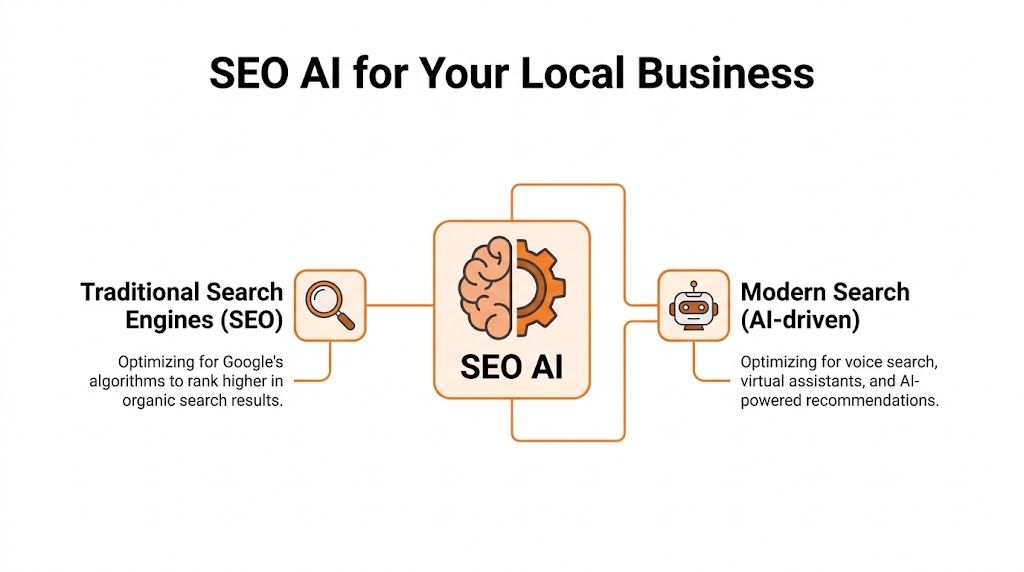
Think of seo ai like running two systems at once.
The first is the familiar one. You’re trying to rank in Google Search and the Maps Pack. The second is newer. You’re trying to become a reliable source for AI-driven answers, summaries, and recommendations. A dental office in [City] may still get found through Google Maps, while a med spa in [Neighborhood] may also get mentioned when someone asks an AI assistant for options that fit a specific need.
Search changed before AI became visible
A lot of business owners think AI search came out of nowhere. It didn’t. Search had already been moving away from exact-match keywords for years.
The clearest summary comes from Amsive’s history of SEO. It notes that the most significant changes from 2015 to 2025 included RankBrain in 2015, Mobilegeddon in 2015, and BERT in 2019, which shifted SEO toward natural language, intent, and structured content rather than rigid keyword matching, as described in Amsive’s evolution of SEO overview.
For a local business, that means old tactics age badly:
- Exact-match stuffing fails: “best dentist [City] best dentist [City]” doesn’t help much.
- Thin service pages struggle: AI systems need details, not placeholders.
- Mobile friction costs leads: If a patient or homeowner can’t call quickly, they move on.
The overlap is stronger than most teams think
Good local SEO work usually supports AI visibility too.
When you keep your name, address, phone number, categories, hours, services, FAQs, and reviews consistent across the web, you’re helping both Google and AI tools resolve the same core question: is this business real, relevant, and trustworthy?
That’s why local teams investing in reputation management often see the benefits stretch beyond one channel. Reviews, accurate listings, and complete profiles don’t just influence map visibility. They create machine-readable signals that support AI discovery too. If you’re evaluating software and workflows, these LLM SEO tools help frame how the stack is changing.
What works and what doesn’t
What works for a vet clinic, HVAC company, or senior living community is usually practical:
- Complete profiles
- Location-specific pages
- Recent review content
- Clear service descriptions
- Fast call and booking paths
What doesn’t work is treating AI as a content gimmick. Publishing generic blog posts with no local angle won’t make a multi-location brand more visible. Neither will copy-pasting one service page across every city.
Local discoverability improves when your digital footprint matches the real customer experience. If your office says one thing, your listings say another, and reviews mention a third, machines hesitate.
The New Rules of Local Search Proximity Relevance and Prominence
A homeowner with water coming through the ceiling does not compare ten plumbers. They search, scan for the closest credible option, and call the business that looks ready to help now. That decision still runs through the same local search logic. Proximity, relevance, and prominence.
AI search changes how people ask and how answers get assembled. It does not erase the local signals that decide which business gets surfaced. For service companies, the practical shift is simple. The same assets that help you show in maps and local packs now also shape whether an AI system sees your business as a safe recommendation.
Proximity still filters the shortlist
For urgent local searches, distance remains a hard constraint. A strong brand across the metro area does not help much if the customer needs an emergency electrician in the next hour and your closest crew is 40 minutes away.
This matters even more for multi-location businesses. Each office needs its own digital footprint tied to the actual service area and the actual customer experience.
A good setup usually includes:
- a unique location page for each office
- office-specific service details
- local photos
- reviews that mention that location
- FAQs based on what customers in that market ask
A dental group with five clinics should not send every visitor to one generic contact page. The Invisalign page for the North Austin office should live on the North Austin location, include that office's hours and booking path, and reflect how patients describe that team.
Relevance now includes context, not just terms
Keyword matching still matters. It just is not enough on its own.
People ask longer, more specific questions now. They include symptoms, timing, insurance, urgency, mobility issues, financing, and comfort concerns. Search engines and answer engines both need clear signals that connect those modifiers to a real service in a real place.
That means your content has to state the basics plainly:
- who the service is for
- what problem you solve
- where you provide it
- what the customer should expect next
A senior living community in [City] should not rely on a broad amenities page. Families want clear answers about memory care, waitlists, move-in timing, pricing conversations, tour availability, and communication with adult children. Those details improve matching for search. They also increase inquiry quality.
A short explainer helps here:
Prominence decides who feels trustworthy
Prominence is the proof layer. Reviews, local mentions, citations, and profile completeness all contribute to it. In practice, prominence answers the question a customer asks after finding you. "Do I trust this business enough to call?"
I see this play out constantly with HVAC, med spa, legal, and home service accounts. Two companies may target the same city and offer the same service. The one with recent reviews, specific review responses, accurate hours, and stronger location detail usually gets more calls because the listing removes doubt faster.
That same proof also helps AI systems summarize your business with confidence. Reviews mentioning "same-day AC repair," "gentle hygienist," or "Saturday appointments" give machines language they can connect to real demand. If you want a clear view of the local SEO work that supports those outcomes, this breakdown of services for local SEO growth is a useful reference.
"Near me" now means "close and clearly matched"
"Near me" searches have become more specific, not less. The local businesses that win are not only close. They are also well-described.
Examples look like this:
- Auto repair: "brake repair near me open Saturday"
- Vet: "emergency vet near me for senior dog"
- Med spa: "laser hair removal near me for darker skin tones"
- HVAC: "AC repair near me financing available"
Those modifiers should show up across your location pages, Google Business Profile services, FAQs, and review program. If they do not, you leave matching quality to chance.
There is a real trade-off here. Some businesses chase broader city visibility with generic pages. Others get more calls by building tighter local relevance around the services and conditions people search for. For local operators adapting their sites and workflows, AI integration strategies can help connect search visibility with booking, messaging, and operational systems.
The rule set is still familiar. Be close enough to serve. Be clear enough to match. Be credible enough to get chosen.
Your Foundational Playbook for SEO and AI Success
A plumbing company can publish great advice, but if Google shows the wrong hours, Apple Maps has an old phone number, and the reviews never mention drain cleaning or water heater installs, the calls go elsewhere. That is the local reality of seo ai. The businesses that show up in search and AI answers usually have the boring operational work under control.
For local service companies, the base layer is simple. Get your listings right, build a steady review process, and mark up your site so machines can read it cleanly. If one of those breaks, visibility gets weaker and conversion gets harder.
Start with listings and profile accuracy
Search engines and AI systems need a clean business identity before they can trust anything else on your site. Your name, address, phone, hours, categories, services, and booking links should match across Google, Apple, Bing, and the main directories in your market.
I see this problem often with multi-location brands. One clinic has an outdated suite number. Another location forwards calls to the front desk but still lists an old direct line. A third office picked a broad category that does not match the revenue-driving service. Those errors do more than create confusion. They break the connection between local intent and the right location.
Use this as a working checklist.
| Category | Optimization Task | Why It Matters for SEO AI |
|---|---|---|
| Business identity | Keep business name, address, and phone consistent across every profile | Consistency helps platforms confirm the correct entity |
| Categories | Choose the most accurate primary category and relevant secondary categories | Category alignment improves matching for service-specific local searches |
| Hours | Update standard hours, holiday hours, and special closures | Wrong hours create lost visits, missed calls, and trust issues |
| Services | Add service lists with plain-English descriptions | Clear service detail improves matching and helps answer engines pull the right context |
| Website links | Use direct links to location pages, booking pages, and key conversion paths | Shorter paths increase calls, messages, and bookings |
| Photos | Upload current exterior, interior, team, and service photos by location | Photos help prospects confirm they found the right business |
| Q&A | Seed common questions and maintain accurate answers | Q&A adds intent-rich language tied to real customer questions |
| Reviews | Request new reviews consistently and reply promptly | Review text adds current proof about service quality and experience |
| Attributes | Complete relevant attributes such as accessibility, payment options, or appointment details | Attributes improve relevance for specific needs |
| Governance | Assign owners and review updates monthly | Local business data drifts quickly without routine checks |
If you need help covering audits, listings, reviews, and profile management, a provider that offers services for local SEO growth can close execution gaps faster than an in-house team juggling it between calls and appointments.
Build a review engine that feeds search and conversion
Reviews do two jobs at once. They help prospects choose you, and they give search systems better language about what you do.
A med spa might list “Botox and fillers” on its site. A better signal is a steady stream of reviews that mention natural results, easy parking, short wait times, and staff who explain aftercare clearly. An HVAC company benefits when reviews mention “fixed our AC the same day” or “got our upstairs cooling again.” That wording supports visibility and conversion at the same time.
The trade-off is operational. Asking for reviews consistently takes process, training, and follow-up. But businesses that leave it to chance usually end up with stale sentiment, fewer recent mentions of their main services, and weaker proof for both Google users and AI answer engines.
A review process that works usually includes:
- Asking soon after the job or appointment
- Using short SMS or email requests with a direct link
- Escalating unhappy customers to a manager quickly
- Replying in a human way, with location-specific detail when appropriate
- Tracking review volume and response time by location, not only at brand level
Quarterly bursts do not hold up well. Steady collection does.
Add schema so machines can read the page correctly
Structured data helps search engines and AI systems identify the business, the page type, the service area, and the relationship between your brand and each location. It does not replace good content or strong reviews. It makes the basics easier to extract.
For local businesses, the useful schema types are usually straightforward:
- Organization schema for the business itself
- LocalBusiness schema for location-level details
- BreadcrumbList schema for site hierarchy
- FAQ or Article schema for educational pages when the content is appropriate
A roofing company with pages for Tampa, Brandon, and Riverview should make those relationships explicit. The homepage represents the brand. Each location page represents a real office or service footprint. Breadcrumbs and local business markup help machines connect those pieces and pull the right page when someone asks about service in a specific area.
Schema works like clear labeling. If your page says one thing in the visible copy, another thing in the title tag, and nothing machine-readable in the code, you force search systems to guess.
One useful outside perspective on the operational side is Altitude Design’s guide to AI integration strategies, especially for teams trying to connect search visibility with booking, messaging, and other front-office workflows.
One practical stack for local teams
Local businesses do not need a complicated tool set. They need one that gets maintained.
A workable stack usually includes Google Business Profile, Apple Business Connect, Bing Places, a review workflow tool, location pages with clear service and booking paths, and schema markup on the site. For a two-location law firm or a five-location dental group, that setup is often enough to support both traditional local SEO and better inclusion in AI-generated answers.
Reviews To The Top is one example of a platform and service model that handles review requests, monitoring, responses, and listing accuracy for local and multi-location businesses. The point is accountability. One system, one owner, and a monthly check beat six disconnected tasks every time.
Advanced Tactics Creating Content That AI Prefers
Most local content fails for one reason. It says the same thing everyone else says.
A service page that repeats “trusted dentist in [City]” doesn’t add much. AI systems look for useful distinctions. That’s why the businesses getting noticed often publish content that sounds more like a real practitioner and less like a generic SEO template.

Information gain beats broad sameness
Animalz makes the shift clear: AI systems synthesize answers from multiple sources, local businesses no longer need to outrank giants, and overlap between AI answers and traditional Google top-10 results is below 50% across categories, which creates opportunity for businesses with specialized and hyperlocal insight, as explained in this piece on information gain.
That changes the content brief.
A med spa in [City] shouldn’t just publish “What is microneedling?” A stronger topic is “How to handle post-treatment skin care during humid [City] summers.” An HVAC company in [Neighborhood] shouldn’t write “Signs you need AC repair” if every competitor has the same post. It should write “Why second-floor cooling problems show up first in older [City] homes.”
What AI-ready local pages look like
The best local content usually has these traits:
- Direct answers near the top: Put the answer in the first few lines.
- Specific local context: Mention climate, housing stock, traffic patterns, neighborhood habits, or service constraints where relevant.
- Real service nuance: Explain who a service is for, who it isn’t for, and what customers should expect.
- Clear page structure: Strong headings, short paragraphs, lists, and FAQs.
A good location page for a vet in [City] might include:
- common urgent care scenarios they handle
- how same-day visits work
- parking details
- what pet owners should bring
- aftercare questions they hear often
A simple framework for service pages and FAQs
Use this for each major service and location.
The service page frame
- State the service and city clearly
- Describe the problem the customer is trying to solve
- Explain your approach in plain English
- Add local nuance
- Handle common objections
- Finish with a direct booking or call step
The FAQ frame
Instead of generic questions, use actual pre-booking friction:
- How quickly can I get an appointment in [City]?
- Do you offer financing for HVAC replacement in [Neighborhood]?
- What should I expect after a dental implant consultation?
- Can I tour the senior living community on weekends?
- Do you work on imported vehicles?
A page built this way becomes easier for both search engines and LLMs to quote.
If your team needs a stronger writing process, this guide on how to write for website content is a useful reference for tightening structure and making answers easier to extract.
Write the page your front desk wishes every prospect had read before calling.
Practical Templates for Your Reputation Program
AI search is fragmented. Different tools pull from different places, and that sourcing can change without warning. Search Engine Land’s analysis makes the operational issue plain: local businesses can’t rely on one platform or one content format, and a strong reputation across review platforms, directories, and social profiles becomes a critical SEO foundation, as discussed in this article on content distribution and SEO.
That’s why review generation needs a repeatable program, not occasional effort.
SMS review request for an auto repair shop
Use this soon after pickup, once payment is settled and the customer has had a moment to process the visit.
SMS template
Hi [First Name], thanks for trusting [Shop Name] in [City] with your vehicle today. If you have a minute, would you share your experience here? [Review Link]
If anything about your visit needs attention, reply to this text and we’ll help.
Why it works:
- It’s short: Easy to read on a phone.
- It sounds human: No marketing language.
- It leaves room for service recovery: That can surface issues before they spread.
Email review request for a dental practice
Keep healthcare outreach HIPAA-aware. Don’t reference treatment specifics, diagnosis, or anything that could expose protected health information.
Email subject: Would you share feedback about your visit to [Practice Name]?
Email body
Hi [First Name],
Thank you for visiting [Practice Name] in [City]. We work hard to make each visit clear, respectful, and comfortable.
If you’re open to it, please share your feedback here: [Review Link]
Your comments help other patients choose a provider with confidence. If there’s anything you’d like us to address directly, reply to this email and our team will follow up.
Thank you,
[Practice Manager Name]
[Practice Name]
[Phone Number]
Review response templates
Positive review response
Thanks, [First Name]. We appreciate you taking the time to share your experience with our [team/location] in [City]. We’re glad you felt well taken care of, and we’ll pass your feedback along to the staff. If you ever need anything else, we’re here to help.
Negative review response
Thank you for your feedback, [First Name]. We’re sorry to hear your experience didn’t meet expectations. We take concerns like this seriously and would like the chance to learn more and address it directly. Please contact [Manager Name] at [Phone] or [Email] so we can follow up with you privately.
A few rules matter here:
- Don’t argue in public
- Don’t disclose private customer details
- Don’t paste the same reply to every complaint
- Do move the conversation offline quickly
7-day review program launch checklist
Day 1
- Choose owners: Assign one local lead and one backup.
- Confirm destinations: Decide where you want reviews collected first.
Day 2
- Clean up links: Test every review link on mobile.
- Update profiles: Check hours, categories, and contact info.
Day 3
- Write scripts: Finalize one SMS and one email version per vertical.
- Train the front line: Explain when and how to ask.
Day 4
- Set response rules: Decide who replies, how fast, and when to escalate.
- Create negative-review workflow: Route sensitive issues to a manager.
Day 5
- Launch at one location first: Start with a manageable test.
- Watch reply quality: Make sure responses sound like your brand.
Day 6
- Review incoming feedback: Spot operational issues early.
- Adjust ask timing: If requests feel too early or too late, shift them.
Day 7
- Roll out to more locations: Expand once the process is stable.
- Track weekly: Keep a simple scorecard by location.
Measuring What Matters Calls Bookings and ROI
If you can’t tie this work to calls, forms, booked appointments, or tours, the program won’t last.
The right scorecard is operational. It should be simple enough for a practice manager or regional marketer to review every week without needing a full analyst build.
The metrics worth watching
Use targets that fit your category and customer volume. The point is consistency, not vanity.
- Review volume: Set a monthly target per location based on real customer throughput.
- Review recency: Aim for a steady flow so your latest feedback never looks stale.
- Response time: Reply fast enough that customers can see active management.
- Star rating: Keep quality high enough to support conversion, while handling edge cases professionally.
- GBP views and actions: Watch calls, direction requests, website clicks, messages, and bookings where available.
- Lead-to-sale conversion: Separate visibility from actual closed business.
For larger brands, this is where governance matters. One office manager may be excellent at asking for reviews while another avoids it. One location page may convert well while another leaks traffic.
This is also where broader analytics planning helps. If your team is building forecasting and decision models, Silver Spoon Agency’s overview of predictive marketing analytics is a useful read for thinking beyond raw traffic counts.
How to track from GBP to booking
Use UTM parameters on your Google Business Profile website link and appointment link so traffic is easier to identify in analytics.
A simple example:
https://www.yourdomain.com/[location-page]/?utm_source=google&utm_medium=organic&utm_campaign=gbp_[city]
If you use a booking page, apply a similar UTM structure there too.
Then track:
- Sessions from GBP-tagged links
- Calls from tracked numbers or call events
- Form submissions or booking completions
- Lead disposition in your CRM or scheduling system
For multi-location operators, keep naming consistent by region and location. Otherwise reporting turns into cleanup.
If you need a cleaner reporting structure, this guide to local SEO reporting is a practical reference for building location-level visibility into calls and conversions.
The point of seo ai isn’t more impressions. It’s more qualified conversations.
Frequently Asked Questions About SEO AI
Do I need to become a prompt engineer to do seo ai well
No. Local businesses need operational discipline more than advanced prompting. Clean listings, strong reviews, clear service pages, and structured site content matter more than clever prompts.
Is traditional SEO still worth it if AI search is growing
Yes. Traditional Google search still drives most website traffic, and local customers still rely heavily on Maps, organic results, and branded search. The smarter move is to treat SEO and AI optimization as one connected system.
For a local business, what matters more right now, new blog posts or new reviews
If your review flow is weak, new reviews usually deserve attention first. Reviews support trust, local prominence, and conversion. Blog content matters more when it adds real local insight and helps customers choose.
Can I use AI to write review responses
Yes, with human review. AI can speed up drafts, but local teams should approve anything customer-facing, especially in healthcare, senior living, and other sensitive categories. Don’t let automation produce generic or risky replies.
How many location pages should a multi-location business have
One strong page per real location is the baseline. Each page should include location-specific services, hours, contact details, FAQs, and conversion paths. Avoid cloning the same text across every city.
What should I fix first if my “near me” visibility is weak
Start with your Google Business Profile, core listings consistency, categories, hours, review recency, and the quality of your location page. Then look at whether your content reflects the actual way customers search in [City] or [Neighborhood].
Is schema optional for local service businesses
It’s not the first thing to fix, but it shouldn’t be ignored. Once your listings and pages are in shape, schema helps search engines and AI systems interpret your business, content, and location structure more reliably.
If your team wants help building a review and listings program that supports both search visibility and AI discoverability, Reviews To The Top offers month-to-month support for local and multi-location brands. A practical starting point is a strategy call to map your profiles, review workflow, and location pages against the channels that are most likely to drive calls, bookings, and tours.