Think of your brand’s online reputation as its digital handshake—the very first impression you make. It’s what can either build instant trust or break it. This guide is your roadmap to shaping that impression on your own terms. It’s about so much more than just damage control; it’s the craft of building a digital identity that consistently attracts customers and keeps them coming back.
What Reputation Management Really Means Today

At its core, reputation management is the ongoing process of monitoring, influencing, and guiding how your business is seen online. This is an active discipline, not a passive one.
Imagine your online presence is a garden. If you just leave it alone, weeds will inevitably pop up. But if you’re constantly tending to it—planting positive seeds (like great customer stories), pulling out the weeds (addressing negative feedback), and nurturing growth—it flourishes.
It’s all about listening to what people are saying about you, engaging in those conversations, and publishing positive content that tells your story. This is the crucial difference between letting random online comments define your brand and taking control of the narrative yourself.
Why It’s a Core Business Function
Not too long ago, a company’s reputation was built through word-of-mouth and maybe a few print ads. Today, it’s forged in the real-time feedback of Google searches, social media threads, and online review sites. A single negative blog post or a handful of one-star reviews can genuinely hurt your bottom line.
This makes reputation management a critical business function, not just some side task for the marketing team.
The market data tells the same story. The global online reputation management software market, currently valued at around $5.2 billion, is expected to skyrocket to $14.02 billion by 2031. That kind of growth shows just how seriously businesses are taking their digital image, especially as customers rely more and more on what they find online.
Your brand isn’t what you say it is. It’s what Google says it is.
This simple truth gets to the heart of the matter. Search results and online reviews hold immense power over how customers see you and whether they choose to buy from you.
The Key Pillars of Modern Reputation Management
To get a handle on your online image, it helps to break the work down into its core components. This table gives you a quick overview of the key components that make up a complete reputation management strategy, giving you a roadmap for what this guide covers.
| Pillar | Objective | Primary Channels |
|---|---|---|
| Monitoring & Listening | To know what’s being said about your brand, where, and by whom. | Social media, review sites, forums, news articles, blogs |
| Review Management | To actively generate positive reviews and professionally handle negative ones. | Google Business Profile, Yelp, Trustpilot, industry-specific sites |
| Content Creation & SEO | To own your search results by publishing positive, valuable content. | Company blog, press releases, case studies, guest posts |
| Social Media Presence | To engage directly with your audience and build a loyal community. | LinkedIn, Instagram, Facebook, X (formerly Twitter) |
| Crisis Management | To have a plan in place to respond quickly and effectively to major issues. | All public channels (press, social media, company website) |
Understanding how each of these pillars works is the first step toward building a reputation that can weather any storm. For a deeper dive into protecting and enhancing your brand’s standing, check out this ultimate guide to reputation management.
The Real Cost of Ignoring Your Online Reputation
Leaving your online reputation to chance is a bit like letting your storefront get covered in graffiti. You might get away with it for a little while, but sooner or later, that neglect will start costing you serious money—far more than it would have to just keep things clean in the first place.
When you ignore what people are saying about you online, you’re not making the problem disappear. You’re just handing the microphone to the loudest, most negative voices out there.
Think about it. A single bad review or a nasty blog post that pops up on the first page of Google for your brand’s name is a silent business killer. It catches potential customers right at the moment they’re ready to make a decision, plants that little seed of doubt, and sends them running straight to your competition. This slow, quiet erosion of trust can bleed your revenue dry before you even know what’s happening.
The Financial and Brand Impact
This isn’t just theory; the financial hit is very real. When a potential customer stumbles upon negative search results, their opinion of your brand sours instantly. This triggers a chain reaction of tangible problems that directly kneecap your bottom line and stunt your growth.
Here’s a breakdown of how a bad reputation really hurts:
- Lost Sales and Revenue: It’s simple math. Shoppers are far less likely to buy from a business with a poor star rating or a string of complaints. That translates directly to a drop in sales.
- Eroded Customer Trust: Trust is the bedrock of any business. Once it’s damaged by negative content, customers become hesitant, leading to them bouncing from your website or abandoning their shopping carts.
- Trouble Attracting Top Talent: The best employees do their homework before accepting a job offer. A tarnished online reputation can make hiring the skilled people you need to grow much harder and more expensive.
This infographic breaks down just how quickly the damage from a single negative mention can ripple through your most important business metrics.
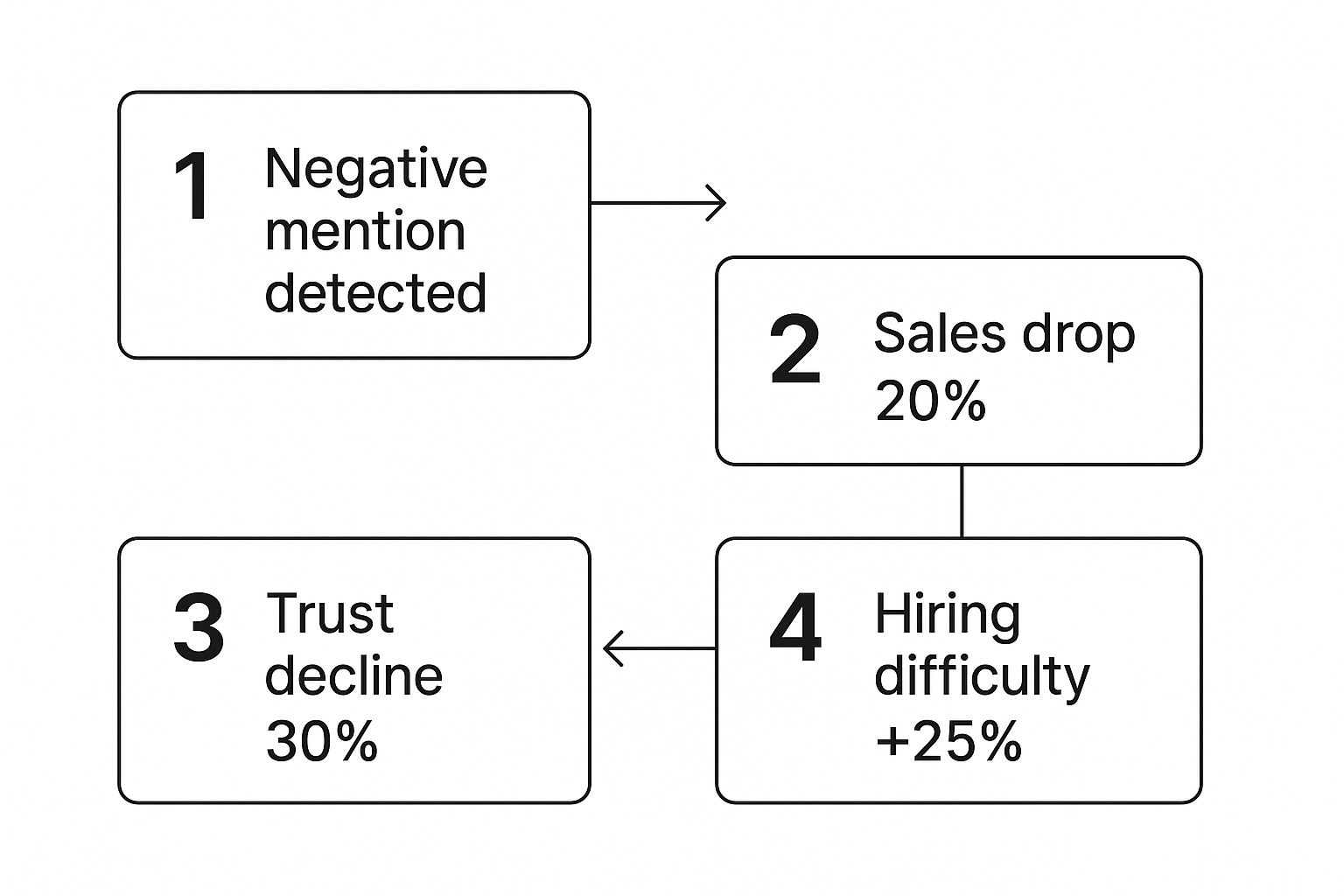
As the visual shows, what starts as one negative comment can spiral into major hits to your sales, customer trust, and even your ability to build a great team.
The Proactive Advantage
Now, let’s flip the script. Investing in a proactive reputation management guide isn’t just another expense—it’s one of the smartest, highest-return investments you can make. By actively shaping a positive online presence, you’re essentially building a digital fortress around your brand.
Good reviews and positive content do more than just fend off the bad stuff. They become powerful magnets for new business, boosting your search engine rankings and making you stand out from the crowd. Even better, a stellar reputation builds brand equity, which means you can often command higher prices because customers have confidence in the value you provide.
A great reputation becomes your best marketing asset, working 24/7 to build confidence and convert prospects into loyal customers.
There’s a massive disconnect between businesses knowing this is important and actually doing something about it. Consider this: while 93% of consumers say they read online reviews before making a purchase and 74% will avoid a business with negative content on the first page of Google, only about 17% of companies are actively managing their reputation.
This gap is a golden opportunity. For any business ready to take the reins, the advantage over the competition is huge. You can learn more about these critical online reputation statistics to see the full picture.
Building Your Reputation Management Framework
Alright, let’s move from theory to action. A solid reputation management framework isn’t about frantically putting out fires; it’s a structured system for building a positive and resilient online presence. Think of it like building a house: you need a strong foundation, sturdy walls, and a protective roof to weather any storm.
This framework breaks the whole process down into four manageable stages. Each step builds on the last, creating a powerful engine that continuously monitors, builds, and protects your brand’s identity online. Let’s walk through how to build your own.

Step 1: Audit Your Digital Footprint
Before you can improve your reputation, you have to know where you stand right now. This initial audit is like taking a candid snapshot of your brand from a customer’s point of view. It’s all about seeing exactly what they see when they look you up.
The goal here is to get a clear baseline. You need to understand your current standing across every important digital channel. You’re looking for the good, the bad, and the ugly—positive reviews, negative articles, social media chatter, and what your search engine results pages (SERPs) actually look like.
To get this done right, you need to:
- Do Incognito Google Searches: Open a private browsing window and search for your brand name, products, services, and even key executives. This prevents your own search history from skewing the results, showing you exactly what a new customer would find.
- Analyze Your Review Sites: Dive into your profiles on major platforms like Google Business Profile, Yelp, Trustpilot, and any review sites specific to your industry. Make a note of your average star rating, the total number of reviews, and the general tone of the comments.
- Scan Social Media: See what people are saying about you on X (formerly Twitter), Facebook, LinkedIn, and Instagram. Are they singing your praises or airing their grievances for the world to see?
- Check Out the Competition: Do a quick search for your top three competitors. How does their online presence stack up against yours? Look at their search results and review profiles for a quick comparison.
This audit will give you a clear map of your strengths and weaknesses, pointing you directly to where you need to focus your efforts.
Step 2: Set Up Your Monitoring System
Once you have your baseline, it’s time to set up a system that automatically tracks new mentions of your brand. Searching for your name every day just isn’t practical or sustainable. A good monitoring system acts as your digital radar, pinging you in real-time whenever your brand pops up online.
Think of it as a smoke detector for your reputation. It alerts you to small sparks before they can turn into a raging fire, giving you a chance to respond quickly and professionally. In fact, nearly 90% of travelers say that a thoughtful response to a negative review improves their impression of a business—that’s how crucial a timely response is.
Here are a few ways to get your monitoring system up and running:
- Google Alerts: This is a free and surprisingly effective starting point. Set up alerts for your brand name, products, and key people to get email notifications whenever Google indexes new content mentioning them.
- Social Listening Tools: Platforms like Brand24 or Mention go deeper, tracking mentions across social media, blogs, and forums for more comprehensive coverage.
- Review Management Software: This is a game-changer. Services like Reviews To The Top pull all your reviews from multiple sites into one dashboard. This makes it incredibly easy to track and respond to new feedback without having to log in and out of a dozen different platforms.
The key to effective monitoring is not just collecting mentions, but acting on them. A good system enables a fast, professional response, which is a cornerstone of great reputation management.
Step 3: Create a Proactive Content Plan
Monitoring and responding are, at their core, defensive moves. To build a truly powerful reputation, you have to go on the offense by creating and promoting positive content that you control. This is how you start to shape the narrative and dominate your own search results.
The idea is to build a library of high-quality, authoritative content that ranks well on Google. When a potential customer searches for you, you want them to find a first page filled with your website, your blog, positive press, and happy customer stories—not some random complaint on a third-party forum.
Your content plan should include a healthy mix of assets you own:
- A Company Blog: Regularly publish articles that show off your expertise, highlight customer successes, and share company news. This builds authority and gives search engines fresh content to crawl.
- Case Studies and Testimonials: These are pure gold. Detailed stories of how you’ve helped real customers provide powerful social proof and tell a compelling story about your brand’s value.
- Press Releases: Announce new products, partnerships, or company milestones. A well-written press release can get picked up by news outlets, creating valuable backlinks and positive buzz.
- Guest Posts on Reputable Sites: Writing for other well-known blogs in your industry introduces your brand to a new audience and instantly builds your credibility.
This proactive approach ensures that you are the one defining your brand, rather than letting others do it for you.
Step 4: Launch a Review Generation Strategy
Finally, no modern reputation guide is complete without a serious focus on customer reviews. For many people, reviews are the single most influential factor in their buying decisions. A steady stream of recent, positive reviews is one of the most powerful marketing assets you can have.
But you can’t just sit back and hope for good reviews to roll in. You need a system to actively encourage your happy customers to share their experiences. A proactive review generation strategy makes it easy for your best clients to become your biggest advocates.
Putting this into action involves a few key things:
- Timing Your Ask: The best time to ask for a review is at the moment of peak customer happiness—right after a successful purchase or a great service interaction.
- Making It Easy: Give customers a direct link to your preferred review platform (like Google). The fewer clicks it takes, the more likely they are to follow through.
- Using Multiple Channels: Don’t be afraid to ask for reviews via email, SMS, or even a simple QR code at your place of business. Meet your customers where they are.
By systemizing your approach, you can create a continuous flow of positive feedback that builds trust, improves your search rankings, and ultimately drives new business. For a deeper dive into these tactics, exploring these reputation management best practices can help you refine your approach even further.
Turning Online Reviews into a Competitive Advantage

When it comes to your online reputation, customer reviews are where the action is. They’re the digital equivalent of a recommendation from a friend, acting as a direct conversation between people who have used your service and those who are thinking about it.
Your goal shouldn’t just be to rack up a bunch of five-star ratings. The real magic happens when you treat this constant stream of public feedback as a strategic asset.
Think of each review as a clue, a small piece of a much larger puzzle. Put them together, and you get a crystal-clear picture of what your customers love and where you can get better. Managing this feedback loop well is how you build trust, sharpen your services, and ultimately, win more business.
This isn’t optional anymore. According to research from Chatmeter, a staggering 93% of consumers read reviews before making a purchase, and 52% specifically hunt for businesses with an average rating of at least 4 stars. What’s even more telling is that 92% of shoppers get nervous about buying from a business with zero reviews. Silence can be just as damaging as a bad review.
Encouraging a Steady Flow of Positive Feedback
The bedrock of a stellar review profile is simple: actively asking your happy customers to share their stories. If you just sit back and wait for feedback to trickle in, you’re likely to get a skewed picture. Unhappy customers are almost always more motivated to speak up, so you need a system that gives your satisfied majority a voice.
A great review generation strategy makes leaving feedback effortless, catching customers right when they’re feeling most positive. This could be immediately after a great service experience, a successful purchase, or the completion of a project.
Here are a few proven tactics that work:
- Email & SMS Requests: A quick follow-up message with a direct link to your Google Business Profile or Yelp page makes it easy.
- In-Person Prompts: Use QR codes on receipts, flyers, or at your checkout counter. A quick scan is all it takes.
- Personalized Asks: For high-value clients or complex projects, a personal note from a manager or owner can go a long way.
Having a system in place builds a consistent stream of social proof that new customers trust. For a deeper dive, check out our guide on how to get more reviews for step-by-step strategies you can use today.
Responding to All Reviews with Grace and Strategy
Believe it or not, your response to a review can be even more impactful than the review itself. A thoughtful reply shows the original reviewer—and every potential customer reading it—that you’re listening, you’re professional, and you genuinely care. This is your chance to shine, whether the feedback is glowing or critical.
A prompt and professional response can turn a negative review into a demonstration of excellent customer service. It shows prospective customers that if something goes wrong, you will be there to make it right.
Responding well doesn’t have to be complicated. This table breaks down how to approach different types of feedback to make sure every response is constructive.
Effective Responses to Customer Reviews
| Review Type | Key Response Elements | Goal of Response |
|---|---|---|
| Positive | Thank the customer by name, reference a specific detail they mentioned, and invite them back. | Reinforce the great experience, build loyalty, and show appreciation. |
| Negative | Apologize sincerely for their experience, take ownership, and offer to resolve the issue offline. Never make excuses. | De-escalate the conflict, demonstrate accountability, and move the sensitive conversation to a private channel. |
| Mixed | Acknowledge both the good and the bad points, thank them for their detailed feedback, and address the criticism constructively. | Show that you value all feedback and are committed to continuous improvement. |
Each response is an opportunity to strengthen your reputation and show potential customers the kind of business you run.
Using Feedback for Business Improvement
Finally, remember that every single review is a goldmine of data. Don’t just see them as something to manage; treat them as free, unfiltered business intelligence. If you notice a pattern of complaints about a certain product, employee, or process, that’s a massive red flag pointing to an operational issue that needs fixing.
By analyzing trends in your reviews over time, you can spot opportunities for staff training, process tweaks, or even product updates. This closes the feedback loop, turning customer comments into real actions that improve your business. Do this consistently, and you’ll create a virtuous cycle: better service leads to better reviews, which in turn gives you a powerful, long-lasting competitive advantage.
Choosing the Right Reputation Management Tools
Trying to manage your brand’s reputation by hand is a bit like trying to catch whispers in a hurricane. It’s just not possible to keep up. Fortunately, there’s a whole world of tools designed to do the heavy lifting, freeing you up to focus on strategy instead of drowning in data.
Think of these tools as specialized experts on your team. Each has a specific job, and when they work together, they build a solid defense for your brand’s image online. Let’s break down the must-haves for any modern reputation management toolkit.
Brand Monitoring Tools
First things first: you can’t manage what you don’t know about. Brand monitoring tools are your eyes and ears online, constantly scanning the web for any mention of your company, products, or even key executives. They pick up on everything from news articles and blog posts to random forum discussions and social media chatter.
This real-time awareness is gold. It means you can jump into a conversation, thank a happy customer, or get ahead of a negative comment before it gains traction.
- What they do: These platforms track your keywords across the internet and shoot you an alert the moment a new mention pops up.
- Example Tool: A great option is Brand24, which even provides sentiment analysis to help you instantly see if a mention is positive, negative, or neutral.
Review Management Platforms
Online reviews are the new word-of-mouth, and they have a massive impact on whether someone decides to do business with you. Review management platforms bring all your reviews from dozens of sites—think Google, Yelp, and industry-specific sites—into one clean, simple dashboard. The time savings alone are huge.
Instead of logging into ten different accounts every day, you can see, analyze, and reply to all your feedback in one spot. This makes it so much easier to stay on top of responses, which is a big deal when 89% of consumers say a business’s response to reviews improves their perception. If you want to see what’s out there, you can explore different types of customer feedback management software to find one that fits your business.
A great review management tool doesn’t just help you react to feedback; it empowers you to be proactive by simplifying the entire process of generating and responding to customer reviews.
Many of these platforms also come with features to help you ask happy customers for new reviews, building up a steady stream of positive feedback that boosts both your credibility and your search rankings. BirdEye, for example, automates review requests through email and text messages.
Search Engine Optimization (SEO) Tools
What shows up on the first page of Google is, for all intents and purposes, your reputation. SEO tools are crucial for understanding and influencing those search results. While they aren’t built only for reputation management, the insights they provide are indispensable.
These tools help you see how you rank for your own brand name, check who is linking to you, and spot any negative content that might be creeping up the search results page.
- Ahrefs: This is a powerhouse for analyzing your backlink profile and discovering who is talking about you and linking to your site.
- Semrush: Offers fantastic features for tracking keyword positions, so you can monitor where your positive content ranks compared to anything negative.
When you use these three types of tools together, you create a powerful, proactive system. Monitoring tools tell you what’s being said, review platforms help you manage direct customer feedback, and SEO tools give you the ability to shape your digital storefront on Google. It’s how you turn reputation management from a reactive headache into a real strategic advantage.
How to Measure Your Reputation Management Success
So, you’re putting in the work. But how do you actually know if it’s paying off? Measuring your reputation management success is the only way to prove its value and justify the investment. We’re not talking about vanity metrics here; this is about tracking key performance indicators (KPIs) that directly tie back to real business goals.
https://www.youtube.com/embed/W8mnsXPc010
Think of it like a fitness tracker for your brand’s health. You need to look at specific numbers to see if you’re getting stronger, not just guess based on a gut feeling. Moving beyond simple follower counts or likes, the right metrics give you a clear, honest picture of your progress.
Measuring your reputation is the only way to move from guessing to knowing. It transforms your efforts from a cost center into a clear driver of business growth.
When you track the right data, you can show anyone who asks—from your boss to your investors—the tangible ROI of your strategy and how a great reputation directly impacts the bottom line.
Key Metrics to Track
For a complete picture, you’ll want to look at a mix of both quantitative (the numbers) and qualitative (the sentiment) data. Together, these metrics provide a well-rounded understanding of how public perception is shifting and where you really stand against the competition.
Here are the essential KPIs you should have on your dashboard:
- Average Star Rating: Keep a close eye on your aggregate score across the big platforms like Google and Yelp. A steady increase, even a small one like going from 4.2 to 4.4 stars, is a huge win and a powerful indicator of success.
- Review Volume & Velocity: How many new reviews are you bringing in each month? A consistent flow of recent feedback sends a strong signal to both potential customers and search engines that your business is active, engaged, and trustworthy.
- Search Engine Rankings (SERPs): Monitor where you show up on Google for branded searches, like “Your Company Name reviews.” The ultimate goal is to own that entire first page with positive assets you control—your website, your blog, and your social media profiles.
These numbers give you a solid, data-driven foundation for your reporting, making it easy to see progress at a glance.
Deeper Qualitative Analysis
Of course, the raw numbers only tell part of the story. To truly understand what’s happening, you need to dig into the context behind them. This is where qualitative metrics come in, helping you understand why people feel the way they do about your brand.
- Sentiment Analysis: This is all about measuring the overall tone of online conversations. Are most mentions of your brand positive, negative, or just neutral? Many monitoring tools can automate this, giving you a score that shows whether public opinion is trending in the right direction.
- Share of Voice (SOV): How often is your brand mentioned online compared to your top competitors? A growing SOV is a fantastic sign that you’re becoming a more dominant and recognized player in your industry’s conversation.
To really get a handle on the impact of your efforts, it’s a good idea to explore various customer satisfaction measurement methods that can add another layer to these digital metrics. Combining these approaches gives you a complete, actionable view of where your brand truly stands.
A Few Common Questions We Hear All the Time
Even with the best plan in hand, you’re bound to have questions as you get started. Let’s tackle some of the most frequent ones that come up when businesses begin to actively shape their brand’s reputation.
How Long Does This Actually Take?
Look, fixing a damaged reputation isn’t an overnight job. It’s more of a marathon than a sprint.
For small dings, you might start seeing a positive shift in just a few months. But if you’re dealing with more significant reputational damage, be prepared for a year or more of dedicated, consistent work. The goal is to create a constant flow of positive content and reviews that slowly but surely pushes the negative stuff further down.
Can I Just Get a Bad Review Taken Down?
Honestly, it’s pretty tough. Unless a review flat-out violates a platform’s rules—think hate speech, spam, or clear fakes—it’s probably staying up.
Your best move is almost always to post a calm, professional, and empathetic public reply. You’d be surprised how often a thoughtful response can completely defuse a bad review, showing everyone else watching that you genuinely care.
What’s a Realistic Budget for a Small Business?
Your budget can be anything from $0 to several thousand dollars a month. You can definitely start for free with tools like Google Alerts to keep an eye on brand mentions.
That said, investing in a specialized platform usually pays for itself quickly. Automating the process of asking for reviews and monitoring feedback saves an enormous amount of time, freeing you up to actually run your business.
Should I Respond to Negative Comments or Just Ignore Them?
Always, always respond.
Engaging with feedback—both the good and the bad—sends a powerful message: you’re listening and you care. A professional response to a complaint can transform a negative into a positive, turning a bad experience into a public demonstration of your amazing customer service.
Ready to take control of your online image and turn customer feedback into your most powerful marketing asset? Reviews To The Top gives you all the tools you need to monitor, manage, and improve your reputation in one simple platform. Start building a five-star reputation today.