A customer in [City] searches for “best dentist near me” or “HVAC repair in [Neighborhood]” and compares two businesses with similar services. One has recent reviews, thoughtful responses, accurate hours, and a strong Google Business Profile. The other has stale reviews, unanswered complaints, and mismatched listings. The first business usually gets the call.
Online reputation management services help you control that difference. In practice, they monitor reviews and mentions, improve profile accuracy, support review generation, and turn your online presence into something that drives more calls, messages, bookings, tours, and walk-ins.
Table of Contents
- Your Guide to Online Reputation Management Services
- What Reputation Management Services Actually Do
- Your Toolkit Templates Scripts and Checklists
- Reputation Management for Your Specific Industry
- How to Choose the Right ORM Service or Vendor
- Measuring Success and Calculating ROI
- Frequently Asked Questions
- How do we manage reputation across many locations without overwhelming staff
- How should we handle reviews that look fake or competitor-driven
- How long does it take to see results from an ORM program
- Is software enough or do we need a managed service
- Can AI write review responses safely
- What should frontline teams own
- Does ORM help with conversational search in tools like ChatGPT
Your Guide to Online Reputation Management Services
A regional manager gets the Monday report and sees the pattern again. One location has a steady flow of fresh reviews and solid response coverage. Another has outdated hours, unanswered complaints, and no review activity for weeks. Both offices offer the same service. One gets the call.
That is why ORM matters for growing local brands, especially multi-location businesses. The job is bigger than protecting your name. It is governing how each location appears across Google, review sites, maps, and now AI assistants that summarize businesses before a prospect ever reaches your website. If you want the broader operating model behind that work, this online reputation management guide is a useful companion.
Key Facts
A few practical patterns show up in nearly every account I review:
- Reviews shape whether a prospect calls, clicks, or keeps scrolling.
- A weak star rating narrows your margin for error fast.
- An empty profile creates doubt, especially in categories where trust drives bookings.
- Fresh reviews improve confidence because they signal that the business is active and still delivering.
- Multi-location brands need standards. Without them, one office can drag down visibility and trust for the whole group.
- AI visibility now belongs in reputation work too. If your business data, review themes, and location details are inconsistent, tools like ChatGPT are more likely to summarize you poorly or skip key context.
As noted earlier, recent industry reporting shows that reviews influence buying decisions, star thresholds affect selection, and online reviews carry trust similar to personal recommendations. The numbers matter, but the operating issue matters more.
In practice, ORM breaks down when nobody owns the process. Front desk teams ask for reviews inconsistently. Managers respond in different tones. Hours change in one system but not another. Escalations sit in email. For a practice manager, that shows up as fewer calls, lower map conversion, and more time spent cleaning up preventable problems.
The better approach is governance. Set review request rules by location. Define response times and escalation paths. Assign one source of truth for hours, services, and provider information. Audit the locations that drift. Then make sure the same facts are easy for search engines and AI systems to interpret.
That is how a brand gets stronger at scale. Not through one-time cleanup, but through repeatable controls that protect trust and turn visibility into booked business.
What Reputation Management Services Actually Do
A patient searches your brand after work, sees one location with fresh five star reviews, another with unanswered complaints, and a third with the wrong hours. Then they ask ChatGPT which office looks most reliable. What shows up in that moment affects whether your phone rings tomorrow.
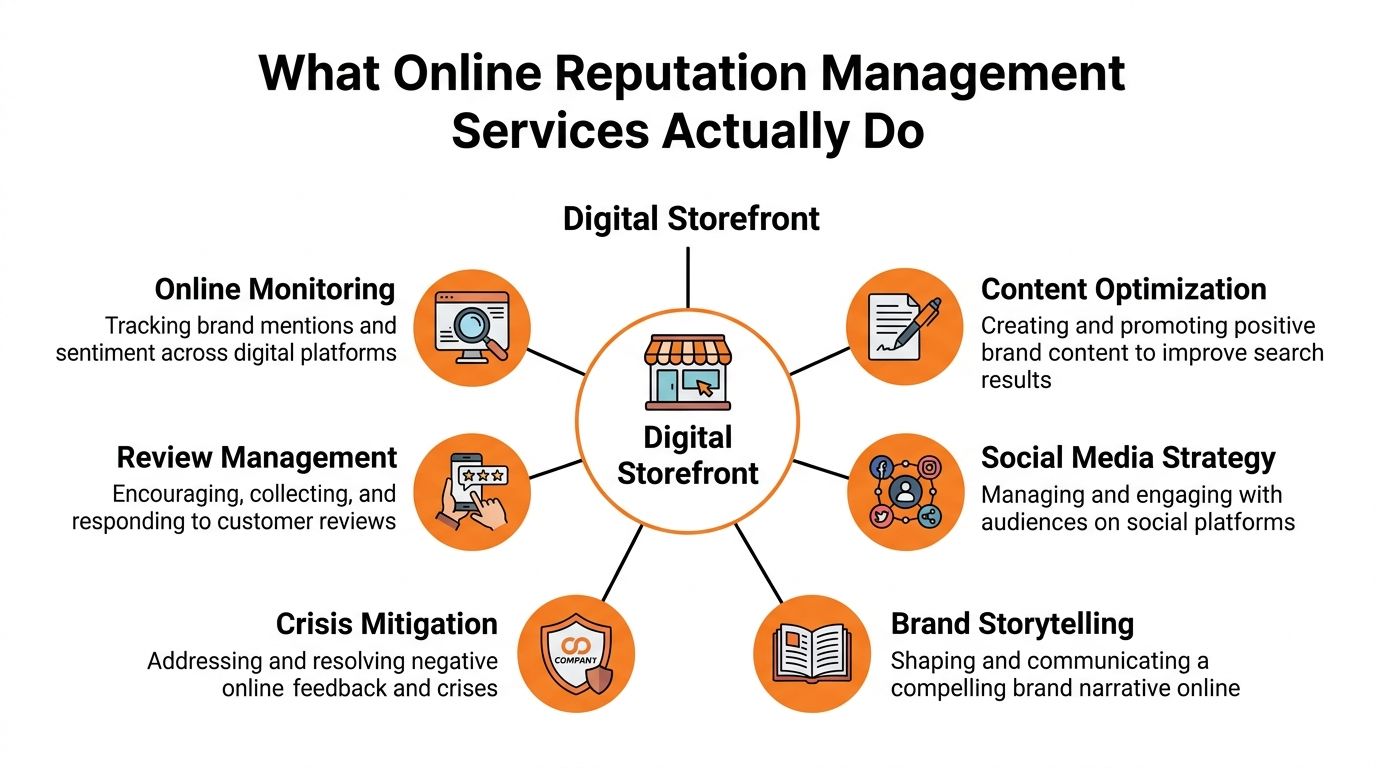
ORM covers the operating work behind that decision point. It shapes how your business appears in branded search, map results, review platforms, and AI summaries. For multi-location groups, it also creates control. Without shared standards, each office ends up publishing a different version of the brand.
I usually break the work into four functions.
The four functions that matter most
Review generation comes first. The goal is a steady flow of honest feedback from real customers, requested at the right time through a simple path. That sounds basic, but the execution is where teams slip. One manager asks consistently, another forgets, and a third sends people to three different review sites. Good ORM services fix that with request rules, staff prompts, timing, and reporting by location.
Monitoring and response comes next. Review volume matters, but response discipline matters too. Customers notice when complaints sit unanswered, and so do prospects comparing options. Google also states that responding to reviews shows customers that a business values feedback, which is why review response belongs in daily operations, not occasional cleanup, in Google's review best practices.
For a practice manager, the workflow usually needs four parts:
- Inbox coverage: Someone checks Google Reviews, Yelp, Facebook, and any industry-specific sites every business day.
- Triage rules: Billing issues, safety complaints, and provider-specific complaints follow a different path than a short comment about wait time.
- Tone control: Responses should be calm, specific, and written in plain language that matches the brand.
- Offline resolution: The public reply acknowledges the issue. The actual fix moves to phone, text, or email with an owner assigned.
A useful walkthrough on the mechanics sits below.
Listings management is the third function. This is less glamorous than review replies, but it affects bookings every week. If one location shows the wrong phone number, if holiday hours live on one profile but not another, or if provider names are formatted three different ways across the web, trust drops fast. Search engines get mixed signals. AI systems get mixed signals too.
That is why mature teams treat listings as governed data, not a one-time setup. One source of truth should control name, address, phone, hours, categories, services, and provider details across Google, Apple, Bing, major directories, and local citations. If you are comparing vendors, a structured reputation management company for multi-location brands can then save a lot of internal cleanup.
Social listening and content support rounds out the program. Reputation is shaped outside review platforms too. Local Facebook threads, Reddit discussions, neighborhood groups, and comments on your own profiles often surface the same issues before they hit your reviews. Those patterns help operators spot training gaps, staffing problems, or a location that is drifting from brand standards.
When operators say the brand feels stronger, they usually mean prospects see recent proof, clear location details, and fewer public signs of disorder.
Why AIO now belongs in ORM
Traditional local SEO still matters. Google still evaluates local visibility through proximity, relevance, and prominence. ORM influences relevance through accurate services and categories, and prominence through review quality, review recency, and brand consistency across the web.
AIO adds a second layer. Buyers now ask conversational tools for recommendations in plain language. They ask who is best for emergency dental care in a neighborhood, which med spa has the strongest reviews, or which clinic seems most responsive. Those systems pull from the public footprint you have already created. If locations publish inconsistent information, collect thin reviews, or leave recurring complaints unanswered, the summary can flatten the brand or miss your stronger offices.
For multi-location businesses, that creates a governance problem more than a marketing problem. One weak location can distort how the whole group is summarized. The practical fix is straightforward. Standardize review requests, enforce response rules, keep listings synchronized, and make sure each office has enough recent, descriptive feedback to give search engines and AI tools something accurate to work with.
Your Toolkit Templates Scripts and Checklists
Operators often know they should ask for reviews. The gap is execution. Staff forget, links are hard to find, and responses get delayed because nobody wants to say the wrong thing.
Review request scripts
Use short language. Ask close to the service moment. Make the next step obvious.
SMS script for dental practices
Hi [First Name], thanks for visiting [Practice Name] today. If you'd be willing, we'd appreciate a quick review about your experience with our team. Your feedback helps other patients in [City] find us. [Review Link]
Email script for HVAC companies
Subject: Quick favor about your service today
Hi [First Name],
Thanks for choosing [Company Name] for your service in [City]. We work hard to make every visit professional, clear, and on time.
If you have a minute, would you share your experience in a review? It helps other homeowners looking for HVAC help near me know what to expect.
[Review Link]
Thank you,
[Manager Name]
[Company Name]
A few rules improve response without making the message sound forced:
- Send promptly: The closer the request is to the completed visit or appointment, the easier it is for the customer to recall details.
- Use one link: Don't make people choose between five sites.
- Keep staff language natural: Frontline teams should say the same thing out loud that the text or email says digitally.
- Avoid incentives that create compliance issues: Especially in healthcare, keep requests neutral and don't tie reviews to gifts or discounts unless your policies clearly allow it.
Review response templates
Responses should protect trust, not win arguments. If you need examples built for difficult situations, this negative review response example covers the tone well.
Positive review response
Hi [Name], thank you for taking the time to share this. We're glad you had a good experience with our team and appreciate your trust in [Business Name]. We look forward to helping again when you need us.
Negative review response
Hi [Name], thank you for your feedback. We're sorry your experience didn't meet expectations. We'd like to learn more and address this directly. Please contact [Phone] or [Email] and ask for [Manager Name] so we can follow up.
That basic structure works because it does four things:
- Acknowledges the customer.
- Avoids arguing facts in public.
- Signals accountability.
- Moves resolution into a private channel.
Field note: In healthcare, never confirm treatment details or include protected health information in a public response. In housing-related businesses, keep language neutral and consistent.
If a review looks fake, don't accuse the poster publicly. Flag it through the platform, document why it appears suspicious, and post a restrained response only if needed.
Seven day review program launch checklist
Here is a simple rollout that works for single-location businesses and can scale to regional groups.
| Day | Action | What good looks like |
|---|---|---|
| Day 1 | Claim profiles | Google Business Profile, Yelp, Apple, Bing, and major vertical directories are under company control |
| Day 2 | Audit listings | Name, address, phone, hours, categories, and service areas match everywhere |
| Day 3 | Set response rules | Decide who answers reviews, who escalates issues, and what approval path exists |
| Day 4 | Write templates | Build positive, neutral, and negative response drafts in brand voice |
| Day 5 | Prepare ask links | Create direct review links by location and assign them to staff workflows |
| Day 6 | Train staff | Front desk, field techs, and managers know when and how to ask |
| Day 7 | Launch requests | Start with a recent list of happy customers and monitor replies daily |
For multi-location businesses, don't let every store improvise. Centralize templates, permissions, and escalation paths. Local managers can still personalize responses, but the guardrails should be consistent across regions.
Reputation Management for Your Specific Industry
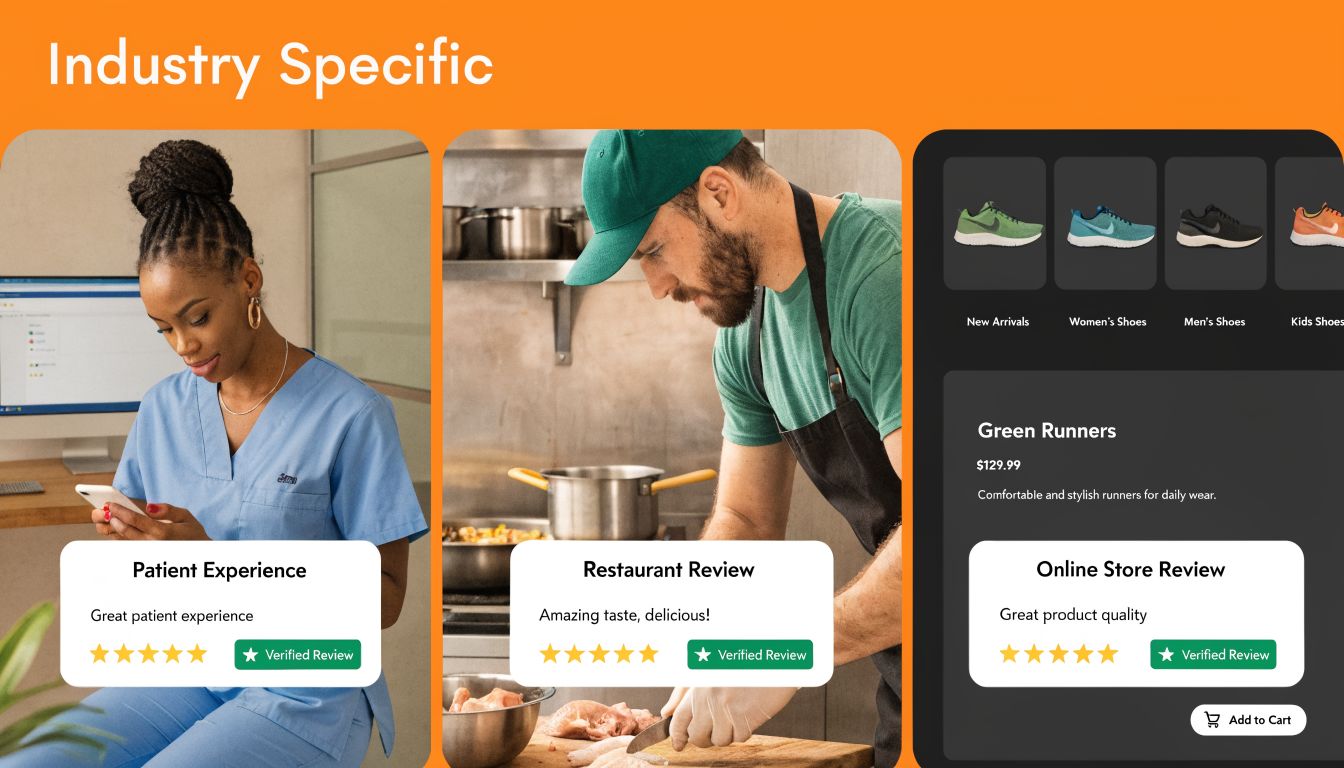
A review strategy that works for a coffee shop won't fit a dental group, a senior living community, and an HVAC company equally well. The customer journey is different. The risk points are different. The language should be different too.
Healthcare and med spa
For dental, chiropractic, vet, and med spa operators, reputation is tied directly to trust. A prospect isn't only checking your star rating. They're looking for signs that the experience will feel safe, respectful, and organized.
That makes review content especially important. Clear mentions of staff professionalism, communication, scheduling, and comfort can help future patients decide to book. It also supports visibility in AI-driven recommendation paths. As Meltwater notes in its overview of reputation platforms, a frequently overlooked aspect of ORM is how LLMs such as ChatGPT summarize a brand, which is why recent and well-structured review data matters.
For healthcare, keep public responses HIPAA-aware. Thank the reviewer. Stay general. Never confirm treatment details. For med spas, avoid exaggerated claims and focus on service, professionalism, and overall experience.
Home services
For HVAC, plumbing, electrical, roofing, landscaping, and general contracting, reviews answer a specific concern: “Can I trust this company to come to my home?”
What moves the needle here is detail. Customers want to see proof of punctuality, communication, cleanliness, and whether the tech explained the work clearly. “Near me” searches often happen when urgency is high, so your profile needs accurate service areas, emergency hours if relevant, and review language that matches real homeowner concerns in [City] and [Neighborhood].
A strong operating pattern for home services looks like this:
- Ask after resolution: Request the review once the issue is fixed and the customer is visibly satisfied.
- Reference the service category: Heating repair, drain cleaning, tune-up, or installation. Specific language helps relevance.
- Respond with professionalism: Thank them for trusting your team in their home.
- Watch recency closely: Older reviews don't reassure customers facing a problem today.
Senior living hospitality auto and restaurants
Senior living has a longer and more emotional decision cycle. You're building confidence with residents and with family members who may be reading every review closely. Keep responses warm, neutral, and fair-housing aware. Focus on staff helpfulness, communication, cleanliness, and community experience without making promises you can't verify publicly.
Restaurants, hotels, and hospitality venues deal with higher review volume and faster perception swings. That's one reason operators in this category often pair ORM with broader service training. If you're working on the guest side of the equation too, these hospitality guest experience strategies add useful operational context.
Auto repair lives somewhere in the middle. Customers want competence, honesty, and clear explanations. Reviews that mention diagnosis clarity, fair communication, and finished-on-time service help future buyers commit.
Recent, specific reviews do more than reassure prospects. They create better raw material for search engines and AI tools to understand what your location is known for.
How to Choose the Right ORM Service or Vendor
Some businesses need software. Others need a managed service. Multi-location operators usually need both structure and support. The wrong choice creates more dashboard activity but doesn't improve calls or bookings.
What to ask before you sign
Start with the workflow, not the sales demo. Ask how the vendor handles review requests, response approvals, listing corrections, location rollups, and issue escalation. If they can't explain the day-to-day process clearly, you'll feel that confusion after onboarding.
These questions usually separate a usable partner from a flashy one:
- How do you help us generate more real reviews? Look for request timing, direct links, and automation tied to actual customer events.
- How do you handle listings accuracy? You want consistency across Google, Apple, Bing, and major directories.
- What governance tools exist for multiple locations? Templates, permissions, and escalation rules matter.
- How do you support AI-facing visibility? AIO is still developing, but the vendor should understand how fresh review content and accurate profiles affect AI summaries.
- Can you report on outcomes, not just tasks? If reports stop at “responses sent,” that's not enough.
- What does support look like month to month? Many operators need guidance, not just logins.
If you want to compare categories and feature sets, this roundup of online reputation management software is a practical starting point.
A second screening point is whether the vendor understands local search. Google's local results depend on proximity, relevance, and prominence. No vendor controls proximity. But they can absolutely improve relevance through categories, services, photos, business descriptions, and FAQs. They can also improve prominence by helping you build stronger review signals and cleaner citations.
Google Business Profile checklist
A vendor that ignores Google Business Profile is missing the center of local discovery. Use this shortlist when evaluating your own setup.
- Primary category: Choose the closest match to the core service.
- Secondary categories: Add only relevant services. Don't stuff.
- Name address phone: Keep them consistent everywhere.
- Hours and special hours: Update them before holidays and seasonal changes.
- Service areas: Use them where appropriate, especially for home services.
- Photos: Add current exterior, interior, staff, and service photos.
- Services and products: Fill these out with plain-language descriptions.
- Questions and answers: Seed common questions and keep answers accurate.
- Booking and call paths: Make it easy for customers to act without hunting.
If a vendor promises reputation improvement without touching Google Business Profile, keep looking.
Measuring Success and Calculating ROI
A regional manager calls after seeing a location's rating hold steady while booked appointments slip. The dashboard looks fine at first glance. The problem usually sits one level deeper: review flow slowed, response times slipped, and location data stopped matching what front desk staff were hearing on calls.
That is why ORM reporting has to connect reputation signals to revenue by location.
The metrics that deserve attention
Start with a scorecard that both leadership and local managers can use without a long explanation. In practice, the best scorecards mix public trust signals, operational discipline, and business outcomes. Review velocity and response rate matter because they show whether the process is healthy. Calls, bookings, tour requests, and close rates matter because they show whether the process is producing business.
For multi-location brands, consistency matters as much as averages. One strong branch can hide three weak ones if reporting is rolled up too loosely.
| Metric | What it Measures | Good Target | Excellent Target |
|---|---|---|---|
| Star rating | Overall public trust signal | 4.0+ | 4.5+ |
| Review volume | New review flow by location | Consistent monthly growth | Strong, steady monthly growth with no long gaps |
| Review recency | How fresh the proof looks | New reviews each month | New reviews every week |
| Response time | Speed of engagement | Within a few business days | Within 24 hours |
| Response rate | Share of reviews answered | Most reviews answered | Nearly all reviews answered |
| GBP views calls and clicks | Discovery and action from Google Business Profile | Month over month improvement | Sustained improvement tied to booked business |
| Lead to sale conversion | Quality of inquiries reaching staff | Stable or improving close rate | Clear improvement after stronger review and profile quality |
The weighting changes by business model. A dental group may care most about consult bookings. An HVAC company may care most about inbound calls tied to urgent searches. A senior living operator may focus on tour set rate and inquiry quality because lead volume alone can be misleading.
Watch for mismatches. If review volume drops, negative themes increase, and close rates soften in the same month, treat it as an operating issue first and a marketing issue second.
How to track Google Business Profile to booked business
Attribution works better when the setup is simple enough to maintain. I usually recommend five controls.
- Tag website links with UTMs. Add UTM parameters to the website link in Google Business Profile so visits show clearly in analytics.
- Use separate booking links when the system allows it. Tagged scheduling URLs make appointment intent easier to isolate.
- Track call sources. If your phone setup supports it, separate calls that originate from GBP from other channels.
- Map every lead to the right location. Multi-location reporting breaks fast when inquiries are assigned to the wrong branch.
- Review results monthly by location. Compare review trends, response behavior, GBP actions, booked business, and closed revenue in the same report.
A workable formula is simple:
ROI = value of additional booked business tied to ORM improvements minus ORM cost
You will not isolate every variable perfectly. That is normal. What matters is whether the pattern holds over time. If a location improves review recency, keeps responses on time, tightens escalation for complaint themes, and then produces more qualified calls from Google, the case for continued investment gets much stronger.
For larger brands, governance is part of ROI. Centralized templates, approval rules, and escalation paths reduce wasted staff time and keep one location from creating legal or brand risk for the rest of the group. They also make reporting cleaner, which is why a disciplined local SEO reporting process for multi-location performance belongs in the same conversation as review generation.
There is another layer now. AI Optimization matters because conversational search tools pull from brand mentions, reviews, business profiles, and third-party sources to shape recommendations. If your locations have uneven review coverage, stale responses, or conflicting service information, that confusion can limit visibility not just in local search, but in AI-driven discovery on platforms like ChatGPT. A good ORM program improves trust with customers and improves the odds that AI systems describe your business accurately.
Frequently Asked Questions
How do we manage reputation across many locations without overwhelming staff
A regional group with 20 locations cannot afford 20 different review policies. That is how response times slip, sensitive complaints get mishandled, and service details drift from one profile to the next.
The workable model is centralized governance with local execution. Corporate or regional marketing sets response standards, templates, approval rules, and escalation paths. Local managers add context, flag service issues, and step in when a customer needs a real follow-up. This keeps the brand consistent without turning every reply into a headquarters bottleneck.
For multi-location teams, the goal is not more software. It is fewer judgment calls at the location level.
How should we handle reviews that look fake or competitor-driven
Start by documenting the pattern. Save screenshots, note dates, compare names against your patient or customer records if your category allows that, and submit the report through the review platform.
Public responses need restraint. Do not accuse the reviewer of fraud unless your legal or compliance team has approved that approach. A short reply that states you cannot verify the interaction and invites an offline conversation is usually the safer move.
How long does it take to see results from an ORM program
Operational improvements show up first. Teams can tighten response times, review request volume, and escalation discipline within weeks.
Public-facing gains take longer because they depend on customer volume, review velocity, listing accuracy, and how competitive the market is. A busy dental group or med spa may see momentum faster than a law firm with a longer decision cycle. In either case, consistency matters more than a short burst of activity.
Is software enough or do we need a managed service
That depends on who will own the work on Tuesday afternoon, not who approves the budget on Friday.
Software handles monitoring, routing, reporting, and templates well. Managed service helps when locations are inconsistent, managers are overloaded, or leadership wants tighter quality control across the brand. Many multi-location businesses use both. The platform keeps operations organized, and the service layer keeps standards from slipping after the first month.
Can AI write review responses safely
AI is useful for first drafts, especially in high-volume environments. It is less reliable when a response touches compliance, refunds, clinical outcomes, legal claims, or a heated customer dispute.
The safe approach is simple. Set approved tone guidelines, banned phrases, escalation triggers, and review rules by location type. Then require human review for sensitive categories. That same discipline helps with AI Optimization, because the language your business publishes across reviews, profiles, and replies shapes how tools like ChatGPT summarize your locations.
What should frontline teams own
Keep frontline ownership narrow and clear. Staff should ask for reviews at the right moment and flag unhappy customers before they post publicly.
Location managers should own service recovery. Marketing, operations, or a centralized reputation team should own templates, listings control, reporting, and policy enforcement. If everybody owns everything, nobody owns the risky parts.
Does ORM help with conversational search in tools like ChatGPT
Yes. The effect is indirect, but it matters more now than many operators realize.
Conversational search tools pull from business profiles, third-party listings, reviews, and other public signals to form recommendations and summaries. If one location says you offer same-day appointments, another says walk-ins only, and a third has not been updated in months, AI systems can repeat that confusion back to potential customers. Strong ORM reduces those contradictions. For multi-location brands, that is not just reputation work. It is governance that protects visibility in both traditional local search and AI-driven discovery.
If you want a practical system instead of another dashboard, Reviews To The Top helps local and multi-location businesses run review generation, responses, listings accuracy, and governance in one place. The support is month-to-month, so you can improve visibility, trust, and booked business without locking yourself into a long contract.