To reduce customer churn, you must proactively manage the customer experience, from their first impression to their ongoing relationship with your business. By consistently gathering feedback, personalizing communication, and making it easy for customers to engage with you, you can significantly increase retention. This matters because keeping an existing customer is up to 5 times cheaper than acquiring a new one, directly protecting your revenue from calls, messages, and bookings.
Key Facts About Customer Churn
- Financial Impact: Acquiring a new customer is 5 to 25 times more expensive than retaining an existing one.
- Profit Boost: A mere 5% increase in customer retention can boost profits by 25% to 95%.
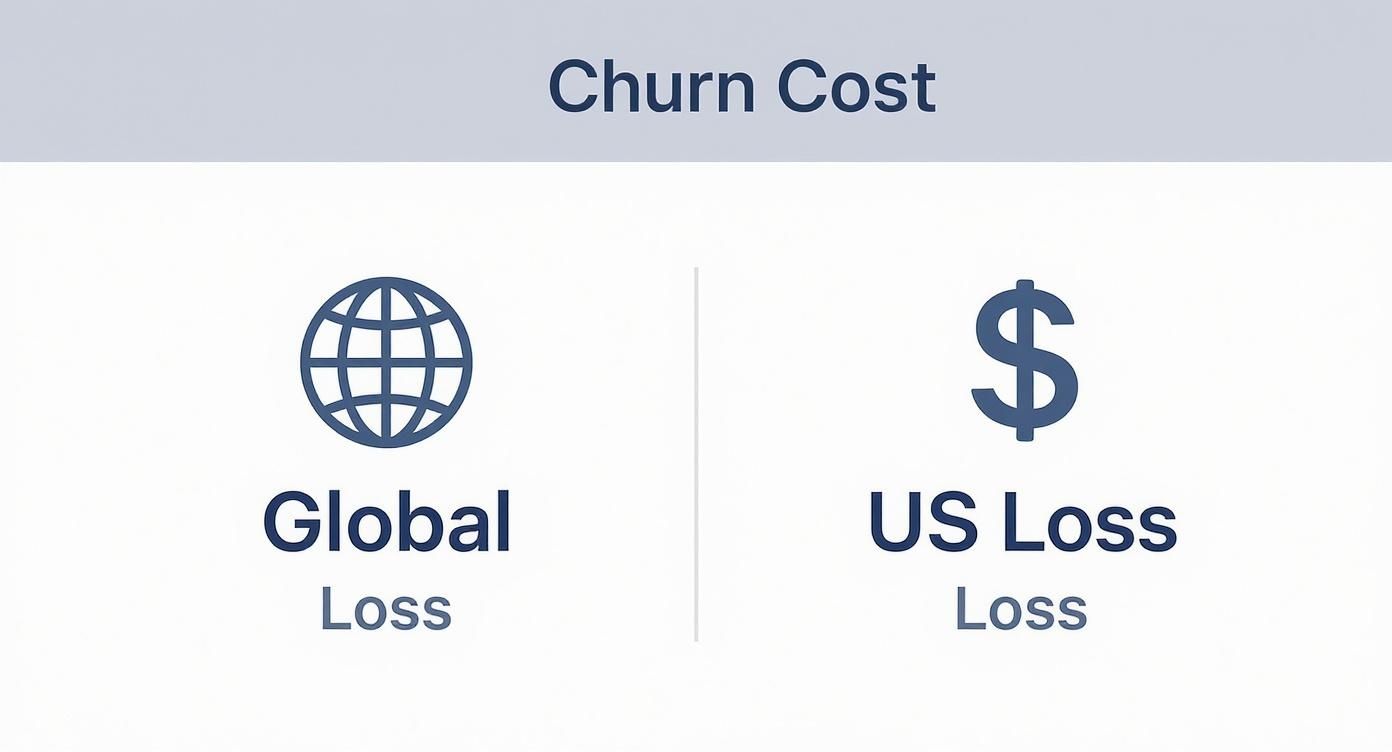
- Primary Cause: Poor customer experiences are the leading driver of churn, costing U.S. businesses an estimated $494 billion annually.
- Local SEO Link: A strong online reputation with high ratings and fresh reviews is a leading indicator of customer satisfaction and a key factor in Google's local search rankings.
- The Power of Feedback: Businesses that actively respond to customer reviews retain more customers and build trust with potential new ones.
1. Summary: Why You Can't Afford to Ignore Customer Churn
Customer churn, also known as customer attrition, is the rate at which customers stop doing business with you. For a local business—whether a med spa in [City] or a multi-location dental practice—a high churn rate is a critical warning sign that something in the customer experience is broken. It could be service quality, pricing, or communication.
Tackling churn isn't just about plugging a leaky bucket; it's a core growth strategy. Loyal customers spend more over their lifetime, refer others, and provide honest feedback. When you focus on reducing churn, you build a more stable, predictable, and profitable business. A low churn rate makes your business more resilient, allowing you to weather slow seasons and confidently invest in growth.
2. Step-by-Step Guide to Reducing Churn
Stopping churn requires a proactive, systematic approach. Follow these steps to diagnose your issues, implement effective strategies, and build lasting customer loyalty.
Step 1: Calculate Your Churn Rate
You can't fix what you don't measure. The first step is to get a clear, data-backed picture of your customer loyalty. It starts with a simple formula:
Churn Rate (%) = (Lost Customers ÷ Total Customers at Start of Period) x 100
For example, if a dental practice in [City] started the quarter with 500 active patients and 25 did not return, their quarterly churn rate is 5%. An auto shop in the [Neighborhood] area could track how many customers on its service reminder list fail to book a follow-up appointment within six months.
Once you have a baseline, segment your data to find patterns. Are you losing more new customers than long-term ones? Are customers who found you via a "vet clinic near me" search leaving faster than those referred by friends? These insights help you create targeted solutions.
Step 2: Improve the Customer Experience
Loyalty is built through small, consistent efforts. Focus on these key areas:
- Seamless Onboarding: The first 30-90 days are critical. A clunky start often leads to early churn. For a dental practice, a simple welcome kit with a toothbrush and a clear treatment plan can make a great first impression.
- Proactive Communication: Don't wait for customers to reach out. An HVAC company can send energy-saving tips before a heatwave. A med spa can text two weeks after a treatment to check on results. This shows you care about their outcome, not just the sale.
- Ask for and Act on Feedback: A robust reputation management program is a powerful churn-reduction tool. Actively asking for reviews and responding to all of them—positive and negative—shows customers their opinion matters. That one-star review about scheduling is a gift; it highlights a friction point you can fix.
Step 3: Optimize Your Online Presence
Sometimes, churn happens because of friction, not a bad experience. A customer can't find your new hours or struggles to book an appointment online, so they go to a competitor. Making your business easy to find and interact with is an underrated retention strategy.
When a customer searches "emergency vet in [City]," Google uses three main factors to rank local businesses:
- Proximity: How close is your business to the searcher's location?
- Relevance: How well does your business profile match the search query?
- Prominence: How well-known is your business, based on factors like review count, star rating, and online mentions?
A complete and active Google Business Profile is a cornerstone of reputation management and makes staying with you the easy choice.
Google Business Profile Optimization Checklist:
- Accurate Core Info: Ensure your Name, Address, and Phone number (NAP) are 100% correct and consistent online. Keep business hours updated.
- Detailed Services: List specific services (e.g., "Lawn Aeration," not just "Landscaping") to appear in more targeted searches.
- Fresh Photos: Upload at least 10-15 high-quality, recent photos of your storefront, team, and work.
- Active Q&A: Proactively add and answer common questions like "Do you offer financing?" or "Is parking available?"
- Use Google Posts: Share weekly updates, special offers, or tips to keep your profile fresh and signal activity to Google.
3. Templates, Scripts & Checklists
Here are practical assets you can adapt and use immediately to improve customer communication and launch your retention efforts.
Scripts for Requesting Reviews
Timing is everything. Ask for feedback within 24 hours of service, always personalizing the message with the customer's name and the specific service they received.
SMS Review Request (Vet Clinic Example)
Hi [Pet Owner Name], this is [Your Name] from [Clinic Name]. Thanks for bringing [Pet's Name] in today! We'd love to get your feedback on your visit. Would you mind taking 30 seconds to leave us a review on Google? [Link to Google Business Profile Review Page]
Email Review Request (Auto Shop Example)
Subject: How was your service, [Customer Name]?
Hi [Customer Name],
Thank you for choosing [Your Company Name] for your recent oil change. We're always working to improve, and your feedback is a huge part of that.
If you have a moment, we would greatly appreciate you sharing your experience by leaving us a review on Google. It helps other drivers in [City] find a reliable team.
[Link to Google Business Profile Review Page]
Thanks again,
The Team at [Your Company Name]
Templates for Responding to Reviews
Responding to every review is non-negotiable. It shows you're engaged and can turn a negative experience around while reinforcing positive ones.
Positive Review Response Template
Hi [Reviewer Name], thank you so much for the fantastic 5-star review! We're thrilled to hear you had a great experience with [Mention specific service/staff member if possible]. We appreciate you choosing us and look forward to seeing you again at our [Neighborhood] location!
Negative Review Response Template
Hi [Reviewer Name], thank you for sharing your feedback. I'm very sorry to hear that your experience didn't meet your expectations. We pride ourselves on excellent service, and it's clear we missed the mark. Please call our manager, [Manager Name], directly at [Phone Number] so we can learn more and work to make this right.
7-Day Launch Checklist for a Review Program
| Day | Action Item | Key Objective |
|---|---|---|
| 1 | Choose Your Platform | Select a review management tool that integrates with your Customer Relationship Management (CRM) software. |
| 2 | Optimize Your Listings | Claim and fully update your Google Business Profile, Yelp, and other key local listings. |
| 3 | Create Your Templates | Write personalized email and SMS templates for requesting feedback. |
| 4 | Define Your Response SLA | Set a goal to respond to all new reviews (positive & negative) within 24 hours. |
| 5 | Train Your Front-Line Team | Teach staff how and when to ask for reviews and who to escalate negative feedback to. |
| 6 | Launch a Pilot Test | Send review requests to a small group of 10-15 recent, happy customers. |
| 7 | Review & Go Live | Analyze pilot results, make any tweaks, and officially launch the program to all customers. |
4. How to Measure Your Success
You can't manage what you don't measure. Track these Key Performance Indicators (KPIs) to prove the value of your retention efforts.
Recommended Targets:
- Review Volume: Aim for 5-10 new reviews per location, per month.
- Review Recency: Ensure your latest review is never more than 2-4 weeks old.
- Response Time: Respond to 100% of reviews within 24 hours.
- Star Rating: Maintain an average rating of 4.5 stars or higher.
- GBP Performance: Track monthly increases in profile views, website clicks, and clicks-to-call.
- Lead-to-Sale Conversion: Monitor the percentage of calls and form fills from GBP that convert into booked appointments.
To connect online activity to your bottom line, use UTM parameters. A UTM (Urchin Tracking Module) is a code snippet added to a URL. By adding UTM tags to the website link in your Google Business Profile, you can use analytics tools to see exactly how many website visits, form submissions, and online bookings originated directly from your local search presence.
5. Frequently Asked Questions (FAQs)
Q1: What is a good customer churn rate for a local business?
A good annual churn rate for a local service business is generally below 10-15%, with top performers often achieving rates under 5%. However, the most important metric is your own trend—focus on consistently improving your rate quarter over quarter.
Q2: How can I find out why my customers are leaving?
The best way is to ask directly and listen proactively. Use simple exit surveys for canceled services, send "we miss you" emails to inactive customers, and monitor your online reviews for recurring complaints about issues like scheduling or pricing.
Q3: What is the most cost-effective way to reduce churn?
Proactive communication and a fully optimized Google Business Profile are the most cost-effective tactics. Automated appointment reminders, post-service check-in texts, and actively managing your online reputation cost very little but have a massive impact on customer loyalty.
Q4: How soon will I see results from my retention efforts?
You can see leading indicators, such as an increase in positive reviews and improved feedback scores, within the first 30-60 days. A measurable drop in your overall churn rate typically takes 3-6 months of consistent effort.
Q5: What is the difference between churn rate and retention rate?
They are two sides of the same coin. Churn rate measures the percentage of customers you lose, while retention rate measures the percentage of customers you keep over a specific period. If your quarterly churn rate is 5%, your retention rate is 95%.
Q6: What is a Service Level Agreement (SLA)?
An SLA, or Service Level Agreement, is a clear, internal commitment that defines a standard for a specific action. For example, an SLA could be "respond to all Google reviews within 24 business hours" or "follow up on all negative feedback via phone within 4 hours." It removes guesswork and ensures a consistent customer experience.
Ready to turn customer feedback into your best retention tool? Reviews To The Top helps local and multi-location businesses build a disciplined review program that not only keeps customers coming back but also strengthens local SEO. We offer flexible, month-to-month support designed for your specific industry. Book a strategy call and let's talk about how we can help you cut churn.