To increase sales in a retail store, you must focus on the entire customer journey: getting found online, creating an excellent in-store experience, and building trust through reviews. This approach is critical because most customers find you through local search, and their decision to visit and buy depends on your online reputation and what happens when they walk through your door, directly impacting calls, bookings, and revenue.
Key Facts
- Proximity, Relevance, Prominence: Google ranks local businesses based on how close they are to a searcher (Proximity), how well their services match the search (Relevance), and how well-known and trusted they are, largely determined by reviews (Prominence).
- Google Business Profile (GBP) is Key: Optimizing your GBP is the most critical first step for driving local foot traffic. A complete profile with photos, reviews, and accurate information directly impacts your visibility in "near me" searches.
- Review Recency Matters: Over 50% of consumers only consider reviews from the last month. A consistent flow of new reviews is non-negotiable for building trust.
- Response Time Impacts Revenue: Businesses that respond to all reviews within 24 hours can see significant revenue lifts compared to those that don't.
- Training Boosts Sales: Well-trained staff who can effectively upsell and cross-sell can increase the average transaction value by 15-20%.
1. Summary: A Straightforward Plan for Boosting In-Store Sales
Knowing how to increase sales in a retail store isn't about one magic bullet. It’s about building a connected customer journey—a series of smart, repeatable actions that turn an online search into a store visit, and that visit into a sale. For any local business operator, from a med spa in [City] to an auto shop in the [Neighborhood] area, the focus has to be on the entire path a customer takes.
Think of it this way: the entire process can be broken down into three fundamental stages.
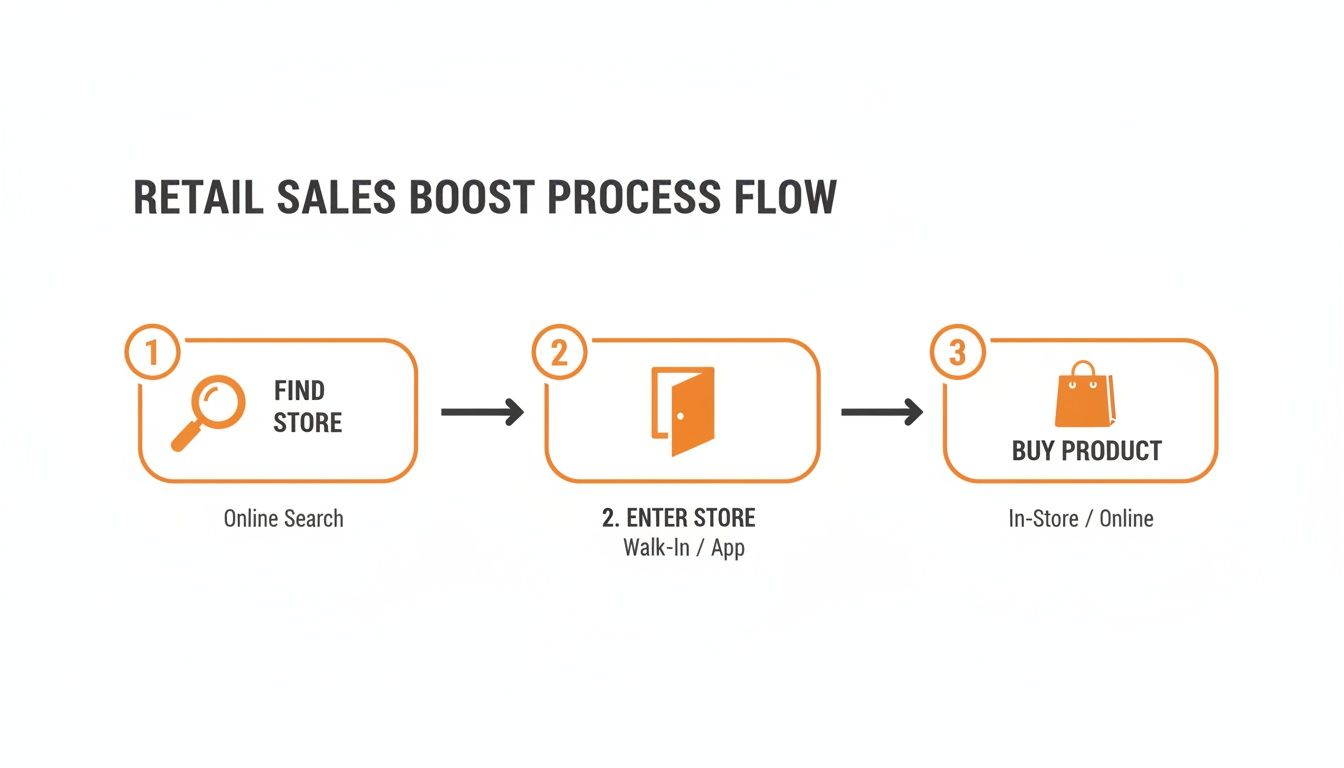
First, customers have to find you online. Then, they need a reason to enter your store. And finally, the in-store experience has to convince them to buy. Every part of your strategy should support one of these steps. A solid reputation management plan is the thread that connects them all, building the trust needed to get found and drive conversions.
2. Step-by-Step Guide to Increasing Retail Sales
Let's be realistic—you're a busy operator, not a full-time marketer. This guide gives you actionable steps to implement quickly, whether you run a single vet clinic or a chain of retail stores.
Step 1: Master Your Local Online Presence to Drive Foot Traffic
Before a customer ever walks through your door, they’ve already met you on their phone. If you want to drive more foot traffic, you have to get serious about your local online presence. Your Google Business Profile (GBP), the info box that appears in Google Maps and search, is your new digital front door.
Google decides who to show in "near me" searches using three factors:
- Proximity: How close are you to the person searching? Ensure your address is perfectly accurate and consistent everywhere online.
- Relevance: Do you offer what the searcher wants? Your GBP must be filled with the right keywords and services (e.g., "emergency dental care," "HVAC repair in [City]").
- Prominence: How well-known and trusted is your business? Google measures this through online signals, especially the quantity and quality of your customer reviews. This is why a strong online reputation is crucial.
Google Business Profile Optimization Checklist:
- Complete Every Field: Fill out your business name, address, phone number (NAP), and hours.
- Choose Smart Categories: Select an accurate primary category (e.g., "Med Spa") and add secondary ones ("Laser Hair Removal Service") to capture specific searches.
- Write a Keyword-Rich Description: Naturally include terms your customers use, like "pet-friendly senior living near me" or "best auto repair in [Neighborhood]."
- Add High-Quality Photos: Regularly upload pictures of your storefront, products, team, and happy customers (with permission).
- Enable Messaging & Q&A: Make it easy for people to ask questions. Pre-populate the Q&A section with common queries.
- Use Google Posts: Announce sales, highlight new arrivals, and promote events to keep your profile fresh.
Getting this right is the first step to optimizing your Google Business Profile for maximum visibility.
Step 2: Turn Your Team into a Sales Powerhouse with Training
Your frontline staff are your most powerful sales asset. A confident, well-trained team doesn't just process transactions; they solve problems and create experiences that turn browsers into buyers. Research shows that consistent training can improve sales performance by over 30%.
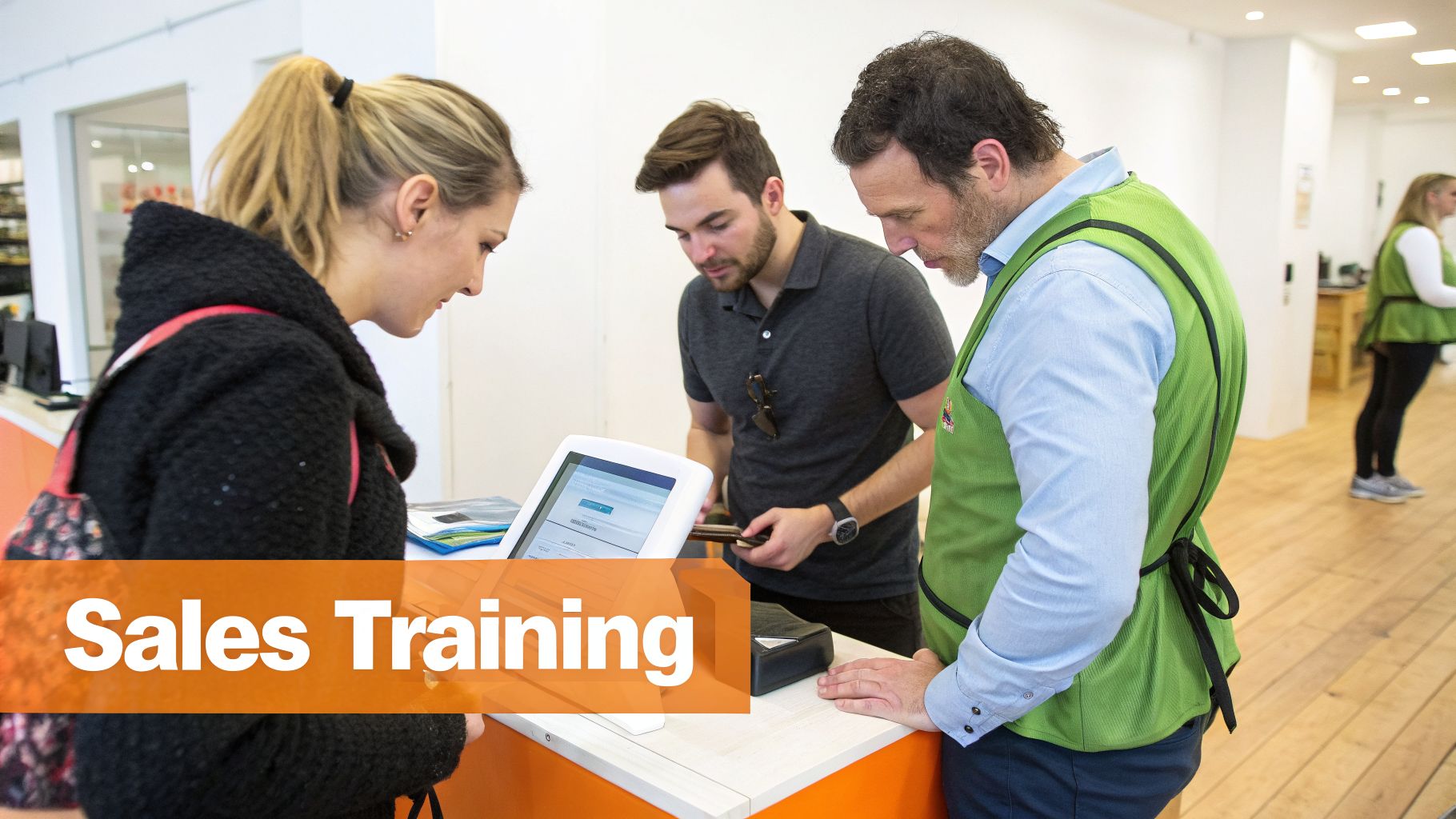
- Integrate Training into Daily Routines: Use 10-minute daily huddles to share a sales tip, demo a product, or celebrate a win. This makes learning continuous, not a one-off event.
- Practice with Role-Playing: Dedicate a few minutes each week to practice real-life scenarios, like upselling or handling a difficult question. This builds confidence and makes suggestions feel natural, not pushy.
- Promote Your Loyalty Program: Train your staff to clearly explain the benefits of your loyalty program at checkout. A simple question like, “Are you part of our rewards program? You’d earn 50 points on today’s purchase,” gives customers a reason to return.
Step 3: Optimize Your Store Layout and Merchandising
Your store's physical layout is a silent salesperson. A well-designed space guides shoppers on a journey that naturally leads to a purchase.
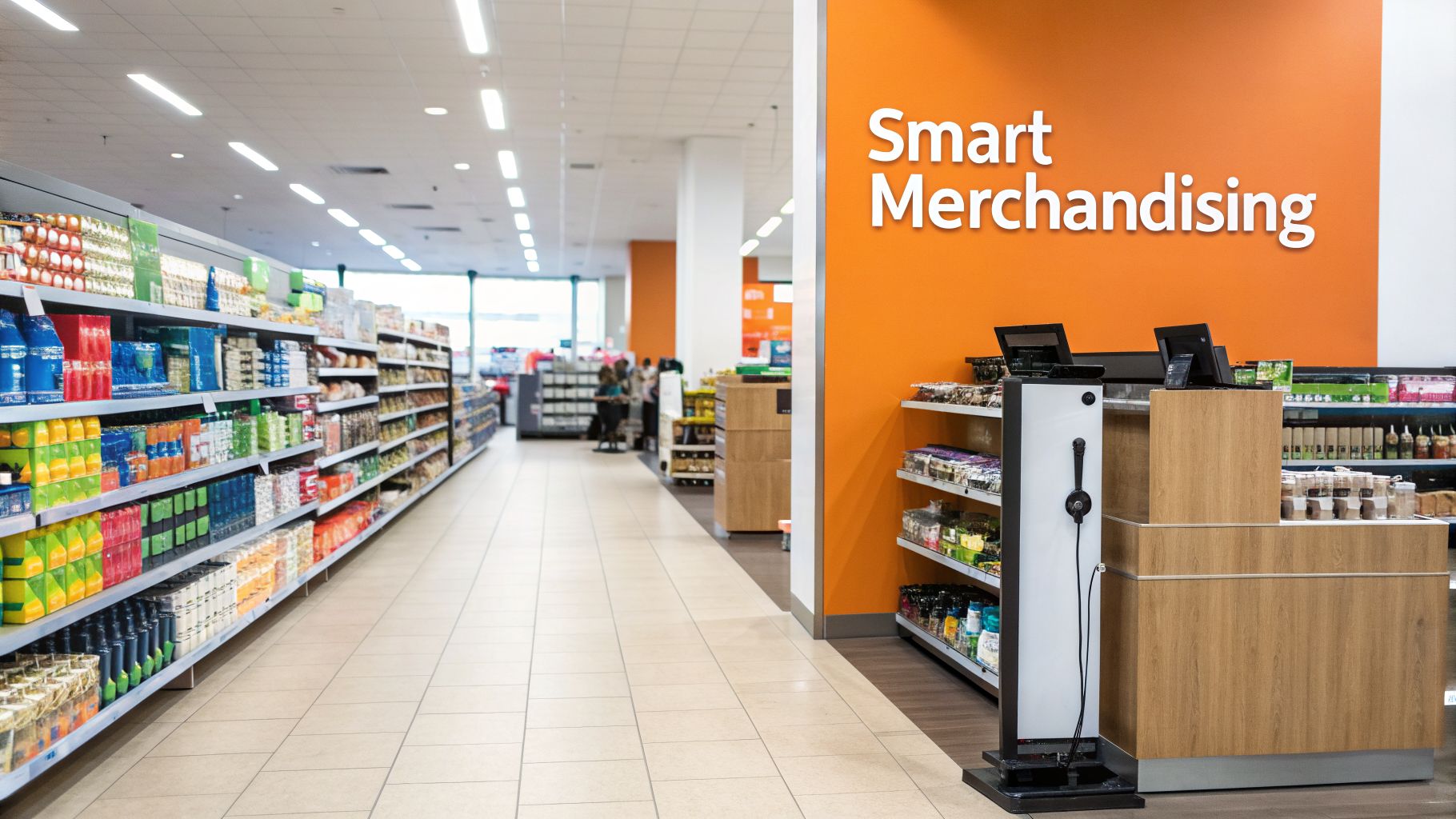
- Map the Customer Journey: Observe how customers move through your store. Identify high-traffic "power zones" and low-traffic "dead spots."
- Place Products Strategically: Use the "eye-level is buy-level" rule, placing your most profitable items where they are easiest to see. Use endcaps for compelling displays, like a "Winter Wellness" bundle at a pharmacy. For more ideas, explore visual merchandising in retail and how it drives sales.
- Leverage the Checkout Counter: The point-of-sale area is perfect for low-cost, high-margin impulse buys. Think phone chargers, gourmet chocolates, or travel-sized products.
3. Templates and Scripts to Get Started
Theory is great, but action is better. Here are the exact scripts and a 7-day plan to launch a review program that builds trust and drives sales.
Review Request Scripts
The best time to ask for a review is right after a positive experience. Keep it simple and personal.
SMS Review Request Template (for a Vet Clinic):
Hi [Pet Owner Name], this is [Staff Name] from [Clinic Name]. We loved seeing [Pet's Name] today! When you have a moment, could you share your experience with our team? Your feedback helps other pet parents in [City] find us. [Link to Google Reviews]
Email Review Request Template (for a an HVAC company):
Subject: How was your service from [Company Name]?
Hi [Customer Name],
Thanks for trusting us with your home comfort system today. We strive to provide the best service in [Neighborhood] and would appreciate your feedback.
If you have 60 seconds, please leave us a review on Google. It makes a huge difference for our local business.
[Link to Google Reviews]
Thank you,
The Team at [Company Name]
Review Response Templates
Responding to all reviews—good and bad—is non-negotiable. It shows prospective customers you are engaged and care about service quality.
Positive Review Response Template:
Hi [Customer Name], thank you so much for your kind words! We're thrilled to hear you had a great experience with our team. We look forward to serving you again soon!
Negative Review Response Template:
Hi [Customer Name], thank you for your feedback. We are sorry to hear your experience did not meet expectations. Our goal is to provide 5-star service, and we would appreciate the chance to learn more. Please call our manager, [Manager Name], at [Phone Number] at your convenience.
7-Day Review Program Launch Checklist
- Day 1-2: Set Goals & Finalize Scripts. Define your targets (e.g., 10 new reviews per month, a 4.5+ star rating). Customize the script templates to match your brand's voice.
- Day 3-4: Build the Process & Train Your Team. Decide who sends requests and when (e.g., at point-of-sale, end-of-day batch). Train your staff on the new process and explain why reviews are vital for sales.
- Day 5: Plan for Responses. Designate one person as the "review champion" responsible for monitoring and responding to all reviews within 24 hours.
- Day 6-7: Test and Go Live. Send a test request to your own phone to ensure the link works. Once confirmed, start sending requests to recent, happy customers.
4. How to Measure Your Success
You can't improve what you don't measure. Tracking the right metrics proves the return on your efforts and shows you what’s working.
Recommended Performance Targets
Set clear, actionable goals for your retail location(s).
- Review Volume: Aim for 5-10 new reviews per month, per location.
- Star Rating: Maintain an average of 4.5 stars or higher.
- Response Time: Respond to 100% of reviews within 24 hours.
- GBP Performance: Target a 15% month-over-month increase in GBP views, clicks-to-call, and direction requests.
- Lead-to-Sale Conversion: Track the percentage of leads from GBP (calls, messages) that result in a sale or booked appointment.
Tracking Conversions from Google Business Profile
To connect your online activity directly to revenue, use UTM tags. A UTM (Urchin Tracking Module) is a snippet of code added to your website URL in your Google Business Profile. When someone clicks it, Google Analytics can show you that the visitor came directly from your GBP listing.
By tagging this link, you can track how many website visits, form submissions, or online purchases originate from local search. This allows you to calculate a clear lead-to-sale conversion rate, proving that your efforts to improve your online reputation are directly fueling sales. For a deeper dive, read our guide on local SEO reporting.
5. Frequently Asked Questions (FAQs)
1. How quickly can I expect to see results?
You should see leading indicators like GBP views and calls increase within 30 days of optimizing your profile. Tangible sales growth from in-store changes and training typically takes 60–90 days to become evident as new habits form.
2. What is the single most important thing for increasing sales?
There is no single magic bullet. The most powerful approach is a connected strategy: 1) a strong online presence to get found, 2) an excellent in-store experience to convert shoppers, and 3) a great reputation to build trust. If you are just starting, mastering your online presence via your GBP is the most critical first step.
3. How should I handle negative reviews?
Respond publicly within 24 hours. Your reply is for future customers, not just the unhappy one. Acknowledge their concern, apologize, and offer to take the conversation offline to resolve the issue. This shows you are responsive and committed to customer satisfaction.
4. How can I train my staff without disrupting the workday?
Use "micro-training." Implement 10-minute daily huddles to cover one small topic (e.g., a new product, an upselling phrase). Use slow periods for quick role-playing exercises. This makes learning consistent and manageable.
5. How do I know if my local marketing is actually working?
Track your Google Business Profile Insights for a 15% month-over-month lift in views, calls, and direction requests. Use UTM tags on your GBP website link to track how many clicks lead to website conversions (like bookings or purchases), giving you a clear ROI.
Managing your online reputation is a direct path to increasing sales. If you need help turning customer feedback into revenue, we provide month-to-month support to help businesses like yours get more reviews, rank higher, and grow. Book a strategy call with our team to get started.