A patient in [City] asks their phone for “best dentist near me open late.” A homeowner in [Neighborhood] types “AC repair near me” into Google, then follows up in ChatGPT to compare providers. That’s where ai and seo now meet real revenue. If your business details are incomplete, your reviews are stale, or your location pages are thin, you’re easier to skip.
For local businesses, AI is changing SEO by rewarding businesses that are easy to verify, easy to understand, and easy to trust. That matters because AI-driven search traffic isn’t just growing fast. It’s converting at a higher rate than traditional organic search in the data we have, which means better local visibility can turn into more calls, messages, bookings, tours, and walk-ins.
The New Rules of Local Search with AI and SEO
A few years ago, local SEO mostly meant ranking in the map pack, keeping your Google Business Profile updated, and collecting reviews consistently. Those basics still matter. The difference now is that AI systems are summarizing, comparing, and recommending local businesses directly inside search experiences.
That changes the job.
When someone searches “vet near me in [City] with Saturday appointments” or “best med spa in [Neighborhood] for laser treatments,” Google and AI assistants try to assemble a direct answer from the businesses they can understand with confidence. They look for clear services, location relevance, strong reputation signals, and consistent business data.
AI search traffic has grown 527% year-over-year, and ChatGPT users convert at 15.9% compared with Google organic conversion at 1.76%, according to Semrush’s AI SEO statistics. For a practice owner or service manager, the takeaway is simple. This channel is no longer experimental.
If you want a broader primer on where this is heading, Raven SEO’s guide to SEO for Generative AI Search is a useful companion read. For a practical explanation of how this fits under generative visibility, this overview of what is generative engine optimization helps frame the shift.
Practical rule: Local businesses usually don’t lose AI visibility because they lack “AI content.” They lose it because their basics are inconsistent, thin, or outdated.
A dental office with complete services, current hours, recent reviews, and useful FAQ content will often be easier for AI systems to surface than a competitor with a prettier website but weak local signals.
How AI Changes Google Search for Local Businesses
Local search now works less like a directory and more like a recommender system.
An LLM, or large language model, is the technology behind tools like ChatGPT, Claude, and parts of Google’s AI-generated answers. Instead of just matching keywords, it interprets meaning. It looks at what the searcher is asking, what businesses offer, and which sources seem most trustworthy.
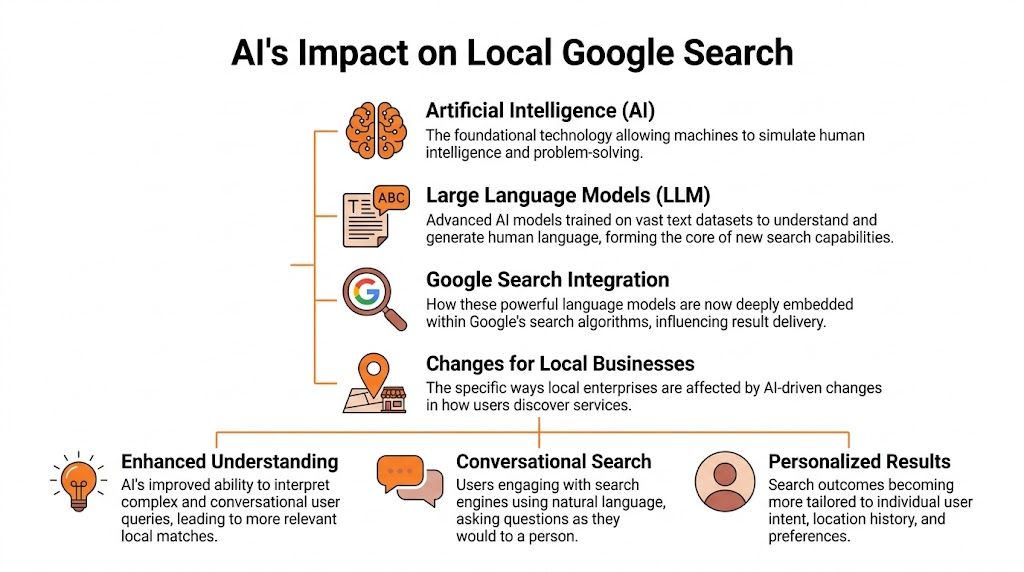
Google still uses proximity relevance and prominence
For local businesses, the old ranking model still matters:
- Proximity means how close the searcher is to your business or service area.
- Relevance means how well your profile, pages, and content match the service being searched.
- Prominence means how established and trusted your business appears online.
AI doesn’t replace this model. It intensifies it.
If your HVAC company in [City] has accurate categories, service pages for furnace repair and AC replacement, recent reviews mentioning those services, and a complete profile, Google has stronger evidence that you’re relevant. If your competitor only says “full-service HVAC” with little detail, they’re harder to recommend confidently.
AI rewards businesses that answer the whole question
Traditional search often rewarded the page that best matched a phrase. AI-assisted search is more likely to reward the business that helps answer the full need.
Take a search like “best pediatric dentist near me that accepts anxious kids.” That search includes:
- Service intent for pediatric dentistry
- Audience detail for children
- Emotional need for anxiety-sensitive care
- Local intent for nearby options
If your site and business profile discuss family dentistry, children’s visits, comfort-focused care, hours, insurance guidance, and appointment options in [Neighborhood], you’re easier for AI to interpret. If that information only lives in a PDF, an image, or a vague services list, you’re much harder to surface.
A local page doesn’t need to sound clever. It needs to sound clear enough that a customer and a machine both understand exactly what you do and where you do it.
Reviews carry more weight because they add outside proof
At this point, many local teams miss the shift.
Your own website says what you do. Your customers’ reviews confirm whether you do it well. AI systems value that distinction because reviews add language you didn’t write yourself. That helps validate service quality, specialties, responsiveness, and location fit.
For example:
- A vet clinic may say it offers urgent appointments.
- Reviews that mention “same-day visit,” “kind staff,” and “helped our dog fast” reinforce that claim.
- A senior living community may describe tours and move-in support.
- Reviews that mention communication, cleanliness, and staff responsiveness create stronger local trust signals.
Conversational search raises the bar for local content
People don’t search the way they did a few years ago. They ask full questions now.
That means your local content should reflect natural language:
- “Do you offer same-day brake repair in [City]?”
- “What should I expect at my first chiropractic visit in [Neighborhood]?”
- “How quickly can you come out for emergency plumbing near me?”
A useful reference on adapting to this shift is X8 Web Design’s piece on increasing organic traffic in the AI-powered era. If you’re actively evaluating software to support this work, this roundup of an LLM SEO tool can help narrow the field.
What this means for a busy operator
You do not need to become an AI expert.
You need to make your business easier to verify.
That usually means:
- Tighten your business profile data.
- Build steady review recency.
- Publish clearer local service pages.
- Remove technical friction so Google and AI crawlers can read your site.
That’s the work that tends to move calls and bookings.
Your Local Playbook for AI Search Dominance
Most advice about ai and seo is written for publishers, SaaS companies, or national brands. Local operators need a different playbook. For a dental group, med spa, HVAC company, auto shop, or senior living community, the fastest gains usually come from stronger local trust signals, not from pumping out generic AI-written blog posts.
The reason is straightforward. AI systems need evidence that your location is real, relevant, and reliable. That evidence comes from reviews, complete listings, service detail, and location-specific content.
A notable local signal in the available data is this: semantically complete local profiles had a 340% higher inclusion rate in AI answers, based on the analysis cited by Tessa. For local service brands, that points to a gap many teams can still exploit.
Key Facts
- AI referral traffic is already a real channel and is showing strong conversion quality in available search data.
- Local completeness matters because semantically complete profiles are included in AI answers more often, based on the source above.
- Reviews are not just reputation assets. They help AI systems understand services, quality, and local relevance.
- Accurate listings reduce friction for both customers and AI systems trying to verify your location.
- Technical clarity still matters because a strong local profile can be held back by a site that’s hard to parse.
A local-first strategy usually beats a flashy one. A restaurant in [City] with current menus, current hours, clean listing data, and steady review flow is better positioned than a competitor that publishes lots of AI-generated content but neglects core local upkeep.
Where local teams should focus first
Start with the assets that influence buying decisions fastest:
- Reviews and responses because they shape trust at the moment of comparison.
- Google Business Profile completeness because it feeds local discovery and action.
- Location pages because they help Google connect services to geography.
- Cross-platform listing accuracy because mismatched hours, categories, or phone numbers create doubt.
This is also where vertical context matters. A dental office needs different review prompts and service detail than a senior living operator or an auto repair chain. If you’re working through your profile updates, this guide on how to optimize your Google Business Profile is a good starting point.
The local businesses that win in AI search usually look boring on the surface. Their data is clean, their reviews are recent, and their pages answer obvious customer questions better than anyone else.
The Four Pillars of Local AI Optimization
Local AI visibility usually rises or falls on execution. A practice can have a decent website and still lose calls if reviews are stale, listings disagree, or location pages say nothing useful about the actual market served.

Pillar one builds review volume and recency
Review signals shape both click behavior and AI summaries. If a location gets a burst of reviews in March and then nothing for three months, that profile looks less trustworthy than a competitor with a steady weekly flow.
The fix is operational. Set one request point after a completed appointment, service call, delivery, or tour. Decide which channel your team uses first. SMS usually gets faster responses. Email works better when the customer needs more context. Then assign someone to respond every business day so new feedback does not sit untouched.
A workable review program usually includes:
- A trigger point tied to a finished service or successful visit
- A channel rule so staff are not guessing between text and email
- A response standard for positive, neutral, and negative reviews
- An escalation path for complaints in healthcare, housing, legal, and other sensitive categories
For healthcare, keep requests HIPAA-aware. Do not mention treatment details, diagnosis, or anything that could expose protected information.
Positive review response template
“Thank you for your feedback, [First Name]. We’re glad you had a good experience with our team at [Business Name] in [City]. We appreciate you taking the time to share it, and we look forward to helping again.”
Negative review response template
“Thank you for your feedback, [First Name]. We’re sorry your experience didn’t meet expectations. We take concerns like this seriously and would like the chance to learn more and address it directly. Please contact [Name or Team] at [Phone] or [Email] so we can follow up.”
Keep negative responses calm, short, and non-defensive. Do not argue in public. For healthcare, do not confirm someone is a patient. For senior living and housing, use neutral language and avoid statements that create compliance risk.
If you need a system for review requests, monitoring, and replies across locations, Reviews To The Top offers review workflows, AI-assisted responses, and listing support for local and multi-location brands.
Pillar two fixes your listing accuracy
AI-driven search relies heavily on entity confidence. If Google sees one phone number on your site, another on Apple Maps, and a third on an old directory profile, confidence drops. That affects rankings, map visibility, and whether your business is cited in AI-generated answers.
Your Google Business Profile deserves tighter management than it usually gets. Check the fields that influence buying decisions and validation first:
- Primary category matches the main service you want to rank for
- Secondary categories reflect real services, not edge cases
- Business description states who you help, what you do, and where
- Hours include regular, holiday, and special hours
- Phone and website point to the correct location
- Services are listed clearly
- Photos are current and tied to the actual location
- Q&A answers recurring pre-call questions
- Booking or appointment links send users to the right page
- Address or service area matches everywhere else online
For multi-location businesses, central control matters. One person should govern naming conventions, categories, and service menus. Local managers can suggest edits, but they should not freestyle the core profile fields.
Here’s a useful walkthrough before you hand this to a coordinator or agency:
Pillar three creates local pages with real information gain
Many location pages still fail the same test. They mention the city name, list services, and say almost nothing a customer could not read on any competitor site.
AI systems reward pages that reduce uncertainty. For local businesses, that means adding specifics a person needs before booking. A good page answers what the service includes, who it is for, what common local problems look like, what the process is, and what someone should expect next.
The strongest pages usually cover points like these:
- What problems do you solve in [City]?
- Which neighborhoods, ZIP codes, or nearby communities do you serve?
- What does the process look like from first call to completed service?
- Which services are requested most often in this market?
- What should a customer know before booking?
- What local details make your approach a better fit?
An HVAC page can mention common seasonal failures, maintenance timing, financing options, and after-hours availability. A dental location page can cover new patient exams, insurance handling, sedation options, parking, and how quickly urgent cases are seen. Those details help Google connect the page to real local intent. They also help the customer decide without making another search.
Write the page your front desk wishes customers had read before calling.
Pillar four removes technical friction
Technical SEO still matters because it helps search systems verify what your business is, where it operates, and which page should be shown for a local need. It is not the first fix for most local brands, but weak technical hygiene can hold back strong reviews, listings, and content.
Handle the basics well:
- Use clean page URLs that describe the topic clearly
- Add schema markup for the organization, location, and relevant page types
- Improve mobile load speed
- Fix broken links and duplicate pages
- Use internal links between service, location, and FAQ pages
- Keep key business information in HTML, not only in images
Analysts at Nav43 note that structured data, descriptive URLs, and faster pages improve how reliably AI systems interpret a site.
Directory consistency belongs in this pillar too. If your business name, address, or phone number varies across the web, Google has more work to do to verify your location data. A clean citation building for SEO process reduces those conflicts and makes your local signals easier to trust.
Your 7-Day Review Program Launch Plan
A review program works best when it’s simple enough for the front desk, service advisor, or office manager to run without chasing people. The goal is to launch quickly, then tighten the process after the first week.
7-Day Review Program Launch Checklist
| Day | Action Item | Notes |
|---|---|---|
| 1 | Define the ask point | Pick the moment right after a completed service, successful appointment, discharge, delivery, or tour. |
| 2 | Build your contact list | Pull recent customers with valid mobile numbers and emails. Exclude anyone with an unresolved complaint. |
| 3 | Create your review link flow | Use the direct review link for the location. Test it on mobile and desktop. |
| 4 | Train staff | Give staff a short script and explain when to ask in person versus by text or email. |
| 5 | Load templates | Save one SMS and one email template in your CRM, review platform, or front-desk workflow tool. |
| 6 | Send the first batch | Start with a small group of recent happy customers so you can catch any process issues early. |
| 7 | Review results and respond | Check incoming reviews, respond promptly, and note what objections or delays staff reported. |
SMS review request script
For a dental, med spa, vet, or auto service business:
“Hi [First Name], thanks for choosing [Business Name] in [City] today. If you have a minute, we’d appreciate your feedback here: [Review Link]. Your comments help other local customers find the right team. Thank you.”
Why this works:
- It’s short.
- It arrives close to the service moment.
- It doesn’t offer incentives.
- It doesn’t pressure the customer.
Email review request script
Subject: Quick favor from [Business Name]
Hi [First Name],
Thank you for visiting [Business Name]. We appreciate the opportunity to serve you in [City].
If you’re willing, please share your experience here: [Review Link]
Your feedback helps future customers decide who to trust, and it helps our team keep improving.
Thank you again,
[Sender Name]
[Business Name]
[Phone]
In-person ask script for staff
“Thanks for coming in today. If everything went well, we’ll text you a quick feedback link. We’d really appreciate your review.”
That line matters because it prepares the customer before the message arrives.
What to avoid
- Don’t ask everyone the same way if your workflow varies by location.
- Don’t ask too early before the service outcome is clear.
- Don’t gate feedback by only inviting happy customers to leave public reviews.
- Don’t write responses that reveal private details in healthcare or sensitive service categories.
For med spas, dental practices, and clinics, keep all requests general. Never reference a procedure, diagnosis, or protected health information.
Measuring Success in the Age of AI Search
If you can’t connect local SEO work to calls, bookings, tours, or closed jobs, the program won’t survive budget review.
Start by tracking the actions that shape visibility, then track the outcomes that matter to operations.
What to monitor every month
Use one dashboard by location and one roll-up view for leadership.
Track:
- Review volume by location
- Review recency so locations don’t go quiet
- Response time to new reviews
- Average star rating
- Google Business Profile views
- Clicks to call
- Clicks for directions
- Website clicks from GBP
- Booking or form submissions
- Lead-to-sale conversion from local leads
The exact targets should fit your category, market size, and lead volume. A multi-location dental group, a single-location vet, and an HVAC franchise won’t need the same pace. What matters is that each location has a clear baseline, a recency standard, and a response SLA.
Use UTMs on your Google Business Profile links
If your GBP website link points to your homepage with no tracking, you lose useful attribution.
Use a tagged URL so analytics can identify traffic from GBP. Keep naming conventions consistent across locations. For example, use one campaign naming format for all location website links, booking links, and appointment links. Then review those sessions and conversions in your analytics platform and CRM.
A simple setup usually includes:
- Website URL with UTM parameters on the primary profile link
- Separate UTM links for booking or appointment pages when possible
- Call tracking or booked appointment tracking tied back to GBP traffic
- CRM source mapping so front-office teams can see which leads came from profile traffic versus organic landing pages
Tie fixes to outcomes
In this context, AI-assisted SEO tools are becoming more useful.
According to Paul Teitelman’s guide, AI tools can connect technical SEO fixes such as schema implementation and internal linking to performance forecasts and real-time health scores. For local teams, that means you can prioritize work instead of guessing which issue matters first.
A practical reporting rhythm looks like this:
| Metric group | What to look for | Why it matters |
|---|---|---|
| Reviews | More recent feedback and faster responses | Stronger trust signals and better conversion support |
| GBP actions | More calls, clicks, bookings, and direction requests | Direct proof that local visibility is turning into demand |
| Local landing pages | More visits to service and location pages | Better relevance for “near me” and service-intent searches |
| Technical health | Fewer crawl issues and stronger internal linking | Better machine readability for search engines and AI systems |
If a location gets more visibility but front-office conversion stays flat, the SEO problem may already be solved. The next fix may be call handling, scheduling friction, or weak follow-up.
For teams that need cleaner reporting across locations, a dedicated local SEO reporting setup helps separate activity from outcome and makes it easier to see which locations need coaching.
Common Questions on AI and SEO for Local Businesses
Is AI replacing local SEO
No. AI is changing how local SEO works, not removing the need for it. You still need strong local pages, an accurate Google Business Profile, reviews, and consistent listings. AI adds another layer that favors businesses with clearer, more verifiable signals.
What’s the difference between SEO AIO and GEO
SEO focuses on visibility in traditional search results. AIO means Artificial Intelligence Optimization, which is work that helps your business appear in AI-generated answers. GEO means Generative Engine Optimization, which is similar language for improving visibility in generative search tools. In practice, local businesses should treat them as connected efforts, not separate silos.
Do I still need a website if Google shows answers directly
Yes. Your website is still the place where Google and AI systems verify deeper details about your services, locations, FAQs, and expertise. A Google Business Profile can drive actions, but your site supports relevance and conversion.
Can I use AI to write my location pages
You can use AI for drafts, outlines, FAQs, and page structure. But a person should review every page for accuracy, local detail, and compliance. Generic AI copy is one of the fastest ways to produce pages that sound polished but say very little.
What kind of reviews help local AI visibility most
Reviews that mention real services, staff interactions, timeliness, communication, and location context are more useful than short praise with no detail. You can’t script the customer’s words, but you can ask at the right moment and make the process easy.
Can a small business handle this without an agency
Yes, if someone owns the process. A single-location practice or shop can make progress with a clean review request workflow, a complete GBP, better service pages, and consistent monthly reporting. Multi-location brands usually need stronger governance because inconsistency across locations becomes the bigger risk.
How do I keep AI-assisted replies compliant and on-brand
Use templates, brand voice rules, and escalation paths. For healthcare, avoid PHI. For housing, stay Fair Housing neutral. For complaint handling, keep public replies brief and move details offline. AI can help draft responses, but a human should still approve sensitive cases.
If you want help turning reviews, listings, and local content into stronger Google and AI visibility, Reviews To The Top works with local and multi-location businesses on month-to-month support. If you’d like a practical plan for your locations, you can book a strategy call and map the gaps between your current profile visibility and the calls, bookings, and tours you want to generate.