If you're looking at Google Maps and seeing a competitor above you for searches like “[City] HVAC repair” or “dentist near me,” you don't have a traffic problem first. You have a local conversion system problem. Small business internet marketing services work when they help the right customer find you, trust you, and contact you fast enough to book, call, message, or visit.
For most local and multi-location operators, that means getting the basics right before chasing every channel. SEO (Search Engine Optimization) improves unpaid visibility. SEM (Search Engine Marketing) covers paid search activity like Google Ads. The practical stack is usually your website, Google Business Profile, reviews, listings accuracy, and a follow-up process that turns demand into appointments.
Table of Contents
- Introduction
- Core Internet Marketing Services Explained
- Mastering Local Search to Win More Customers
- Practical Assets and Templates to Start Now
- Choosing Your Partner and Understanding Pricing
- Measuring Marketing Performance and ROI
- Your First 90 Days: A Prioritized Roadmap
- Frequently Asked Questions
- How much should a small business budget for internet marketing?
- How long does SEO take?
- Can I do internet marketing myself?
- What's the difference between SEO and SEM?
- Is social media necessary for every local business?
- What matters more, ads or reviews?
- What's the first thing to fix if leads are weak?
Introduction
Most owners don't need more marketing theory. They need the phone to ring more often from the right searches, they need more appointment requests, and they need fewer leaks between a Google view and a booked customer.
That's why internet marketing is now part of core business operations, not a side project. Salesforce notes that digital marketing for small businesses centers on websites, content, social media, email, and SEM, and that SEO is especially useful for visibility, organic traffic, and credibility. The same source says 62% of small business owners call their website essential for attracting new customers and 48% say it boosts credibility in a 2026 report roundup, which is why online visibility now directly affects growth for local operators and multi-location brands alike (Salesforce SMB digital marketing guide).
Key Facts
- Your website and local presence drive growth: many owners treat them as core to new customer acquisition and credibility.
- Local search is decisive: Google uses relevance, distance, and prominence to rank local businesses.
- Reviews, listings, and response speed matter: they often influence conversions more than another round of top-of-funnel traffic.
- Measurement beats guesswork: track sources, conversion rates, acquisition cost, and ROI.
- Channel focus wins: most small businesses do better with a few disciplined systems than with scattered activity.
Core Internet Marketing Services Explained
A local business doesn't need every service at once. It needs the right mix, in the right order, tied to how customers buy.

What each service actually does
SEO helps your site show up in unpaid search results for services you offer. For example, an HVAC company in [City] wants service pages that can rank for furnace repair, AC replacement, and seasonal tune-ups.
Local SEO is narrower and often more valuable for service-area and brick-and-mortar businesses. A dental office in [City] uses local SEO to appear in the Maps Pack when someone searches “emergency dentist [Neighborhood]” or “dentist near me.”
PPC means pay-per-click advertising, usually through Google Ads. It buys immediate visibility for high-intent searches, which is useful when you need leads now, have a clear service line, and can answer the phone quickly.
Content marketing answers buyer questions before they call. A vet clinic might publish simple pages on puppy vaccinations, urgent symptoms, or first-visit expectations so anxious pet owners can self-qualify and book.
Email marketing keeps current customers warm. Think service reminders, seasonal offers, reactivation messages, and post-visit follow-up.
Reputation management builds trust at the moment of decision. For a med spa, auto shop, or senior living community, recent reviews and professional responses often decide whether a prospect taps “call” or keeps scrolling.
How the pieces work together
Most agency pages treat these channels as separate products. In practice, local performance is more connected than that.
A better model looks like this:
- Search creates discovery: SEO, local SEO, and PPC help people find you.
- Profiles and pages remove friction: your website, location pages, and Google Business Profile help them confirm fit.
- Reviews create confidence: fresh feedback and active responses answer the trust question.
- Operations close the lead: someone answers the phone, replies to a message, or confirms a booking quickly.
That's why local SEO, Google Business Profile, and reputation management should be planned together, not bought in silos. If you want a deeper look at organic search support, see this page on SEO services for small businesses.
The channel is rarely the real problem. More often, the business is visible enough to get considered, but not trustworthy enough, clear enough, or responsive enough to get chosen.
Mastering Local Search to Win More Customers
For most local businesses, local search isn't one tactic. It's the main route from intent to revenue.

How Google decides who shows up locally
Google's local ranking systems are driven by relevance, distance, and prominence, and complete business information, accurate hours, reviews, photos, categories, and service details materially affect whether a location appears in Maps Pack results and converts nearby demand into calls or visits (OuterBox on local ranking inputs for small business).
That matters because owners often focus on one lever and ignore the rest.
- Relevance is how well your profile and pages match the search. If you're a dental office, your services need to be clearly listed, not buried in generic copy.
- Distance is proximity to the searcher or the place named in the search. You can't control where the user stands, but you can build strong location signals for [City], [Neighborhood], and each service area.
- Prominence is your business's online footprint. Reviews, citations, website authority, and profile completeness all feed it.
A multi-location brand has an extra challenge. Every branch needs accurate hours, categories, services, photos, and review coverage that reflect the authentic customer experience at that specific location. If your [City] location closes early on Sundays but your profile says it's open, you're not just creating a bad visit. You're training prospects not to trust your listing.
A disciplined local program usually includes review requests, review monitoring, response workflows, listing management across Google, Apple, Bing, and directories, and location page upkeep. One option in that category is reputation management for local listings and Google presence, which focuses on keeping profile information current and operational across locations.
Here's a short walkthrough if you want a visual explanation before you assign work internally:
Google Business Profile checklist
Use this as a working checklist, not a one-time setup task.
- Verify your NAP: keep name, address, and phone consistent everywhere your business appears.
- Set real hours: include holiday hours and special closures.
- Choose the right categories: start with the primary category that best matches your main revenue driver.
- Add service details: list individual services and service areas clearly.
- Upload current photos: exterior, interior, team, products, and completed work.
- Turn on messaging if you can respond quickly: don't enable it if replies will sit.
- Link to the best conversion page: use the booking page, location page, or contact page that best matches intent.
- Monitor reviews weekly: read for patterns, not just ratings.
What operators should fix first
The fastest wins usually come from cleaning up friction.
Start with these:
Wrong hours and bad phone routing
A profile that sends calls to the wrong line wastes demand you've already earned.Thin or mismatched service information
If your Google profile says “general contractor” but your money service is kitchen remodeling in [City], you're leaving relevance on the table.No review request system
Happy customers often need a prompt. Without one, you rely on chance.Slow response habits
A missed form or late text reply can erase the value of rankings, ads, and content.
Practical rule: If your listing, reviews, and response workflow are messy, don't increase ad spend yet. Fix the leak before you pour in more water.
Practical Assets and Templates to Start Now
A lot of small business internet marketing services stop at “get more traffic.” That's incomplete. The operational layer, reviews, listings accuracy, and response speed, is what turns local intent into calls, bookings, and visits, especially across multiple locations (Bain on underserved SMB digital models and operational gaps).
Review request scripts
SMS review request for HVAC
Hi [First Name], thanks for choosing [Business Name] for your HVAC service today. If the visit was helpful, would you mind leaving a quick Google review? It helps other homeowners in [City] find us. [Review Link]
Email review request for a med spa
Subject: Thank you for visiting [Med Spa Name]
Hi [First Name],
Thank you for visiting [Med Spa Name] today. We appreciate the opportunity to care for you.
If you'd like to share feedback about your experience, you can leave a review here: [Review Link]
We use feedback to improve service, scheduling, and communication. Please avoid sharing private health details in your public review.
Thank you,
[Team Member Name]
[Med Spa Name]
If you need examples for different situations, this collection of Google review response templates is a useful starting point.
Review response templates
Positive review response
Thank you, [First Name]. We appreciate you taking the time to share your experience with [Business Name]. Our team works hard to provide clear communication and dependable service, and we're glad that came through. If you ever need us again, we're here to help.
Negative review response
Thank you for your feedback, [First Name]. We're sorry to hear that your experience didn't meet expectations. We take concerns like this seriously and would like the chance to learn more and address it directly. Please contact us at [Phone] or [Email] and ask for [Manager Name] so we can follow up.
7-day launch checklist
- Day 1. Pick your review source priorities: Google first, then any industry-specific platform that matters to your buyers.
- Day 2. Build your contact capture process: make sure staff collect mobile and email consistently.
- Day 3. Write scripts by location or vertical: home services, dental, vet, and auto should not sound identical.
- Day 4. Assign response ownership: decide who replies, who escalates, and what the response window is.
- Day 5. Train front-line staff: teach when to ask, how to ask, and what not to say.
- Day 6. Test the links and routing: send requests to yourself and confirm they land on the correct profile.
- Day 7. Review first-week activity: check sent requests, incoming reviews, response quality, and operational bottlenecks.
Choosing Your Partner and Understanding Pricing
The biggest hiring mistake isn't choosing the wrong channel. It's buying activity without buying accountability.
A lot of owners come in after paying for social posts, blog articles, or ad clicks that never tied back to calls, booked consultations, or showroom visits. That's why partner selection matters as much as service selection.

Sixth City's roundup notes that many small businesses are unsure whether their marketing works, while businesses that blend in-house efforts with external services report 2.5x more marketing success than those relying only on in-house teams. The same source says 78% of service buyers search online before deciding, which is why the right digital partner can matter so much for service businesses (small business marketing stats roundup).
What to buy first
If you're a local operator, buy in this order:
- First, fix discovery and trust: local SEO, Google Business Profile, listings, reviews.
- Second, fix conversion paths: forms, call routing, appointment flows, mobile speed.
- Third, add demand capture: PPC for high-intent searches if operations can keep up.
- Fourth, layer retention: email, reminders, and reactivation campaigns.
For category-specific help, this guide to marketing agencies for small businesses can help frame what to look for.
Comparing Internet Marketing Pricing Models
| Model | Best For | Typical Cost (2026) | Pros & Cons |
|---|---|---|---|
| Monthly retainer | Ongoing SEO, local SEO, reviews, PPC, reporting | Varies by scope | Pros: steady execution, easier planning. Cons: can become vague if deliverables aren't defined. |
| Project-based | Website rebuilds, one-time audits, listings cleanup | Varies by project | Pros: clear scope. Cons: often stops before ongoing optimization starts. |
| Hourly rate | Advisory, training, troubleshooting | Varies by provider | Pros: flexible. Cons: hard to forecast if the work expands. |
| Performance-based | Narrow lead-gen engagements | Varies by agreement | Pros: aligned incentives in theory. Cons: definitions can get messy fast. |
| Value-based | Mature businesses with clear economics | Varies by business impact | Pros: tied to outcomes. Cons: requires trust and strong attribution. |
If you want context on how agencies structure offers and margins behind the scenes, this explainer on agency revenue models and profit is useful because it shows why some firms push retainers, mark up media, or unbundle services.
Questions to ask before you sign
Ask these before approving any proposal:
- How do you measure success: ask what gets tracked weekly and monthly.
- What does reporting include: dashboards are nice, but you need calls, bookings, lead quality, and location-level trends.
- Who owns reviews and listing changes: especially important for franchises and regional groups.
- How do you handle response workflows: ask who drafts, who approves, and how escalations work.
- What happens in the first 30 days: strong partners can describe setup clearly.
- How do you coordinate with internal staff: front desk, call center, field team, and managers all affect results.
A good proposal reduces ambiguity. A weak one hides behind broad phrases like “brand growth” and “digital presence.”
Measuring Marketing Performance and ROI
If you can't connect marketing to calls, booked appointments, tours, or sold jobs, you don't have a marketing system. You have activity.
The practical benchmark is disciplined measurement. Track traffic sources, conversion rates, lead generation, customer acquisition cost, return on ad spend, and ROI, then use a 70/20/10 allocation rule: 70% of spend on proven tactics, 20% on promising new ideas, and 10% on experiments (SBDCNet digital marketing basics for small business).
Metrics that matter for local businesses
For local and multi-location operators, these are the first metrics to watch:
- Review volume: set a monthly target by location based on customer flow and service volume.
- Review recency: recent reviews usually matter more than a stale profile.
- Response time: aim to respond to all reviews within 24 hours.
- Star rating: protect trust by spotting service issues early.
- GBP views and actions: monitor website clicks, calls, messages, and direction requests.
- Lead-to-sale conversion: compare leads generated with actual booked work, patients seen, or units sold.
If you need a structure for monthly tracking, this page on local SEO reporting shows the kind of visibility operators should expect.
How to tag your Google Business Profile link with UTMs
UTM stands for Urchin Tracking Module. It's just a tagged URL that tells Google Analytics where traffic came from.
Use a consistent structure for your website link in Google Business Profile:
- Start with the correct destination page: usually your location page, booking page, or main contact page.
- Add source:
utm_source=google - Add medium:
utm_medium=organic - Add campaign: use something clean like
utm_campaign=gbp_[city] - Use the same naming convention everywhere: don't switch between “GMB,” “GBP,” and “googlebusinessprofile.”
Then check in analytics whether that tagged traffic produced calls, form fills, and bookings.
90-day measurement priorities by business type
HVAC or plumbing
Focus on calls, booked estimates, after-hours response, and job type quality.
Dental or med spa
Focus on appointment requests, consultation show rate, review recency, and conversion from branded search.
Multi-location retail
Focus on direction requests, store-level review coverage, location page traffic, and call routing accuracy.
Your First 90 Days: A Prioritized Roadmap
A local business can waste three months chasing traffic while calls go unanswered, listings stay inconsistent, and fresh reviews sit without a response. The first 90 days should fix those operational leaks first, because that is where local conversion rate is won or lost.
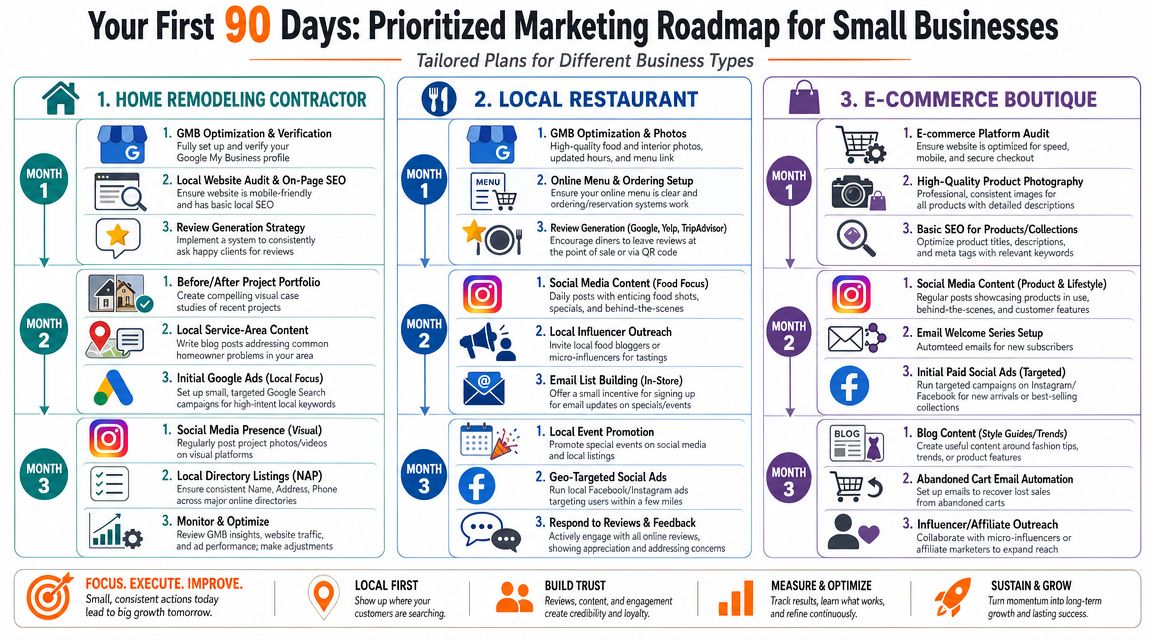
Home services
HVAC, plumbing, electrical, roofing, and similar service businesses usually do not have a traffic problem first. They have a response and trust problem. If the phone is hard to reach, the service area is unclear, or review activity looks stale, more clicks will not fix the pipeline.
- Days 1 to 30: clean up Google Business Profile, confirm service areas, fix wrong hours and call routing, tighten click-to-call paths, and start a review request process tied to completed jobs.
- Days 31 to 60: add recent job photos, strengthen service and city pages, set expectations for response time on forms, and make sure someone owns missed-call follow-up.
- Days 61 to 90: add branded and high-intent paid search after lead handling is consistent and booking capacity can support more demand.
Healthcare practices
Dental, med spa, veterinary, chiropractic, and similar practices need trust and intake discipline early. Review requests and responses must stay HIPAA-aware, and the front desk needs a clear process for handling web leads fast.
- Days 1 to 30: standardize listings, tighten provider and service descriptions, confirm phone and booking accuracy, and train staff on compliant review asks and response rules.
- Days 31 to 60: improve location content, FAQs, insurance or financing details, and pre-visit information that reduces hesitation before booking.
- Days 61 to 90: add educational content and selective paid campaigns for high-value services once scheduling, follow-up, and review generation are steady.
Multi-location retail and franchise
Multi-location brands need control before expansion. One bad phone number, duplicate listing, or inconsistent hours at the location level can waste spend across the system.
- Days 1 to 30: audit every location for hours, categories, phone numbers, duplicate listings, and broken map pins.
- Days 31 to 60: launch review workflows by location, define who responds, set escalation rules for complaints, and check that store teams know what to do with inbound leads or messages.
- Days 61 to 90: localize offers, location pages, and store-level support by market after the core data is accurate and response coverage is in place.
If you want help building that rollout without locking into a long contract, ask about month-to-month support.
The strongest first-quarter plans feel operational because local revenue depends on details like listing accuracy, review activity, and how quickly a real person responds.
Frequently Asked Questions
How much should a small business budget for internet marketing?
Base the budget on channel fit, margin, and operational capacity. Start with the channels closest to purchase intent, then expand once you can measure results clearly.
How long does SEO take?
Local SEO usually requires patience because rankings depend on profile quality, website relevance, and review activity over time. PPC can create visibility faster, but it won't fix weak conversion paths.
Can I do internet marketing myself?
Yes, many owners can handle basics like updating profiles, asking for reviews, and tightening website calls to action. The difficulty is consistency, cross-location governance, and measurement.
What's the difference between SEO and SEM?
SEO is unpaid search visibility. SEM usually refers to paid search marketing such as Google Ads.
Is social media necessary for every local business?
No. Some businesses get more value from search, reviews, and email than from daily posting. Social works best when buyers expect visual proof, community engagement, or regular updates.
What matters more, ads or reviews?
If local buyers are already searching for your service, reviews often have a bigger effect on whether they choose you. Ads can increase visibility, but trust still decides the click and the call.
What's the first thing to fix if leads are weak?
Check Google Business Profile accuracy, reviews, mobile conversion paths, and response speed before adding more traffic sources.
If you want a practical system for reviews, listings, and local conversion tracking without a long-term commitment, Reviews To The Top can help you tighten the operational side of local marketing and support it month to month.