A driver in [City] hears a clunk, feels the steering pull, and searches tn auto service near me before the next red light. If your shop doesn't show up with a credible profile, recent reviews, and clear service signals, that call goes to someone else. For most Tennessee shops, Google Maps visibility is no longer a branding issue. It's a booking issue.
Table of Contents
- Winning the Moment a Customer Searches for TN Auto Service
- Understanding Your Tennessee Auto Service Customer
- How Google Ranks Auto Shops in Local Search
- The Economics of Trust Online Reviews and Reputation
- Actionable Templates to Grow Your Reviews
- Your 7-Day Launch and Measurement Plan
- FAQs for TN Auto Service Owners
Winning the Moment a Customer Searches for TN Auto Service
The highest-value search for most repair shops isn't broad brand discovery. It's the urgent, local search done on a phone by someone who needs a fix, an answer, or a shop they can trust right now.
That's why tn auto service marketing has to start with the search moment itself. A customer types “auto repair near me,” “brake shop near me,” or “check engine light [Neighborhood].” Google shows a tight set of local results. The shops that win usually make the decision easy. Clear hours. Accurate phone number. Strong reviews. Real service categories. Photos that look current. A profile that feels alive.
Practical rule: If a driver has to think too hard, they won't call.
Owners often overfocus on websites and underfocus on Maps. Your website still matters, but the local pack often gets the first look, the first tap, and the first call. For a busy operator, that means your first priority is making your business profile conversion-ready, then making sure your reputation supports it.
Three things move the needle fastest:
- Accuracy first: Your business name, address, phone, hours, and service list need to match everywhere.
- Trust signals next: Recent reviews and active responses help a shop feel current and accountable.
- Intent match: Your profile should reflect what people search for, including diagnostics, brakes, suspension, AC, tires, and “near me” intent in places like [City] and [Neighborhood].
If your shop serves multiple Tennessee markets, each location needs its own complete local presence. One strong master brand doesn't fix weak location pages or neglected profiles.
A practical starting point is to optimize your Google Business Profile before you spend more on ads or broader SEO. Most shops have more upside there than they think.
Understanding Your Tennessee Auto Service Customer
Tennessee drivers don't search in neat marketing categories. They search from frustration, urgency, and cost concern. “Grinding noise front end.” “Car shaking on highway.” “Battery dead after work.” “Best mechanic near me.” That means your messaging has to meet the problem behind the keyword, not just list generic services.
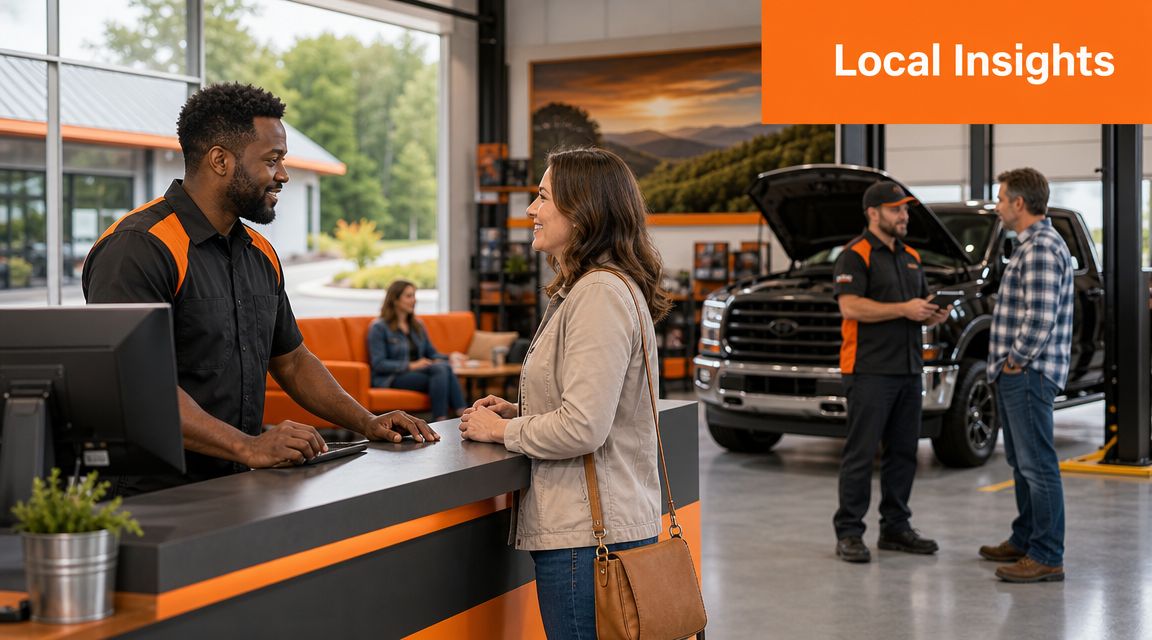
What Tennessee drivers are actually trying to solve
A lot of shops write service pages as if every visitor is calmly scheduling maintenance. That's not how local demand works. Some customers need routine work. Others need immediate mobility restored so they can get to work, pick up kids, or make a medical appointment.
Tennessee has a state-run roadside option through the TDOT HELP program, which patrols major freeways in Nashville, Knoxville, Chattanooga, and Memphis seven days a week and provides assistance without charge. That matters because some searches for tn auto service are really first-step breakdown searches, not repair-shop comparisons. A smart shop account for this in FAQs and service pages by clarifying when a driver should call roadside assistance first and when they should contact a repair shop or tow service.
There's another blind spot. Many local pages talk about oil changes and brakes, but skip undercarriage risk. Yet Tennessee driving conditions make that topic useful. Local service content cited by Ewing Bass Garage's undercar services page points to undercar repairs that include brake lines and suspension. The better marketing angle is not “we do undercar work.” It's “after a pothole hit or debris impact, here are the warning signs that justify a full inspection.”
Customers respond to problem recognition before they respond to service menus.
How to position your messaging for local intent
Good local positioning sounds like a service advisor, not a brochure. Use plain language tied to real search behavior in [City], [Neighborhood], and nearby corridors.
A stronger framing looks like this:
- Routine intent: “Factory-scheduled maintenance, oil changes, brake inspections, tire service.”
- Symptom intent: “Clunking over bumps, pulling steering, vibration at speed, no-start diagnosis.”
- Urgent intent: “Breakdown help, towing coordination, same-day diagnostic triage.”
- Safety intent: “Post-impact suspension and undercarriage inspections after potholes or road debris.”
This is also where automotive shop marketing gets more effective. Shops that reflect local conditions and customer urgency tend to earn more trust before the first phone call.
If you want better conversion from Maps and “near me” searches, write for the actual job the customer is hiring your shop to do. Often that job is not “perform service.” It's “help me keep my day from falling apart.”
How Google Ranks Auto Shops in Local Search
Google local rankings are easier to work with once you strip away the mystery. For auto shops, the core model is proximity, relevance, and prominence. You can't fully control proximity, but you can tighten the other two fast.
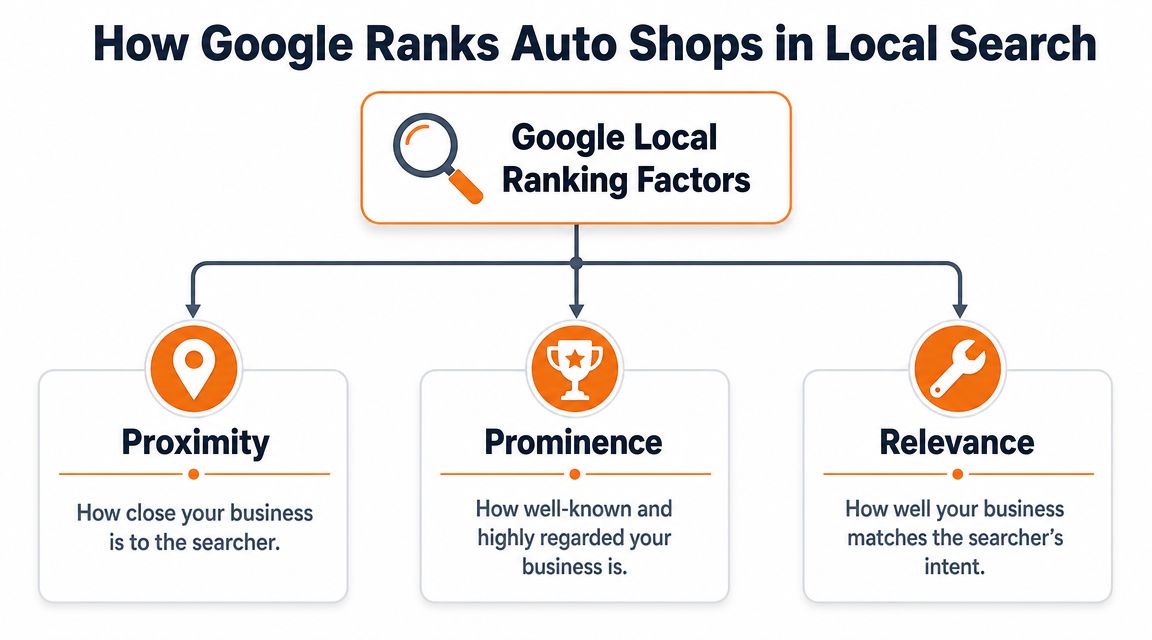
Proximity relevance prominence
Proximity is simple. Google considers how close your location is to the person searching. A shop in [Neighborhood] has an edge for a searcher nearby, especially on mobile.
Relevance is where many operators leave money on the table. Google needs evidence that your shop matches the search. If a driver searches “suspension repair near me” and your profile only emphasizes “auto repair,” you're asking Google to guess.
Prominence is your reputation footprint. Reviews, responses, complete profiles, and consistent business data all help. Shops that look established and trustworthy tend to earn more clicks and calls.
For owners trying to improve local pack visibility, this is the best mental model to keep: proximity gets you considered, relevance gets you shown, prominence gets you chosen.
A deeper walkthrough on Maps visibility is available if you want to rank higher on Google Maps.
Google Business Profile checklist for auto shops
Most GBP issues are operational, not technical. Use this short checklist:
- Primary category: Choose the category that best matches your main revenue driver.
- Secondary categories: Add supporting categories only when they reflect real services.
- NAP consistency: Keep your name, address, and phone number identical across web listings.
- Hours and holiday hours: Fix them before customers find the wrong answer.
- Services: List actual repair and maintenance offerings with clear wording.
- Photos: Add exterior, lobby, bays, team, and service photos that look current.
- Booking and call paths: Make sure calls route correctly and booking links work on mobile.
- Location detail: Mention service areas naturally on your site, such as [City] and [Neighborhood].
A quick visual helps teams remember the model before they start editing profiles.
Why technical detail improves relevance
Google also reads the depth of your service language. That's one reason vague copy underperforms. Tennessee automotive training aligns with the eight core ASE A-series domains through TCAT Elizabethton's automotive technology program, including engine repair, brakes, electrical and electronic systems, heating and air conditioning, and engine performance. In practice, that means strong shops diagnose across systems, not just replace parts.
Use that reality in your content and profile language. “Diagnostic testing for drivability, electrical, and engine performance concerns” is more useful than “we fix cars.” It's better for the customer, and it gives Google clearer relevance signals.
The Economics of Trust Online Reviews and Reputation
A Tennessee driver searches “best auto repair near me” after a breakdown, a warning light, or a quote that felt too high somewhere else. Your shop gets a few seconds to look like the safe choice. Reviews do a big part of that work before anyone calls the front desk.
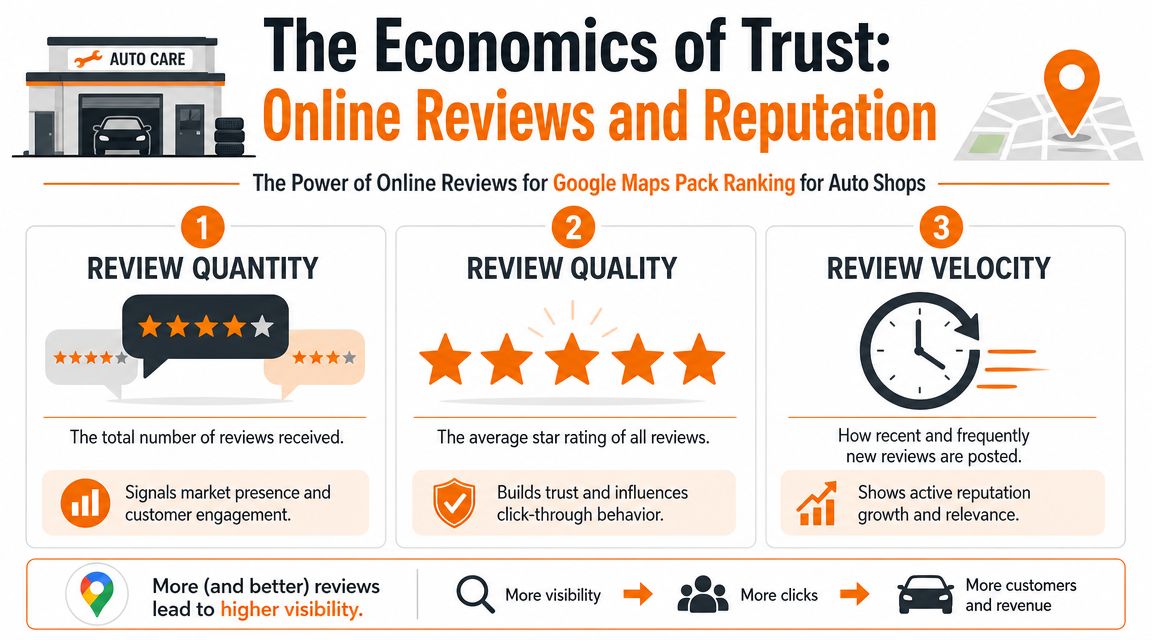
Key Facts
| Fact |
|---|
| Tennessee has a large automotive service workforce, and a Clarksville Now repair-market overview points to steady demand for technicians and mechanics. |
| That same labor pressure affects customer experience. Shops that are short-staffed often struggle with communication speed, estimate follow-up, and consistency at pickup. |
| A visible review profile helps in two places that matter to revenue. It increases customer confidence, and it gives potential hires a quick read on how the shop operates. |
Why reviews pay for themselves
Reviews influence ranking, but the bigger business effect is conversion. A strong profile turns search impressions into calls. A weak one sends the click to the next shop.
Drivers are not judging torque specs or scan-tool skill from a Google listing. They are judging risk. They read for signs that your team explains repairs clearly, finishes close to the promised time, handles pricing professionally, and stands behind the work if something goes sideways.
That is the gap many shop owners miss. They see reviews as branding. Customers use them as proof that booking with you is less likely to become a headache.
One bad review will not sink a good shop. Twenty stale reviews, no owner responses, and a six-month silence absolutely can.
What changes before the phone rings
Three trust signals matter more than owners usually expect.
First, recency. A profile full of old reviews makes the shop feel inactive, even if the bays are full. Second, specificity. “Great service” helps a little. “They diagnosed an intermittent electrical issue and explained the fix in plain English” helps a lot more. Third, response quality. A short, calm reply tells future customers that someone in the building is paying attention.
This also affects hiring. Good technicians look at reviews too. They want to avoid shops with chronic communication problems, pricing fights, or a pattern of customers saying they felt ignored. Reputation is not just front-end marketing. It shapes who wants to work there.
A thin review profile creates friction. Drivers who are ready to book keep shopping.
What actually works in an auto shop
The best review systems are boring on purpose. They run the same way every day.
- Ask after the concern is resolved: The customer understands the invoice, has the keys, and feels the problem is handled.
- Use a direct review link: Fewer steps means more completed reviews.
- Put the process with the advisor or cashier: That is where the handoff happens.
- Reply to reviews quickly: Short, specific, professional responses are enough.
- Watch for patterns: If reviews keep mentioning wait times, poor updates, or surprise charges, fix the process, not just the wording online.
A few habits waste time.
- Inconsistent asking: If requests depend on memory, review flow dries up.
- Defensive replies: Arguing in public lowers trust with the next customer reading the thread.
- Generic language: Broad praise looks nice but does less for conversion than detailed service feedback.
- Ignoring criticism: Silence reads like indifference.
If you want a repeatable way to get Google reviews from real customers, build it into checkout and measure it like any other front-desk process. Shops that do this well usually see the payoff in better call conversion, stronger map performance, and fewer shoppers asking, “Why should I choose you?”
Actionable Templates to Grow Your Reviews
A review program works best when it feels like part of checkout, not an extra marketing task. In most shops, the service advisor or cashier should trigger the request. The timing should be tight. Same day is better than “whenever we remember.”
When to ask and who should ask
Ask after the invoice is explained and the customer's main concern is resolved. If there's still confusion about price, warranty, or next steps, wait until that is clean. Asking too early creates avoidable negative feedback.
Keep the handoff simple:
- Advisor closes out the job.
- Customer gets keys and summary.
- Advisor says a short verbal ask.
- SMS or email goes out with the direct review link.
Shop-floor advice: The script should sound like something your staff would actually say at 5:15 p.m. on a busy Friday.
A verbal line that works well is: “If we took good care of you today, I'll text you a quick review link. It helps other drivers in [City] know what to expect.”
Review Request and Response Templates
| Template Type | Script |
|---|---|
| SMS review request | Hi [First Name], thanks for trusting [Shop Name] with your [Vehicle Make/Model]. If your visit went well, would you mind sharing a quick Google review? It helps other local drivers find a shop they can trust: [Review Link] |
| Email review request | Subject: Quick favor from [Shop Name] nnHi [First Name], thank you for choosing [Shop Name] for your recent service. We know drivers have a lot of options for tn auto service in [City], so we appreciate the opportunity to help. If you have a minute, please leave a quick Google review here: [Review Link] nnYour feedback helps other customers decide who to call when they need reliable auto repair near me. nnThank you, n[Advisor Name] n[Shop Name] |
| Positive review response | Thank you, [First Name]. We appreciate you trusting us with your vehicle and taking the time to share your experience. Our team works hard to explain repairs clearly and get drivers back on the road with confidence. If you ever need maintenance or diagnostics in [City], we're here to help. |
| Negative review response | Thank you for the feedback, [First Name]. We're sorry your visit didn't meet expectations. We take concerns about communication, timing, and repair experience seriously. Please contact [Name/Role] at [Phone] so we can review what happened and work toward a fair resolution. |
Why these work:
- They're short: Customers decide fast.
- They're specific: The message references the visit, not a generic campaign.
- They reduce friction: One clear action, one link.
- They stay professional: Especially on negative replies, the goal is accountability without arguing in public.
Don't bribe for reviews. Don't gate who gets asked based on assumptions. Ask broadly, then manage the responses well.
Your 7-Day Launch and Measurement Plan
Most review programs fail because they depend on good intentions. Shops get busy. Advisors forget. No one owns the dashboard. A short launch sprint fixes that by making the process operational.
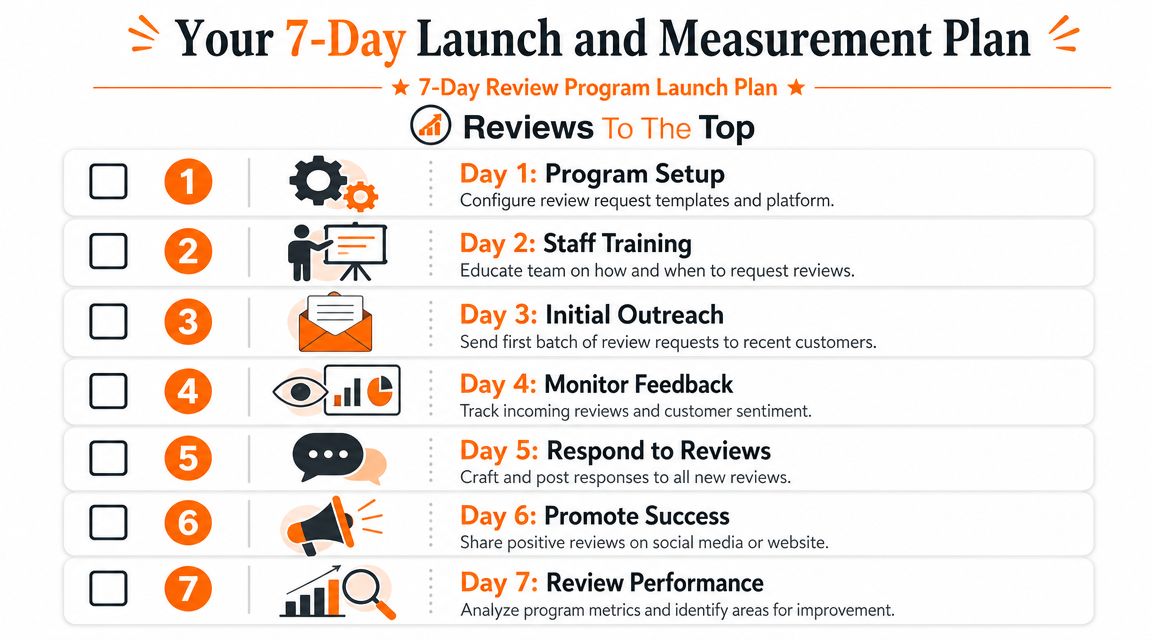
7-Day Review Program Launch Checklist
| Day | Action |
|---|---|
| Day 1 | Confirm your Google Business Profile details, review link, assigned owner, and response workflow. |
| Day 2 | Train advisors and front-desk staff on when to ask, what to say, and how to flag unhappy customers before a request goes out. |
| Day 3 | Send review requests to a recent batch of completed customers whose jobs closed cleanly. |
| Day 4 | Check incoming reviews, confirm notifications work, and correct any process gaps. |
| Day 5 | Respond to every new review. Keep positive replies warm and negative replies calm and short. |
| Day 6 | Update weak directory listings and local citations so core location data stays consistent. |
| Day 7 | Review calls, bookings, review flow, and profile engagement. Adjust the ask process where staff friction shows up. |
If your shop has inconsistent business data across directories, build local citations before you expect stable local search performance. Bad location data creates friction for both Google and customers.
What to measure every week
Not every metric deserves equal attention. Track the ones that tie to discoverability and closed work.
Recommended scorecard:
- Review volume: Set a monthly goal per location that your staff can realistically hit and sustain.
- Recency: Watch whether new reviews are coming in steadily or in bursts.
- Response time: Aim to answer reviews quickly enough that the profile looks active.
- Star rating: Monitor trend, not just snapshot.
- GBP views and calls: Watch for direction over time after profile and review improvements.
- Lead-to-sale conversion: Compare booked work against inbound calls and form leads from Google channels.
Don't obsess over daily ranking fluctuations. In local search, operating discipline usually matters more than minute-by-minute checking.
How to track GBP to calls and bookings
Use tagged links in your Google Business Profile website and appointment fields so your analytics can separate GBP traffic from other traffic. A simple UTM structure can include source, medium, and location name. For example, tag each location link so [City East] and [City West] don't blur together in reports.
Then connect the path:
- GBP click or call
- Landing page visit or phone conversation
- Appointment set
- Vehicle shown
- Invoice closed
That chain matters more than impressions alone. If one location gets fewer views but converts more callers into approved work, that location may be operating better even if rankings look similar.
FAQs for TN Auto Service Owners
A driver in Murfreesboro searches for "best auto repair near me" after hearing a suspension clunk on the way to work. Your shop shows up. So do three competitors with similar services, similar hours, and similar pricing. At that point, the shop that wins is usually the one with cleaner trust signals, better review proof, and a profile that answers the customer's question fast enough to earn the call.
Frequently Asked Questions
| Question | Answer |
|---|---|
| What's the fastest way to improve tn auto service visibility in Google Maps? | Clean up your Google Business Profile first. Make sure your primary category fits the core service, your hours are accurate, your service list reflects actual repair work, and your photos look current. Then put a steady review request process in place. For most Tennessee shops, that combination drives faster gains than waiting on website changes alone. |
| Does “near me” wording still matter? | Yes, but as a reflection of search intent, not as a phrase to force into every line. Build pages and FAQs around real services, real cities, and real customer problems. Google already understands proximity. Your job is to make relevance and trust obvious. |
| What should a multi-location Tennessee operator do differently? | Run each location like its own local storefront. Each shop needs its own profile, review mix, service-area wording, and call tracking. A Nashville customer and a Johnson City customer may search for the same repair, but Google still evaluates the nearest and most credible local result. |
| Is there enough demand to justify investing in local visibility? | Yes. Tennessee has a large vehicle-related economy, and that supports steady downstream demand for maintenance and repair. Think Tennessee's review of the state's automotive growth reports that the state's auto manufacturing sector accounts for 16.6% of manufacturing output and employed 66,828 auto manufacturing workers in 2024, with projections of 86,459 by 2032. For shop owners, the practical takeaway is simple. More vehicles, more commuters, and more working households usually mean more ongoing service demand. |
| Should I create content beyond oil changes and brakes? | Yes. Basic maintenance terms are crowded and often price-sensitive. Shops usually get better leads from content tied to diagnosis and decision-making, such as check engine light testing, vibration at highway speed, hard shifting, suspension noise, post-pothole inspection, or whether a repair is still safe to delay for a week. Those searches often come from customers closer to booking. |
| Can reputation help with hiring too? | Yes. Technicians read reviews. So do service advisors who might be considering a move. A shop with recent customer feedback, professional replies, and accurate listings looks better run. That matters when skilled people are deciding where they want to work. |
| We also offer detailing. Should that be marketed separately? | Usually, yes. Detailing attracts a different customer, a different service cadence, and different expectations around packages and presentation. If you want to expand that side of the operation, this guide to building a successful detailing business is a useful starting point. |
If you want help turning reviews, listings, and Google Business Profile work into measurable calls and bookings, Reviews To The Top offers month-to-month support for local and multi-location operators. If you'd like a practical plan for your shop, you can book a strategy call.