
Effective dentist practice management comes down to running three systems together: finance, operations, and patient acquisition. Practices that track overhead against the 60 to 65% benchmark, aim for 25 to 50 new patients per provider per month, and actively reduce no-shows with automated reminders put themselves in a much stronger position to increase calls, messages, bookings, and treatment starts.
If you're running a practice in [City] or overseeing several locations across [Neighborhood] markets, you probably feel the same tension most operators do. The schedule looks full until no-shows hit. Production looks strong until overhead eats the margin. Marketing seems busy, but the front desk still says, "We need more qualified new patients." That isn't a marketing problem alone. It's a management problem.
The practices that grow don't treat the business as a stack of separate departments. They treat patient flow, scheduling, staff behavior, case acceptance, reviews, and local visibility as one connected system. When that system works, patients find you in "dentist near me" searches, book faster, show up more reliably, accept more treatment, and leave stronger public feedback that drives the next round of demand.
Table of Contents
- The Modern Dental Practice CEO Mindset
- Mastering Your Financial Health and KPIs
- Optimizing Daily Operations and Staffing
- Building The Patient Experience Flywheel
- Dominating Local Search and Online Reputation
- Choosing Your Dentist Practice Management Tech Stack
- Your Implementation Playbook and FAQs
- A practical 90 day rollout
- Measurement that ties GBP to bookings
- FAQs
- How often should a dentist review practice KPIs
- What's the most important KPI in dentist practice management
- How many new patients should a dental practice target
- What overhead percentage is healthy for a dental practice
- How can a dental office reduce no shows
- Does online reputation really affect local bookings
- What's the right way to respond to negative reviews in healthcare
The Modern Dental Practice CEO Mindset
Clinical skill gets patients healthy. It doesn't automatically build a durable business. The operator who wins in modern dentist practice management knows how to read a P&L, protect schedule efficiency, coach the front desk, and make sure great patient experiences turn into visible reputation signals online.

What changes when you think like an owner operator
The biggest shift is this. You stop managing by stress and start managing by signal.
A CEO mindset means you don't ask only, "Was today busy?" You ask whether the day created profitable production, whether the schedule was filled with the right mix of visits, whether the team converted demand efficiently, and whether the patient journey strengthened future demand through reviews and referrals.
That matters because overhead is unforgiving. Overhead percentage is a critical KPI, with industry benchmarks targeting 60 to 65% of total income. Post-pandemic inflation pushed the average to 68 to 70% in 2022 to 2023, with staff costs alone accounting for 25 to 30% of collections according to dental practice KPI benchmarks. When a practice drifts above target, good production can still produce disappointing profit.
Practical rule: If you're reviewing collections every week but overhead only when payroll feels painful, you're managing too late.
The core system to manage every week
Strong practices manage a connected chain:
- Demand generation: Are you attracting the right new patients from search, referrals, and reputation?
- Front desk conversion: Are calls, forms, and messages turning into confirmed appointments?
- Schedule integrity: Are productive blocks protected, and are short-notice holes being filled?
- Chairside trust: Are treatment recommendations being explained clearly and consistently?
- Post-visit advocacy: Are satisfied patients being prompted to leave compliant feedback?
- Financial review: Are expenses and staffing decisions aligned with margin targets?
Most struggling practices are not broken everywhere. They usually have one weak link that distorts the rest. A leaky schedule creates idle time. Idle time creates pressure. Pressure leads to rushed conversations or poor service recovery. That reduces review quality and referral momentum. Then ownership spends more trying to buy growth back.
This is why reputation can't be treated as a side task. If you want a clear example of how patient perception becomes revenue, study strong reputation management for dentists programs. They work best when operations and communication are already disciplined.
A good operator doesn't separate "practice management" from "marketing." Patients don't experience your org chart. They experience one journey.
Mastering Your Financial Health and KPIs
Monday opens with a full schedule, a busy hygiene column, and a team that feels productive. Then the month closes and profit is thin. In almost every case, the problem is not one bad number. It is a chain reaction across pricing, payroll, scheduling, treatment acceptance, and patient acquisition cost.
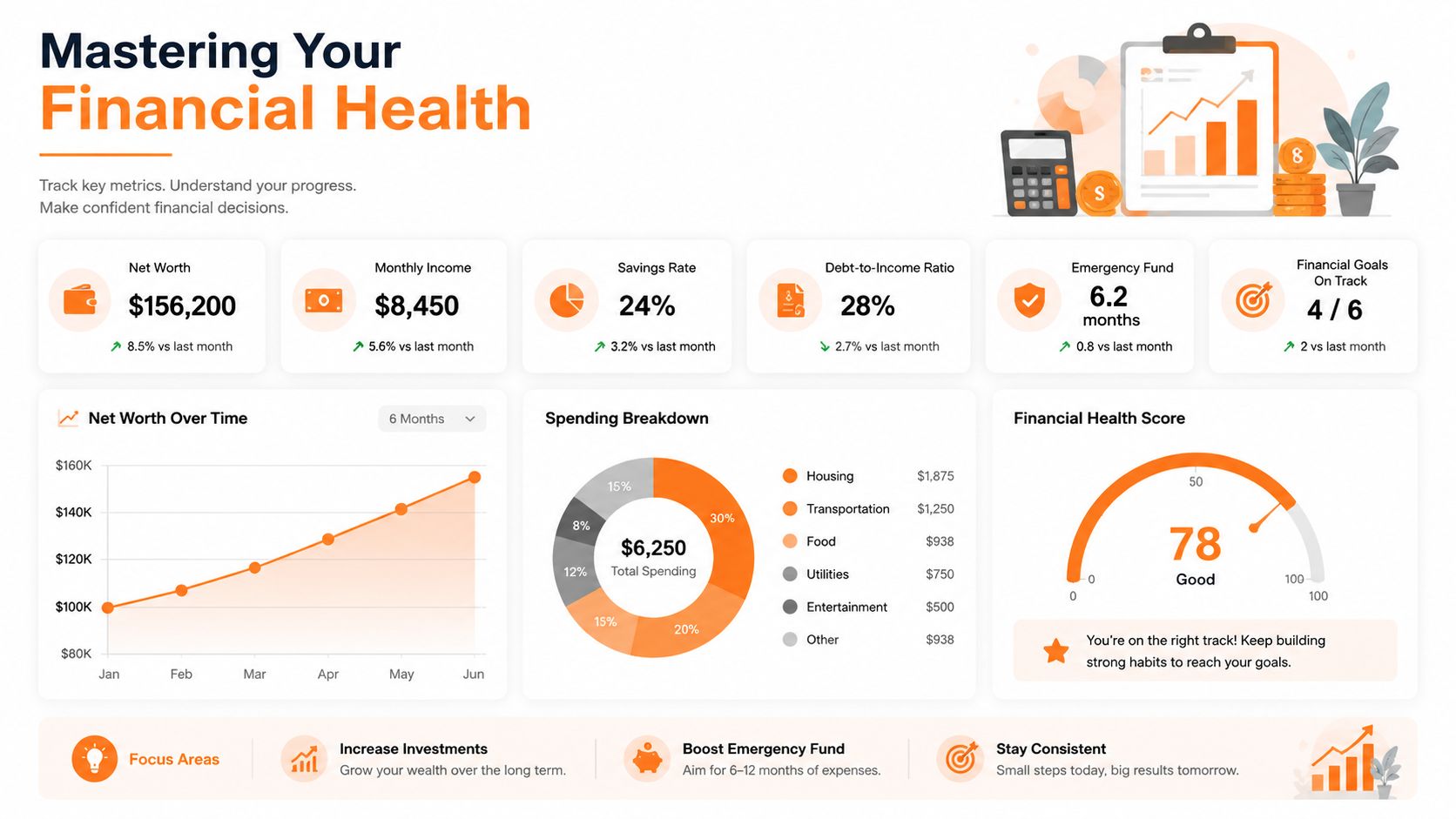
Owners who scale well stop treating finance as a bookkeeping exercise. They use a compact scorecard to see whether the business model is healthy, whether patients are converting into production, and whether growth is profitable after labor and marketing costs.
The numbers that deserve a monthly dashboard
Keep the dashboard short enough to review every month without fail. For most practices, that means overhead, payroll percentage, collections, new patient volume, case acceptance, hygiene production, no-show rate, and provider productivity. That set is enough to separate a demand problem from an operations problem or a cost structure problem.
The useful move is to read those numbers together. Rising new patient volume with flat collections usually points to poor case presentation, weak payer mix, or low-value appointment fill. High production with weak profit usually points to payroll creep, supply cost drift, or too many low-margin procedures crowding the schedule.
If the books are messy or the reporting cadence keeps slipping, fix that early. Clean monthly reporting gives ownership faster decisions on hiring, marketing spend, and provider mix. Many growth-minded owners use outside specialists or Hire CPAs to tighten reporting and build owner-level dashboards.
What to track, and why it matters
A KPI matters only if it leads to action. These are the metrics I would review first with any owner.
- Overhead percentage: Shows how much revenue the practice consumes to stay open. If it climbs, review payroll, supply purchasing, lab costs, rent, and procedure mix before adding more marketing spend.
- Payroll as a percentage of collections: Labor is usually the largest controllable expense. A high number can mean overstaffing, low schedule utilization, or compensation plans that no longer fit current production.
- Collections and collection rate: Production does not pay bills. Collections reveal whether insurance follow-up, patient financing, and front-desk financial conversations are working.
- New patient volume by source: Volume alone is not enough. Track whether new patients came from search, referrals, paid ads, or reactivation, then compare those sources against collections and treatment value.
- Case acceptance: Clinical trust translates into revenue. If acceptance drops, check exam-to-treatment handoff, financing options, and follow-up speed.
- Hygiene production and reappointment rate: Hygiene is both a production center and a retention engine. Weak recare creates softer future doctor schedules.
- No-show and late-cancel rate: This metric belongs on the financial dashboard because open chair time erodes labor efficiency and daily production.
- Provider productivity: Compare doctors and hygienists by adjusted production, procedure mix, and schedule utilization, not by raw busyness.
Key Dental Practice Financial KPIs and Benchmarks
| KPI (Key Performance Indicator) | Industry Benchmark | What it Measures |
|---|---|---|
| Overhead percentage | Varies by model and payer mix | How much of revenue is consumed by operating expense |
| Payroll as a share of collections | Varies by staffing model | Whether labor cost is aligned with collections |
| New patients per provider | Tracked monthly against capacity | Growth capacity and replacement of attrition |
| Patient retention rate | Tracked over time | Whether active patients continue care |
| Case acceptance for routine care | Tracked by provider and coordinator | How often straightforward care plans are accepted |
| Case acceptance for larger treatment plans | Tracked separately from routine care | How well higher-value treatment converts |
| Hygiene production share | Tracked monthly | Preventive engine strength and recare contribution |
Benchmarks help, but context matters more. A fee-for-service cosmetic office, a PPO-heavy family practice, and a Medicaid pediatric office should not be managed to the same margin assumptions. Use benchmarks to ask better questions, then compare each location against its own history, capacity, and patient mix.
For multi-location groups, the best financial review happens at three levels. Start at the enterprise level for margin and cash flow. Then review each location for production, labor, and new patient quality. Finally, break out provider-level performance to find training needs, scheduling issues, or treatment presentation gaps. That is the CEO view. It connects the P&L to the patient journey instead of treating finance, operations, and marketing as separate departments.
One more point. Marketing reporting belongs inside the financial conversation. A proper local SEO reporting dashboard for dental practices helps connect visibility, calls, reviews, and booked appointments to the revenue those patients generate over time.
Optimizing Daily Operations and Staffing
Monday looks full on the schedule. By noon, two patients have canceled, one crown seat is sitting in a hygiene gap, the doctor is waiting between exams, and the front desk is scrambling to fill holes instead of controlling the day. That is not a demand problem. It is an operating system problem.
Strong practices do not treat scheduling, staffing, and patient communication as separate tasks. They run them as one system. A broken schedule hurts production. Weak communication increases no-shows. Unclear roles slow handoffs and leave treatment unscheduled. The result is lower collections, stressed teams, and a patient experience that feels disorganized before anyone complains publicly.
Fix the schedule before you add more marketing
A full schedule is not the same as a productive schedule. The question is whether the calendar protects the procedures, providers, and visit types that move the practice forward.
Too many offices drift into first-available scheduling. It feels convenient in the moment and expensive by the end of the month. High-value procedures land in poor time slots. Doctors lose momentum. Hygiene runs late because exams stack up. The front desk spends the day reacting.
A better template is simple and strict enough to protect production without making access harder for patients.
- Reserve prime blocks for the procedures that drive the most revenue and require the most focus.
- Hold limited same-day capacity for emergencies so they do not consume the entire schedule.
- Review the next day in advance with the scheduling lead and clinical lead.
- Identify weak appointments early so the team can confirm, reschedule, or replace them before chair time is lost.
This is a CEO issue, not just a scheduling issue. Template design determines provider utilization, labor efficiency, treatment mix, and how often patients can get the care they were diagnosed to need.
Reduce no-shows with a workflow, not reminders alone
Missed appointments are rarely just a reminder problem. They usually start earlier. The patient was not given a strong reason to keep the visit, did not understand the next step, or booked too far out without enough follow-up.
The fix is a layered process tied to appointment value and patient behavior.
- At booking: Confirm the purpose of the visit, the time, location, and any preparation in plain language.
- Several days before: Send a reminder that asks for a clear confirmation response.
- The day before: Send a shorter follow-up to anyone who has not confirmed.
- For higher-risk patients: Assign direct outreach by phone, not another automated message.
- For open chair time: Keep a short-notice list with patients who already want sooner appointments.
Practices that handle this well also make two-way communication easy and secure. A HIPAA compliant patient messaging platform helps staff confirm visits, answer simple questions, and fill openings without creating unnecessary compliance risk.
When a patient misses repeatedly, look at the handoff. The team may be booking a date without building commitment.
Staffing without bloat
Labor is too expensive to manage by instinct. Understaffing creates delays, burnout, and rushed patient interactions. Overstaffing hides weak processes and drags down margin.
The first move is not hiring. The first move is role clarity.
Every practice should be able to answer three questions without hesitation:
- Who owns schedule integrity? That includes confirmations, hole filling, and daily schedule review.
- Who owns treatment follow-up? That includes unscheduled dentistry, financing next steps, and reactivation.
- Who owns clinical flow? That includes room turnover, exam timing, and provider handoffs at checkout.
If those answers are fuzzy, headcount will not fix the problem. It will spread the problem across more payroll.
I have seen offices add another front desk coordinator when the issue was that nobody owned tomorrow's schedule after 3 p.m. I have seen practices hire another assistant when exam timing, not assistant capacity, was slowing the doctor. Good operators diagnose the constraint before they add labor.
The right staffing model gives each team member a measurable outcome. Phones answered. Hygiene reappointed. Treatment followed up. Open time reviewed daily. That is how operations, patient experience, and profitability stay connected.
Building The Patient Experience Flywheel
Patient experience is where operational excellence becomes visible. The patient doesn't know your overhead target, your staffing ratio, or your provider utilization. They know whether calling was easy, whether they felt informed, whether the visit ran on time, and whether checkout felt organized.
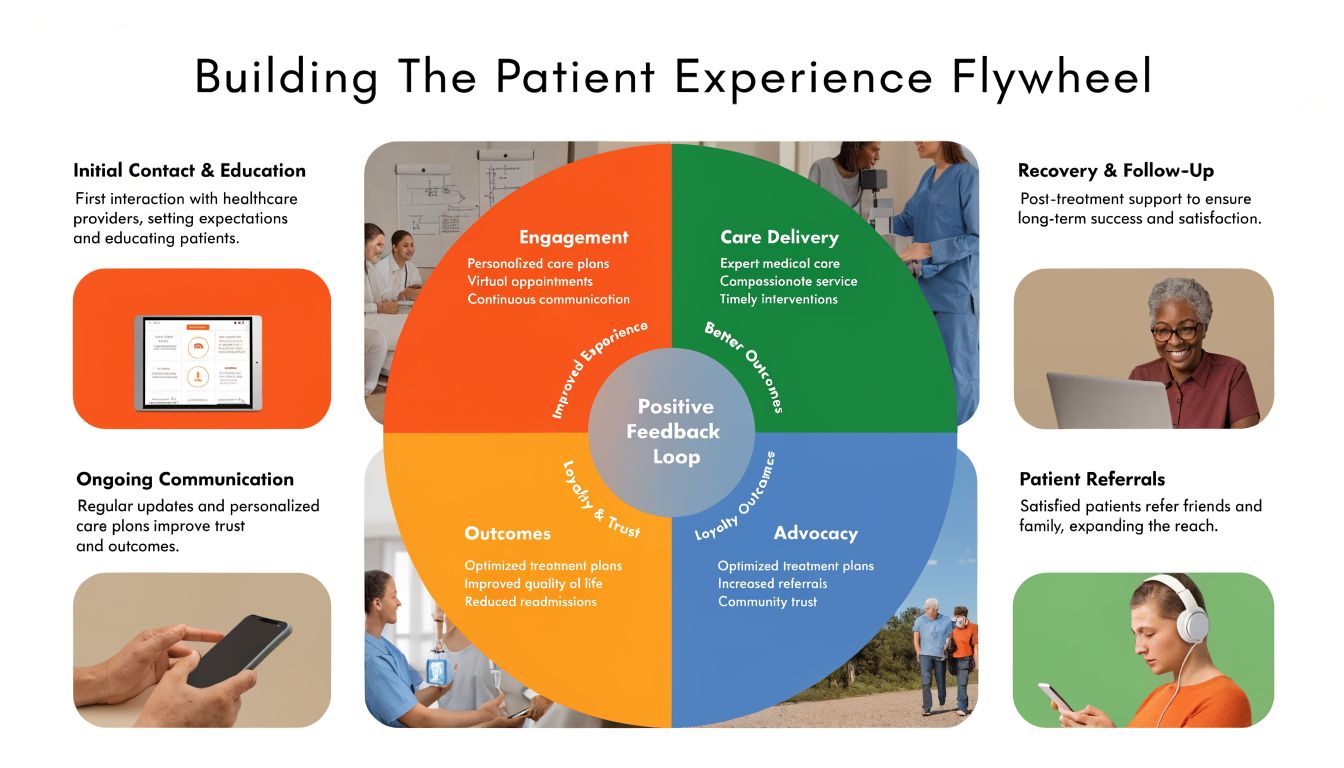
How the flywheel actually works
A well-run patient journey builds momentum in a repeatable order.
A new patient finds the practice through search, a referral, or map results. The first call or form submission gets a fast, reassuring response. The visit feels prepared. The assistant and doctor communicate clearly. The treatment plan is easy to understand. Checkout is smooth. Then the patient gets a thoughtful follow-up and a simple review request.
That final step matters because reviews are not separate from patient care. They are the public record of patient care. Strong experiences create strong sentiment. Strong sentiment creates better review content. Better review content strengthens local visibility and helps the next patient choose you.
The easiest review request is the one made right after a patient says, "That went better than I expected."
Use tools like digital intake, clear chairside scripting, and structured post-visit follow-up to remove friction. If you need a way to capture patient sentiment before issues spill into public reviews, use customer feedback forms as part of your post-visit workflow.
Templates and scripts
Keep review requests short, compliant, and free of Protected Health Information (PHI).
SMS review request
Hi [First Name], thank you for visiting [Practice Name] today. If you'd like to share feedback, we'd appreciate a quick review here: [Review Link]
Email review request
Subject: Thanks for visiting [Practice Name]
Hi [First Name],
Thank you for choosing [Practice Name]. We value your feedback and use it to improve the patient experience. If you'd like to leave a review, you can do that here: [Review Link]
Thank you again,
[Practice Name]
Positive review response template
Thank you for your kind feedback. Our team appreciates you taking the time to share your experience with [Practice Name]. We look forward to seeing you again.
Negative review response template
Thank you for your feedback. We're sorry to hear that your experience didn't meet expectations. Because we want to protect patient privacy, we won't discuss details here, but we'd like to learn more and address your concerns directly. Please contact [Phone] and ask for [Manager Name].
These scripts work because they are easy to send, easy to approve across multiple locations, and safe from a compliance standpoint.
Dominating Local Search and Online Reputation
If you want more bookings from "dentist near me" searches in [City] or "[Neighborhood] dentist," you need to understand how local search works. Google isn't ranking practices only by who has a website. It evaluates whether your location is close enough, relevant enough, and prominent enough to deserve visibility.

How Google decides who appears for dentist near me
Use this simple model.
- Proximity means how close your verified location is to the searcher or the place named in the query.
- Relevance means how well your profile, categories, services, and site content match what the patient is looking for.
- Prominence means whether the web reflects that your practice is trusted and well known. Reviews, consistent business information, and strong location signals all help.
This is why reputation work matters for search performance, not just persuasion. For dentists serving vulnerable or underserved populations, a proactive review program still matters. Responding to all feedback with on-brand, AI-assisted replies can increase Google Maps Pack rankings by 15 to 25% for relevant local searches like "FQHC dentist in [City]" according to guidance on proactive dental practice growth.
If you want a second perspective on dental visibility strategy, VIP TECH CONSULTING has a useful breakdown of SEO considerations specific to dentists.
Google Business Profile checklist
Your Google Business Profile, or GBP, is often your highest-converting local asset. Optimize every location individually.
- Primary category: Use the most accurate dental category for that office.
- Core details: Keep name, address, phone, hours, and website consistent everywhere.
- Services: Add real service lines patients search for in plain language.
- Description: Write a clear local description that mentions [City] and [Neighborhood] naturally.
- Photos: Upload current exterior, interior, team, and treatment-room photos.
- Messaging and booking: Turn on the features you can staff reliably.
- Review process: Request reviews consistently and respond quickly.
- Location pages: Make sure each office has a matching page on the site.
For healthcare operators managing multiple sites, broad local SEO for medical practices workflows often translate well to dental groups because the location-governance challenge is similar.
Don't stuff keywords into your profile. Make the profile complete, accurate, and obviously useful to a real patient.
A 7 day launch checklist for a review program
This is the fastest way to install discipline without overwhelming the team.
- Day 1. Pick the trigger points. Decide exactly when staff asks for feedback. Checkout and same-day follow-up are the cleanest moments.
- Day 2. Finalize scripts. Approve one SMS and one email template for every location.
- Day 3. Build routing. Make sure positive patient sentiment goes toward review requests and sensitive issues go to internal follow-up.
- Day 4. Assign response ownership. One person or team should own review replies and escalation.
- Day 5. Train the front line. Front desk and office managers should know when to ask, what to avoid, and how to escalate.
- Day 6. Check every GBP. Verify categories, hours, services, and links before traffic increases.
- Day 7. Launch and review daily. Watch for response delays, missing links, and location-level inconsistency.
Choosing Your Dentist Practice Management Tech Stack
A practice with a full schedule can still bleed margin if the tech stack forces the team to re-enter data, chase confirmations in three inboxes, and guess why reviews dropped at one location. I have seen offices buy more software when poor handoff between systems was the problem. The right stack supports bookings, follow-up, and visibility from one operating view.
For dental groups, that means choosing tools as a system, not as isolated purchases.
The three layer stack that helps
Most practices need three connected layers, and each one should support revenue, patient experience, and operator control.
First is the Practice Management System, or PMS. It runs the schedule, charting, patient records, billing, and core reports. In many dental groups, that means platforms like Dentrix or Eaglesoft. If the PMS is hard to report from or locked down by location, every downstream process gets slower.
Second is the communication layer. This covers reminders, confirmations, two-way texting, recall, forms, and missed-call follow-up. The test is simple. Can the front desk use it during a busy morning without creating extra clicks, and can leadership see whether messages are leading to booked visits instead of just being sent?
Third is reputation and feedback management. This layer should request reviews, route service issues for internal follow-up, track response times, and show location-level trends. Reputation software matters because it affects more than ratings. It exposes where the patient experience is breaking, which then affects retention, referrals, and acceptance of larger treatment plans.
The hard part is not buying these categories. The hard part is making them work together. If your review platform cannot tie back to real appointments, or your messaging tool cannot sync cleanly with the PMS, your team ends up maintaining workarounds instead of running the practice.
What works and what usually breaks
What works is clear ownership with tight integration. An office manager owns appointment communication. Regional operations owns escalations and workflow compliance. Marketing or growth leadership owns review velocity and listing performance. The CEO or owner gets one scorecard that connects those activities to kept appointments, reactivation, and production.
What breaks is tool sprawl.
I often see one vendor for reminders, another for forms, another for reviews, plus a spreadsheet that tracks no-shows because none of the systems agree. That setup looks manageable in demos and turns expensive in live operations. Staff stop trusting the reports. Location leaders create their own shortcuts. Brand standards drift.
When comparing vendors, use a short set of buying criteria:
- Integration quality: Does it connect to your PMS without manual exports, duplicate records, or broken mappings?
- Multi-location control: Can leadership manage templates, permissions, and escalations centrally while still giving each office the right local access?
- Reporting clarity: Can you connect activity to bookings, retention, unscheduled treatment, and recall performance?
- Front-desk usability: Can the team confirm, reschedule, and respond fast during peak hours?
- Vendor discipline: How often do integrations break, how fast is support, and who owns implementation on their side?
One more trade-off matters. All-in-one platforms reduce complexity, but they are often weaker in one or two functions. Best-in-class tools can outperform them, but only if the integrations are stable and someone on your team owns the system design. For a single office, fewer tools usually wins. For a growing group, the better choice is often a controlled stack with strong central governance.
If you're comparing options across categories, Simbie AI's software comparisons is a useful starting point.
Your Implementation Playbook and FAQs
Monday morning tells you whether the practice is being run as one system or five disconnected projects. The schedule is full, but two high-value visits were pushed out for low-production appointments. Yesterday's reviews went unanswered. One location manager changed confirmation wording. Another office is booking too far out and watching new patient inquiries go cold. None of those issues lives in a single department, and each one affects production.
That is why implementation has to follow a CEO's sequence, not a manager's checklist. Start with the controls that affect cash flow, patient conversion, and operational consistency. Then add the layers that strengthen reputation and local demand.
A practical 90 day rollout
Days 1 to 30
- Create one operating scorecard: Review production, collections, overhead, payroll, new patients, no-shows, unscheduled treatment, and case acceptance in one place.
- Fix schedule architecture: Reserve productive blocks, define emergency capacity, and stop letting the day get rebuilt by whoever answers the phone first.
- Standardize patient communication: Use one set of confirmation, cancellation, and reactivation scripts so conversion does not depend on which team member picks up the call.
- Set ownership: Assign one leader to reporting, one to schedule performance, and one to patient communication quality.
Days 31 to 60
- Turn on review requests: Send them after the visit using approved SMS and email scripts.
- Set response rules: Give the team a clear positive-review template, a negative-review escalation path, and a response-time standard.
- Clean local listings: Verify Google Business Profile details, hours, booking links, categories, and service descriptions for every location.
- Audit call handling: Spot-check missed calls, hold times, and booking conversion. Marketing waste often starts at the front desk.
Days 61 to 90
- Compare offices by conversion, not effort: Look at review recency, lead-to-booking rate, no-shows, and treatment acceptance side by side.
- Coach from real examples: Use call reviews, checkout audits, and reputation-response QA to correct weak execution.
- Centralize what should be centralized: Templates, escalation rules, reporting definitions, and listing standards should not vary by office.
- Decide what each location can customize: Local personality is useful. Local process drift is expensive.
A multi-site group usually loses margin in the handoffs. Marketing generates demand, the front desk books inconsistently, the schedule absorbs low-value work at prime times, and reputation slips because nobody owns follow-through. Fixing one piece helps. Aligning all four changes the P&L.
Measurement that ties GBP to bookings
Google Business Profile activity matters only if it produces scheduled visits and completed care. That sounds obvious, but many practices still review visibility metrics in isolation and never connect them to booking outcomes.
Track these categories each month:
- Review volume and recency: Are new reviews coming in steadily at every office?
- Response discipline: Are reviews answered within your standard, with the right tone and escalation?
- Rating trend: Is patient sentiment stable, improving, or slipping?
- GBP engagement: Are profile views turning into calls, website visits, messages, and direction requests?
- Lead-to-booking conversion: Are inbound calls, forms, and messages becoming scheduled appointments?
- Booking-to-visit conversion: Are scheduled patients showing up and starting treatment?
- Unscheduled treatment follow-up: Are high-value diagnosed cases being re-contacted and recovered?
Use UTM parameters on booking links so analytics can separate Google Business Profile traffic from other local channels. Match that traffic with call tracking, form submissions, scheduled appointments, and completed visits. The goal is simple. Prove which local visibility work creates patient flow, and stop funding activity that looks busy but does not produce care.
FAQs
How often should a dentist review practice KPIs
Review financial and growth KPIs monthly. Review schedule utilization, no-shows, call handling, and reputation response activity weekly. In practices with high new patient demand or multiple locations, a daily flash report is often worth the effort.
What's the most important KPI in dentist practice management
There is no single KPI that runs a practice well. The best operators watch a short set together: production, collections, overhead, new patient volume, lead-to-booking conversion, no-shows, case acceptance, and unscheduled treatment. That mix shows demand, margin, and execution at the same time.
How many new patients should a dental practice target
Set the target based on provider capacity, procedure mix, retention, and how quickly the practice can absorb demand without damaging patient experience. A healthy target for one office can be a bad target for another if hygiene capacity is tight or the doctor is already booked too far out.
What overhead percentage is healthy for a dental practice
Use overhead as a management tool, not a vanity number. The right range depends on rent, staffing model, specialty mix, and whether the practice is in growth mode. The better question is whether current overhead leaves enough room for strong doctor income, reinvestment, and consistent service quality.
How can a dental office reduce no shows
Start at booking, not the day before. Confirm the appointment value clearly, set expectations on timing, send reminders, and review tomorrow's schedule early enough to fill gaps. Repeat offenders need personal outreach and, in some cases, tighter scheduling rules.
Does online reputation really affect local bookings
Yes. Patients compare providers fast, especially in map results. A weaker rating, stale reviews, poor response habits, or inaccurate profile details can depress calls even when the office ranks well.
What's the right way to respond to negative reviews in healthcare
Acknowledge the concern, protect patient privacy, avoid arguing in public, and move the conversation to a manager or patient relations contact. The response should show professionalism to future patients, not try to win the exchange online.
If you want help building a disciplined, month-to-month review and local visibility program for one location or a multi-site dental group, Reviews To The Top can help you centralize requests, manage replies, improve profile accuracy, and tie reputation activity back to calls, messages, bookings, and growth. If you'd like a practical plan rather than a long sales process, you can book a strategy call and start with the locations that need the most support.


