If you want more customers to write a review for a business, you need an operating system, not a one-time ask. Reviews directly affect whether prospects call, message, book, or keep scrolling, and the gap is bigger than most owners realize: for every 100 purchases, only approximately one customer writes a review, while 82 read existing feedback, according to Chatmeter’s review statistics roundup.
Busy operators don't need another generic reminder to “ask more often.” They need a repeatable process that gets fresh, detailed reviews from real customers, protects compliance, and turns Google Business Profile activity into booked revenue.
Table of Contents
- Why Reviews Are Your Most Powerful Local Marketing Tool
- Your 7-Day Launch Plan to Generate More Reviews
- Templates and Scripts for Requesting and Responding to Reviews
- How to Measure Your Review Program's Success
- Ethical Guidelines and Advanced Strategies
- Turn Your Reviews Into a Growth Engine
Why Reviews Are Your Most Powerful Local Marketing Tool
Review volume changes buyer behavior. Marquiz found that customers start treating a star rating as credible once a business has built a meaningful base of reviews, and many buyers screen out local companies with weak ratings before they ever call or book. For a business owner, that means reviews affect two outcomes at once. They shape whether people trust you, and whether they choose you over the shop down the street.
That plays out every day in local service categories. An HVAC company can lose a high-intent homeowner to a competitor with better review depth. A dental office with strong patient feedback gets more clicks from people comparing providers. An auto repair shop with recent, specific reviews gives drivers a reason to stop searching and schedule service.

Reviews also influence local search visibility. Google evaluates proximity, relevance, and prominence. You cannot control proximity, and relevance depends on how well your Google Business Profile and website match the search. Prominence is where reviews carry real weight. A steady stream of recent feedback signals that the business is active, trusted, and worth showing.
For operators working through broader proven strategies for small business success, reviews deserve a dedicated operating process because they improve visibility and conversion at the same time. If you want a closer look at the search side, this guide on do Google reviews help SEO explains how review signals support local rankings.
Key Facts
- Buyers read far more reviews than they write. Happy customers rarely leave feedback without a prompt, a link, and good timing.
- Thin review profiles underperform. A business with only a handful of reviews looks less established than a competitor with consistent volume.
- Rating quality still filters leads. Many prospects will not contact a provider whose average score raises concerns.
- Specificity improves conversion. Reviews that mention service type, speed, communication, and outcome do more selling than “great place” ever will.
Practical rule: If reviews affect revenue, the process cannot depend on memory. Assign ownership, define the ask, and respond with a clear standard.
How Google decides who shows up near me
Local SEO is not a mystery, but it does reward disciplined operators.
If someone searches for “AC repair near me,” “family dentist in [Neighborhood],” or “brake repair in [City],” Google compares nearby options and decides which listings look most relevant and established. Reviews support that decision. They add keyword-rich service language, show recency, and strengthen the business’s public reputation.
They also help the customer do the same evaluation faster.
A homeowner choosing between two HVAC companies will look for proof that the technician showed up on time, explained the repair, and solved the issue without a callback. A dental patient wants signs of professionalism, calm staff, clear billing, and smooth scheduling. A car owner wants confidence that the shop diagnosed the problem correctly, communicated costs, and finished when promised. Strong reviews answer those questions before your team ever gets the call.
What strong reviews look like
The reviews that move rankings and sales are detailed enough to remove doubt.
For HVAC, the best reviews mention the problem, the response time, and the result. “They came out the same day, explained why the upstairs unit stopped cooling, and had it fixed before dinner” does more work than “great service.”
For dental practices, useful reviews often mention front desk experience, wait time, chairside manner, and treatment clarity. For auto repair, high-value reviews usually include diagnostics, pricing communication, repair timeline, and whether the customer felt pressured.
This is the operational point many businesses miss. The goal is not to collect random praise. The goal is to generate specific, recent, credible feedback that improves click-through rate, supports local SEO, and gives the next buyer a reason to choose you.
Your 7-Day Launch Plan to Generate More Reviews
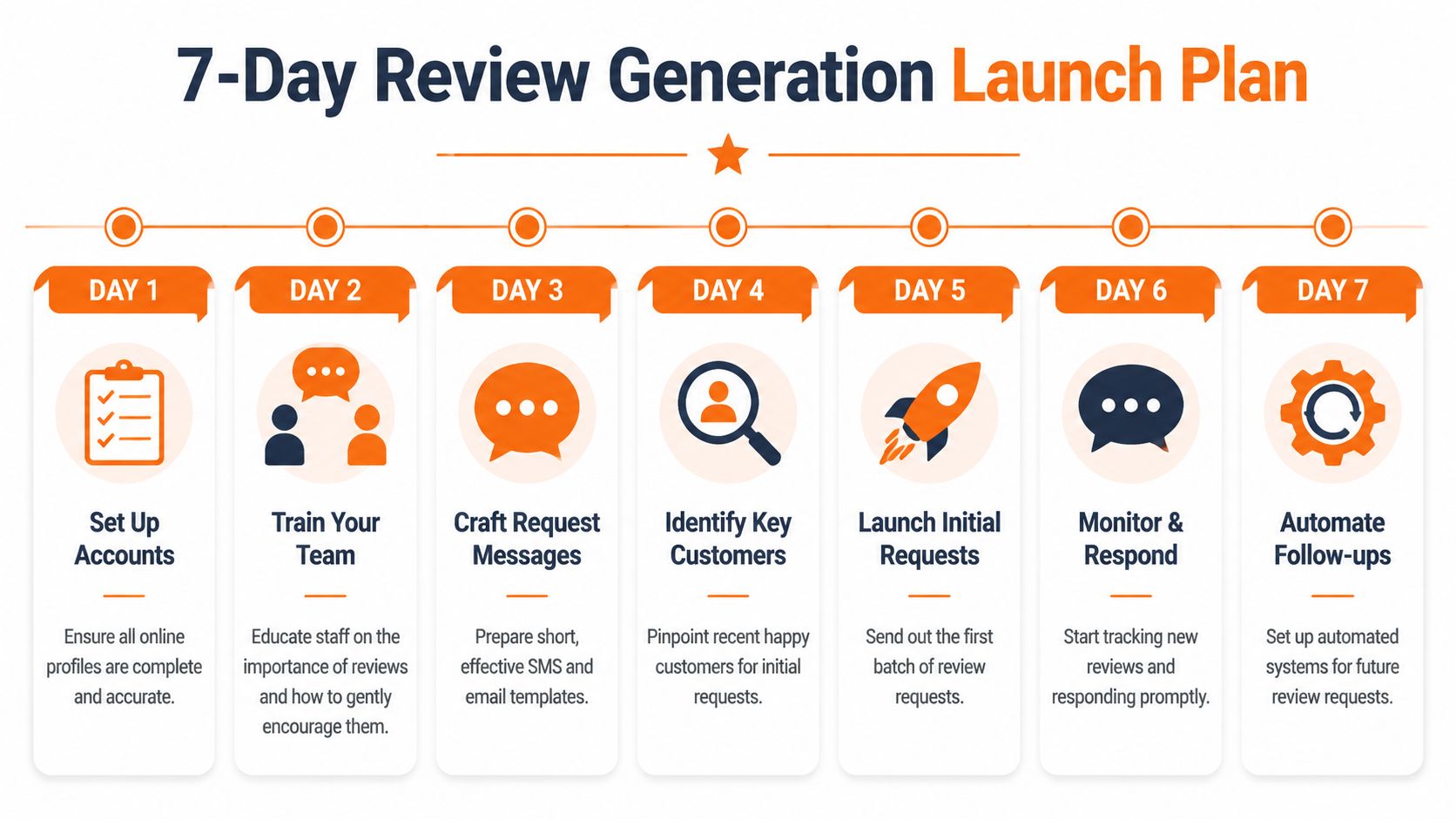
Most businesses fail here because they ask inconsistently. One manager remembers, another forgets, and the front desk only brings it up when things are slow. A seven-day rollout fixes that by turning review generation into a routine.
A short Google Business Profile checklist
Before you ask anyone to write a review for a business, tighten the profile they will land on.
- Verify basics: Confirm your business name, address, phone number, website, and hours are accurate.
- Clean up services: List core services clearly, such as emergency AC repair, Invisalign consults, oil change, or brake service.
- Add real photos: Use current team, facility, vehicle, treatment room, or storefront images.
- Choose relevant categories: Your primary category should match the main service you sell.
- Check attributes: Add useful details like appointment availability, payment types, or accessibility where applicable.
- Match landing pages: The booking or website link in GBP should go to the most relevant page, not just the homepage.
For healthcare, keep examples and responses HIPAA-aware. Never confirm treatment details in public replies.
The seven-day rollout
Day 1
Assign ownership. One person should own review operations for each location, even if the frontline team triggers requests. For a single-location HVAC company, that might be the office manager. For a dental group, it may be the practice manager.
Day 2
Build your request list. Start with recent satisfied customers. Think completed tune-ups, cleanings, repairs picked up on time, or resolved service tickets. Don't cherry-pick only perfect outcomes, but do avoid unresolved complaints.
Day 3
Create your send paths. Decide where requests go out from: text platform, CRM, email tool, or your customer communication system. Keep the path short. Fewer clicks means fewer abandoned attempts.
Day 4
Train the team with one sentence they can say. Don't give staff a speech. Give them a line such as, “If today went well, you'll get a quick text from us. We'd really appreciate your feedback.”
The ask works best right after the service outcome is clear. Not days later, when the moment has cooled off.
Day 5
Send the first batch. Start with a manageable group so you can check links, timing, and message tone. Watch what happens. If customers reply with questions instead of clicking, your message may be unclear.
Day 6
Review incoming feedback and respond. Thank positive reviewers promptly. Route negative feedback to the right manager. If a location gets a complaint about wait times or billing confusion, fix the root issue before sending another wave.
Day 7
Set the weekly operating rhythm. Choose who checks reviews, who responds, and who reports results. If you need a framework for the ask itself, this guide on how to ask customers for feedback gives a practical starting point.
7-day launch checklist
- Claim and verify profiles
- Standardize location data
- Write SMS and email scripts
- Create a happy-customer send list
- Train staff on the verbal handoff
- Launch the first request batch
- Set response and reporting cadence
For multi-location operators, keep one core process but allow small local edits. A vet clinic and an auto shop don't talk the same way, and your scripts shouldn't either.
Templates and Scripts for Requesting and Responding to Reviews
A short, well-timed review request consistently beats a long, polished message sent after the customer has mentally moved on. The goal is simple. Make it easy for satisfied customers to respond while the service outcome is still fresh.
That matters for local search, but it also affects sales. In HVAC, a review that mentions fast diagnosis or fair pricing helps the next homeowner choose you. In dental, comments about front-desk communication and gentle care reduce hesitation before booking. In auto repair, specifics like clear estimates and finished-on-time work build trust faster than generic five-star praise.

Request scripts you can use today
Use these as operating templates, not final copy. The best scripts match the service, the channel, and the customer's state of mind. A furnace repair customer responds to speed and relief. A dental patient responds to reassurance and professionalism.
SMS script for HVAC
Hi [First Name], thanks for choosing [Business Name] for service in [City] today. If the visit helped, would you take a minute to share your experience in a review? [Review Link]
We appreciate it. Reply here if you need anything else.
Why this works: it references the completed job, keeps the ask under a few seconds to read, and leaves the door open for follow-up. For HVAC clients, I usually recommend SMS first because response rates are often stronger right after the technician leaves.
Email script for dental
Subject: Quick favor from [Practice Name]
Hi [First Name], thank you for visiting [Practice Name]. If you have a moment, we'd appreciate your feedback on your experience with our team. You can leave a review here: [Review Link]
If anything about your visit needs attention, reply to this email and we'll help directly.
Best,
[Sender Name]
[Practice Name]
Email fits dental practices well because the visit often involves more context, and patients may prefer to respond later that day instead of immediately from the parking lot.
SMS script for auto repair
Hi [First Name], thank you for trusting [Business Name] with your vehicle. If our team took good care of you today, would you leave a quick review here? [Review Link]
If you have any questions about the repair, reply to this text and we'll help.
For repair shops, this wording works because it speaks to trust, which is usually the deciding factor in whether someone returns or refers a friend.
Response templates for positive and negative reviews
Replies need to sound human, but they also need process behind them. A good response acknowledges the customer's point, reflects the brand voice, and never creates legal or compliance problems.
Positive review response template
Thank you, [First Name]. We appreciate you taking the time to share your experience with [Business Name]. We're glad [reference one specific detail, such as same-day scheduling, clear explanations, painless treatment, or honest pricing] stood out. If you need us again, our team is here to help.
Specificity matters. “Thanks for your review” says very little. “We’re glad our technician explained the repair options clearly” reinforces a selling point future customers care about.
Negative review response template
Thank you for the feedback. We're sorry your experience fell short of expectations. Our team takes concerns like this seriously, and we'd like to review what happened. Please contact [Name or Team] at [Phone/Email] so we can look into the details and work toward a resolution.
Keep public responses brief. Solve the issue offline. A defensive reply may feel satisfying to a manager, but it usually costs more than it saves.
For healthcare, do not confirm the reviewer was a patient, mention treatment details, or argue facts in public. Managers who need more variety can use these positive review response examples for different customer situations to keep replies consistent across locations without sounding copied.
Here's a quick walkthrough worth sharing with your team:
How to ask without sounding awkward
Staff should not improvise this. Give them one line that fits naturally at the end of a successful interaction.
“You’ll get a short text from us. If you’re open to sharing your experience, we’d appreciate it.”
That phrasing works because it sets expectation without pressure. It also reduces confusion when the message arrives a few minutes later.
If your business is recovering from a service failure, billing issue, or a streak of poor reviews, fix the root cause before increasing request volume. These expert strategies for regaining trust pair well with review collection because they focus on operational repair, not surface-level reputation cleanup.
One option operators use for this is Reviews To The Top, which centralizes review requests, monitoring, and replies across locations.
How to Measure Your Review Program's Success
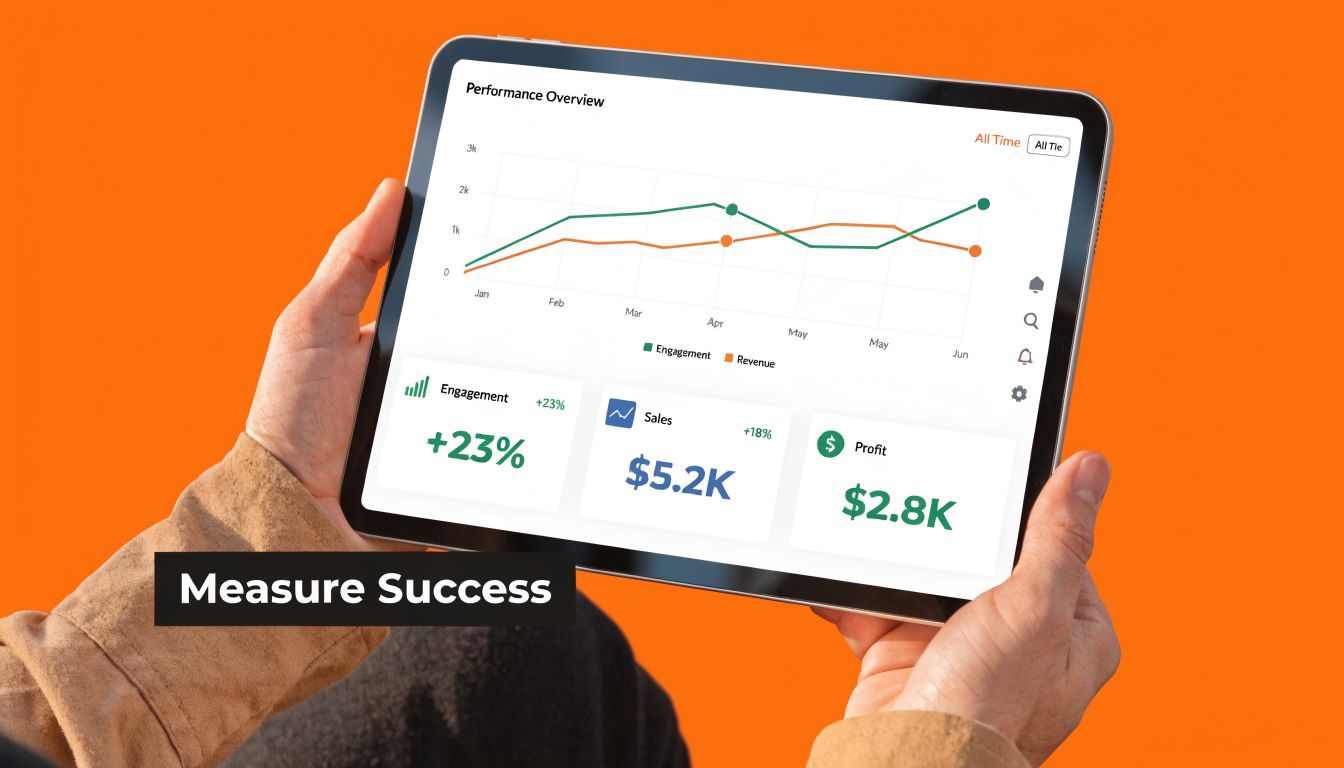
If you don't measure the program, the team will default to vanity metrics. More reviews feels good, but operators need to know whether review activity is improving visibility, calls, bookings, and close rates.
The scorecard that matters
Use a monthly scorecard with a few operational KPIs.
| Metric | What to track | What good looks like |
|---|---|---|
| Review volume | New reviews by location and service line | Rising month over month |
| Review recency | How recently each location received feedback | No long gaps |
| Star rating | Average rating trend by location | Stable and competitive in market |
| Response time | Time from review posted to response sent | Under 24 hours is a strong operating target |
| Response rate | Share of reviews that receive a reply | High coverage across positive and negative reviews |
| GBP actions | Calls, website clicks, direction requests, bookings | Trending with review growth |
| Lead quality | Leads from GBP that become estimates or appointments | Improving over time |
You don't need a giant dashboard on day one. You need consistency. A weekly review of these numbers will tell you whether the process is running.
Reviews should be measured like pipeline health. Volume matters, but recency, response discipline, and conversion matter more.
If your team needs a primer on KPI thinking, this overview of mastering KPIs for growth is a useful reset.
How to track Google Business Profile to booked business
Start with link tagging. Add UTM parameters to the website and appointment links in your Google Business Profile. UTM stands for Urchin Tracking Module. It lets Google Analytics and other reporting tools identify traffic that came from GBP.
A simple setup can separate traffic by source, medium, campaign, and even location. For example, one dental office in [City] can use a different tagged appointment URL than another office in [Neighborhood]. That makes location-level reporting cleaner.
Track this path:
- GBP view to click
- Click to landing page session
- Session to form fill, call, or booking
- Lead to scheduled job or appointment
- Scheduled job to revenue
Also align your call tracking and CRM notes. If the front desk hears “I found you on Google,” that should have a clear tag in the system. Over time, you'll see which locations have strong review momentum but weak conversion, and which have both.
For operators who want cleaner reporting between local visibility and revenue, this guide on local SEO reporting is a practical next read.
Ethical Guidelines and Advanced Strategies
A strong review program stays within the rules. Shortcuts create bigger problems than they solve, especially for regulated categories and multi-location brands.
The FTC can impose fines up to $50,000 for undisclosed incentives or fake reviews, and platforms like Yelp remove up to 20% of submissions annually for manipulation, according to Marketing 360’s review guidance. The safest approach is to request reviews transparently after service and never condition the request on leaving a positive rating.
What you can and can't do
Use this as your operating line:
- You can ask every customer for honest feedback.
- You can send a direct review link after service.
- You can train staff to mention the request in person.
- You can't offer undisclosed rewards for positive reviews.
- You can't filter unhappy customers away from public review opportunities.
- You can't ask employees, friends, or vendors to pose as customers.
For healthcare, add another rule. Keep all public responses free of protected health information. Stay general, courteous, and offline.
If you're using SMS, get consent right and keep your text workflow compliant. This guide on opt-in text messaging is useful for teams that want to ask by text without creating avoidable risk.
Frequently asked questions
Can I incentivize reviews
You shouldn't offer undisclosed incentives tied to positive sentiment. If you run any promotion related to feedback, involve counsel and make disclosure requirements explicit.
What if a customer says my team pressured them
Stop the request flow for that location and review the script. Staff should invite feedback, not push for stars.
How do I handle a fake review
Document why you believe it's fake, report it on the platform, and respond calmly if a public reply is needed. Don't accuse the reviewer in public unless you have clear platform-backed evidence.
Should I ask on Google only
Google usually deserves first priority because of local visibility, but multi-location operators should still monitor other platforms your customers use, such as Apple Maps, Yelp, or industry-specific sites.
How do reviews help AI and voice search
Detailed reviews help because they answer real buyer questions in natural language. A vague five-star rating says little. A review that mentions service type, timing, payment method, accessibility, or neighborhood gives AI systems more context.
What should I ask customers to mention
Ask for honesty, not a script. Helpful details include the service received, what stood out, how communication felt, and whether the experience met expectations.
Should I respond to every review
Yes, if your staffing allows it. At minimum, respond to all negative reviews and build toward full coverage. Response discipline signals that the business is active and accountable.
Turn Your Reviews Into a Growth Engine
The businesses that win local search don't leave reviews to chance. They ask at the right time, make it easy to respond, reply quickly, and learn from patterns in the feedback. That's true whether you're running one med spa in [City] or dozens of auto service locations across a region.
Recent data shows 68% of local searches now involve AI overviews or conversational queries. Detailed, FAQ-answering reviews such as “Fixed my AC in 2 hours, accepts Apple Pay” boost inclusion in AI summaries by 40%, driving 25% more foot traffic for multi-location businesses, according to Reputation’s guidance on writing a great review.
What disciplined operators do differently
They don't just collect stars. They collect useful language.
A dental group might encourage patients to mention scheduling ease, staff warmth, and clear explanations. An HVAC company might benefit from reviews that mention emergency response, parts availability, or technician communication. An auto repair operator might want detailed comments on diagnostics, estimate clarity, and pickup timing.
That shift matters because local search is moving beyond simple keyword matching. Richer review content helps both traditional search and AI-driven discovery.
For a deeper look at how that supports local visibility, this page on Google reviews for local business growth connects the dots.
The compounding advantage
A review program compounds because each review does more than fill a profile. It improves trust for the next buyer, adds language around your services, creates new response content, and highlights operational issues your team can fix.
The review isn't the finish line. It's the input that improves marketing, sales, and service at the same time.
For busy operators, the practical takeaway is simple. Build the process once, assign ownership, track it weekly, and keep the ask honest and easy. That's how reviews stop being a passive reputation asset and start acting like a growth channel.
If you'd like help putting this into a repeatable system, Reviews To The Top can help you centralize requests, responses, and reporting across one location or many. The support is month-to-month, so you can build a disciplined review program without locking yourself into a long contract.