Respond publicly and professionally within 24 hours, then use the feedback internally to fix the underlying issue. That approach protects conversions because a single negative one-star review can deter up to 30 potential guests from booking a hotel, while businesses that respond to at least 40-45% of reviews earn 2x the booking revenue compared to those that don't reply at all.
If you're dealing with a fresh 1 star review right now, the worst move is silence and the second worst is a defensive reply. Prospects searching for your business in [City] or typing in terms like "dentist near me," "HVAC repair near me," or "senior living near me" aren't just reading the complaint. They're judging whether your team listens, owns problems, and fixes them.
For local and multi-location operators, that means treating every 1 star review as both a customer service event and an operations signal. The reply matters. The internal follow-up matters more. And because review content now shapes both search visibility and AI-driven discovery, your response isn't only for the unhappy customer. It's for the next person deciding whether to call, message, book, or tour.
Table of Contents
- Why a 1 Star Review Is an Opportunity in Disguise
- The First 24 Hours Your Immediate Response Plan
- Crafting the Perfect Reply Templates and AI Tools
- Beyond the Reply Investigation and Systemic Fixes
- Mitigating Impact on SEO and AIO
- The Best Defense A Proactive Review Program
- Your Questions Answered
Why a 1 Star Review Is an Opportunity in Disguise
A 1 star review feels like a reputation problem. In practice, it's also a visibility signal, a trust test, and an operations audit.
Most owners focus on the rating drop. Buyers focus on something else first. They want to know what went wrong, whether it sounds believable, and how the business handled it. That's why a 1 star review can become useful when your team responds well and fixes the issue behind it.
Key Facts
- Buyers actively inspect negative feedback. 62.4% of shoppers click on one-star review filters, and products displaying these reviews still convert at 108.8% the rate of pages without visible rating breakdowns, according to PowerReviews research on rating impact and conversion.
- A public response is only half the job. The rest is internal remediation, especially if the same complaint appears across locations, service lines, or shifts.
- SEO means Search Engine Optimization. It covers how your business shows up in Google Search and Maps.
- AIO means Artificial Intelligence Optimization. It refers to how clearly your business can be understood and surfaced in AI-driven search experiences and LLM results.
- A 1 star review near me searches are high-intent moments. People comparing businesses in [Neighborhood] or [City] use recent reviews to choose who gets the call.
Why buyers read the worst reviews first
People don't trust a profile that looks too polished. They trust a profile that looks real. Negative reviews provide context, and your response tells prospects whether the issue was an exception or a pattern.
That matters for a dental office in [City], an HVAC company serving [Neighborhood], or a senior living community scheduling tours. The buyer isn't only asking, "Do people complain?" They're asking, "If something goes wrong, will this team handle it well?"
Practical rule: A calm, specific response builds more confidence than a perfect-looking profile with no visible effort to address problems.
A visible reply also gives you a chance to add helpful context without arguing. You can clarify process, invite an offline conversation, and show accountability. That's why online reputation management matters for local search and buyer trust.
The First 24 Hours Your Immediate Response Plan
A 1 star review needs triage, not panic. You want a simple workflow that front desk staff, a location manager, and a regional team can all follow without improvising.
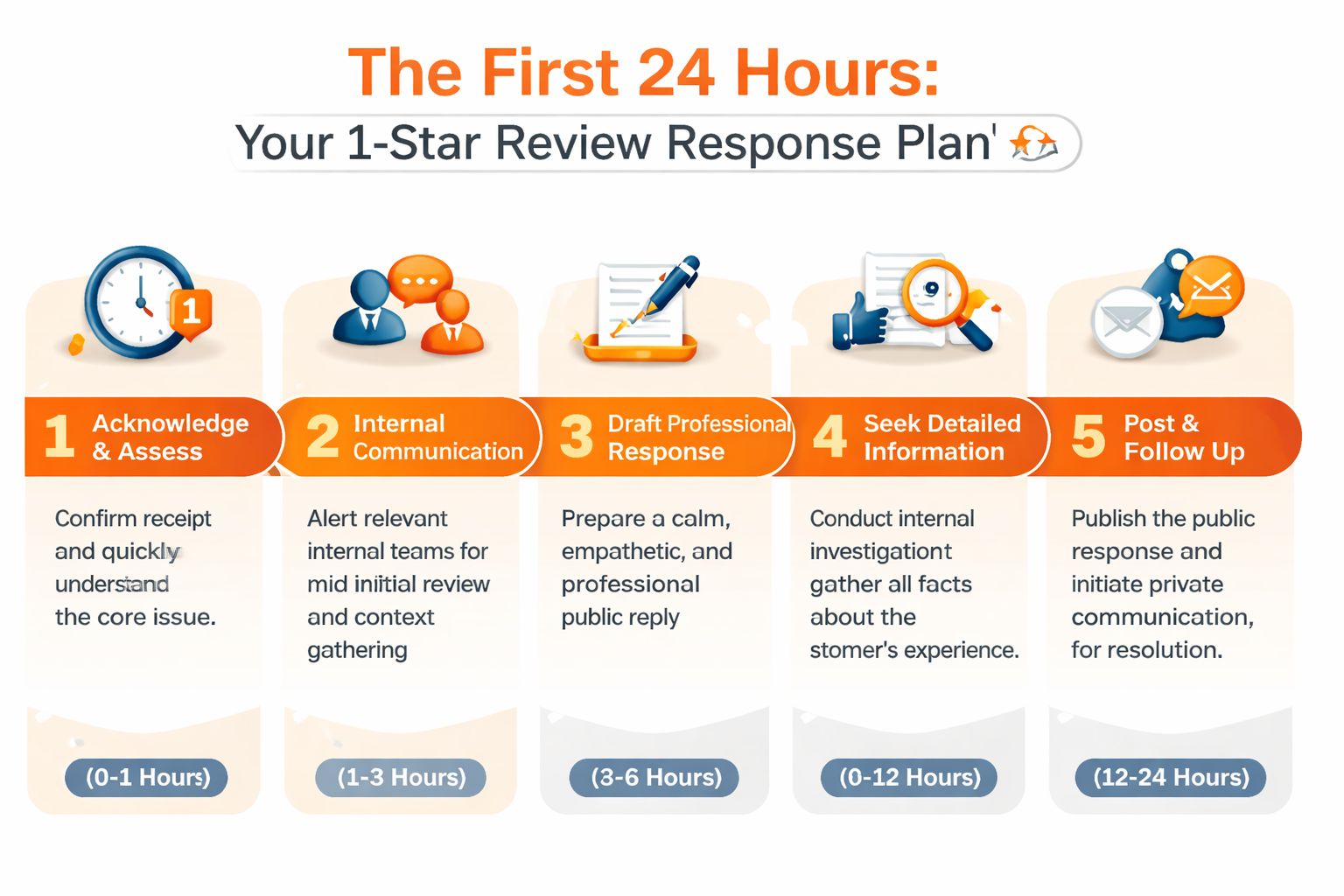
In hospitality, a single negative one-star review can deter up to 30 potential guests, and businesses that respond to 40-45% of reviews earn 2x the booking revenue compared to those that don't reply at all, based on hospitality review response data from Famepilot. The lesson applies well beyond hotels. Delay costs calls, appointments, and bookings.
Within 1 hour
Start by confirming three things:
- Is the reviewer identifiable. Match the name, timing, service line, or visit details in your CRM, scheduling system, POS, or patient management system.
- Who owns the response. Assign one person to draft and one approver to sign off. Multi-location brands need a clear owner by store and by escalation level.
- What category this is. Service issue, wait time, billing confusion, rude staff, no-show dispute, quality complaint, or suspicious review.
Don't draft publicly until someone verifies the basics. Fast doesn't mean sloppy.
A simple internal note works well:
- Location: [City] East
- Platform: Google
- Issue type: Staff attitude
- Reviewer likely matched: Yes or No
- Public reply owner: Practice manager
- Escalation needed: Yes or No
Within 8 hours
Investigate before you answer. Pull the call recording if you have it. Check texts, appointment notes, work orders, photos, or front desk logs. If this is healthcare, keep it HIPAA-aware and avoid exposing Protected Health Information.
Then draft the public response. Your reply should do four things well:
- Acknowledge the experience without repeating every accusation.
- Show respect even if the customer is harsh.
- Offer a path to resolution through a direct contact method.
- Avoid legal admissions or public debates.
Don't write for the reviewer alone. Write for the next ten prospects who will read the thread before deciding whether to contact you.
If your team needs examples, a practical library of negative review reply examples for common situations can speed up approvals and reduce off-brand responses.
Within 24 hours
Post the reply. Then open an internal remediation task.
Use this workflow:
| Step | Owner | What happens |
|---|---|---|
| Public response posted | Location manager or marketing lead | Reply goes live on the review platform |
| Private outreach attempted | Manager or service lead | Call, email, or text the customer if appropriate |
| Root cause logged | Operations or location lead | Categorize what failed |
| Follow-up assigned | Department head | Fix policy, coaching, or handoff issue |
| Trend monitored | Regional manager | Check whether similar complaints exist elsewhere |
A good rule is simple. If the complaint points to safety, discrimination, billing risk, recurring service failure, or a pattern across locations, escalate it beyond the store.
For a med spa, that might mean checking consent and scheduling handoffs. For an auto shop, it might mean reviewing estimate communication. For a vet or dental practice, it often means looking at wait-time expectations and front desk tone.
Crafting the Perfect Reply Templates and AI Tools
The best reply isn't clever. It's clear, calm, and useful.
A strong response follows a simple structure: acknowledge the issue, apologize for the experience, and explain the action you're taking. That formula works across home services, healthcare, automotive, hospitality, and senior living, with wording adjusted for compliance and tone.
What a strong reply needs
Use this checklist before posting:
- Specific acknowledgement: Reference the issue category, such as long wait, poor communication, or scheduling confusion.
- Neutral apology: Apologize for the experience without arguing facts in public.
- Next step: Give a real path to contact a manager, office lead, or support inbox.
- Brand voice: Keep the same tone across all locations.
- No overpromising: Don't guarantee outcomes you can't control.
If you're building a team process, Sight AI's modern review and response playbook is a useful resource for thinking about workflows, consistency, and response quality at scale. For additional language patterns, this roundup of negative review response examples is useful when training location managers.
Copy and customize these templates
Negative review response template
Hi [Name], we're sorry to hear about your experience with our [team/location] in [City]. This isn't the standard we want for our customers. We'd like to learn more and address what happened. Please contact [Manager Name] at [phone/email] so we can review the details and work toward a resolution.
Positive review response template
Thank you, [Name]. We appreciate you taking the time to share your experience with our [location/service]. We're glad our team could help, and we appreciate the opportunity to serve you in [City]. We look forward to seeing you again.
SMS review request script for HVAC
Hi [First Name], thanks for choosing [Company Name] for your service in [City]. If you'd be open to it, would you share a quick review about your experience with our technician? Your feedback helps other homeowners nearby find a reliable HVAC company. [Review Link]
Email review request script for dental
Subject: Would you share feedback about your visit?
Hi [First Name], thanks for visiting [Practice Name] in [City]. If you have a minute, we'd appreciate your feedback on your recent visit. Your review helps other patients looking for a dentist near me make a confident choice. You can leave feedback here: [Review Link]
How to use AI without sounding fake
AI can speed up drafting, but it shouldn't auto-publish every response. The best setup is human-reviewed AI.
Use AI for:
- Drafting first versions based on issue type and platform
- Applying brand tone across multiple locations
- Flagging sensitive reviews for legal, HIPAA, housing, or safety review
Don't use AI to:
- Invent facts
- Argue with reviewers
- Sound overly polished
- Reply without internal context
One practical setup is to store approved prompts by category. For example, "draft a calm response for a one-star Google review about long wait time at a dental office, no PHI, invite offline contact." That saves time and keeps language consistent.
This is also where platforms like Birdeye and one-option-among-many services such as Reviews To The Top fit. They centralize requests, monitoring, and reply workflows so local teams don't have to manage every review manually.
Beyond the Reply Investigation and Systemic Fixes
The visible reply is the public layer. The operational layer is where value shows up.
For multi-location businesses, the key question isn't "How do we answer this?" It's "Is this a local issue or a brand issue?" Guidance tied to restaurant and hospitality operations research from 86 Repairs coverage points to the need for playbooks that flag recurring 1-star themes by category and track remediation by store.
Sort the issue before you solve it
Tag every 1 star review into operational buckets. Keep the list short enough that managers will use it.
A practical tagging model:
- Service speed: Long waits, missed callbacks, delayed arrival windows
- Quality: Incomplete repair, unsatisfactory treatment, product issue
- Communication: Poor explanation, unclear pricing, no follow-up
- Staff conduct: Rude tone, dismissive behavior, lack of empathy
- Process failure: Scheduling errors, billing confusion, handoff problems
Then add two filters:
- Severity
- Repeat pattern
A single complaint about a grumpy receptionist is different from repeated complaints about the same front desk at the same location. A one-off scheduling issue is different from a region-wide pattern tied to a centralized call center.
The real mistake isn't getting a 1 star review. It's failing to classify it well enough to prevent the next one.
For businesses that want better visibility into complaint trends, systems for tracking customer feedback across locations are worth setting up before review volume grows.
How multi-location operators should govern 1 star reviews
Single-location owners can often solve issues informally. Multi-location brands can't. They need governance.
Use a simple escalation ladder:
- Location manager owns first-pass investigation and private outreach.
- Regional leader reviews repeat themes, high-risk complaints, and tone consistency.
- Corporate marketing or reputation lead approves response standards and platform access.
- Operations team fixes training, staffing, process, or policy failures.
A senior living group in [City] might notice that one community gets repeated complaints about unanswered tour inquiries while others don't. That's likely local. If multiple communities show complaints about confusing move-in communication, that points to a system problem.
This short video is a useful reminder that review handling and operational follow-through have to work together, not separately.
Document the fix, assign an owner, and check whether the same complaint shows up again. If it does, the original response wasn't a fix. It was a patch.
Mitigating Impact on SEO and AIO
A 1 star review can affect how often your business appears when someone searches for services near them. It can also influence how AI systems summarize your business.
How Google reads review signals
Google's local model is often explained with three factors: proximity, relevance, and prominence.
- Proximity means how close the business is to the searcher or specified area.
- Relevance means how well the business profile matches the service being searched.
- Prominence means how established and trustworthy the business appears online.
Reviews affect prominence, and review text can also reinforce relevance. That's why service-specific wording matters. If your auto shop in [City] consistently gets reviews mentioning brake repair, oil changes, and honest estimates, Google has stronger clues about what you do.
Research specific to auto repair highlights that Google increasingly uses review content, including low-rated review themes and business responses, to shape categorization and AI-driven visibility. In plain terms, your response to a 1 star review isn't just customer service copy. It's public context that search systems can read.
Google Business Profile checklist
If you're trying to protect visibility after a bad review, tighten your Google Business Profile first.
- Verify core data: Business name, address, phone, hours, and service areas must be accurate.
- Update service details: Add categories, services, and descriptions that match how customers search.
- Upload fresh photos: Use real team, location, and service photos from each branch.
- Monitor Q&A: Answer common questions about pricing, timing, availability, and policies.
- Respond to reviews consistently: Not only the positive ones.
- Check location pages: Make sure each branch has a matching page on your website with local details.
If you want the review side tied more directly to visibility, this guide on whether Google reviews help SEO connects the dots well.
Why review responses matter for AI discovery
AI tools don't just look at ratings. They look at language patterns, business details, and how consistently your public signals line up.
That means your replies should include useful context when appropriate:
- the service category involved
- the location
- the fact that a manager is reviewing the issue
- a clear invitation to continue the conversation privately
A vague response helps nobody. A precise, professional response helps the customer, the next prospect, and the systems interpreting your business.
If someone searches "best vet near me in [Neighborhood]" or asks an AI assistant for a reliable med spa in [City], those systems are trying to infer trust. Transparent responses make that easier.
The Best Defense A Proactive Review Program
The cleanest way to reduce the impact of any single 1 star review is to maintain a steady flow of recent, authentic feedback. Not because you want to hide criticism, but because a fuller review profile gives prospects better context.
A 7 day launch checklist
Day 1
- Choose your request moment: Right after service completion, appointment checkout, delivery confirmation, or successful issue resolution.
- Pick one owner: Usually marketing, office management, or operations.
- Create one review link per location: Keep routing simple.
Day 2
- Write channel-specific scripts: One SMS and one email per vertical.
- Build approval rules: Sensitive categories should route for review.
- Train frontline staff: They should know when to ask and what not to say.
Day 3
- Set response standards: Decide who answers positive, neutral, and negative reviews.
- Define escalation triggers: Safety, discrimination, billing disputes, and legal threats go higher.
Day 4
- Turn on notifications: Review alerts should reach the right manager fast.
- Connect reporting: GBP, website forms, call tracking, and booking requests should be visible in one place.
Day 5
- Pilot one location: Test links, timing, and message copy with a single branch in [City].
- Watch for friction: Broken links, poor timing, or low staff adoption usually show up quickly.
Day 6
- Expand carefully: Roll out to more locations after fixing process issues.
- Document the workflow: Keep it short enough for operators to follow.
Day 7
- Review quality, not just quantity: Check whether reviews mention target services, staff professionalism, and buying signals.
- Tune the program: Adjust timing, scripts, and ownership.
If you're evaluating platforms before rollout, it's smart to compare leading reputation software and check whether each option supports multi-location routing, review monitoring, response workflows, and reporting.
What to measure every month
Busy operators don't need a giant dashboard. They need a few useful metrics.
Track:
- Review volume by location
- Review recency
- Response time
- Overall star trend
- GBP views, calls, messages, and booking actions
- Lead-to-sale conversion from GBP-sourced traffic
Use targets that fit your category, staffing, and traffic level. A single dental practice won't use the same benchmarks as a regional HVAC brand. The important part is consistency by location and month-over-month review.
How to track GBP to bookings and calls
Use UTMs, or Urchin Tracking Modules, on the website link in your Google Business Profile so website analytics can identify visits coming from GBP.
A simple naming convention works well:
- source = google
- medium = organic
- campaign = gbp
- content = [location-name]
Then check:
- website sessions from GBP
- contact form submissions from GBP-tagged visits
- booking starts and completions
- calls attributed to your GBP listing or call tracking setup
That gives you a cleaner line from reputation work to business outcomes. Not perfect, but much better than guessing.
Your Questions Answered
Can I delete a bad Google review
Usually no. You can respond publicly and flag reviews that may violate platform policies. Removal is not something you control directly.
What if the review seems fake
Treat it carefully. Don't accuse the reviewer publicly unless you have strong evidence and a clear policy basis. Research on rating systems shows that credibility filtering can improve identification of unreliable reviews, with 43% reduction in error and 35-45% reduction in false-positive damage from fake reviews in the cited context of review analysis, according to research on reviewer credibility and filtering methods.
How should healthcare practices respond without exposing PHI
Keep it generic. Thank the reviewer for the feedback, say you're sorry to hear about the experience, and invite them to contact the practice directly. Don't confirm treatment details, appointment history, or identity in public.
Should I ask happy customers to post reviews after a 1 star review
Yes, if your process is already part of normal operations and you're asking for honest feedback from real customers. Don't gate requests based on who you think will leave only positive feedback.
What if the customer is wrong
You still don't want to argue in public. State that you'd like to review the matter, invite offline contact, and document the facts internally. The goal is to protect trust, not win a comment thread.
Do 1 star reviews hurt every location in a multi-location brand
Sometimes the impact stays local. Sometimes the pattern damages the broader brand. If similar complaints appear across locations, treat them as a system issue, not a store issue.
If you want a workable review process instead of a pile of alerts, Reviews To The Top helps local and multi-location businesses centralize requests, monitor reviews, keep profiles accurate, and respond with clear governance across locations. If you'd like a practical, month-to-month playbook for protecting calls, bookings, and local visibility, you can book a strategy call and map out the response standards, escalation rules, and Google Business Profile workflow that fit your team.