TL;DR: Nearly 60% of U.S. Google searches now end without a click. For local and multi-location businesses, that shifts SEO from a website-only job to a visibility-and-conversion job across Google Business Profiles, reviews, local landing pages, and directory data.
AI in SEO means your business has to win in two places at once: traditional search results and AI-generated answers. For a franchise owner, that changes the work. Strong rankings still matter, but so do accurate hours, complete service details, fresh reviews, and location pages that clearly match how people ask for help in each market.
The local angle is where generic AI SEO advice usually falls short. A national brand might care about broad informational traffic. A local operator needs calls, direction requests, form fills, and booked appointments from specific neighborhoods. That is why the business benefits of local SEO now extend beyond rankings and into how Google Maps, review snippets, and AI summaries shape the buying decision before a customer reaches your site.
There is upside here, but there is also risk. AI can help scale page creation, review response drafts, and listing updates across dozens or hundreds of locations. It can also spread bad data faster if your inputs are wrong. For franchise and multi-location teams, the businesses that win will use AI to speed up local SEO work without giving up human review, brand control, or market-level accuracy.
How AI is Changing Local Search and What It Means for You
Nearly 60% of Google searches in the U.S. now end without a website click. For local businesses, that changes what winning looks like.
A customer can see your hours, reviews, services, directions, and booking options without ever visiting your site. They can also ask a phone assistant or AI tool a local question and get one short list of businesses back. If your location data is weak, inconsistent, or thin, you lose visibility before the customer ever compares websites.

What ai in seo means for a local operator
For a local operator, AI in SEO changes the job from ranking pages to managing trust signals across every location touchpoint.
SEO still covers the basics. Show up for searches like "dentist near me" or "AC repair in [City]." AIO focuses on whether AI-generated answers, map results, and conversational search tools can understand your business well enough to mention it. In practice, the two are tied together for franchise systems, service-area businesses, and brands with multiple storefronts.
A single location with the wrong holiday hours, weak service descriptions, or outdated reviews can underperform even if the main brand site looks strong. I see this often with multi-location companies. Corporate invests in the website, but the location pages, Google Business Profiles, and review responses are left uneven by market. AI systems tend to surface the locations with the clearest and most consistent signals.
This distinction is critical for local businesses.
Generic AI SEO advice usually centers on publishing more content. Local businesses need a different playbook. They need each location to send clear signals about where it operates, what it offers, when it is open, and why customers trust it. That is what improves visibility in Google Maps, branded searches, and conversational results tied to immediate local intent.
What changes for franchise and multi-location brands
The biggest shift is operational. AI can help your team draft location copy, categorize reviews, suggest FAQ topics, and flag missing listing data at scale. It can also spread mistakes across 20, 50, or 200 locations if no one checks the output.
That trade-off matters. A national publisher can afford broad, top-of-funnel content that misses local nuance. A med spa chain, dental group, or home service franchise cannot. If one page says "same-day appointments," another says "appointments only," and the Google Business Profile says something else, customers get mixed signals and search platforms lose confidence.
Local visibility still comes back to a familiar set of factors. Distance, relevance, and prominence still shape who appears in the map pack and local finder. If you need a plain-English refresher on the benefits of local SEO, start there, then compare it with these Local Search Ranking Factors to see where AI changes execution, not the fundamentals.
The practical takeaway is simple. Use AI to speed up local SEO work, not to replace judgment. The businesses that gain ground are the ones that pair faster production with tighter review, cleaner location data, stronger service pages, and market-level accuracy.
Understanding Google's AI and Local Ranking Signals
Google’s AI isn’t a new switch that flipped on overnight. It’s been building for years.
Google introduced Hummingbird in 2013 and RankBrain in 2015, and today 86% of SEO professionals use AI while 68% of marketers report higher ROI from AI usage (Seoprofy AI SEO statistics). For local businesses, that means your competitors are already using AI to publish faster, shape FAQs, and respond to reviews more efficiently.
Think of AI as Google’s newer brain
Older search relied more heavily on matching terms. Newer search is better at understanding intent.
If someone searches “best dentist near me open Saturday for tooth pain,” Google isn’t just looking for a page with those exact words. It’s trying to understand urgency, location, service type, hours, and business credibility.
That matters because local businesses often lose visibility by organizing their websites around internal categories instead of customer questions. A service page called “Preventive Solutions” is weaker than a page clearly about “teeth cleaning in [City].”
The local rulebook still matters
Google’s local system still leans on proximity, relevance, and prominence.
Proximity
This is distance from the searcher or the place named in the search.
You can’t optimize your way around geography. If a customer in [Neighborhood] searches “oil change near me,” nearby businesses have an advantage. What you can do is make sure each location has its own complete profile, its own location page, and accurate hours so Google doesn’t hesitate to show it.
Relevance
This is how closely your business matches the search.
A med spa in [City] should clearly list treatments, service categories, FAQs, photos, and booking paths. A vet clinic should separate emergency care, wellness visits, vaccinations, and specialty services so Google can match the right query to the right page or profile.
Prominence
This is your reputation and visibility across the web.
Reviews, brand mentions, local citations, and strong business information all feed this signal. It’s one reason local reputation management now plays such a large role in ai in seo.
For another perspective on the core ranking ingredients, Frank Digital Agency’s overview of Local Search Ranking Factors is worth reading.
What AI changes for franchise and multi-location teams
AI increases the payoff for consistency.
If one dental office has fresh reviews, complete service descriptions, and well-written FAQs, while another office under the same brand has missing categories and old hours, Google has mixed signals. That confusion hurts discoverability in both traditional local search and AI-generated summaries.
Accurate, repeated facts win. Conflicting data gets ignored.
That’s why local operators should think less about “gaming AI” and more about making every location easy to understand. Clean location pages, standardized categories, and structured FAQs are often more effective than publishing lots of generic blog posts.
If you want the broader framework for optimization beyond standard SEO, this explainer on what is generative engine optimization helps connect the dots.
Practical AI Strategies to Win the Local Search Pack
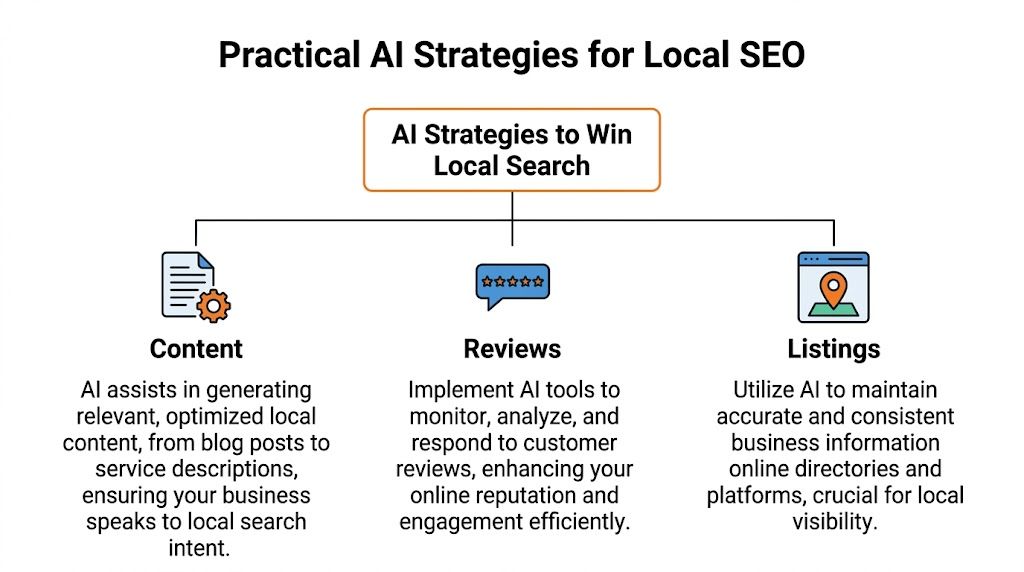
Local pack winners usually do three things better than everyone else. They publish clearer local service content, keep review flow steady, and maintain cleaner listings across every location.
AI can help with all three. It can also spread bad information at scale if no one checks the output. For franchise and multi-location teams, that trade-off matters more than speed.
Start with content that matches local intent
The best use of AI here is not mass-producing blog posts. It is turning the questions your staff already hears into pages and FAQs that match how people search in a specific city, neighborhood, or service area.
A practical workflow looks like this:
- Pull real questions from front-desk staff, technicians, and call recordings.
- Group them by service and location.
- Use AI to draft FAQ sections and service-page updates.
- Edit every draft for accuracy, tone, and local specifics.
That last step is where many brands slip. AI can draft a strong first version, but it will not know that one clinic offers same-week appointments and another does not, or that one HVAC branch serves three suburbs while another focuses on one metro area. Those details affect rankings and conversions.
A few examples:
- Dental practice: “How much time does a crown appointment take in [City]?”
- HVAC company: “When should I schedule furnace maintenance in [City]?”
- Senior living community: “What should families ask during a tour in [Neighborhood]?”
- Auto shop: “Do I need brake service before a road trip from [City]?”
These topics work because they reflect buying intent close to the decision point.
What works
- Location-specific FAQs: Add questions tied to services, neighborhoods, and common buying concerns.
- Short direct answers: Put the answer immediately below the question so Google and AI tools can extract it cleanly.
- Service-page depth: Explain who the service is for, what the process looks like, and what a customer should do next.
- Location proof: Include staff details, service areas, parking notes, insurance accepted, or availability when relevant.
What doesn't
- One generic page for all locations: That weakens local relevance and makes pages blend together.
- City swapping: Cloning the same page and changing only the city name rarely holds up.
- Keyword repetition: Repeating “dentist near me in [City]” does not make a page more useful.
Use AI to improve review operations
Reviews influence both visibility and conversion. They also give Google and AI systems fresh language about what each location is known for.
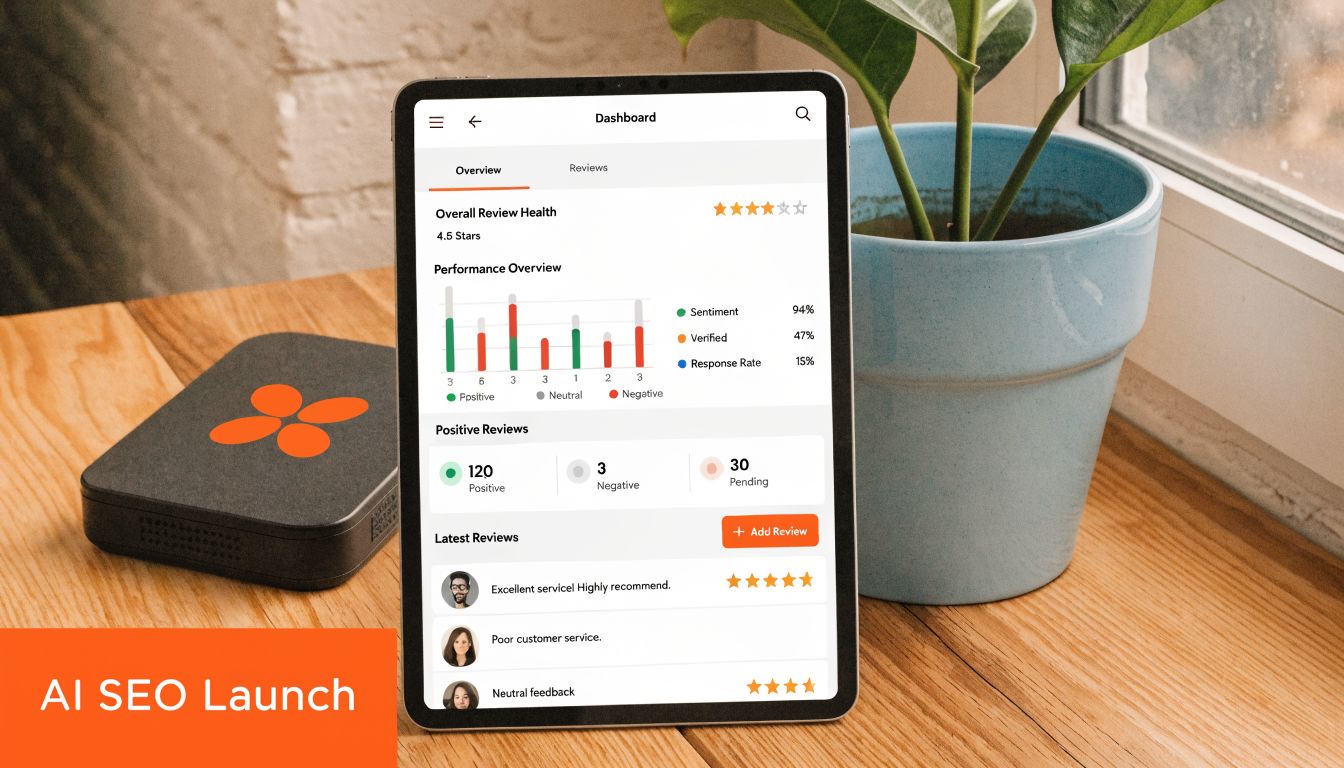
AI helps most when review volume is too high for managers to sort manually. It can draft review requests, group feedback by theme, suggest replies, and flag issues that need a human response. A vet group, for example, can sort reviews into wait time, staff friendliness, emergency care, or billing concerns, then compare patterns by location.
That is more useful than a generic sentiment score.
One practical option for this workflow is LLM SEO tools for local teams, including platforms that combine review monitoring, response suggestions, and listing management. Reviews To The Top is one example for brands that need centralized review requests, monitored replies, and profile accuracy across locations.
A common mistake is automating every response. Customers can tell when every reply sounds the same, and so can your field managers. Use AI for a first draft, then give local teams rules for when to personalize, when to escalate, and when to take the conversation offline.
Many multi-location brands spend more time publishing content than keeping review signals fresh. In local search, that is often the wrong priority.
Clean up your listings before you chase AI visibility
Listings are one of the first places AI pulls business facts from. If your hours, phone number, suite number, or services vary across platforms, you create doubt about which version is right.
That doubt costs visibility in Maps and hurts your chances of being mentioned in conversational search results.
Focus on:
- NAP consistency: Keep name, address, and phone uniform across every major platform.
- Category accuracy: Choose the best primary category, then support it with relevant secondary categories.
- Service completeness: Fill in services, not just broad labels.
- Photo freshness: Add current photos of exterior, interior, team, and service work.
- Hours and special hours: Update these before holidays and seasonal changes.
For multi-location brands, this work is operational as much as it is marketing. Someone needs ownership. If no one is responsible for holiday hours, duplicate listings, or category updates, AI will keep surfacing old information.
Why schema matters for AIO
Schema helps search engines and AI systems interpret the facts on your site. It labels your business details, services, FAQs, and page structure in a way machines can process more reliably.
Semrush analyzed 5 million cited URLs and found a strong correlation between AI citations and structured data (Semrush technical SEO and AI search study).
For local businesses, the most useful schema usually covers:
- Business details
- Service pages
- FAQ content
- Breadcrumbs
- Articles when relevant
Schema is not a shortcut to rankings. It supports the clearer pages and cleaner location data you already need. AI can generate a draft, but your SEO lead or developer should validate every field before it goes live.
Google Business Profile checklist
Your Google Business Profile still carries a lot of weight in local search, especially for businesses trying to win near-me searches, map visibility, and branded queries across multiple locations.
Use this checklist:
- Primary category: Choose the closest match to your main revenue service.
- Secondary categories: Add only categories you offer.
- Business description: State services, locations served, and who you help in plain language.
- Services section: List each service clearly, including location-specific offerings where appropriate.
- Hours: Keep standard and holiday hours current.
- Photos: Add recent team, storefront, treatment room, fleet, or completed-job photos.
- Reviews: Request them continuously, not in occasional bursts.
- Responses: Reply quickly and professionally.
- Q&A: Seed common questions and answer them accurately.
- Booking and website links: Add tracked links so you can measure calls, forms, and bookings later.
Your AI-Powered Local SEO Launch Kit
Most operators don’t need another theory piece. They need scripts the staff can use this week.
This launch kit is built for speed. Use AI to personalize the drafts, but keep a human review before anything goes out.
SMS review request script for dental
Send this after a successful visit. Keep it short and don’t mention treatment details.
SMS template
Hi [First Name], thanks for visiting [Practice Name] today. If you have a minute, we’d really appreciate your feedback about your experience with our team. You can leave a review here: [Short Link]
Thank you, [Practice Name]
Email review request script for HVAC
Use this after the job is complete and the customer confirms the system is working.
Subject: Quick favor about your service today
Email template
Hi [First Name],
Thanks again for choosing [Company Name] for your service in [City]. We hope everything is working smoothly.
Would you be willing to share a quick review of your experience with our technician and team? Your feedback helps other local homeowners know what to expect.
Leave a review here: [Review Link]
Thanks for your time,
[Company Name]
[Phone Number]
Review response templates
A template should guide the tone, not produce robotic replies. AI can draft these, but someone should approve the final version.
Positive review response
Hi [Reviewer Name], thank you for the kind words. We’re glad our team could help and that you had a good experience with [location or service]. We appreciate you taking the time to share your feedback and look forward to serving you again.
Negative review response
Hi [Reviewer Name], thank you for your feedback. We’re sorry your experience didn’t meet expectations. We take concerns like this seriously and would like the chance to learn more and address it directly. Please contact [Name or Team] at [Phone/Email] so we can follow up.
In healthcare, keep replies HIPAA-aware. Don’t confirm treatment details, visit dates, or any protected information in public.
Seven-day launch checklist
Day 1
- Choose locations: Start with one brand-wide pilot or a small regional group.
- Set ownership: Decide who sends requests, who monitors reviews, and who approves escalations.
Day 2
- Build templates: Finalize one SMS, one email, one positive reply, and one negative reply template.
- Create short links: Use location-specific review links so each office routes customers correctly.
Day 3
- Train staff: Show front-desk teams, advisors, or technicians exactly when to ask.
- Set rules: No incentives, no pressure, and no selective asking.
A quick walkthrough can help teams understand how AI-assisted review workflows fit into daily operations:
Day 4
- Turn on monitoring: Route new reviews to one inbox or dashboard.
- Tag issues: Label reviews by theme such as service, wait time, communication, cleanliness, or billing.
Day 5
- Send the first batch: Start with recent satisfied customers from completed visits or jobs.
- Check deliverability: Make sure texts and emails are going out properly.
Day 6
- Review responses: Approve AI-assisted drafts and adjust tone where needed.
- Escalate problems: Route sensitive complaints to management.
Day 7
- Inspect early results: Look for reply speed, review quality, and any staff friction.
- Refine the process: Tighten timing, wording, and escalation rules.
How to Measure the ROI of AI and Local SEO
If you can’t tie visibility to calls, bookings, or tours, the program won’t survive budget review.
The easiest way to start is with UTM tags on the website link, appointment link, and offer link in each Google Business Profile. A UTM tag is a short tracking label added to a URL so your analytics can identify where the visit came from.
A simple tracking setup
For each location, create tagged links for:
- Website
- Appointment or booking page
- Menu or service page when relevant
A simple naming pattern keeps reporting clean:
- utm_source: google
- utm_medium: organic
- utm_campaign: gbp-[city]-[location-name]
This lets you see what happened after a visitor clicked from the profile. You can then connect those visits to forms, booked appointments, or tracked calls.
What to watch each month
The most useful dashboard is boring. It should show whether local visibility is producing leads and whether those leads turn into revenue.
| Metric | Target | Why It Matters |
|---|---|---|
| Star rating | 4.5+ | Strong ratings improve trust before the click or call. |
| Review volume | 5-10 new reviews per location per month | Steady volume keeps profiles active and improves prominence. |
| Review recency | At least one new review every two weeks | Recent feedback signals that the business is active now. |
| Response time | Under 24 hours | Fast replies show attentiveness and reduce reputation drift. |
| GBP views and calls | Trend upward month over month | These indicate local visibility and purchase intent. |
| Lead-to-sale conversion | Track by location and channel | This shows whether visibility is creating qualified business, not just traffic. |
These aren’t universal laws. A vet clinic, senior living community, and quick-service restaurant will all have different lead cycles. Still, the framework holds.
Connect activity to outcomes
A useful monthly review asks six questions:
- Did each location get new reviews consistently?
- Did the team respond quickly enough?
- Did Google Business Profile views, calls, or clicks improve?
- Did website visits from GBP produce forms or bookings?
- Which locations converted best after the lead came in?
- Which service pages or FAQs appeared to support more local actions?
If one location has strong rankings but weak conversion, the problem may be the profile presentation, review mix, or booking friction. If another location gets reviews but little visibility, the issue may be categories, incomplete services, or poor local page quality.
For operators managing several markets, a reporting system that combines profile activity with lead outcomes makes the job easier. This overview of local SEO reporting shows the kind of tracking structure to aim for.
Governance and Risk Mitigation for Multi-Location Brands
AI is useful. Unmanaged AI is expensive.
Google’s March 2024 Core Update penalized “low-quality automation at scale,” and while AI can cut content production time by 50-75%, one bad prompt pushed across many locations can create broad ranking damage (Search Engine Land on whether AI will replace SEO).
Where local brands get into trouble
The biggest failures usually come from speed without controls.
A regional marketing team asks AI to write fifty location pages. The prompt is weak. The model invents neighborhood references, repeats the same copy, and adds services that some locations don’t offer. Then the content goes live everywhere.
That isn’t an AI problem. It’s a workflow problem.
The guardrails that actually help
Use approved prompt frameworks
Don’t let every manager invent prompts from scratch.
Create standard instructions for:
- Review replies
- Location-page drafts
- FAQ generation
- Google Business Profile updates
Include brand tone, prohibited claims, local compliance notes, and escalation triggers.
Require human review for public-facing content
This applies to:
- Negative review responses
- Healthcare replies
- Senior living and housing copy
- Promotional claims
- Any service description that could be inaccurate location to location
If a response could expose PHI in healthcare, create Fair Housing concerns, or misstate an offer, it needs human review.
Speed matters. Accuracy matters more when the content is public and tied to trust.
Set approval levels by risk
Not every asset needs the same scrutiny.
A basic positive review reply can often be approved faster than a new service page. A holiday-hours update is lower risk than an FAQ about medical procedures or financing.
This keeps governance from becoming a bottleneck.
Build a practical operating model
A workable model for multi-location brands usually includes:
- Central team ownership: One team controls templates, prompts, and permissions.
- Local participation: Store or office managers can suggest edits or flag issues.
- Escalation rules: Complaints involving billing, safety, discrimination, or health concerns route to a supervisor.
- Audit routine: Review a sample of AI-assisted outputs each month for drift.
- Privacy guidance: If you operate in regulated markets, train staff on what can’t be included in public replies.
For businesses with international exposure or stricter privacy requirements, these GDPR guidelines for AI chatbots are a helpful reference point when shaping internal policy.
Operators with many locations also need local governance that matches the actual org chart. This resource on local SEO for multiple locations is useful for structuring ownership, consistency, and approvals by market.
Frequently Asked Questions About AI in SEO
Is ai in seo just using ChatGPT to write blog posts
AI in SEO covers much more than article drafting.
For local and multi-location businesses, the bigger wins usually come from faster review replies, better service-page outlines, cleaner business information, stronger FAQ coverage, and tighter consistency across Google Business Profiles and location pages. Google also uses AI to interpret intent, compare business details, and decide which results deserve visibility in Maps and local packs.
Do I need an AI specialist to compete locally
Usually, no.
A local business is more likely to gain from a clear process than from a new job title. Someone on the team needs to own listing accuracy, review follow-up, page updates, and final approval of AI-assisted content. That matters more than hiring a specialist and then feeding the system weak inputs.
For franchise groups, the practical setup is simple. Centralize templates and guardrails. Let local managers supply the market details that AI will never know on its own.
Are near me searches still important
Yes.
People still search with city names, neighborhoods, and "near me" language. They also ask broader questions such as "who fixes garage doors open now" or "best pediatric dentist for anxious kids." Google often reads the local intent without the exact phrase, which means your business details, categories, services, hours, and reviews have to be accurate enough to match those searches.
Should small businesses worry about zero-click search
Yes, because local SEO now has to win visibility before the click.
As noted earlier, a large share of searches end without a website visit, and AI-generated answers now absorb part of the attention that used to go to the first organic result. For local businesses, that shifts the job. The goal is not only to earn traffic. It is to earn the call, direction request, booking, or branded search after someone sees your business in Maps, a profile panel, or an AI summary.
That is why review freshness, correct hours, complete services, and strong location-page answers matter so much for local brands.
Can AI respond to all my reviews automatically
It can draft every response. It should not publish every response on its own.
For routine positive reviews, AI can save a lot of staff time if the template still sounds human and mentions the actual service. For complaints, refund disputes, safety issues, and anything involving health, legal, or discrimination concerns, a person should review the reply before it goes live. One careless response can create more damage than the time you saved.
What should I do first if I have multiple locations
Start with the assets Google trusts most, then add automation after the foundation is clean.
- Standardize name, address, phone number, and hours for every location.
- Clean up each Google Business Profile, including categories, services, and photos.
- Put a repeatable review request process in place by location.
- Add location-specific FAQs and service details to key pages.
- Set approval rules for AI-assisted review replies and content updates.
This order works because it improves the signals that drive local visibility first. AI helps more after the business data is reliable.
Can a smaller local brand still compete with large chains
Yes.
Big brands usually have more budget, but they also have more approval layers, slower updates, and weaker local nuance. A smaller business can still win in its market by keeping listings accurate, answering reviews quickly, publishing better city-level service content, and reflecting what customers in that area ask.
I see this often with franchise competitors. The brand with the biggest footprint does not always get the call. The one with the clearest local proof usually does.
If you want help putting this into a workable system, Reviews To The Top supports local and multi-location businesses with month-to-month guidance on reviews, listings, response workflows, and local visibility. If you’d like a practical plan for your locations, you can book a strategy call and keep the support as light or hands-on as you need.