Your team is probably already stretched. Phones need answering, schedules change by location, reviews pile up, and someone still expects marketing to keep every [City] location visible when a customer searches for your service "near me."
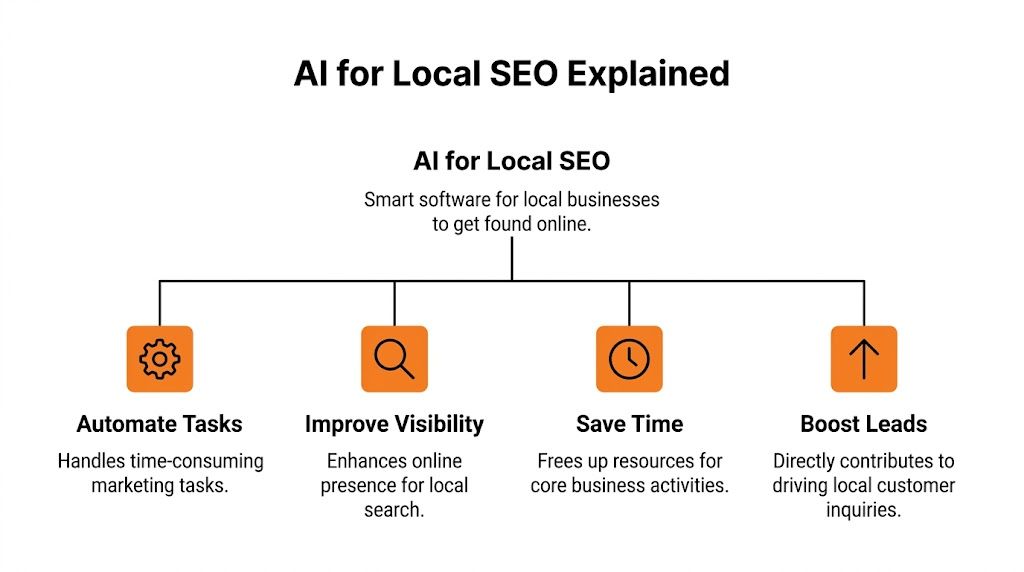
AI for SEO helps by taking repetitive local search work off your plate and tightening the parts that influence conversions: reviews, listings, service pages, FAQs, and response speed. Used well, it doesn't replace local marketing judgment. It helps you produce cleaner signals that lead to more calls, messages, bookings, tours, and walk-ins.
Your Guide to AI for SEO
Monday morning usually exposes the problem. One location has the wrong hours in Google. Another has three unanswered reviews from last week. A service page still mentions a promotion that ended two months ago. Corporate wants every market to rank, but local managers do not have time to clean up search details one by one.
That is where ai for seo earns its keep for a local business.
For a local or multi-location operator, ai for seo means using artificial intelligence to keep search visibility tied to day-to-day operations. The practical upside is speed and consistency across the tasks that affect local conversions: review responses, listing accuracy, local page updates, FAQ coverage, and the answers AI-driven search tools are likely to surface. The goal is not publishing more pages for the sake of volume. The goal is getting more qualified calls, form fills, tours, bookings, and walk-ins from the markets you already serve.
Used well, AI helps marketing teams and location teams keep dozens of small but important signals aligned. Used poorly, it creates polished inaccuracies at scale.
That trade-off matters. A healthcare group, home services brand, legal office network, or senior living operator can use AI to draft, classify, and flag work quickly. Staff still need to review anything tied to compliance, pricing, reputation recovery, or location-specific details. If a system replies to a complaint with the wrong policy or updates the wrong holiday hours across 18 profiles, the time saved disappears fast.
Practical rule: Use AI where consistency and speed affect local visibility. Keep humans responsible for approvals, exceptions, and customer-sensitive moments.
The shift in search behavior also raises the bar. AI-generated answers now influence what customers see before they ever click through to a site, and classic rankings still shape which businesses get cited. For local brands, that means the work has to be operational, not just editorial. Clean business data, credible reviews, accurate service descriptions, and pages that answer real location-level questions are what make AI useful here.
A simple way to frame it is this: AI can help your team maintain local search signals across many locations, but it cannot decide what is true at each location without good inputs and oversight. If the underlying data is messy, AI spreads the mess faster. If your governance is solid, AI cuts hours out of recurring SEO work and helps your team respond faster where it counts most.
What AI for SEO Means for Your Local Business
A regional brand with 12 locations gets hit with a common problem. One office changes Saturday hours, two locations collect a wave of new reviews, and three service pages still describe offerings that no longer match what the front desk is booking. AI for SEO matters here because it helps a team catch, draft, organize, and update local search signals before those gaps cost calls.
AI means artificial intelligence.
SEO means search engine optimization.
AIO means artificial intelligence optimization. In practice, that means making your business easy for AI-driven search tools to understand, summarize, and cite.
LLM means large language model, the type of system behind tools like ChatGPT and Perplexity.
GBP means Google Business Profile.
For local businesses, AI works best as an operating layer. It speeds up recurring tasks across locations, surfaces errors faster, and helps teams keep business data, review responses, and location content in sync. That matters more than bulk content production.
How local search actually decides who shows up
Local search still runs on a few practical signals.
- Proximity. How close your location is to the person searching.
- Relevance. How clearly your profile, pages, categories, and services match the search.
- Prominence. How established and trusted your business appears through reviews, mentions, and brand signals.
AI does not change those fundamentals. It helps you maintain them at scale.
A vet clinic in [City] cannot move closer to every searcher. It can improve relevance by tightening its service descriptions, categories, and appointment FAQs. It can improve prominence by responding to reviews consistently, fixing stale profile details, and publishing location pages that reflect what that office offers.
For multi-location teams, this is where governance matters. One approved category list, one hours update process, one review-response policy, and one owner for location data will do more for visibility than asking AI to generate 50 generic city pages.
Why AIO matters now
Customers do not always move from a blue link to a landing page to a form fill anymore. They often scan a map result, read reviews, compare service details, and act from the search results page itself. Some also use AI-driven tools that summarize businesses before a click happens.
That changes what local SEO work needs to cover. Your business has to be easy to verify, easy to summarize, and easy to contact. Accurate listings, complete service descriptions, strong review language, and clean location data all affect whether your brand shows up well in both classic local search and newer AI-assisted answers.
If your team is preparing for that shift, this guide to generative engine optimization for local businesses is a useful next step.
A customer searching for "emergency plumber near me in [Neighborhood]" may compare map pack listings, skim review snippets, check whether you serve that area, and call the business with the clearest information. In that journey, AI-generated content alone does very little. Operational accuracy does a lot.
Local SEO performance now depends on whether each location can be trusted quickly.
Where AI helps and where it doesn't
AI is useful for pattern recognition and first drafts. It is not a substitute for location truth.
It can help teams:
- Draft review replies based on sentiment, service type, and location
- Find listing inconsistencies in hours, phone numbers, categories, or service areas
- Cluster recurring customer questions into page topics and FAQs
- Suggest schema markup for locations, services, and reviews
- Create first-pass outlines for local pages your team still needs to fact-check
It cannot confirm whether Suite 204 is the correct address, whether a provider left the practice, whether a holiday schedule applies to one market or all of them, or whether a complaint needs a legal or compliance review.
That is the essence of AI for SEO in a local business. Use it to reduce manual work, shorten response times, and keep every location easier to find and easier to choose. Keep approvals, exceptions, and customer-sensitive decisions with people who know the business.
Five Practical AI Use Cases to Drive Local Leads
Monday at 8:15 a.m., one location has three new one-star reviews, another still shows last year's holiday hours, and a third has a service page that ranks but does not mention the neighborhood people search for. That is the local SEO workload AI can help with. Used well, it shortens response time, catches accuracy issues earlier, and gives each location a better chance to turn searches into calls.

AI-assisted review management
For multi-location brands, review management is usually the fastest place to get practical value from AI.
A dental group with locations in [City] and [City] does not need generic thank-you messages pasted everywhere. It needs fast drafts that reflect the service mentioned, match the tone of the review, and stay inside brand and compliance rules. AI can do the first pass well if the workflow is controlled.
Here is the useful setup:
- Draft replies by review type such as praise for staff, wait-time complaints, billing frustration, or service follow-up
- Route sensitive reviews for human approval when they mention medical details, legal threats, discrimination claims, refunds, or safety concerns
- Adjust language by location so replies sound relevant to that office, not copied from a central script
- Track unresolved patterns so repeated complaints become operating issues, not just reputation tasks
The trade-off is straightforward. Faster replies help, but bad automation creates risk fast. If the system posts a polished response to a serious complaint without context, the brand looks careless. I would rather have slower approval on the few reviews that matter most than fully automated replies that create a customer service problem in public.
Listing accuracy across every platform
Listing work is tedious. It also drives real revenue.
A restaurant brand may have updated holiday hours on Google, old hours on Apple Maps, and the wrong phone number sitting in a secondary directory. Customers do not care which platform caused the mistake. They just get frustrated, leave, or call a competitor.
AI helps by comparing core fields across sources and flagging mismatches for review. That is useful for teams managing dozens or hundreds of locations because it turns a manual hunt into an exception list. The team still needs a source of truth and someone responsible for final changes. AI can identify likely errors. It cannot know whether a temporary closure applies to one branch or the whole region.
A workable cadence looks like this:
- Weekly checks for hours, phone number, website URL, and primary category
- Monthly checks for photos, attributes, service descriptions, and booking links
- Immediate checks after relocations, holiday schedule changes, ownership transitions, or weather-related closures
For local businesses, this use case is underrated. A corrected listing often drives more calls than a new blog post.
Hyper-local service pages at scale
Service area coverage breaks down quickly when every location page says roughly the same thing.
An HVAC company serving [Neighborhood], [Neighborhood], and nearby suburbs usually needs pages that reflect how people search. They look for furnace repair in one part of town, emergency AC help in another, and financing options everywhere. AI can speed up first drafts for those pages if the inputs are good.
Good inputs include:
- the exact service area for that location
- recurring questions from calls and reviews
- neighborhood terms customers use
- proof points tied to that branch, not the brand in general
- the primary action you want, call, booking, or quote request
That produces better drafts for city pages, neighborhood pages, service FAQs, financing content, and after-hours service explainers. The pages still need editing. If you publish thin variations with swapped place names, rankings stall and conversion rates stay low because the page never answers the local question.
A stronger page usually includes:
- A clear match between service and location
- Specific FAQs based on real customer language
- Proof pulled from review themes or job history
- A visible call or booking path
- Internal links to related services and nearby locations
Schema and technical cleanup
Technical debt accumulates across multi-location sites. A few broken templates, weak internal links, duplicate location copy, or inconsistent schema can hold back pages that should be easy to rank.
AI helps sort the mess faster. It can cluster crawl issues by type, suggest schema patterns, and surface repeated problems across similar location pages. That saves time for the SEO manager or developer because they are not sorting every URL by hand.
A few paragraphs later, a short walkthrough helps:
Use AI for triage and drafting. Keep implementation with a technical lead, developer, or SEO owner who can validate what goes live. If the schema is wrong, AI will help you publish the same mistake across every location.
Conversational search readiness
Local search behavior has shifted from short keyword queries to fuller questions with more context. People ask which clinic takes same-day appointments, which roofer serves a specific suburb, or which repair shop is open now and has strong reviews.
That changes what "AI for SEO" should mean for a local business. The goal is not just more content. The goal is making each location easier for search engines and AI assistants to verify, summarize, and recommend.
The pages and profiles that perform best in this environment usually have direct answers, current business details, strong review language, and clear next steps. Teams building that process can use these LLM SEO tools for conversational search workflows to evaluate how they want to handle research, drafting, and QA.
A practical checklist:
- Turn repeated review themes into FAQ questions
- Answer local intent clearly on each location page
- Use specific service language instead of brand slogans
- Keep hours, service areas, and contact details current
- Make calls, bookings, and directions easy to find
The best local AI SEO programs improve response speed, listing accuracy, and answer quality first. More publishing comes after the business is easier to verify and easier to choose.
Implementing Your AI-Powered Local SEO Strategy
Monday at 9:00 a.m., a location manager changes Saturday hours, another store gets three new reviews before lunch, and a third asks marketing to update a service line that is no longer offered. Across ten or fifty locations, AI helps only if those updates move through a controlled process. Without that process, teams publish the same wrong hours, the same weak review replies, and the same outdated service details at scale.
That is the implementation challenge for local SEO. The work is less about buying another writing tool and more about setting rules for listings, reviews, approvals, and page updates so every location stays accurate.
Start with a baseline audit
Audit the operation before you automate it. For multi-location brands, I want one worksheet per location and one owner for each data source. That sounds simple, but it is where rollout quality is won or lost.
Review each location's:
- GBP completeness including categories, hours, services, photos, Q&A, and booking links
- Review coverage across Google and any industry-specific platforms that matter to your category
- Location pages for accuracy, unique local detail, and clear conversion paths
- Core listing data such as name, address, phone, and URL consistency
- Response workflow including who replies, how quickly, and what gets escalated
- Service availability so AI is not drafting copy for offers a location does not provide
Bad inputs create expensive cleanup. If hours, categories, or phone numbers are off, AI can spread that error across every profile and page in a week.
Choose tools by workflow, not feature list
A regional team usually needs fewer tools than vendors suggest. One system for review drafting, one reliable source of truth for listings, and a reporting layer is often enough if the approval flow is clear.
Choose tools based on the jobs your team needs to handle every week:
- Review response drafting
- Listings updates and sync checks
- FAQ and service summary drafts
- Issue tagging and escalation
- Location page content support
- Reporting by location, region, and brand
I look for three things first. Can the tool separate locations cleanly. Can it enforce permissions by role. Can it keep a record of who approved what. If the answer is no, the platform may save a few minutes but create a governance problem later.
Build governance before rollout
At this juncture, local teams either protect the brand or create avoidable risk.
AI should draft. People should approve anything that touches regulated language, pricing, service claims, refunds, safety, or sensitive customer issues. That applies even more in healthcare, legal, housing, financial services, and franchise systems where one careless response can create a compliance problem.
Set rules before the first location goes live:
- Templates by sentiment for positive, neutral, and negative reviews
- Role-based permissions for store managers, regional leads, agencies, and corporate marketing
- Escalation rules for legal, compliance, refund, safety, discrimination, or privacy issues
- Approved claims and banned phrases so AI does not invent outcomes, guarantees, or services
- Location-level context such as parking notes, provider names, service areas, and local offers
- Review intervals for checking whether AI replies still match brand tone and current policy
For listings work, use one documented process for how a location update gets submitted, approved, published, and checked. Teams tightening that process should review this guide to Google local listings optimization for multi-location businesses.
Governance check: If a review mentions an injury, billing dispute, protected health information, fair housing concern, or threat of legal action, route it to a trained human reviewer.
Roll out in a controlled 7-day pilot
A pilot beats a full launch. Start with a small region or a handful of locations that represent common issues, then tighten the process before expanding.
Day 1
- Audit review volume, unanswered reviews, hours accuracy, and listing ownership for the pilot group.
- Confirm who approves responses at the location, regional, and brand levels.
Day 2
- Build review request templates for SMS and email.
- Define escalation categories and blocked response types.
Day 3
- Load approved response templates for common positive and low-risk negative scenarios.
- Train managers on what they can publish and what must be escalated.
Day 4
- Connect Google profiles and any other review sources you actively monitor.
- Test whether notifications reach the right person for each location.
Day 5
- Turn on AI drafting for low-risk review replies only.
- Check output for accuracy, tone, and local relevance.
Day 6
- Publish updates for a limited set of listing changes, such as hours or service descriptions.
- Verify that the published details match the approved source data.
Day 7
- Review pilot results.
- Expand only after response quality, listing accuracy, and approval speed are stable.
One final point matters more than teams expect. Multi-location SEO breaks when no one owns the exceptions. Assign a person or small group to handle edge cases, disputed reviews, duplicate listings, and location-specific errors. AI can speed up the routine work. It cannot resolve accountability.
Templates and Scripts to Get Started Today
A regional manager with 40 locations does not need more blank-page work. They need approved prompts, approved fields, and clear stop signs so local teams can move fast without creating brand, legal, or listing problems.
Templates help because they reduce judgment calls at the location level. That matters in multi-location SEO, where one off-brand review reply or one inaccurate local update can create cleanup across Google Business Profiles, store pages, and customer support. If you are also tightening crawl paths for location pages, this guide on how to make a sitemap is a useful companion.
The other practical step is choosing tools that fit your approval process and location count. If your team is still comparing vendors, this list of best AI SEO tools can help narrow the field before you build workflows around the wrong platform.
AI-ready scripts and templates for local businesses
| Asset Type | Vertical Example | Script / Template |
|---|---|---|
| SMS review request | Auto repair | Hi [First Name], thanks for visiting [Business Name] in [City] today. If you'd share a quick review about your experience, it would help other local drivers find us: [Review Link] |
| Email review request | Dental practice | Subject: Thanks for choosing [Practice Name] nHi [First Name], thank you for visiting [Practice Name]. We appreciate the chance to care for you. If you'd like to share feedback about your visit, please use this link: [Review Link]. Your comments help our team improve and help other patients in [City] choose a dentist with confidence. |
| Positive review response | Med spa | Thank you, [First Name]. We're glad you had a good experience with our team at [Location Name]. We appreciate you taking the time to share your feedback and look forward to seeing you again. |
| Negative review response | HVAC | Thank you for your feedback. We're sorry your experience did not meet expectations. We'd like to review the issue directly. Please contact [Manager Name or Team Email/Phone] so we can look into what happened and work toward a resolution. |
How to use these without sounding scripted
The fix is simple. Feed AI only the fields you have approved for public use.
For review requests, that usually means first name, location name, city, service category, and review link. For review responses, it means sentiment, location, approved tone, and escalation status. Do not let the model fill in service details, timelines, staff names, or outcomes unless those details are already confirmed in the source system and allowed for public use.
This matters even more for local reputation work because AI can sound convincing while being wrong. A made-up detail in a review reply is not just a writing issue. It can create privacy risk, frustrate the customer, and put location managers in a position where they have to explain a response they did not fully review.
For healthcare, keep every request and response HIPAA-aware. Do not repeat treatment details, diagnoses, insurance information, or anything that could expose protected health information.
For housing-related businesses, keep language Fair Housing neutral. Avoid wording that suggests preference toward protected groups.
A simple prompt standard for internal use
Use one house prompt, then customize only the approved fields:
Draft a review response for a [vertical] location in [City]. Use a warm, professional tone. Keep it under [length]. Use only the details provided below. Do not mention private information. If the review includes billing disputes, safety concerns, discrimination claims, legal threats, or facts that cannot be verified, mark it for escalation instead of drafting a final response.
That prompt does more than save writing time. It creates governance. In practice, the strongest AI setups for local SEO are the ones that know when not to publish.
Measuring Success and Proving ROI
If your ai for seo program doesn't connect to calls, bookings, or tours, it will feel like busywork. Local teams need a scoreboard that ties activity to revenue outcomes.
What to track every month
Use a simple dashboard by location and region.
- Review volume by location
- Review recency so no location goes stale
- Response time for new reviews
- Average star rating
- GBP views, calls, direction requests, and website clicks
- Form fills and booked appointments from local landing pages
- Lead-to-sale or lead-to-visit conversion rate
The exact target should match your category, market, and customer volume. A dental office, vet clinic, and HVAC operator won't all use the same benchmark. What matters is consistency by location and a visible upward trend in the metrics that lead to revenue.

How to connect GBP activity to leads
Start with tagged links.
Add UTM parameters to:
- Website link in GBP
- Appointment link
- Menu or service links where relevant
A simple structure looks like this in concept:
- source = google
- medium = organic
- campaign = gbp
- content = location-name
That lets your analytics platform separate traffic from GBP versus other organic sources. Pair that with call tracking, booking software, and CRM stages so you can see the path from profile visit to lead to sale.
A useful chain looks like this:
- Customer searches "best vet near me in [City]"
- Customer views your GBP
- Customer clicks website or booking link with UTM tags
- Customer calls, submits a form, or books online
- Lead is recorded in CRM by source
- Sale or appointment outcome gets matched back to source
For teams building this reporting discipline, this practical guide on how to measure marketing ROI is a solid companion to your internal dashboard setup.
What AI changes in the ROI conversation
AI can improve speed and consistency, but you still need outcome metrics.
Data shows AI-enabled strategies can yield an 83% SEO performance uplift, and for local businesses, integrating review signals into schema markup can boost local pack dominance by 28%, according to Semrush's technical SEO impact study.
That doesn't mean every location will get the same result. It means your reporting should watch whether better reviews, stronger schema, faster responses, and cleaner profiles correspond with measurable changes in local discovery and conversion.
If you need a reporting framework for that, local teams usually do best with a monthly view that separates:
- visibility metrics
- engagement metrics
- lead metrics
- sales metrics
This kind of local SEO reporting keeps activity from getting mistaken for impact.
A dashboard should answer one question first: did this location become easier to choose?
Common Pitfalls and How to Avoid Them
A regional brand rolls out AI across 18 locations. Review responses go out faster, location pages multiply, and GBP posts stay active for a month. Then the problems show up. One location replies to a refund complaint with canned language that sounds cold. Another still has the wrong holiday hours. A third publishes service copy that does not match what the front desk provides.
That is how AI creates extra work instead of local leads.
Over-automation
Customers can tell when every response was written by a machine. The issue is not just tone. Generic replies miss the details that calm an upset customer, answer a buying question, or show that a location manager is paying attention.
Use AI to draft first versions. Keep auto-publishing limited to low-risk cases such as simple thank-you responses for positive reviews, and only after you set approved language, approval rules, and location-specific guardrails.
For negative reviews, billing complaints, safety concerns, and anything that could trigger legal or compliance issues, require human review every time.
Scaling bad local data
AI speeds up production. It also spreads errors fast.
If your hours, categories, services, or landing page details are inconsistent across locations, AI will repeat those inconsistencies in listings, schema, FAQs, and review responses. That hurts trust with customers and creates conflicting signals for search platforms.
Fix the base layer first. Confirm name, address, phone, hours, primary category, secondary categories, and service availability for each location. Then use AI to help maintain accuracy, flag mismatches, and draft updates for approval.
Treating content as the whole strategy
Local teams often buy AI tools for content generation first because that use case is easy to picture. The bigger wins usually come from operations. Review response workflows. Listing accuracy. FAQ coverage. Duplicate suppression. Better answers for conversational search queries.
A location page can rank and still fail to convert if reviews are stale, photos are outdated, or the listed services do not match what happens in the store.
Ignoring compliance and escalation paths
Multi-location businesses need clear rules for what AI can answer and what must be routed to a person. Healthcare brands need HIPAA-aware handling. Housing companies need Fair Housing-safe language. Home services, legal, financial, and franchise groups all have their own risk points.
Set escalation triggers before launch. Public accusations, threats, discrimination claims, refund disputes, pricing disputes, and medical or legal questions should go straight to a manager or central team. AI should identify these cases, not improvise a response.
Buying tools before defining ownership
Software does not decide who owns holiday hours, who approves location page edits, or who steps in when a review mentions a service failure at one branch. Operations does.
The strongest setup is simple. Corporate sets policy, templates, and QA rules. Local managers supply on-the-ground details. Marketing or an agency reviews patterns across locations and fixes recurring issues. AI supports that system by drafting, tagging, summarizing, and flagging exceptions.
Without ownership, the tool becomes another dashboard nobody trusts.
Short GBP optimization checklist
- Confirm core data including name, address, phone, and hours
- Choose the best primary and secondary categories
- Add services and business description in plain language
- Upload fresh photos regularly
- Keep review requests and responses active
- Use booking, call, and website links that can be tracked
Frequently Asked Questions About AI for SEO
Is ai for seo mainly about writing content
No. For local businesses, the biggest wins often come from review workflows, listing accuracy, FAQ development, and stronger location pages. Content matters, but it isn't the whole system.
Can AI help me rank for near me searches
It can help improve the signals that support visibility for "near me" searches, especially relevance and prominence. It cannot change proximity, but it can help you tighten service descriptions, categories, reviews, and location detail.
How much human review do we really need
More than most vendors imply. The safest model is AI draft plus human approval for anything public that involves complaints, compliance, or brand-sensitive messaging.
Does AI replace local SEO staff or agency support
Usually no. It changes the work. Teams spend less time drafting from scratch and more time reviewing, prioritizing, and fixing the issues that affect conversion.
What's the best first use case for a multi-location business
Start with review response workflows or listings accuracy. Those are operationally clear, easy to govern, and directly connected to local trust.
How long does it take to see results
Some improvements happen quickly, like faster review response and cleaner listings. Search visibility and conversion impact usually require consistent execution over time.
What should I ask before buying an AI SEO tool
Ask how it handles approvals, permissions, escalations, and multi-location governance. Also ask whether it supports local pages, reviews, listings, and reporting instead of only content generation.
If you want a practical, low-friction way to improve reviews, listings, and local visibility without locking into a long contract, Reviews To The Top offers month-to-month support with a single point of contact. If you'd like help building a cleaner review program, tightening local discoverability, or getting more value from AI-assisted workflows, you can explore their reputation management, learn how to optimize your Google Business Profile, or book a strategy call.