If you're staring at a backlog of review replies, FAQ updates, and location page edits, surfer seo ai humanizer probably sounds like a shortcut. The practical answer is this: it can help reshape rough AI drafts for low-risk tasks, but it isn't a tool I'd trust for your core website copy, service pages, or anything that needs to build search visibility and customer trust over time.
For local businesses, that matters because content isn't just content. It affects whether people call, message, book, or keep scrolling to the competitor in [City] or [Neighborhood].
What Local Businesses Must Know About AI Humanizers
A lot of owners ask the same question in different ways. "Can I use AI to speed this up without making my business sound fake?" That's the right question.
Surfer's tool is designed to rewrite AI text so it reads more naturally and is less likely to trigger AI detectors. For a busy dental office, HVAC company, med spa, or vet clinic, that sounds useful because repetitive writing tasks pile up fast.

The catch is simple. Faster writing only helps if the final output still sounds like your team, reflects your market, and supports conversions.
Key Facts
- Purpose: Surfer SEO AI Humanizer rewrites AI-generated text to sound more natural.
- Detection limits: Independent testing found it still struggles against stronger detectors.
- Best fit: It makes more sense for first drafts and repetitive support content than for high-value pages.
- Local SEO concern: If your content feels generic, it won't help you win "near me" searches or build trust with searchers.
- Better approach: Use AI for draft support, then add real local detail, staff knowledge, and customer context.
A med spa in [City] doesn't need a paragraph that sounds vaguely polished. It needs copy that answers real objections, reflects actual services, and matches how local patients talk. Same for an auto shop targeting "brake repair near me" or a senior living community trying to increase tours.
Google's local model still comes down to proximity, relevance, and prominence. You can't control proximity much. You can improve relevance with complete service information and local detail. You build prominence with strong reviews, accurate listings, active profiles, and a credible reputation. If your pages and review responses read like machine-polished filler, that doesn't help.
If you're evaluating AI workflows more broadly, this overview of LLM SEO tools gives useful context on where these tools fit and where they don't.
Practical rule: Use AI humanizers for speed on low-risk drafts. Don't use them as a substitute for real brand voice, subject matter expertise, or local proof.
Short Google Business Profile checklist
- Check your core details: Business name, address, phone, hours, and primary category should be accurate.
- Tighten service coverage: Add services, service areas, and business description with natural local phrasing like [City] and [Neighborhood].
- Upload current photos: Show staff, vehicles, storefront, treatment rooms, or completed work.
- Keep reviews moving: Ask consistently and reply quickly.
- Use FAQs and posts: Answer common questions that support relevance for local searches.
How the Surfer SEO AI Humanizer Actually Works
Think of raw AI writing like a capable employee who always talks in the same rhythm. The grammar is fine. The wording is polished. But after a while, every paragraph starts sounding cut from the same template.
That predictability is what detection systems look for.
What the tool changes
Surfer SEO AI Humanizer uses natural language processing, or NLP, to spot patterns that often show up in AI text. According to AmpiFire's review of Surfer SEO Humanizer, it looks for traits like uniform sentence lengths and repetitive structure, then rewrites the text by varying sentence complexity and swapping more formal wording for more conversational phrasing.
So a stiff line like "The primary advantage of this service is improved efficiency" might become something closer to "The big benefit is that it saves time." That's the basic idea.
Why that only goes so far
Surface edits can help a paragraph feel less rigid. They don't automatically make it sound like a real technician, office manager, or local owner.
The same AmpiFire benchmark reported that ZeroGPT detection dropped from 98% to 39.8% over two iterations, while Originality.ai still identified the output as 100% AI-generated in that testing environment. That's the central trade-off. The tool may soften obvious signals for some detectors, but it doesn't reliably change the deeper patterns more advanced systems look for.
For a local business, that's less a technical curiosity and more a workflow warning. If your team uses AI to draft FAQ answers for "emergency plumber near me" or "teeth whitening in [Neighborhood]," a humanizer may improve readability. It won't add the missing ingredients that make local content persuasive:
- actual service nuances
- local proof points
- staff experience
- policy accuracy
- tone that matches your business
A tool can vary sentence length. It can't know how your front desk explains same-day appointments or how your advisor calms down an upset customer.
Where this fits in a real workflow
Used carefully, this kind of tool belongs near the beginning of the process, not the end.
A practical sequence looks like this:
- Draft a rough answer with AI.
- Rewrite for local accuracy and compliance.
- Add examples from your real customer interactions.
- Check that it answers the exact question a buyer has.
- Publish only after a human reviews it.
That same principle shows up in broader generative engine optimization work. Structure and clarity matter, but originality and usefulness matter more.
Benefits and Critical Limitations for Local Businesses
There is a real use case for this kind of tool. It just isn't the one many businesses hope for.
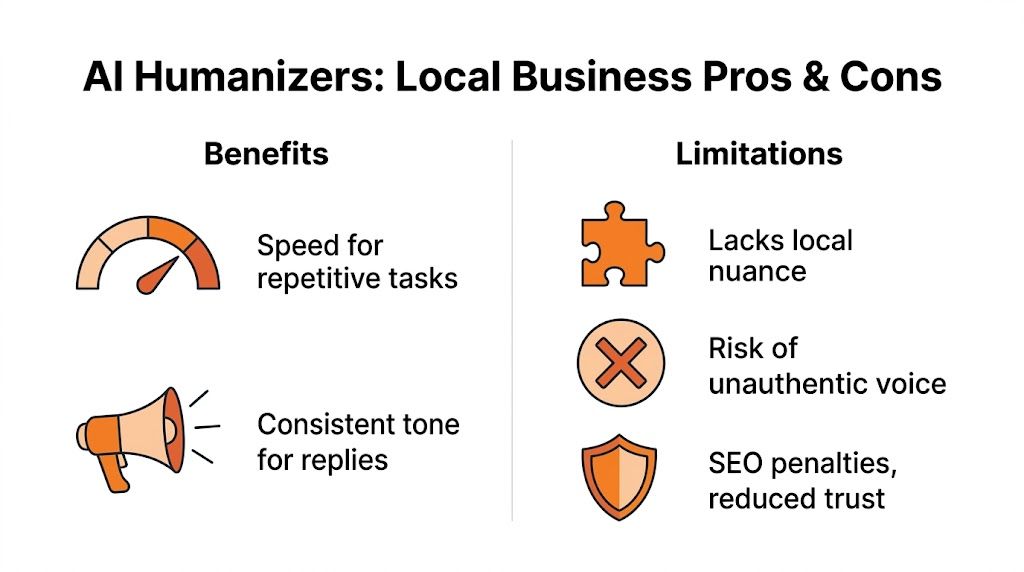
For repetitive content tasks, AI rewriting can save time. For trust-building assets, it's a weak substitute for real writing and local expertise.
Where it can help
The best use is operational support. Think volume, repetition, and low downside.
Examples:
- Review response drafts: Helpful when your team needs several polite, varied starting points.
- Google Business Profile post drafts: Good for creating first-pass copy your staff can personalize.
- Internal brainstorming: Useful when you're stuck on angles for FAQs, offers, or service descriptions.
- Multi-location consistency: It can help regional teams start from a common voice before local edits.
For a vet practice with several clinics, that may mean faster draft replies to positive reviews. For an HVAC brand, it may mean quick outlines for seasonal maintenance reminders in [City].
Where it breaks down
The bigger issue isn't whether the tool can produce cleaner sentences. It's whether the final output is strong enough to represent your business in public.
An independent analysis of 16 AI humanizers gave Surfer's tool a score of 5 out of 100, with Originality AI flagging the output as 100% AI and ZeroGPT flagging it as 93% AI, according to eesel's Surfer SEO AI Humanizer review. That review concluded the tool worked like basic paraphrasing and didn't change the underlying robotic patterns.
That matters if you're using it for:
- service pages
- location pages
- doctor or provider bios
- legal or policy-heavy website content
- core FAQ content that should reflect your real expertise
Why local SEO raises the stakes
Local search doesn't reward generic polish. It rewards usefulness and trust.
Google's local visibility still depends on proximity, relevance, and prominence:
| Factor | What it means for local operators | Where AI humanizers help or hurt |
|---|---|---|
| Proximity | How close the searcher is to your location or service area | AI text doesn't change this |
| Relevance | How well your profile and content match the search | Generic rewritten copy often weakens this |
| Prominence | Your reputation, review profile, citations, and visibility | Authentic reviews and real responses strengthen this more than polished filler |
If you run a dental practice in [Neighborhood], "dentist near me" content needs specific services, accepted insurance details, neighborhood cues, and patient-friendly explanations. If you run an auto shop in [City], your brake service page should sound like a real service advisor wrote it.
Bottom line: Humanized AI can save draft time. It can't replace firsthand knowledge, local specifics, or credibility.
My recommendation by content type
Use a light AI-assisted workflow for:
- review reply drafts
- GBP posts
- simple FAQ brainstorming
- internal summaries
Avoid using it as the final writer for:
- homepage copy
- service pages
- location pages
- testimonials
- healthcare content that needs careful wording
- anything tied directly to trust or compliance
For healthcare, stay HIPAA-aware and don't include protected health information in prompts or replies. For senior living and housing-related businesses, keep language Fair Housing neutral.
Practical Templates and Prompts for Local Content
If the goal is to sound more human, the safest approach isn't to rely on a detector-dodging tool. It's to build prompts and templates that force specificity.
That's especially true because testing showed mixed results. In Originality.ai's Surfer humanizer review, ZeroGPT's detection dropped from 98% AI to 39.8% after two passes, but Originality.ai still flagged all versions as 100% AI. For local operators, that's a reminder to use AI as a drafting aid, not a disguise.

Prompt formula for better local drafts
Use this framework before you generate anything:
- Business type: dental office, HVAC company, med spa, vet, auto repair, senior living
- Location context: [City], [Neighborhood], service area
- Audience: new patient, returning customer, emergency caller, family member
- Desired action: call, book, request estimate, schedule tour
- Tone: warm, direct, reassuring, practical
- Hard rules: no promises, no fake urgency, no PHI, no made-up details
A simple prompt:
Write a short, friendly response to a Google review for a dental office in [City]. Mention the team's appreciation, reference the patient's experience in general terms, avoid PHI, and end by inviting them back. Use plain English and avoid sounding scripted.
If you want a stronger foundation for website copy, this guide on how to write for website content is the better reference point.
Positive review response template
Use this for dental, med spa, vet, HVAC, and auto with small edits.
Hi [First Name], thank you for the kind words. We're glad you had a positive experience with our team at [Business Name]. We appreciate you taking the time to share your feedback, and we look forward to helping again when you need us.
Variation prompt: Rewrite this reply in a warmer tone for a family-focused practice in [Neighborhood]. Keep it under 60 words and avoid repeating "thank you."
Negative review response template
Keep this calm and professional. Don't argue in public.
Hi [First Name], we're sorry to hear your visit didn't meet expectations. We take feedback seriously and want to learn more about what happened. Please contact [Phone] or [Email] and ask for [Manager Name] so our team can look into this directly.
Healthcare note: Don't confirm treatment details or reference any protected health information.
SMS review request script
This works well for home services, dental, vet, and auto repair.
Hi [First Name], thanks for choosing [Business Name] today. If you'd be open to it, we'd appreciate a quick Google review about your experience. Your feedback helps other customers in [City] find us. [Review Link]
Email review request script
Subject: Thanks for visiting [Business Name]
Hi [First Name],
Thank you for choosing [Business Name]. We work hard to make every visit smooth, helpful, and professional. If you'd be willing to share your experience, we'd appreciate a Google review.Leave a review here: [Review Link]
Thanks again,
[Team Member Name]
[Business Name]
FAQ draft template for local pages
Use this for a page targeting phrases like "HVAC repair near me" or "vet in [Neighborhood]."
Question: Do you offer same-day appointments in [City]?
Answer: We offer appointment availability based on schedule and service type. If you need help quickly, call our team and we'll let you know the soonest opening for your location.
Question: What areas do you serve near [Neighborhood]?
Answer: We serve customers in [Neighborhood] and surrounding areas. Contact us with your address and service need, and we'll confirm availability.
Question: What should I bring to my first visit?
Answer: Bring any documents, records, or information our office requested when you scheduled. If you're unsure, call ahead and our team will let you know what to bring.
GBP post prompt
Use this for offers, reminders, or seasonal updates.
Write a Google Business Profile post for an HVAC company in [City] promoting spring AC maintenance. Keep it direct, local, and under 100 words. Mention scheduling, preventive service, and a call to action. Do not use hype.
A safer operating rule
Don't publish raw AI output, even after it's been "humanized." Edit for:
- Local proof: mention the actual city, neighborhood, or service area
- Operational accuracy: hours, availability, services, limitations
- Voice: make it sound like your front desk, advisor, or owner
- Compliance: avoid PHI in healthcare and avoid housing language that could create risk
A 7-Day Launch Plan for Your Review Program
Most businesses don't need more review theory. They need a simple routine their staff will follow.

Day-by-day checklist
- Day 1: Audit your Google reviews, response habits, and current request process. Pick one owner for the program.
- Day 2: Clean up your Google Business Profile. Confirm name, address, phone, hours, categories, services, and photos.
- Day 3: Customize your SMS and email request scripts for each location or department.
- Day 4: Train front-line staff. Show them when to ask, what to say, and when not to ask.
- Day 5: Send requests to recent happy customers. Start with fresh interactions, not stale contacts.
- Day 6: Respond to every new review. Keep replies prompt, specific, and professional.
- Day 7: Review what worked. Check whether staff followed the process and where requests stalled.
What to keep simple
Your team doesn't need a complicated SOP. They need three things:
- a review link
- approved language
- a response owner
If you want a model to compare against, these review management services show the kind of structured workflow many operators move toward once manual follow-up starts slipping.
A strong review program also supports prominence in local search. More high-quality, recent reviews and timely responses make your listing look active and trustworthy to both searchers and Google.
For a practical playbook on outreach, this guide on how to get Google reviews for my business is worth saving for your team.
How to Measure the ROI of Your Local SEO Efforts
If you can't tie local visibility work to calls, bookings, and sold jobs, it turns into busywork.
What to track every month
Focus on a short scorecard by location:
- Review volume: Are new reviews coming in consistently?
- Review recency: Did you earn fresh feedback this month?
- Response time: Are replies going out quickly?
- Star rating trend: Is your average stable or improving?
- GBP activity: Track views, calls, direction requests, website clicks, and bookings if enabled.
- Lead-to-sale conversion: Of the leads from GBP and local landing pages, how many become appointments or revenue?
How to connect GBP to outcomes
Use UTM tags, which are tracking parameters added to URLs. Add a tagged website link to your Google Business Profile so traffic from GBP shows clearly in analytics.
A basic structure looks like this in practice:
- source = google
- medium = organic
- campaign = gbp-[location]
That lets you separate GBP traffic from other local traffic and see what happened next. Did the visitor fill out a form, call, book online, or bounce?
Measurement tip: Track the full path. GBP view to click. Click to lead. Lead to sale.
A med spa might compare GBP clicks to consultation requests. An HVAC company might compare GBP traffic to calls and booked estimates. A dental office might track booked appointments from local landing pages and map listing clicks.
For teams managing this across multiple locations, a clean reporting framework matters. This overview of local SEO reporting is a good benchmark for what your dashboard should show.
The Verdict and Smarter Alternatives
Surfer SEO AI Humanizer is best treated as a convenience tool, not a publishing strategy.
It can help clean up rough AI drafts for repeatable, low-risk tasks. It isn't the right foundation for core website content, local service pages, or anything meant to carry your expertise in front of customers comparing options in [City] or searching "near me."
What works better
A stronger system looks like this:
- use AI for ideation and rough outlines
- keep humans in charge of final copy
- build reusable response templates
- add local specifics before anything goes live
- protect trust-heavy content from generic automation
That approach is better for conversions because it improves relevance and credibility at the same time. Those are the signals that support stronger local performance, especially when buyers are making quick decisions.
If you're comparing different approaches to building a local SEO advantage, this overview of local SEO advantage is useful background reading on why local specificity still beats generalized content.
For busy operators, the smart question isn't "Can this tool beat detectors?" It's "Will this help my business sound trustworthy enough that someone calls?" That's the standard worth using.
Frequently Asked Questions
Can Google detect content from surfer seo ai humanizer
There isn't a guaranteed answer for how any one platform evaluates content. The practical issue is that stronger detection systems have still flagged Surfer-humanized output in independent testing, so it isn't something I'd rely on for important public-facing pages.
Is surfer seo ai humanizer better than using ChatGPT alone
Not automatically. It's more of a post-processing layer. ChatGPT can help with brainstorming and first drafts. A humanizer tries to smooth out patterns in the output. Neither replaces a real edit for local accuracy, trust, and voice.
Should I use it for review responses
Only as a draft helper. It's useful for generating starting points, especially when you're replying at scale across locations. But your team should still personalize responses so they don't read repetitive or generic.
Should I use it for service pages and location pages
No. Those pages are too important. They need real local details, clear offers, operational accuracy, and a voice that sounds like your business. That's hard to get from automated rewriting.
How does this affect near me searches
"Near me" visibility depends on proximity, relevance, and prominence. AI-polished content doesn't improve proximity. It can help relevance only if you add real local detail. Prominence comes more from reviews, profile quality, and business reputation.
Is it safe for healthcare businesses
Only with caution. Don't put protected health information into prompts, replies, or templates. Keep examples general, avoid confirming patient relationships in public responses, and make sure a human reviews anything customer-facing.
What's a smarter alternative
Use AI to speed up rough drafts, then have staff or a trained marketing partner add the details that matter. For many local businesses, structured templates, good review operations, and solid Google Business Profile management produce better results than trying to disguise AI writing.
If you want a cleaner way to turn real customer feedback into stronger local visibility, Reviews To The Top helps local and multi-location businesses run disciplined review programs, improve profile accuracy, and connect those efforts to calls, bookings, and search performance. If you'd like expert help without a long-term contract, you can book a strategy call and explore month-to-month support.