A competitor in [City] is getting the call, the booking, or the tour request because their Google profile looks safer and more relevant at a glance. For busy operators, reviews by google aren't a side metric. They shape whether someone taps your listing, trusts your business, and chooses your location instead of the one down the street.
Google Reviews are the ratings and written customer feedback shown across Google Search and Maps. They matter because they influence local visibility and buyer confidence at the same time, which means stronger reviews can lead directly to more calls, messages, bookings, and walk-ins.
Your Guide to Reviews by Google
A district manager checks Monday numbers and sees the same pattern across three markets. Locations with steady, recent Google reviews are getting more calls. Locations with stale profiles, mixed ratings, or no owner responses are losing traffic before the sales team ever gets a chance.
That is why Google reviews have to be run like an operating system, not a side task.
For one location, a manual approach can hold for a while. For a franchise group, regional brand, or multi-unit operator, review management needs rules, owners, timelines, and reporting. Without that structure, one store asks consistently, another asks only after great service, a third ignores negative feedback, and the brand ends up with uneven trust signals across the map.
The practical goal is not a perfect star rating. The goal is a review program that scales across locations, keeps quality high, and gives Google, customers, and AI-driven discovery tools fresh evidence that your business is active, credible, and well run.
A strong program usually includes five parts:
- Clear ownership at the corporate, regional, and location level
- A repeatable ask process tied to real customer touchpoints
- Response standards that protect brand voice without sounding scripted
- Location-level oversight so weak operators are visible early
- Measurement tied to calls, bookings, visits, and local visibility, not vanity totals
For multi-location brands, the trade-off is straightforward. Tight control creates consistency but can slow down response times and make replies sound generic. Too much local freedom speeds things up but often produces compliance gaps, off-brand messaging, and uneven review velocity. The best system sets a central playbook, then gives local teams enough room to sound human.
Google reviews also do more than support traditional local SEO. They feed the signals people see in Search and Maps, and they shape how your brand is interpreted in AI-assisted discovery, where platforms summarize reputation, compare nearby options, and look for patterns in recent customer sentiment. If your locations collect feedback inconsistently, AI systems inherit that inconsistency.
Practical rule: Build a believable review profile that stays active, earns fresh feedback, and shows customers that someone is paying attention.
Understanding Google Reviews and Local Search Dominance
A franchise owner can spend heavily on local ads and still lose the click to a competitor with a cleaner profile, fresher reviews, and stronger location signals in Google. That happens before a prospect reaches your site, calls your team, or compares pricing.
Where reviews show up
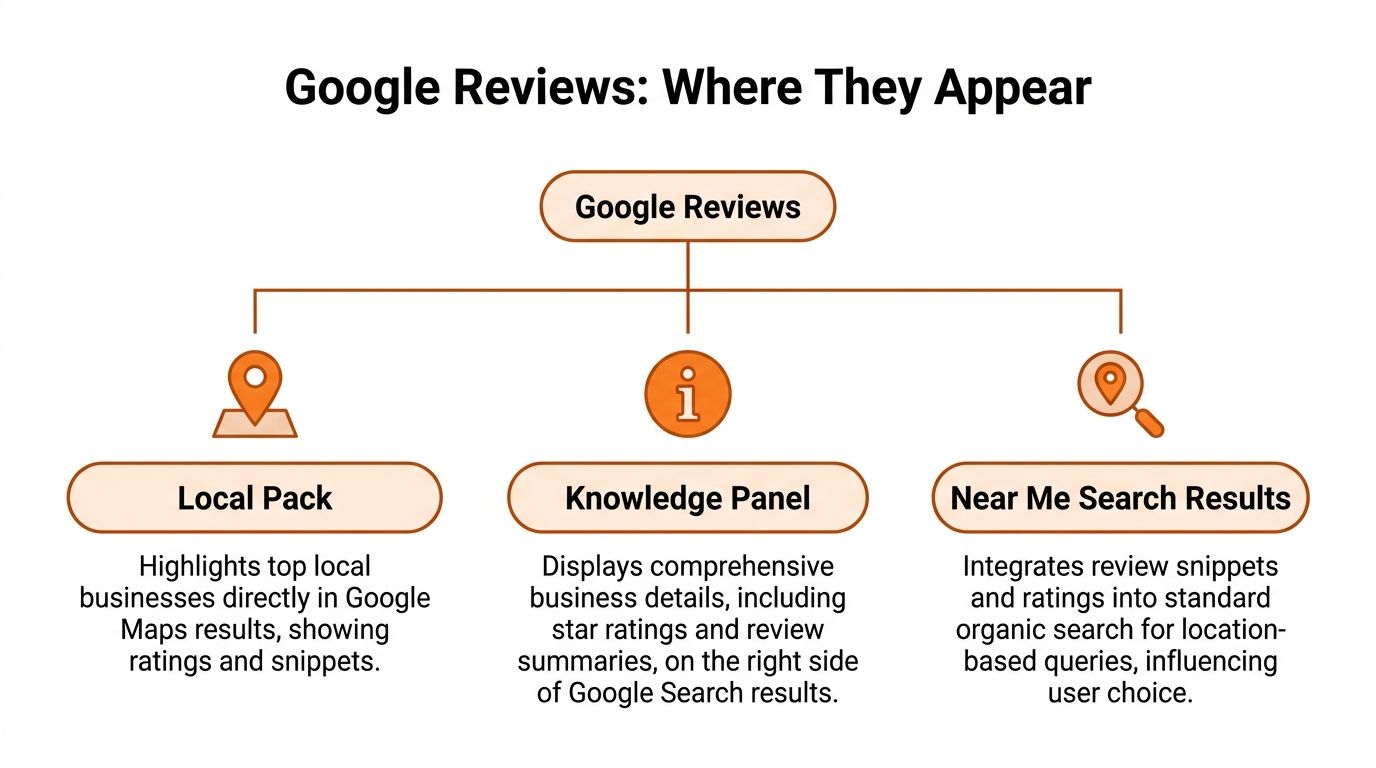
Google reviews influence visibility in three places that matter for local conversion:
Local Pack is the map-based result block that captures a large share of high-intent clicks.
Knowledge Panel is the business summary on the right side of desktop search.
Near me search results can also display ratings and review snippets inside standard organic results.
For multi-location brands, those placements are operational territory, not just SEO territory. If one store has accurate categories, recent reviews, and active responses while another sits stale for months, Google treats them differently. AI-driven discovery systems do the same. They summarize whatever signals you give them.
Proximity relevance and prominence in plain English
Google's local system still comes down to three factors: proximity, relevance, and prominence.
Proximity is distance between the searcher and your location. No review strategy changes that.
Relevance is how closely your profile matches the search. Categories, services, business descriptions, and review language all help Google connect your listing to real intent.
Prominence is your reputation signal. Reviews provide the heaviest lifting for this signal. They do not override distance or weak profile setup, but they give Google and potential customers visible proof that a location is active, credible, and worth considering.
For this reason, Google review work feels like a local popularity contest with rules. A location still needs the right category, complete service data, and accurate profile details. But the operator with steady, believable feedback usually beats the operator who ignores reviews and hopes brand awareness carries the day.
That pattern matters even more for brands with dozens or hundreds of locations. Google ranks locations individually. AI systems also interpret them individually. If five locations earn detailed, recent praise for fast service and another five collect old complaints with no replies, your brand does not show up as one clean reputation asset. It shows up as a mixed operating system.
Short checklist for your Google Business Profile
Before you push review generation harder, make sure each profile can turn visibility into action.
- Check your core details. Name, address, phone, website, and hours should match what customers see in the world and across your local listings.
- Choose the right primary category. A dental office should not sit under a broad medical label if "dentist" is the search intent.
- List specific services. Include the services customers mention, such as teeth whitening, brake repair, emergency furnace repair, or senior living tours.
- Upload current photos. Use location-specific images, not only a shared brand library.
- Turn on messaging and booking where relevant. Remove friction from the next step.
- Assign an owner for profile hygiene. Someone needs clear responsibility for updates, holiday hours, and review monitoring.
If your locations need help cleaning that up first, start with this guide on how to optimize your Google Business Profile for reviews and local SEO.
The practical goal is consistency at scale. Every location does not need identical reviews. Every location does need a profile that is accurate, active, and governed well enough that Google and AI discovery tools can trust what they find.
The New Rules of Discovery SEO and AIO
Traditional SEO means search engine optimization. AIO means artificial intelligence optimization. LLM means large language model.
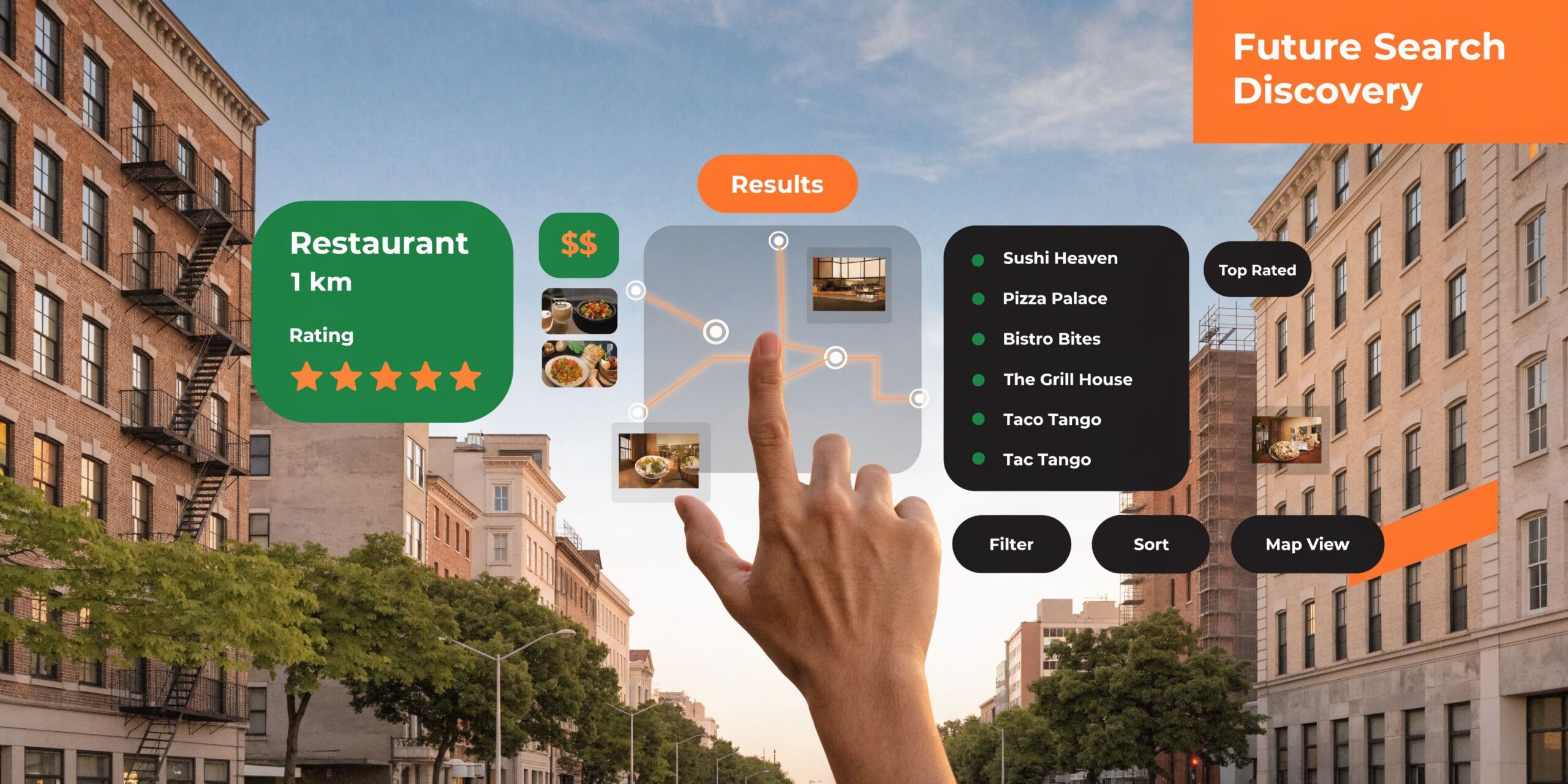
Those terms sound technical, but the operating takeaway is straightforward. Review text now does more than influence rank. It also feeds the language systems people use to discover businesses through conversational search.
Why detailed reviews outperform generic praise
A five-star rating with no details can help trust. It doesn't help interpretation nearly as much.
Google's review algorithm uses AI-powered sentiment analysis and contextual keyword matching. A review that mentions a specific service like "exceptional HVAC repair" can generate 3-4x more search impressions for relevant queries than a generic five-star rating, and review quality acts as an approximately 10% local ranking factor according to this explanation of the Google review algorithm.
That changes how you should ask for reviews.
For a med spa in [City], "Great place!" is nice.
"Had a laser treatment consultation and the staff explained aftercare clearly" is stronger.
For an auto shop in [Neighborhood], "Fast service" is fine.
"Fixed my brake issue the same day and explained what needed replacement" is more useful to both Google and the next buyer.
What this means for AI-driven discovery
LLMs summarize patterns. They look for consistent signals around services, outcomes, and location context.
So when your reviews repeatedly mention "emergency AC repair," "same-day dental crown," "gentle vet team," or "assisted living tour," you're building language that can support visibility beyond the standard search page. That's where review operations start overlapping with search keyword strategy. The strongest review programs don't script customers. They make it easy for real customers to describe what occurred.
Specific, natural language beats generic praise every time.
If your team is already thinking beyond classic rankings, this broader shift is why many operators are now paying attention to generative engine optimization.
How to Collect More High-Quality Google Reviews
Most operators know they need more reviews. The primary challenge is execution.
What works is a simple process your front desk, advisor, service manager, or care coordinator can repeat without thinking too hard. The easiest framework is the 3 T's: timing, tone, and technology.
Timing
Ask when the customer has received value.
For an HVAC company, that's right after the job is completed and the system is running again. For a dental office, it's usually after checkout, when the visit went smoothly and the patient isn't rushed into the chair anymore. For a senior living community, it's often after a positive tour follow-up, not during the first inquiry.
A delayed ask usually underperforms. So does asking before the customer has seen the outcome.
Tone
The best requests sound human and low-pressure. They don't beg, overexplain, or try to steer the customer toward only positive feedback.
Use language like this:
SMS review request for dental
Hi [First Name], thanks for visiting [Practice Name] today. If you'd share your feedback on Google, it would help other families in [City] find us. Review here: [Direct Review Link]
Email review request for dental
Subject: Quick favor from [Practice Name]
Hi [First Name],
Thank you for coming in today. If you'd be open to leaving a Google review, we'd appreciate it. Your feedback helps other patients in [City] choose the right dental office.
Leave a review here: [Direct Review Link]
Thanks again,
[Practice Name]
Technology
Make the path short. Don't send people to your homepage and hope they figure it out.
Use a direct Google review link tied to the correct location. For multi-location brands, each office, clinic, or store should have its own link, templates, and routing rules. That prevents reviews from piling onto the wrong profile and keeps local visibility aligned with the branch.
A few practical rules help:
- Keep the ask close to the service event. Speed matters more than copy polish.
- Train one role per location. Usually the front desk, service advisor, or manager owns the ask.
- Automate the send. Trigger SMS or email after completed jobs, closed tickets, or checked-out appointments.
- Don't script the customer's language. Ask for honest feedback. Let them choose the words.
- Avoid incentives. They create compliance risk and can attract filter issues.
A basic review engine is enough to start. If your team needs a cleaner workflow, this guide on how to get Google reviews for my business is a solid next step.
Managing and Responding to Reviews at Scale
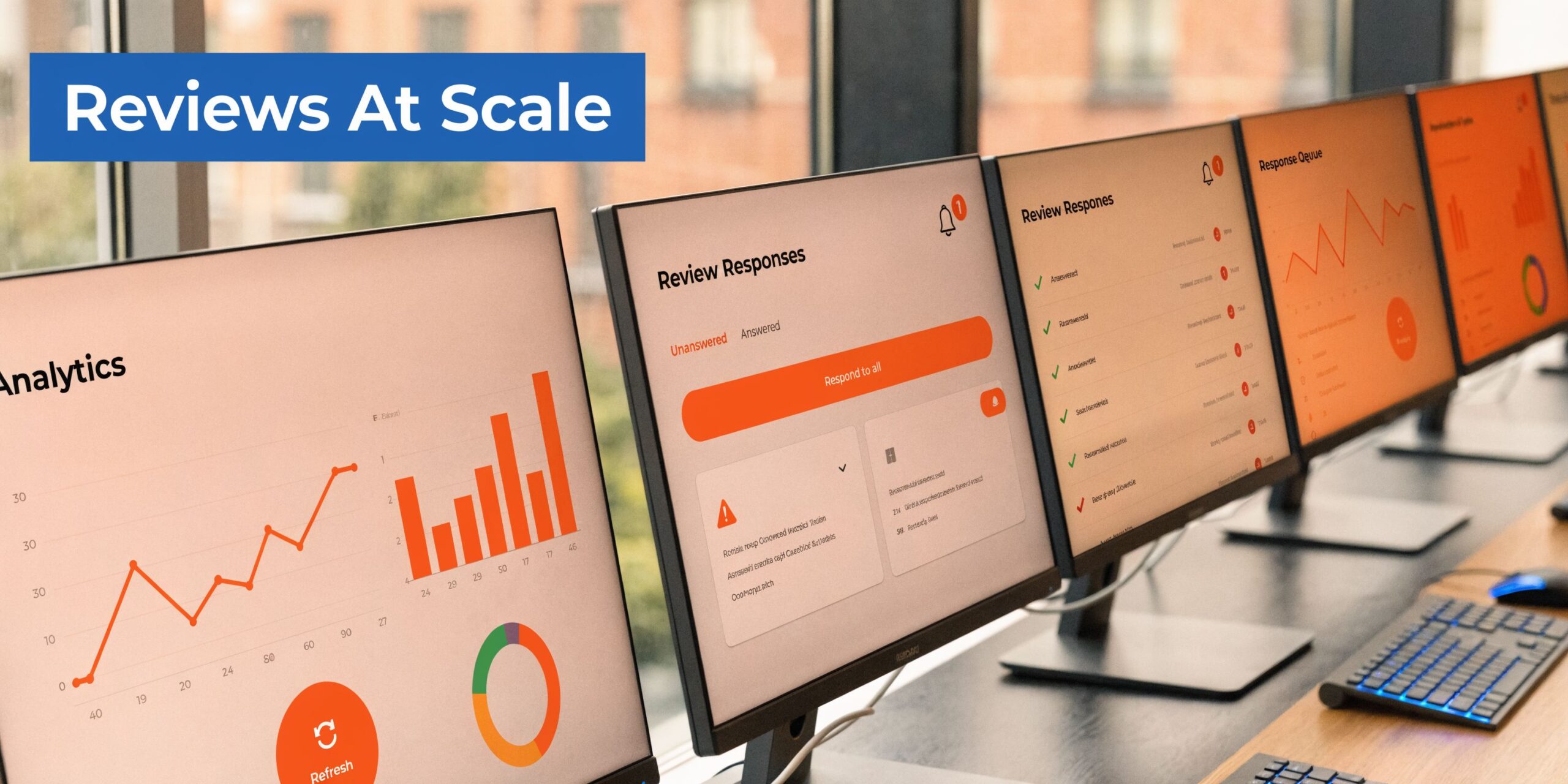
One location can get away with informal replies. Multi-location businesses can't.
Without rules, one manager writes thoughtful responses, another ignores reviews for weeks, and a third posts defensive replies that create more damage than the original complaint.
The governance model that works
Start with three decisions.
Who replies first
For most brands, local managers should own day-to-day responses, with regional oversight for quality control.
Which reviews need escalation
Healthcare complaints, safety issues, discrimination claims, billing disputes, and legal threats shouldn't sit in a generic queue.
How fast replies must happen
Pick a service standard and enforce it. If you manage healthcare, keep responses HIPAA-aware and never confirm someone was a patient unless their own public wording already did so and your compliance policy allows a careful response.
Data cited in this video summary on Google review performance notes that consumers often find a 3.5 to 4.5 star rating more trustworthy than a perfect 5.0, that businesses with more than 82 total reviews can earn up to 54% more annual revenue than average, and that Google's algorithm prioritizes businesses that respond to reviews.
That last point matters operationally. Response behavior isn't cosmetic. It's part of the visibility and trust equation.
Response templates your team can use
Positive review response template
Thank you, [First Name]. We appreciate you taking the time to share your experience with [Location Name]. We're glad our team could help with [service if appropriate]. Thanks for choosing us in [City], and we look forward to seeing you again.
Negative review response template
Thank you for your feedback, [First Name]. We're sorry your experience didn't meet expectations. We take concerns like this seriously and want to review what happened. Please contact [name/role] at [phone/email] so we can follow up directly.
For healthcare, keep it neutral:
Thank you for your feedback. We take all concerns seriously. To protect privacy, we can't discuss details here, but we'd welcome the chance to speak directly. Please contact [role] at [phone/email].
A good response does three jobs at once. It acknowledges the reviewer, signals professionalism to future buyers, and moves sensitive issues offline.
If your managers need coaching on de-escalation, this guide on effectively handling upset customers is useful reading before you hand them reply permissions.
A quick walkthrough helps when you're building reply standards across locations:
For deeper tactical help, review these examples on how to respond to reviews.
Your 7-Day Review Program Launch Plan
A franchise group with 20 locations does not need a longer plan. It needs one week of focused setup, clear ownership, and a few controls that prevent local teams from improvising the wrong process.
The goal is simple. Get a repeatable review engine live fast, then tighten it after you see how each location performs. That matters for local rankings, but it also matters for AI-driven discovery. Fresh, specific, location-level reviews give Google and AI search tools better signals about where you operate, what you do well, and which locations earn trust consistently.
Day 1
Audit every Google Business Profile. Confirm the exact business name, hours, phone number, website, primary category, and review link for each location. For multi-location brands, this step prevents a common failure. Customers leave reviews on the wrong profile because the branch data was never cleaned up.
Day 2
Set the operating rules. Decide who asks for reviews, who responds, what gets escalated, and which phrases staff cannot use. If you manage regulated categories or service issues across markets, write that down now. Verbal guidance breaks the minute a district manager gets busy.
Day 3
Build the message set. Create one SMS request, one email request, one positive review response, and one negative review response for each major service line. Keep the core structure consistent across the brand, then allow light local customization so replies still sound human.
Day 4
Choose the trigger and make it automatic. Use the point when the customer has received value: completed appointment, closed invoice, finished work order, move-in tour, or successful follow-up. Manual asking sounds easy on paper and falls apart across 10, 30, or 100 locations.
Day 5
Train one accountable person at each location. Twenty minutes is enough if the process is clear. Show them how to send the request, when to escalate a complaint, and how to spot reviews that mention a staff member, a service issue, or a recurring operational problem.
Day 6
Launch with a controlled pilot. Start with a small batch of recent customers from each location. That gives you time to catch broken links, wrong-profile routing, duplicate sends, or copy that sounds awkward before volume goes up.
Day 7
Check the first week's output in one shared view. Look at three things first: requests sent on time, reviews posted to the correct profile, and response coverage by location. Then add one layer of governance. Flag locations that are underperforming, locations that need coaching, and locations producing strong review language you can learn from.
That is the playbook. Keep it operational, not theoretical.
A good launch is one that managers will still follow 60 days from now. For multi-location brands, the winning system is usually not the fanciest one. It is the one with clear rules, easy reporting, and enough central oversight to keep every branch feeding accurate trust signals into both Google Search and AI discovery tools.
Measuring What Matters and Tracking Review ROI
A franchise brand can add 200 new reviews in a quarter and still see flat results. I see this happen when teams track count and rating, but never connect review activity to local visibility, lead quality, or store-level execution.
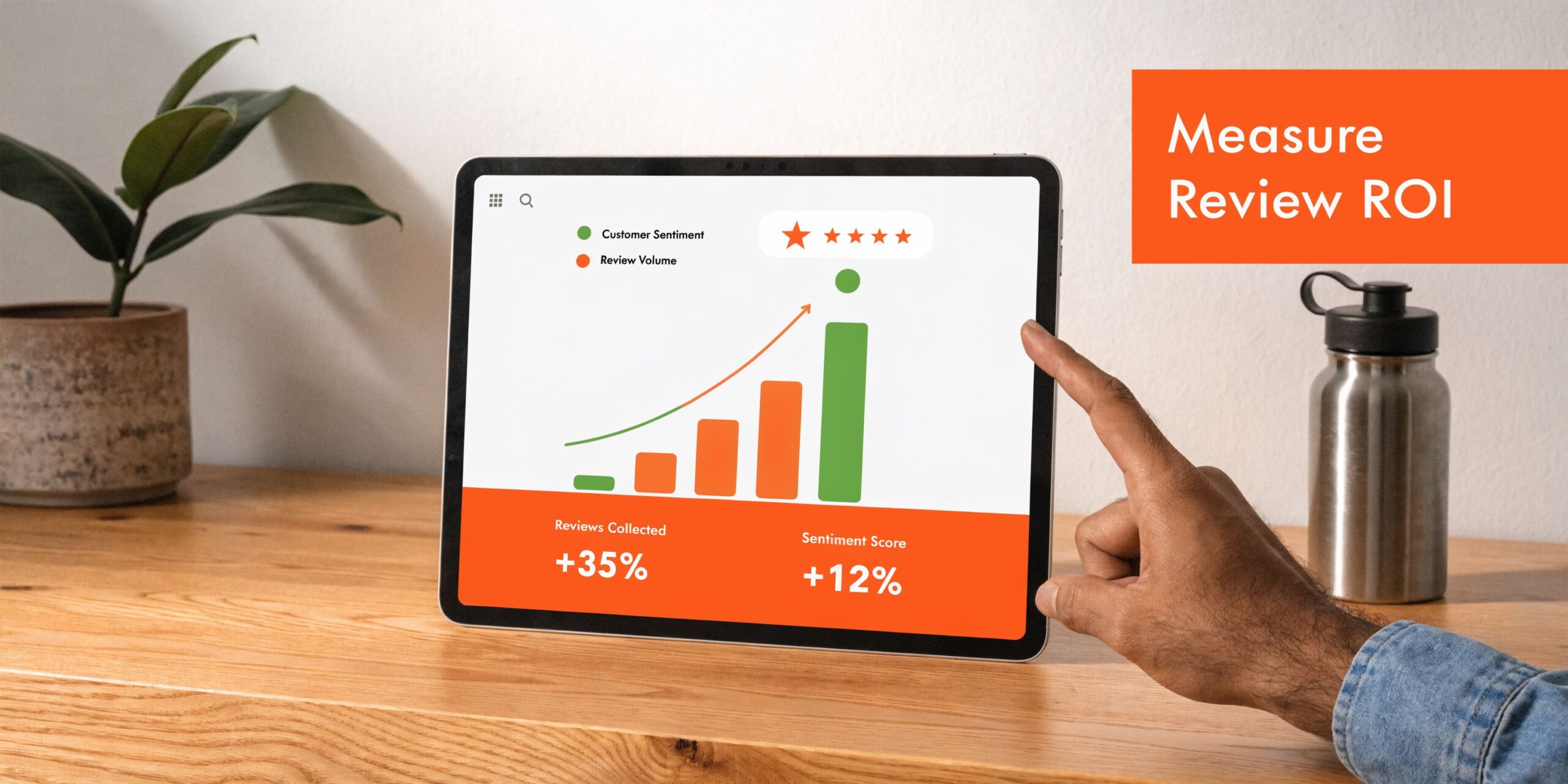
The job here is to measure whether reviews are helping each location win more discovery, more trust, and more revenue. That matters in both classic local search and AI-driven discovery, where review language, recency, and response behavior can shape how a location gets summarized and recommended.
The metrics worth watching
Use one scorecard for every location, then roll it up by region and brand. If each operator uses different definitions, the reporting becomes noise.
| Metric | What to watch |
|---|---|
| Review volume | Whether each location is adding reviews consistently, not in short bursts |
| Recency | How long it has been since the last new review on each profile |
| Star rating | Whether the location stays in a trust range that supports clicks and conversions |
| Response time | Whether managers reply within your service standard |
| GBP actions | Whether profile views, calls, direction requests, messages, and bookings are trending up |
| Lead-to-sale conversion | Whether leads from local search turn into booked jobs, visits, or revenue |
Add two more fields if you run a multi-location program at scale. First, track response coverage, which shows whether locations are following the process. Second, track review themes by category, such as staff praise, wait times, cleanliness, billing confusion, or service quality. That is where reviews stop being reputation data and start becoming operating data.
A high average rating with stale review activity is a weak signal. A lower-volume location with fresh reviews, strong response coverage, and clear service mentions often performs better in search and converts better after the click.
How to track from Google Business Profile to leads
Start with attribution you can trust. Put UTM parameters on the website link in each Google Business Profile so your analytics platform can separate GBP traffic from other organic visits.
A simple setup usually includes:
- Source: google
- Medium: organic
- Campaign: gbp or the location name
Then track what happens after the click. Look at calls, form fills, booked appointments, tour requests, coupon downloads, or any other action that matters to your sales process. If you use call tracking, confirm it fits your compliance and brand standards before rolling it out chain-wide.
For multi-location brands, branch-level reporting is the only useful view. Brand averages hide execution problems. One region may have strong review recency and fast responses, while another is sitting on unanswered complaints and losing high-intent traffic.
That is why I tie review reporting to three layers of measurement:
- Visibility: profile impressions, map exposure, and branded versus non-branded discovery.
- Engagement: calls, clicks, messages, bookings, and direction requests.
- Business outcome: qualified leads, closed sales, revenue, and repeat visits where available.
If one location gains reviews but nothing changes in engagement or sales, inspect the full picture. The issue may be poor response handling, weak landing pages, bad offer alignment, or reviews that are too generic to reinforce the services customers search for. In AI discovery, that last point matters more than many teams realize. Specific review language gives machines more context to associate a location with real-world needs and use cases.
Track operational inputs and business outputs together. Review growth without conversion data is incomplete. Conversion data without review governance is hard to improve.
If you need a cleaner way to present this across locations, this guide to local SEO reporting for multi-location performance is a practical reference.
Frequently Asked Questions About Google Reviews
How many Google reviews do I need to rank better
There's no fixed number that guarantees higher rankings. In competitive local markets, volume helps, but recency, response activity, profile completeness, and review quality also matter. If you're a multi-location operator, compare locations against direct local competitors, not just against your own internal average.
Can I remove a bad review from my profile
You usually can't remove a review just because it's negative. You can report reviews that appear fake, abusive, off-topic, or policy-violating. While that process runs, post a calm public response and move the issue offline when possible.
Why did some legitimate reviews disappear
Legitimate reviews can disappear temporarily because of Google's backend processes, including spam reprocessing waves and indexing glitches during algorithm updates, according to this discussion of disappearing Google reviews. That doesn't always mean your profile was penalized.
Is it okay to offer incentives for reviews
It's a bad idea. Incentives can distort the feedback you collect and can create compliance issues. Steady, organic review growth is less likely to be flagged than sudden bursts tied to incentivized campaigns, as noted in the same discussion above.
Should I ask every customer for a review
Ask consistently, but use judgment. Don't push someone who is in the middle of a service recovery issue. Fix the issue first. For healthcare, keep requests privacy-aware and avoid language that pressures patients to disclose sensitive details.
What if I get a fake one-star review
Document it, report it in Google, and respond briefly without sounding combative. State that you take feedback seriously and invite the reviewer to contact the location directly. For chains and franchise groups, route suspected fake reviews to a central owner so patterns across locations don't get missed.
Should every location have its own review process
Yes, but under one brand framework. Each location needs its own review link, local accountability, and escalation path. Corporate should set the standards, templates, and monitoring rules so the program stays consistent.
If you want help building a review system that works across one location or a full portfolio, Reviews To The Top can help you put the process, governance, and tracking in place without locking you into a long contract. Their month-to-month support is built for busy local operators who need recent reviews, faster responses, cleaner profiles, and a clearer line from Google visibility to revenue, calls, and sales.