If you're managing a local business or a multi-location brand, google reviews directly affect whether people call, message, book, or keep scrolling. The short answer is simple: you need a steady flow of authentic recent reviews, fast responses, and clean profile governance across every location if you want stronger conversions in search and Maps.
Most operators I work with aren't asking whether reviews matter. They're asking why one location in [City] keeps generating calls while another in [Neighborhood] has similar services, similar pricing, and fewer leads. In practice, the difference is usually visible in the profile itself: review volume, review recency, response discipline, and whether the listing looks trustworthy the moment someone searches for a service "near me."
Why Google Reviews Are Your Most Powerful Marketing Tool
A customer searches for a service, sees three local options, and makes a choice in under a minute. In that window, your Google reviews often do more selling than your website, paid ads, or brand copy.
Google sits at the point where local discovery and purchase intent meet. People are already looking for a provider, comparing options, and scanning for proof that your location is reliable. Analysts at Ranko Media found that Google holds the vast majority of online reviews and that the average business has far more review volume there than on Yelp, as noted in this roundup of Google review statistics. That's important because multi-location brands do not need equal effort across every review platform. They need tighter execution where buying decisions occur.
For single-location businesses, that usually means getting more recent reviews and responding faster. For multi-location brands, the challenge is bigger. One weak location can drag down trust, create inconsistent brand signals, and give prospects mixed messages about service quality across the whole network.
What makes Google reviews such a strong marketing asset:
- They influence click-through and conversion at the exact moment a prospect is comparing local options.
- They shape how each location is perceived before a lead ever calls or submits a form.
- They generate customer language your team can use to improve service positioning, local SEO, and AIO.
- They expose operational gaps between locations, which is why review management should sit inside a governance model, not as an informal front-desk task.
Why this affects conversions immediately
Reviews answer practical questions buyers already have.
A parent looking for a pediatric dentist wants evidence that the staff is patient with nervous kids. A homeowner hiring an HVAC company wants signs that technicians show up on time and explain the repair clearly. A prospect comparing senior living communities wants reassurance from families, not polished brochure language.
That is what strong review profiles do. They reduce uncertainty with specific, third-party proof.
I see the same pattern across multi-location brands. Locations with steady review recency, specific review content, and disciplined response habits usually convert better from the same level of visibility than locations with stale or thin profiles. Search rankings matter, but trust often decides who gets the call.
What good operators do differently
They treat reviews as an operating system for local growth.
That means consistent asks after real service moments, response standards by location, escalation rules for negative feedback, and regular checks for profile issues that distort performance. It also means using review themes across the organization. If five locations are praised for speed and one is repeatedly criticized for poor communication, that is not just a reputation issue. It is a management issue.
This is also where AIO starts to matter. Review content gives AI-driven search and recommendation tools more context about what each location does well, how customers describe the experience, and which attributes show up repeatedly. Brands that manage reviews systematically create cleaner, more usable signals than brands that leave each location to improvise.
If you want a practical example, this guide on Google Reviews that convert is useful because it focuses on conversion behavior, not vanity metrics. For the search side of the equation, review this explanation of how Google reviews help SEO so your team treats review management as part of growth operations, brand governance, and local visibility.
First Things First Your Google Business Profile Foundation
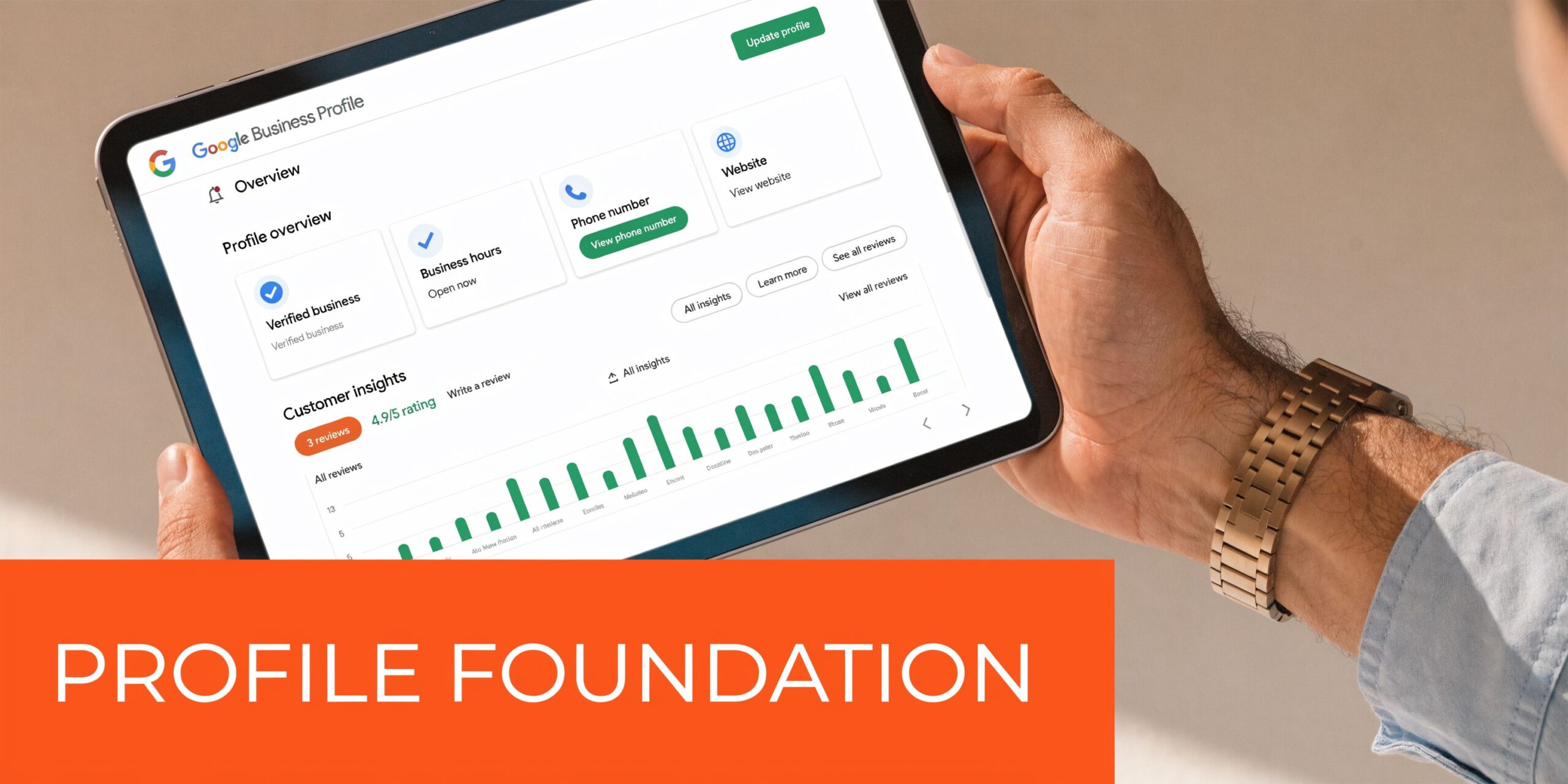
Before you ask for a single review, fix the storefront. If your Google Business Profile is incomplete, inaccurate, or lightly managed, even a good review program will underperform.
How Google decides who shows up locally
Google local visibility still comes down to three practical factors: proximity, relevance, and prominence.
| Factor | What it means | What you control |
|---|---|---|
| Proximity | How close the searcher is to your location or service area | Accurate address, service areas, location-specific pages, correct map pin |
| Relevance | How well your profile matches the search intent | Primary category, secondary categories, services, business description, Q&A |
| Prominence | How established and trusted your business appears | Reviews, response activity, photos, citations, local mentions, profile completeness |
Proximity is the hardest to change. Relevance and prominence are where most operators leave money on the table.
A med spa in [City] may be close enough to rank, but if its category setup is sloppy and its profile lacks recent reviews, a competitor farther away can still win the click. The same applies to an auto shop, vet clinic, or plumbing company.
Your Google Business Profile checklist
Use this as a working checklist before launching review outreach.
- Verify core business data. Your business name, address, phone number, hours, and website need to match across your major listings.
- Choose the right primary category. Don't get clever. Pick the category that best matches what you most want to rank for.
- Add useful secondary categories. A dental office might add cosmetic or emergency-related categories only if they fit the location.
- Complete services and products. Write clear service names your customers use in search.
- Upload current photos. Exterior, interior, staff, service examples, and branded environment shots all help users confirm they're choosing the right place.
- Review your Q&A section. Seed the profile with common pre-sale questions and accurate answers.
- Turn on messaging only if you can monitor it. Unanswered messages create another conversion leak.
- Publish updates when relevant. Promotions, seasonal service reminders, and operational updates signal that the profile is active.
- Check the map pin. A misplaced pin hurts visits, calls, and trust.
- Standardize UTM-tagged website links. This matters later when you want to prove which locations generate leads.
A complete profile doesn't guarantee top placement. An incomplete one creates drag you don't need.
What breaks at multi-location scale
Single-location advice often falls apart once you have ten, fifty, or two hundred profiles.
The common failure points are operational:
- one region updates hours and another doesn't
- location managers add off-brand photos
- categories drift
- old practitioners or staff remain on listings
- review responses sound like five different companies
That inconsistency weakens relevance and prominence over time. It also confuses customers comparing multiple nearby listings.
A helpful primer on the power of Google My Business in local search shows why "near me" intent depends so heavily on profile quality. If your listings need cleanup before you push harder on reviews, start with how to optimize your Google Business Profile.
How to Collect More Google Reviews Systematically
Most businesses don't have a review problem. They have a process problem.
They ask inconsistently. They depend on a motivated receptionist, technician, or advisor. They send requests too late. Or they overcorrect and create unnatural bursts that look suspicious.
According to Search Engine Land's review operations guide, businesses should benchmark competitor review velocity and aim for a 10-20% higher organic volume, while avoiding sudden bursts that can trigger spam scrutiny. The same guide notes that systematic multi-channel programs using SMS and email have shown 338% review volume growth in four months (Search Engine Land).
Build the request flow around real moments
The best review requests happen right after value is delivered.
For common verticals, that usually looks like this:
- Home services. Send the request after the technician closes the job and the customer has confirmed the work is complete.
- Dental or medical. Send after the visit, but keep the wording general and HIPAA-aware. Don't mention treatment details.
- Automotive. Trigger after pickup and payment.
- Restaurant or hospitality. Use receipts, follow-up email, or loyalty capture after the visit.
- Senior living. Ask the responsible family contact after a meaningful interaction, not during a sensitive care event.
The timing window that works best operationally is usually 24-48 hours after the visit or service completion, especially when tied to CRM or POS automation, as noted in the Search Engine Land methodology above.
What works and what gets businesses in trouble
There are two mistakes I see repeatedly.
First, businesses try to force volume by doing a big push only when leadership starts paying attention. That creates the kind of burst pattern Google may distrust.
Second, they drift into review gating or incentives. Both are bad practice. Ask for honest feedback from real customers. Don't offer rewards. Don't screen people before deciding who gets the review link.
Ask every eligible customer for honest feedback. Don't ask only the happy ones. Don't offer anything in exchange.
A simple review collection system
Use a repeatable sequence instead of ad hoc reminders.
| Step | Owner | What happens |
|---|---|---|
| Capture contact info | Front desk, advisor, tech, checkout staff | Confirm mobile and email before the interaction ends |
| Trigger automation | CRM, POS, or review software | Send SMS or email request after service |
| Direct to one action | Marketing ops | Use the direct Google review link, not a generic homepage |
| Follow up once | Automation | Send one reminder if there is no response |
| Monitor location velocity | Regional marketing or ops | Compare location-by-location patterns weekly |
If you're formalizing this process, this resource on how to request Google reviews is a good operational companion.
SMS template for HVAC or plumbing
Keep text requests short. Mobile users won't read a paragraph.
SMS review request
Hi [First Name], thanks for choosing [Business Name] for your service in [City]. If you have a moment, would you share honest feedback about your experience on Google? Your review helps other local customers find a provider they can trust: [Google Review Link]
Email template for dental or vet
Healthcare and care-related businesses need to stay general.
Subject: Could you share feedback about your visit to [Practice Name]?
Hi [First Name],
Thank you for visiting [Practice Name]. We appreciate the opportunity to care for you at our [City] location.
If you'd be willing, please share your honest feedback on Google. Reviews help other families choose a provider with confidence.
[Google Review Link]
Thank you,
[Practice or Team Name]
A quick training video can help front-line staff understand how to ask naturally without sounding scripted:
Staff prompt that doesn't sound awkward
Train staff to say one clean line at the end of the interaction:
"If everything went well today, you'll get a quick text from us. We'd really appreciate honest feedback on Google."
That works because it sets expectation without pressure. It also ties the request to a real customer experience, not a random marketing blast.
Mastering Review Responses to Build Trust and Rankings
A review request earns the feedback. A response shows whether the business is paying attention.
Operators usually understand the customer service part. They often miss the visibility part. Google's filters have become more aggressive, and reports cited by OrangeMonke note that businesses can lose 20-30% of their reviews after sudden updates. The same analysis says businesses responding to over 90% of reviews within 24 hours retain 15% more visible reviews long-term, yet only 22% of multi-location businesses do this consistently (OrangeMonke).
Positive responses should sound local, not robotic
Thanking someone matters. Repeating the same canned line across every location doesn't.
For a positive review, the goal is simple:
- acknowledge the specific compliment
- reinforce the brand promise
- signal that this location is active and accountable
Positive review response template
Thank you, [First Name]. We appreciate you taking the time to share your experience with our [City] team. I'm glad to hear [mention a real detail such as communication, timeliness, friendliness, or cleanliness]. We appreciate your trust and look forward to helping again when you need us.
That works for HVAC, auto, dental, med spa, and vet with small edits. The key is the middle sentence. Personalize it.
Negative responses need an escalation path
The worst negative review responses have one thing in common. The business tries to solve everything publicly in one reply.
Don't do that.
A good public response does three things:
- acknowledges the concern
- avoids defensiveness
- moves the discussion offline to the right person
For healthcare, keep replies HIPAA-aware. Never confirm treatment or patient status in public.
Negative review response template
Thank you for sharing this feedback. We're sorry your experience did not meet expectations. We take concerns like this seriously and want to review what happened. Please contact [name or department] at [phone/email] so our team can look into it directly.
Use AI carefully
AI can help with draft speed, consistency, and brand voice across many locations. It should not be allowed to auto-publish every sensitive reply without oversight.
Use AI for:
- first drafts on routine positive reviews
- tagging themes like wait time, billing, friendliness, or scheduling
- routing severe complaints to the right person
- keeping language consistent across regions
Don't use AI to:
- invent facts
- over-apologize for legal or regulatory issues
- respond to allegations without review
- post healthcare-specific details
Fast matters. Generic doesn't. A response should feel human, location-aware, and specific to the issue raised.
Mine review text for operational insight
The biggest missed opportunity in review response work isn't speed. It's analysis.
Subrating language matters. If reviews repeatedly mention "wait time," "cleanliness," "front desk," or "fast plumbing repair," that's not just reputation data. It's operational intelligence and search language.
A dental group might spot recurring comments about scheduling friction at one office. An HVAC brand may learn that one branch consistently earns praise for communication while another gets complaints about arrival windows. Those patterns belong in weekly ops reviews, not just marketing reports.
A practical response workflow
For multi-location brands, I recommend a simple triage model.
| Review type | Response owner | Time standard | Escalation |
|---|---|---|---|
| Routine positive | Local manager or centralized team | Same day | None |
| Mild complaint | Local manager with approved template | Same day or next day | Regional ops if repeated |
| Serious accusation | Centralized escalation owner | Hold for review | Legal, compliance, or executive team |
| Fake or suspicious | Marketing or listing admin | Flag and document | Re-flag with evidence over time |
If you need examples and workflows your team can use, this guide on how to respond to reviews is a practical place to standardize language.
How to Measure the ROI of Your Google Reviews
A review program should produce more than a prettier profile. It should produce measurable business outcomes.
SPRY reports that businesses with systematic review programs see 234% higher patient or customer acquisition and 89% better conversion rates. The same source recommends baselining review velocity and rating, then tracking GBP-driven inquiries and conversions with tagged links. It also notes that responding within 48 hours is a key benchmark because delays can reduce trust recovery by 15% per day (SPRY).
The metrics that matter
Track these at the location level first, then roll them up by brand, region, and category.
- Review volume. Are you increasing the number of authentic new reviews?
- Review recency or velocity. Are fresh reviews arriving consistently?
- Average star rating. Is the location staying at a level that supports conversion?
- Response time. Are reviews getting answered quickly enough to preserve trust?
- GBP actions. Monitor calls, website clicks, direction requests, messages, and bookings where available.
- Lead-to-sale conversion. Compare close rates from GBP-originated leads against other channels.
A simple baseline and reporting rhythm
Before changing anything, capture a clean baseline for each location.
| Metric | Starting point | Target direction |
|---|---|---|
| New reviews | Current weekly or monthly pace | Higher and more consistent |
| Average rating | Current rating | Stable or improving |
| Response time | Current median turnaround | Faster |
| GBP calls and clicks | Current monthly volume | Rising |
| Bookings or form fills from GBP | Current attributed conversions | Rising |
| Lead-to-sale conversion | Current close rate | Improving |
This doesn't need to be complicated. Many teams can run it from Google Business Profile performance data, CRM reporting, and a simple dashboard.
Use UTM tags so GBP traffic isn't a black box
UTM stands for Urchin Tracking Module. It's just a way to label the website link in your Google Business Profile so analytics tools can identify visits from that listing.
A practical setup looks like this:
- source = google
- medium = organic
- campaign = gbp-location-name
That lets you connect profile traffic to:
- appointment bookings
- contact form submissions
- phone call events
- demo requests
- tour requests for senior living or housing-related businesses
If a location's reviews improve but calls don't, check the basics. The profile may be winning visibility but losing conversions because the phone isn't answered, the booking page loads slowly, or the service offering isn't clear.
Reviews should be tied to outcomes. If your reporting stops at star rating, you still don't know what the program is worth.
Recommended operating targets
Use targets as guardrails, not guarantees.
- Volume should rise steadily, not in bursts.
- Recency should look active every month.
- Response time should be measured in hours or days, not weeks.
- Star rating should stay conversion-friendly and consistent with actual service quality.
- GBP actions should trend upward if the location is improving in both visibility and trust.
- Lead quality should be reviewed with operations, not marketing alone.
Scaling Your Strategy A Governance Plan for Multi-Location Brands
Single-location tactics break when no one owns governance.
A regional manager answers one way. A store manager answers another. One franchise group sends review requests daily. Another forgets for weeks. One office flags suspicious reviews. Another never notices them. That's how brand inconsistency shows up in public.
What governance should include
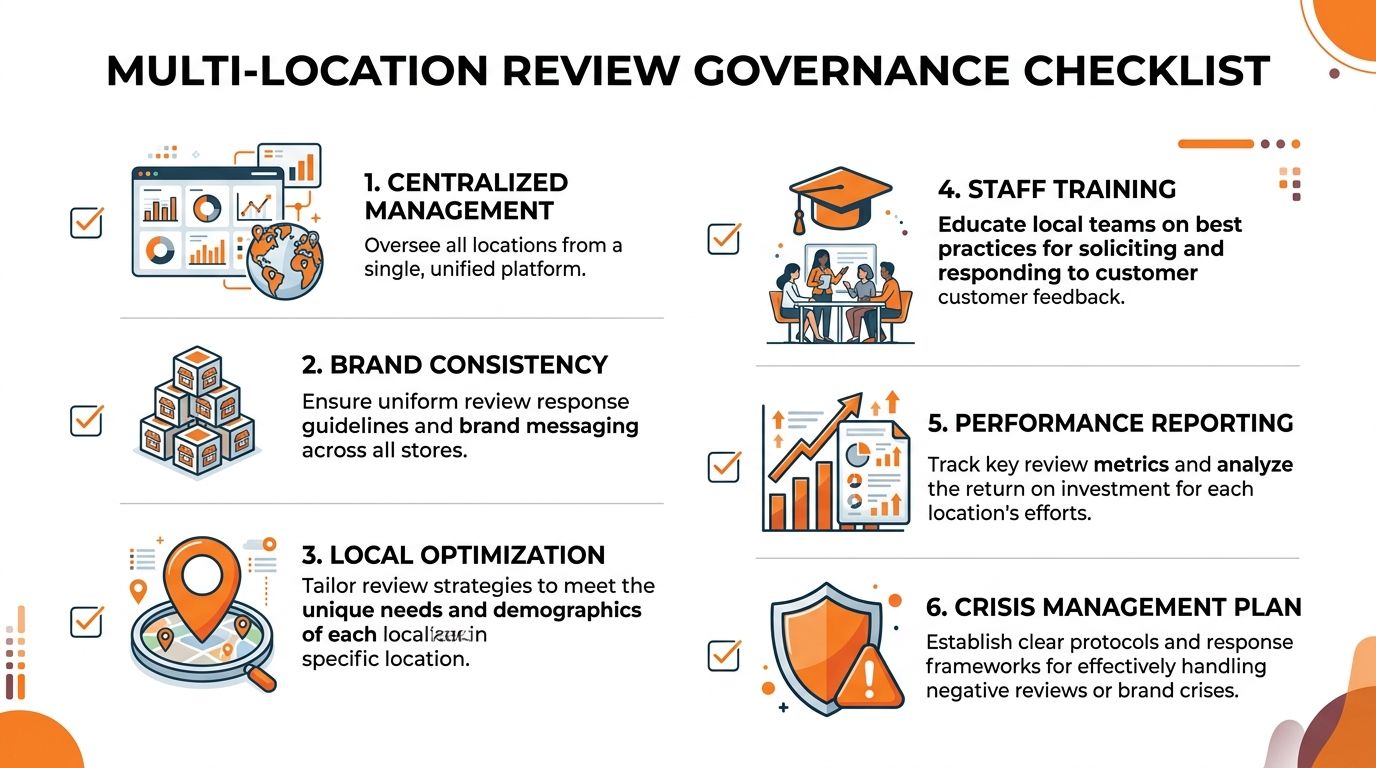
For multi-location brands, review strategy has to be centrally defined and locally executable.
The minimum standard should include:
- role-based permissions so not everyone can edit or respond
- response SLAs, meaning Service Level Agreements, by review type
- approved templates with room for location-specific personalization
- escalation rules for legal, compliance, or reputational risk
- weekly reporting by location, region, and brand
- profile hygiene checks so hours, categories, and key details stay accurate
That mix gives you scale without sounding corporate and lifeless.
7-day review program launch checklist
If you're rolling this out across multiple locations, use a short implementation sprint.
Day 1
Audit every Google Business Profile. Confirm ownership, hours, categories, phone numbers, and links.
Day 2
Assign access levels. Decide who can respond, who can approve, and who handles escalations.
Day 3
Install or connect your CRM, POS, or review software so requests can trigger automatically after service.
Day 4
Train front-line teams on the one-sentence verbal ask and the rules around honest, non-incentivized requests.
Day 5
Publish response templates for positive, negative, and escalated reviews. Include healthcare-safe language where relevant.
Day 6
Set reporting rules. Review velocity, response time, and GBP actions should be visible by location.
Day 7
Launch, then review first-week exceptions. Fix missed triggers, weak staff adoption, and any inconsistent replies.
Why centralized oversight wins
The point of governance isn't control for its own sake. It's quality.
Centralized systems make it easier to preserve brand voice, maintain compliance, and catch issues early, especially when multiple locations operate in different markets with different staffing realities. If your team is growing across regions, this overview of local SEO for multiple locations helps frame review operations as part of the broader local visibility system.
Frequently Asked Questions About Google Reviews
A new location opens strong, gets a burst of five-star reviews, then stalls. Another location gets fewer reviews but answers them well and keeps feedback coming every week. Six months later, the second profile usually looks healthier to customers, easier to govern centrally, and more useful to AI systems that summarize local businesses at scale. That is the right frame for these questions.
Can you remove a negative Google review?
Sometimes. Google will remove reviews that break policy, including spam, fake engagement, off-topic content, harassment, or conflicts of interest. A real complaint usually stays.
For multi-location brands, the operational fix is straightforward. Triage the review, document what happened, decide whether it should be flagged, and post a calm response that moves the issue offline. Then keep review flow steady across the location so one incident does not dominate the profile.
What is a good number of Google reviews for a local business?
There is no universal target. A dental office, an auto shop, and a senior living community will not need the same review volume, and neither will two locations in different markets.
Use local competitive parity instead. Measure each location against the top few competitors in its category and city, then track review recency, rating stability, and request-to-review conversion rate. For enterprise teams, consistency across the network matters more than chasing one impressive count at a flagship store.
Why do some Google reviews disappear?
Google filters reviews that look manipulated or low-trust. That includes duplicated wording, sudden unnatural spikes, reviewer account issues, or patterns that suggest employees, vendors, or non-customers were involved.
I also see reviews vanish when locations use weak request processes. If staff copy the same script, send too many requests at once, or push reviews from shared devices, Google can suppress some of that activity. The fix is better hygiene. Use natural timing, unique customer touchpoints, and account-level oversight.
Do google reviews help with AI search, not just SEO?
Yes. Reviews now influence more than rankings in traditional local search. They also shape how AI systems describe a business, compare locations, and surface recurring themes from customer language.
That matters for AIO. If ten locations consistently earn recent reviews mentioning speed, staff professionalism, or cleanliness, those patterns become easier for AI-driven tools to interpret across the brand. If the review profile is thin, outdated, or uneven by location, AI summaries become less reliable and brand control gets weaker.
What are subratings and why should operators care?
Subratings are the recurring service themes customers mention, such as wait time, communication, cleanliness, or product quality. They influence how buyers compare options before they ever call.
They also give operators something more useful than a star average. At scale, those patterns help regional teams spot location-level issues early, standardize coaching, and feed better prompts and knowledge inputs into AI workflows. A 4.6 rating is helpful. Knowing that three locations are repeatedly praised for staff friendliness while two are repeatedly criticized for long waits is actionable.
Should you ask friends, family, or employees to leave reviews?
No. That creates trust risk and weakens the data you need to run the program well.
Google wants reviews from real customer experiences. For multi-location brands, questionable review sources can trigger bigger problems than one removed post. They can distort location reporting, make compliance reviews harder, and reduce confidence in the signals your team is using for search, customer experience, and AI analysis.
How often should a business respond to reviews?
Daily is the best operating standard. If daily coverage is not realistic, set a written SLA by review type and location tier.
Speed matters, but governance matters more. A same-day reply that breaks policy, sounds defensive, or ignores brand standards creates avoidable risk. The better system is centralized rules with local execution: clear templates, approval paths for sensitive cases, and reporting on response time, escalation rate, and unresolved issues.
What should healthcare practices avoid in review replies?
Do not confirm someone is a patient. Do not mention treatment, diagnosis, appointment details, insurance, or any protected health information.
Keep the response general, polite, and brief. Invite the person to contact the office privately if follow-up is needed. In healthcare, one careless reply can create a compliance problem that outweighs any reputation benefit.
If you want help building a disciplined, month-to-month review program across one location or many, Reviews To The Top can help you centralize requests, protect brand consistency, improve response speed, and connect google reviews to real outcomes like calls, bookings, and lead-to-sale conversion. If you'd like a practical next step, book a strategy conversation and get a clear plan before adding more work to your front line.