
Effective SEO services are your most direct path to attracting local customers ready to buy. A smart SEO strategy ensures that when a potential customer searches for "emergency plumber near me" or "best med spa in [City]," your business appears at the top, turning their immediate need into a phone call, message, or booking. This visibility is crucial for driving conversions and growing your bottom line.
Key Facts About Local SEO Services
- Main Goal: To increase your visibility in local search results (like Google Maps) for terms related to your services and location (e.g., "HVAC repair [Neighborhood]").
- Core Components: A successful strategy combines On-Page SEO (content), Technical SEO (site performance), and Local SEO (Google Business Profile, reviews).
- Google's Model: Google ranks local businesses based on three factors: Proximity (how close you are), Relevance (how well you match the search), and Prominence (how well-known and trusted you are).
- Critical Asset: Your Google Business Profile (GBP) is the cornerstone of local SEO. A complete and optimized profile is non-negotiable.
- Key Metric: The ultimate measure of success is not just traffic but tangible leads—phone calls, form fills, and booked appointments that turn into revenue.
- Timeline: While foundational improvements show results in 1–2 months, significant ranking gains and lead growth typically take 3–6 months of consistent effort.

A Step-by-Step Guide to Winning with Local SEO Services
For local and multi-location operators, from med spas to auto repair shops, a clear plan is essential. This guide breaks down how to use SEO services to get found by more customers and directly impact your revenue. We will cover the "how-to," provide ready-to-use templates, show you how to measure success, and answer your most pressing questions.
How Google Ranks Local Businesses: Proximity, Relevance, Prominence
To win at local search, you need to understand how Google thinks. It uses a simple but powerful model to decide which business is the best answer for a searcher.
Proximity: How close is your business to the person searching? This is the first filter. Google prioritizes businesses that are physically near the user, which is why an accurate address on your Google Business Profile is critical.
Relevance: How well do your services match the search query? Google scans your website content, service descriptions, and reviews for keywords. If someone searches "sedation dentistry in [City]," it will favor practices that explicitly mention that service.
Prominence: How well-known and trusted is your business? This is determined by factors like your online review count and star rating, the number of quality links pointing to your website, and your overall online authority. A vet clinic with 200 positive reviews is seen as more prominent than one with 20.
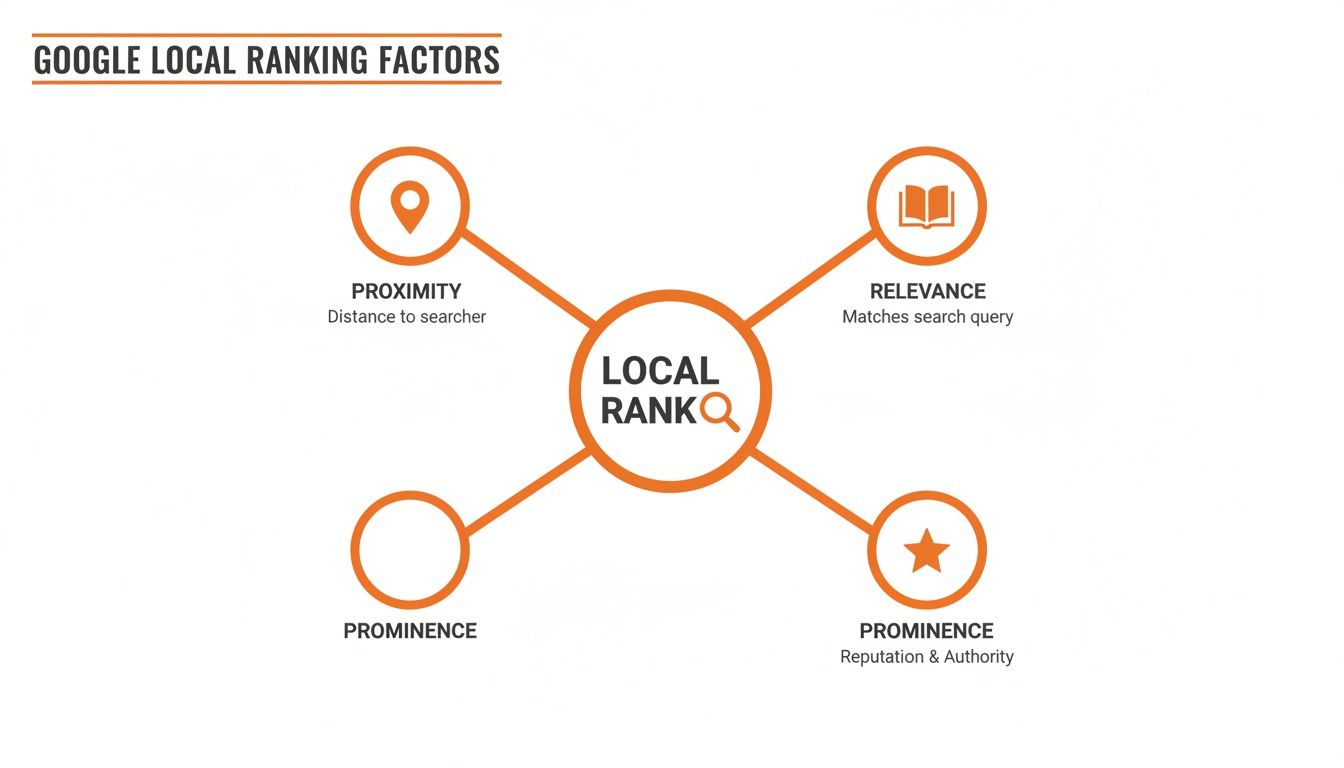
Mastering these three pillars is the key to dominating the search results for queries like "senior living near me" or "emergency vet in [Neighborhood]". An effective SEO services strategy focuses on strengthening all three signals.
Core SEO Services and Their Impact
| SEO Service | What It Includes | Business Impact |
|---|---|---|
| On-Page SEO | Keyword research, service page content, page titles, headings (H1, H2), internal links. | Makes your website highly relevant to what customers are searching for, directly answering their needs. |
| Technical SEO | Site speed optimization, mobile-friendliness, site architecture, and structured data (Schema.org). | Ensures search engines can find and understand your site, providing a fast, smooth user experience that boosts rankings. |
| Local SEO | Google Business Profile (GBP) optimization, citation building, and local link building. | Increases your visibility in local map packs and "near me" searches, driving foot traffic and local calls. |
| Review Management | Generating new reviews, responding to feedback, and managing your online reputation. | Builds trust and social proof (prominence), making your business the obvious choice over competitors. |
Templates & Checklists: Your Action Plan
Getting started with local SEO doesn't have to be overwhelming. This section provides a practical launch plan and ready-to-use scripts to build momentum in just one week.
7-Day Launch Checklist for Your Review Program
Focus on reviews first. They are a powerful driver of prominence and conversions.

- Day 1: System Setup. Connect your review software to your business system (e.g., Point of Sale, Customer Relationship Manager). Upload a list of customers from the last 30–90 days.
- Day 2: Customize Messages. Draft your SMS and email review requests. Set the sending delay to 1–24 hours after service is complete.
- Day 3: Team Training. Hold a 15-minute meeting with your staff. Explain the new process and why reviews are critical for business growth.
- Day 4: Go Live. Activate the automation. Send your first batch of requests to the customer list you uploaded on Day 1.
- Day 5: Monitor & Respond. As reviews come in, respond to every single one (positive and negative) within 24 hours.
- Day 6: Optimize Google Business Profile. Go through the GBP checklist below and ensure every section is 100% complete and accurate for all locations.
- Day 7: Review & Plan. Assess your first week's results: number of new reviews, open rate, and overall rating. Share wins with your team.
Scripts and Templates for Your Business
Review Request Scripts (Med Spa)
- SMS: Hi [Client First Name]. This is [Staff Name] from [Spa Name]. We hope you enjoyed your treatment today! If you have a moment, we'd love for you to share your experience: [Review Link]
- Email:
- Subject: How was your visit at [Spa Name]?
- Body: Hi [Client First Name], Thank you for choosing [Spa Name]. We hope you left feeling refreshed and confident. Your feedback helps others in the [City] community find us. Please take a moment to leave a review of your experience: [Review Link]. We look forward to seeing you again soon!
Review Response Templates
- Positive Review (Auto Shop): Hi [Customer Name], thank you for the fantastic feedback! We're glad we could get your car back on the road quickly and safely. We appreciate you trusting us with your vehicle here in [City] and look forward to helping you again.
- Negative Review (Senior Living): [Reviewer Name], thank you for taking the time to share your feedback. We are sorry to hear that your experience did not meet your expectations, as our goal is always to provide a compassionate and supportive environment. Our Community Director would appreciate the opportunity to speak with you directly. Please call us at [Phone Number] at your convenience.
Google Business Profile (GBP) Optimization Checklist
Your GBP is your digital storefront. Keep it pristine.
- Business Name: Use your exact legal name. No extra keywords.
- Categories: Choose the most accurate primary category, then add 5–8 relevant secondary categories.
- Address & Pin: Ensure the address is correct and the map pin is in the exact location.
- Service Area: If you are a service-area business (e.g., HVAC, plumbing), define your specific zip codes or cities.
- Hours: List regular hours and always update for holidays.
- Phone Number: Use a call-tracking number to measure leads from GBP.
- Website Link: Add a UTM-tagged link (
yourwebsite.com/?utm_source=google&utm_medium=organic&utm_campaign=gmb) to track visitors. - Services/Products: Add all your services with detailed descriptions and pricing where applicable.
- Business Description: Write a 750-character description that includes your key services and service area.
- Photos: Upload at least 10 high-quality photos of your location (exterior/interior), team, and work. Add new photos quarterly.
- Q&A: Proactively add and answer 5–10 frequently asked questions.
A fully optimized profile is the fastest way to improve your local relevance and prominence. It's a foundational step when you optimize your Google Business Profile.
How to Measure the ROI of Your SEO Services
SEO is only valuable if it generates a positive return on investment (ROI). Tracking the right metrics is essential to connect your marketing spend to real business results like calls and bookings. It's how you prove that your SEO services seo strategy is working.
Recommended KPI Targets for Local Businesses
Instead of vague goals, focus on specific Key Performance Indicators (KPIs). Here are realistic monthly targets for a local service business.
| Metric | Good Target | Excellent Target |
|---|---|---|
| New Reviews (Per Location) | 5–10 reviews/month | 10+ reviews/month |
| Overall Star Rating | Maintain 4.3–4.5 Stars | Maintain 4.6+ Stars |
| Review Response Time | Under 48 hours | Under 24 hours |
| GBP Views (Search & Maps) | 10% month-over-month increase | 15%+ month-over-month increase |
| GBP Actions (Calls & Clicks) | 15% month-over-month increase | 20%+ month-over-month increase |
| Lead-to-Sale Conversion Rate | Establish baseline and aim for 5% increase | 10%+ increase |
How to Track Performance from GBP to Sale
To prove ROI, you must connect online activity to actual revenue.
- Tag Your Links with UTMs: As mentioned in the checklist, add UTM parameters to the website link in your Google Business Profile. This tag tells Google Analytics that a visitor came specifically from your GBP listing, allowing you to see how that traffic behaves.
- Use Call Tracking: Implement a unique call-tracking phone number on your GBP listing. This allows you to count the exact number of phone calls generated by your local search presence.
- Calculate ROI: Once you know how many leads (calls, form fills) your SEO is generating, the math is simple. If your SEO services cost $1,500/month and you generate 10 leads, your cost per lead is $150. If you close 2 of those leads into customers worth $1,000 each, you've spent $1,500 to make $2,000—a positive ROI.
This data-driven approach transforms SEO from an expense into a predictable growth engine. Our expertise in reputation management is a key part of this success.
Frequently Asked Questions (Q&A)
Here are concise answers to the most common questions from local business operators.
1. How much do local SEO services cost?
For a single-location business, expect to invest between $500 and $2,500 per month for a comprehensive retainer. Costs vary based on market competition and the number of locations. Project-based work is also an option for specific tasks like a website audit.
2. How long does it take to see results from SEO?
You can see foundational improvements (like corrected listings) in 1–2 months. Meaningful results, such as ranking in the top 3 on Google Maps and a measurable increase in leads, typically take 3–6 months of consistent effort.
3. What is the difference between SEO and Local SEO?
Traditional SEO aims to rank a website for broad topics nationally or globally. Local SEO is geographically focused, aiming to rank a business for customers in a specific city or neighborhood, often for "near me" searches. Its cornerstone is the Google Business Profile.
4. How do customer reviews affect my SEO ranking?
Reviews are a major "prominence" signal for Google. It looks at:
- Review volume: The total number of reviews.
- Review velocity: The speed at which you get new reviews.
- Review rating: Your average star rating.
- Review content: Keywords used by customers in their reviews.
A steady stream of positive reviews tells Google you are a trusted, relevant local business.
5. What is "near me" SEO?
"Near me" SEO is the practice of optimizing your online presence to appear for location-based searches like "dentist near me" or "auto repair near me." It relies heavily on an accurate Google Business Profile, positive reviews, and location-specific content on your website to capture high-intent customers.
6. Which SEO metrics should I actually track?
Focus on metrics that translate to revenue:
- Google Business Profile Actions: Clicks for calls, website visits, and directions.
- Tracked Phone Calls: The number of calls generated from your SEO efforts.
- Keyword Rankings: Your position in the local map pack for top service keywords.
- Lead-to-Sale Conversion Rate: The percentage of leads that become paying customers.
7. What is Google's Proximity-Relevance-Prominence model?
It's how Google ranks local businesses. Proximity is how close you are to the searcher. Relevance is how well your business matches the search query. Prominence is how well-known and trusted your business is, based on reviews, links, and overall online authority.
Ready to turn your online presence into a predictable engine for growth? Reviews To The Top offers flexible, month-to-month support that combines expert guidance with a powerful platform to boost your rankings and win more customers in your industry. Book a strategy call to see how we can build a plan that delivers measurable results for your business.


