SEO optimization services connect your business with local customers actively searching for what you offer, turning "near me" searches into calls, messages, and bookings. A strong local SEO strategy ensures that when someone in your area needs your services, your business is the one they find and trust first, directly increasing your conversions.
Key Facts
- What is SEO? Search Engine Optimization (SEO) is the process of making your business more visible in online search results like Google and Google Maps.
- Why It Matters: Better visibility leads directly to more customer inquiries, appointments, and sales. It's the most effective way to attract ready-to-buy local customers.
- Google's Ranking Factors: Google ranks local businesses based on three main signals: Proximity (how close you are), Relevance (how well you match the search), and Prominence (your reputation, especially reviews).
- Core Components: Effective local SEO focuses on optimizing your Google Business Profile (GBP), improving your website (on-page SEO), managing online listings (citations), and building a strong online reputation through reviews.
- Timeline: Expect to see initial results in 60-90 days, with more significant ranking improvements taking 3-6 months of consistent effort.
Step 1: Understand How Local SEO Works
For any local or multi-location business, from a dental office to an HVAC company, Search Engine Optimization (SEO) is a direct line to new customers. When someone in your town searches for "emergency dental clinic near me" or "best AC repair in [City]," SEO is what decides if they see your business or your competitor's. Getting it right means your phone rings and your appointment calendar fills up.
To win at local search, you must play by Google's rules. The algorithm for local results boils down to three main signals:
- Proximity: This is straightforward. How close is your business to the person searching? If a customer is in the [Neighborhood] area and searches for a "med spa," Google will prioritize the spas closest to their physical location.
- Relevance: This is about how well your online presence matches the searcher's intent. When someone looks up "senior living tours," Google scans for communities whose websites and profiles are packed with information about tours, including service descriptions, photos, and related content. A complete, detailed Google Business Profile is absolutely critical here.
- Prominence: Think of this as your business's local reputation. Google measures it by looking at factors like your online reviews—their quantity, quality, and how recent they are. It also considers "backlinks" from other local sites and mentions in directories. A vet clinic with 150 fresh, positive reviews will naturally look more prominent to Google than one with only 15.
These fundamentals—along with consistent business information and an optimized website—form the bedrock of any successful local SEO strategy.
Step 2: Implement the Core Components of Local SEO
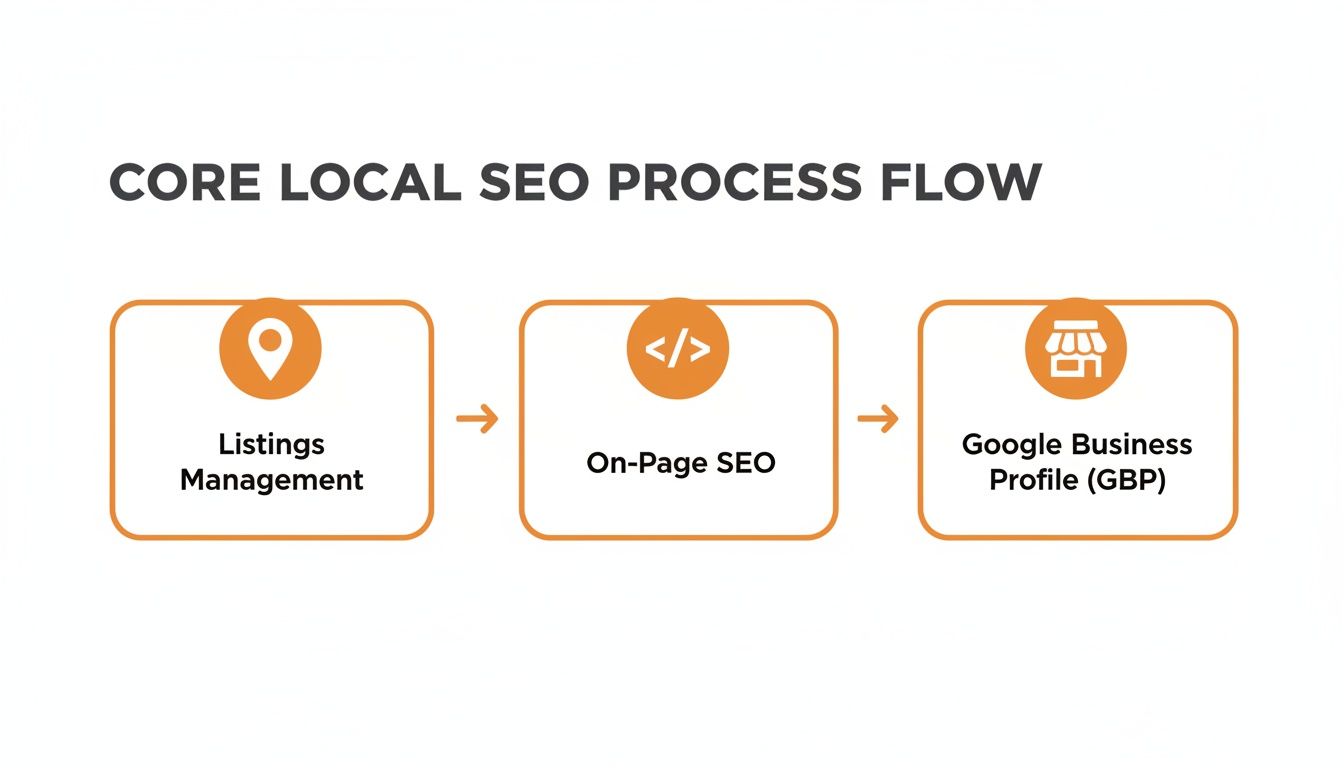
Effective local SEO is not a single task; it’s a system of interconnected parts working together. A great SEO optimization service doesn't just check these boxes; they weave them together into a powerful system that gets you ranked, gets you noticed, and gets you more customers.
Google Business Profile Optimization
Your Google Business Profile (GBP) is your new front door. It’s the first thing most potential customers see on Google and is the single most critical factor for showing up in the Google Maps "local pack."
GBP Optimization Checklist
- Complete Every Section: Fill out services, business hours, accessibility details, and all other attributes. Do not skip anything.
- Add High-Quality Photos: Show off your work. Upload at least 10-15 clear photos of your location, your team, and your services.
- Use Google Posts Weekly: Keep your profile fresh by sharing updates, offers, or news at least once a week.
- Enable Messaging: Make it easy for customers to ask a quick question by allowing them to message you directly.
- Manage Q&A Proactively: Add and answer common questions yourself. Don't wait for customers to ask.
On-Page and Technical SEO
While your GBP is the front door, your website is your home base. On-page SEO is all about making sure the pages on your site are set up to rank for specific local searches, like "emergency vet in [Neighborhood]." This means having dedicated pages for each core service and location.
Technical SEO happens behind the scenes to help search engines find and understand your site. The main things to focus on are:
- Mobile-Friendliness: Your website must work perfectly on a smartphone.
- Site Speed: Pages should load in under 3 seconds.
- Secure Connection (HTTPS): A secure site builds trust and is a confirmed ranking signal.
Listings and Citation Management
Your business information—Name, Address, and Phone number (NAP)—exists on dozens of online directories like Apple Maps, Yelp, and Bing. Each mention is called a citation. The goal is simple: consistency. If your auto shop is listed with three different phone numbers online, it sends confusing signals to search engines and frustrates customers. Listings management services ensure your NAP is identical everywhere, building trust and reinforcing your geographic relevance for those valuable "near me" searches.
Step 3: Use Templates to Boost Your Reputation
A steady stream of recent, positive reviews is a massive signal to Google. It directly fuels your "prominence," one of the three pillars of local ranking. Getting more reviews often just comes down to asking. The key is to make it incredibly simple for your happy customers.
SMS and Email Review Request Scripts (Senior Living Example)
SMS Review Request:
Hi [Family Member Name], it's [Staff Name] from [Community Name]. We hope you enjoyed your tour today! Would you mind sharing your experience on Google? Your feedback helps other families find us. [Link to Google Review Page]
Email Review Request:
Subject: How was your tour of [Community Name]?
Hi [Family Member Name],
Thank you for visiting our community today. We enjoyed showing you around and hope you found it helpful.
We'd be grateful if you could take a moment to share your feedback on Google. Your review helps us improve and guides other families in their search.
[Link to Google Review Page]
We look forward to connecting again soon.
Best,
The Team at [Community Name]
Positive and Negative Review Response Templates (Auto Repair Example)
Responding to reviews shows you're engaged and that you care.
Positive Review Response:
Hi [Customer Name], thank you so much for your kind words! We're thrilled to hear you had a great experience with our team and that your car is running smoothly. We appreciate your business and look forward to seeing you for your next service!
Negative Review Response:
Hi [Customer Name], thank you for your feedback. We are sorry to hear your experience did not meet expectations. Providing quality service is our top priority, and we've shared your comments with our management team to review this. Please contact our Service Manager, [Name], at [Phone Number] so we can learn more and work to resolve this.
7-Day Launch Checklist for a Review Program
Day 1: Finalize your SMS and email review request templates.
Day 2: Train your front-line staff on when and how to ask for a review.
Day 3: Create a list of happy customers from the last 30-60 days.
Day 4: Send your first batch of review requests to the list.
Day 5: Monitor for new reviews and respond to every single one (good or bad) within 24 hours.
Day 6: Review the results. If the response rate is low, tweak your templates.
Day 7: Make it a habit. Set a weekly time to send new requests and respond to reviews.
Step 4: Measure What Matters
SEO optimization services are an investment. To know if it's paying off, you must track key performance indicators (KPIs) that translate directly into calls, bookings, and real growth.

Local SEO KPI Targets for Service Businesses
| Metric | Good Target (Monthly) | Excellent Target (Monthly) | How to Track |
|---|---|---|---|
| New Reviews | 5-10 per location | 10+ per location | GBP Insights / Reputation Platform |
| Star Rating | 4.0 – 4.4 Stars | 4.5+ Stars | GBP / Reputation Platform |
| Review Response Time | Under 48 hours | Under 24 hours | Reputation Platform |
| GBP Clicks-to-Call | 10% MoM growth | 15%+ MoM growth | GBP Insights |
| GBP Profile Views | 15% MoM growth | 20%+ MoM growth | GBP Insights |
| Lead-to-Sale Conversion | 15% | 25%+ | CRM or Manual Tracking |
How to Track Bookings from Google Business Profile
To prove that a booking came from your GBP, use UTM parameters. These are small tags added to your website link that tell analytics software where the visitor came from.
- Use Google’s Campaign URL Builder (a free tool).
- Enter your booking page URL (e.g.,
https://yourwebsite.com/book-now). - Fill in the tags:
utm_source=googleutm_medium=organicutm_campaign=gbp
- Copy the generated URL and paste it into the "Website" field on your Google Business Profile.
Now, in Google Analytics, you can see exactly how many bookings originated from your GBP, proving the ROI of your efforts.
Step 5: Frequently Asked Questions (FAQ)
1. How long does it take to see SEO results?
You should see initial positive signals (more calls, more GBP views) within 60 to 90 days. However, achieving significant, stable rankings for competitive terms typically takes 3 to 6 months of consistent effort. SEO is a marathon, not a sprint.
2. Can I do SEO myself?
Yes, you can tackle the basics like claiming your Google Business Profile. The challenge is the significant time investment and steep learning curve. For multi-location businesses, managing multiple profiles, creating unique content for each, and tracking performance can easily become a full-time job, which is where SEO optimization services provide value.
3. What is the difference between SEO and AIO?
- SEO (Search Engine Optimization): This is the work of ranking your business in traditional search results, like Google's list of links and the map pack.
- AIO (Artificial Intelligence Optimization): This is about structuring your business data so AI assistants (like ChatGPT or Google's AI Overviews) can find it and serve it as a direct answer. Strong SEO fundamentals, especially a great reputation, are the foundation for good AIO.
4. How much should I budget for local SEO services?
For a single-location business, a comprehensive monthly retainer typically costs $1,500 to $3,000. For multi-location businesses, expect to budget $2,500 to $7,500+ per month, depending on the number of locations and scope of work. Be wary of services that cost only a few hundred dollars, as they often lack the strategy to deliver meaningful results.
5. Why are customer reviews so important for SEO?
Reviews are a top-ranking factor for local SEO. They build trust with Google, provide keyword-rich content from your actual customers, and directly drive conversions by providing the social proof potential customers need to choose you over a competitor. A strong reputation management program is essential.
6. What do Google’s proximity, relevance, and prominence mean?
This is Google's three-part model for ranking local businesses. Proximity is how close you are to the searcher. Relevance is how well your business services match what the person is looking for. Prominence is your business's overall reputation and authority, heavily influenced by online reviews and mentions.
7. What is a "citation" in local SEO?
A citation is any online mention of your business's Name, Address, and Phone number (NAP). Consistency across all citations (on platforms like Yelp, Apple Maps, Bing, etc.) is critical for helping search engines trust your location data and rank you correctly for "near me" searches.
Managing your online presence effectively is crucial for growth. We provide the expertise to optimize your Google Business Profile and turn your reputation into measurable results. If you’re ready to improve your local search visibility with flexible, month-to-month support, book a strategy call with us today.