
The services of SEO are what connect your business to customers actively searching online for what you offer. A well-executed SEO strategy gets your business found for high-intent searches like “emergency plumber near me,” turning that visibility directly into more calls, appointments, and customers for your business. For busy local operators, this isn’t about abstract rankings; it’s about measurable conversions and revenue growth.
Key Facts
- Primary Goal: To increase visibility in search engines like Google to drive more calls, bookings, and foot traffic.
- Core Components: SEO services include technical optimization, content creation, local SEO (Google Business Profile), review management, and link building.
- Measurement: Success is measured by Key Performance Indicators (KPIs) like Google Business Profile calls, website clicks, star rating (aim for 4.5+), and new review volume (aim for 10-15/month).
- Google's Model: Local SEO success hinges on Google's three pillars: Proximity (how close you are), Relevance (how well you match the search), and Prominence (how well-regarded you are, largely based on reviews).
- Timeline: While some improvements can be seen in the first month, expect to see significant results within 3 to 6 months of consistent effort.
- ROI: The return on investment is tracked by connecting SEO activities to tangible business outcomes, like tracking conversions from Google Business Profile using UTM tags.
Step-by-Step Guide: How to Lay Your Local SEO Foundation
For any local or multi-location business, getting found online isn't optional. It all comes down to taking clear, practical steps that help more customers discover you through local search. The absolute best place to start is your Google Business Profile (GBP), which is the most critical element of the services of SEO for local businesses.
Think of your GBP listing as your digital front door. For most potential customers, it's the very first impression they'll have of your business. Making sure it’s completely filled out and perfectly accurate is one of the highest-impact SEO activities you can tackle.
Your Google Business Profile Optimization Checklist
Your GBP is the engine that powers your ranking in Google's local pack (the map results at the top of the page). It proves your Proximity, Relevance, and Prominence to Google. Follow this checklist to get your profile into fighting shape.
- Nail Your NAP: Make sure your Name, Address, and Phone number (NAP) are 100% correct. Even a small difference like "St." vs. "Street" can cause confusion, so ensure it matches your website exactly.
- Define Your Service Area: Don’t make Google guess. Clearly list the specific towns, neighborhoods, and cities you serve, like "[City]" and "[Neighborhood]," to attract the right local customers.
- Get Specific with Services: Instead of a generic entry like "HVAC," list out everything you do. Think "emergency AC repair," "furnace installation," and "duct cleaning." This helps you rank for the exact terms people are searching for.
- Upload Plenty of Photos & Videos: Show off your best work, your friendly team, and your clean shop or vehicle. Profiles with more photos get 42% more requests for driving directions.
- Turn on Messaging: Let customers text you directly from your profile. It's a low-friction way to capture leads who would rather not make a phone call.
- Publish Google Posts Weekly: Share updates, promotions, and recent projects. This sends a powerful signal to Google that your business is active and open.
7-Day Local SEO & Review Program Launch Checklist
| Day | Action Item | Goal |
|---|---|---|
| 1 | Claim & fully verify your Google Business Profile (GBP). | Establish official ownership and control of your most important local listing. |
| 2 | Complete every single section of your GBP with 100% accuracy. | Optimize for Relevance by giving Google all the information it needs. |
| 3 | Upload at least 10 high-quality photos and one short video. | Make your profile visually engaging and build trust with potential customers. |
| 4 | Identify your top 3-5 local directory/citation sites and create profiles. | Start building NAP consistency across the web to reinforce Prominence. |
| 5 | Draft and finalize your SMS and email review request templates. | Prepare the tools needed to consistently generate new customer reviews. |
| 6 | Send your first review requests to 5-10 recent, happy customers. | Kickstart your review generation process and build immediate social proof. |
| 7 | Publish your first Google Post announcing a special offer or recent project. | Signal to Google that your profile is active and provides fresh content. |
This one-week sprint sets a powerful baseline. From here, your job is to maintain this momentum by consistently asking for reviews and keeping your profile updated. A key part of our reputation management services is making this process seamless.
Templates and Scripts for Reputation Management
Think of your online reviews as a public conversation about your business. When you respond, you’re not just talking to one person; you’re showing everyone watching that you're active and you care. This is a huge signal to Google, directly feeding into the “Prominence” factor that helps you rank higher for searches like “vet near me in [City]”.
SMS & Email Review Request Scripts
Reviews are the fuel for local SEO. They build your "Prominence" in Google's eyes and give new customers the confidence to choose you. Here are two simple, effective scripts you can start using immediately.
SMS Review Request Script (For an Auto Repair Shop)
Hi [Customer Name], this is [Your Name] from [Company Name]. Thanks again for trusting us with your vehicle today. Would you mind sharing your experience on Google? It really helps our local shop! [Link to Google Review]
Email Review Request Script (For a Med Spa)
Subject: How was your visit with [Provider's Name]?
Hi [Patient Name],
We hope you had a great experience at [Practice Name] today. We are always working to provide the best service in [City], and your feedback is a huge part of that. If you have a moment, we would be grateful if you could share your experience in a Google review.
[Link to Google Review]
Thank you for being a valued client!
Sincerely,
The team at [Practice Name]
Positive & Negative Review Response Templates
Positive Review Response Template (Senior Living Community):
"Hi [Reviewer Name], thank you so much for the kind words! We're thrilled your family had such a positive experience during your tour of our [City] community. It was a pleasure meeting you, and our team is here if you have any more questions."
Negative Review Response Template (Dental Practice):
"Hi [Reviewer Name], thank you for letting us know about this. We are very sorry to hear your experience did not meet your expectations. Providing excellent care is our top priority, and we would appreciate the chance to understand what happened. Could you please give our office manager, [Manager Name], a call at [Phone Number] at your convenience?"
This kind of response is professional, shows empathy, and immediately provides a clear next step toward a resolution. Nailing these responses is a core part of any successful reputation management strategy, especially for trust-based verticals like med spa and dental.
How to Measure the ROI of Your SEO Services
Investing in SEO services without tracking the outcome is just burning cash. The whole point is to connect the work being done to tangible business results, like more phone calls, new bookings, and feet walking through your door. You need to see exactly how improving your online visibility translates directly into revenue.
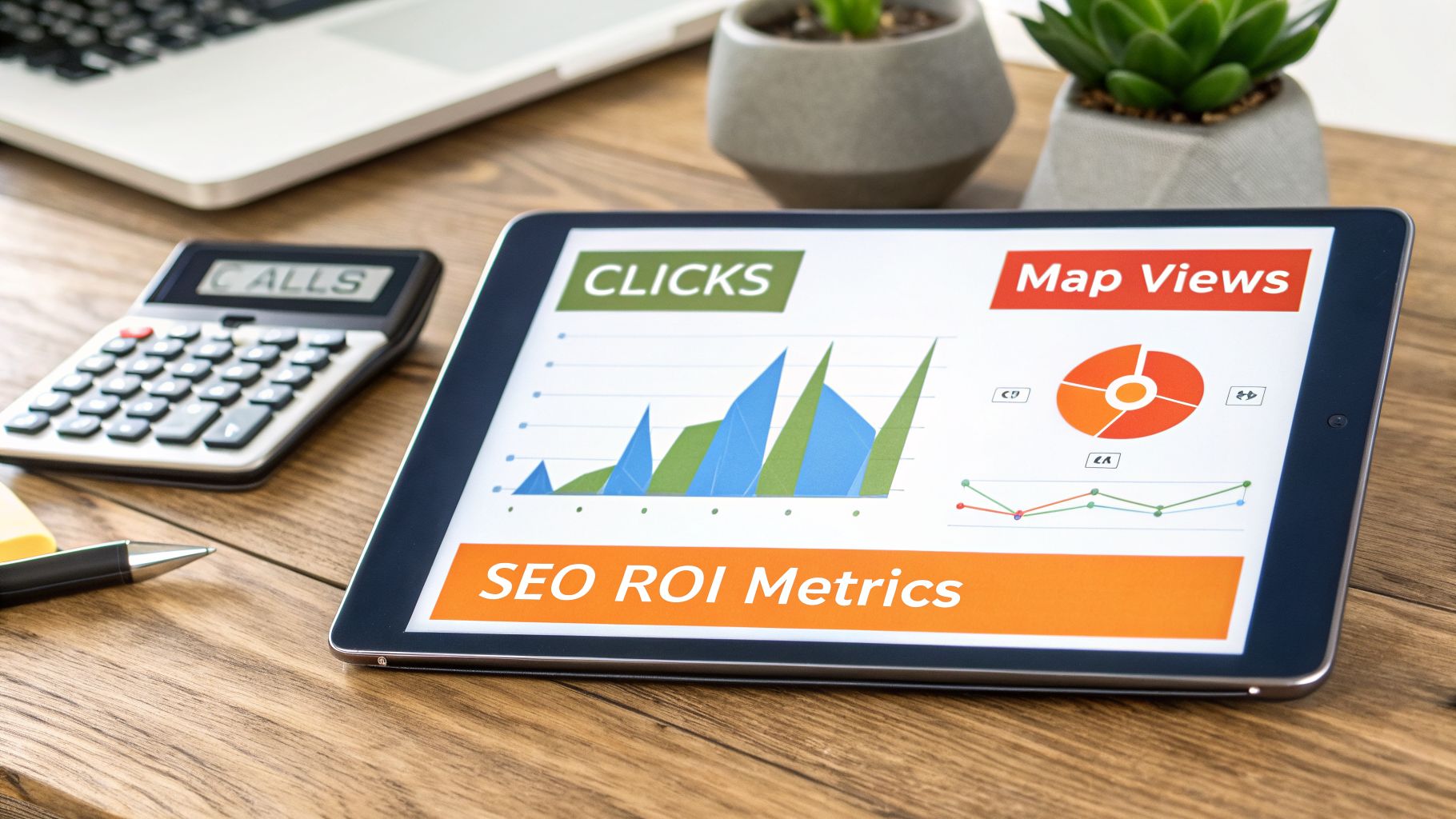
Key Performance Indicators for Local SEO
To get a real sense of whether your SEO strategy is working, focus on these Key Performance Indicators (KPIs).
Target Metrics for Local Businesses:
- Review Volume: 10–15 new reviews per location, per month.
- Star Rating: Maintain an average of 4.5 stars or higher.
- Review Recency: Ensure the majority of reviews are less than 90 days old.
- Response Time: Respond to all new reviews within 24 hours.
- GBP Performance: Track month-over-month growth in GBP views, calls, and website clicks.
- Lead-to-Sale Conversion: Aim for a target conversion rate specific to your industry (e.g., 20% of qualified calls from GBP convert to paying customers).
Tracking the Customer Journey with UTMs
A UTM (Urchin Tracking Module) is a small bit of code added to the end of a URL that acts like a tracking tag. By adding a unique UTM tag to the website link in your Google Business Profile (for example: yourwebsite.com/?utm_source=google&utm_medium=organic&utm_campaign=gmb), you can trace exactly how many people clicked from your profile and what they did next. This allows you to follow a customer's path from a Google search for "HVAC repair in [City]" all the way to a paid invoice, proving the clear financial return of your SEO investment. If you need help setting up this level of tracking, it’s a standard part of how we optimize your Google Business Profile.
Q&A: Frequently Asked Questions About SEO Services
How long does it take for SEO services to work?
You can expect to see meaningful movement in rankings, traffic, and leads within 3 to 6 months. Initial improvements, like fixing your business listings, can provide quick wins in the first 30 days, but competitive terms require a sustained effort.
How much do SEO services cost?
For a local business, monthly retainers typically range from $500 to $2,500. The cost depends on the competitiveness of your market and the scope of services. A company in a competitive industry like the home services industry in a major city will invest more than a niche business in a small town.
Can I do SEO myself?
Yes, you can start with the basics. Claiming and optimizing your Google Business Profile and asking customers for reviews are high-impact tasks you can do yourself. An agency or consultant becomes valuable for more technical work, advanced content strategy, and scaling your efforts.
Why are customer reviews so important for SEO?
Reviews are a primary factor in Google's "Prominence" signal. A steady stream of positive reviews tells Google that your business is active, trusted, and a popular choice in the local community, which directly leads to higher rankings in the map pack.
What is the difference between SEO and Local SEO?
SEO is the broad practice of ranking in search engines. Local SEO is a specialized subset focused on ranking a business for location-based searches (e.g., "near me" or "in [City]"). Local SEO prioritizes your Google Business Profile, local citations, and reviews.
What is AIO (Artificial Intelligence Optimization)?
AIO means optimizing your content so that AI tools like ChatGPT and Google's SGE can easily understand it and use it to answer user questions. It involves using clear headings, factual data, and a natural, conversational tone.
What is NAP and why is it important?
NAP stands for Name, Address, and Phone number. Keeping your NAP 100% consistent across all online directories (like Yelp, Apple Maps, etc.) is critical for local SEO. Inconsistencies confuse search engines and can hurt your rankings.
Ready to turn searches into customers with a disciplined SEO strategy? Our team provides transparent, month-to-month support focused on driving measurable growth. If you're ready for a plan built on clear results, book a strategy call with us today.


