Search engine optimization services are a set of practices designed to make your business highly visible on Google when customers are looking for you. For local and multi-location operators, this isn't just about website clicks; it's about turning online searches into real-world conversions like phone calls, messages, and bookings. A strong SEO strategy directly increases your leads by ensuring your business is the first and best answer a potential customer finds.
Key Facts
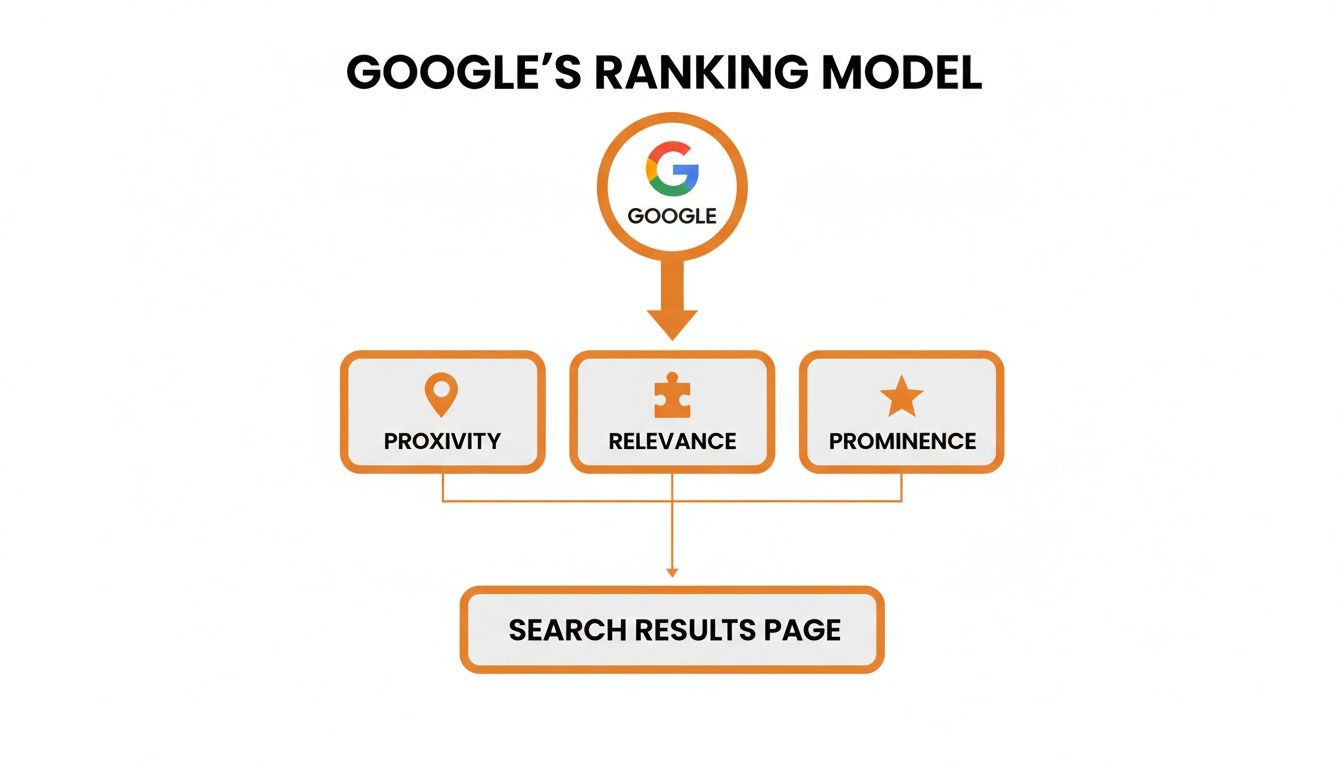
- Google's Ranking Model: Local search results are determined by Proximity (how close you are), Relevance (how well you match the search), and Prominence (how trusted your business is).
- Time to Results: Expect to see meaningful results like increased calls and leads within 4 to 6 months of starting a consistent SEO campaign.
- Core SEO Pillars: A complete strategy includes Technical SEO, On-Page SEO (content), Local Listings Management, Google Business Profile Optimization, and Reputation Management (reviews).
- Measurement is Key: Track conversions by using UTM tags on your Google Business Profile link to see exactly how many calls and bookings come from your SEO efforts.
- Target Metrics: Aim for a 4.5+ star rating, 10+ new reviews per month, and a review response time of under 24 hours.
How Search Engine Optimization Services Drive Growth
The entire goal of search engine optimization services is to connect your business with customers who are actively searching for what you offer. When someone in [City] searches for “emergency HVAC repair near me” or “best med spa in [Neighborhood],” SEO determines if they find you first. It works by optimizing your entire online presence to align with what search engines like Google value most: relevance and trustworthiness.
Understanding Google’s Local Ranking Model: Proximity, Relevance, Prominence
To rank at the top of local search results, you need to satisfy Google's three main criteria. Think of these as the three legs of a stool that support your visibility.
- Proximity: How close is your business to the person searching? Google prioritizes nearby options for searches with local intent.
- Relevance: How well does your business match the searcher's query? A dental practice with a dedicated page for "sedation dentistry for anxious patients in [City]" is highly relevant for that specific search.
- Prominence: How well-known and trusted is your business? Google measures this using signals like the quantity and quality of your online reviews, mentions from other local websites (citations), and the overall authority of your website.
A smart SEO strategy works to boost your performance across all three pillars.
A Step-by-Step Guide to Local SEO
A comprehensive SEO service is a combination of several jobs working together. For a busy owner or manager, understanding these steps helps you ask the right questions and ensure a strategy is designed to get you more calls, bookings, and customers.
Step 1: Technical SEO Audit
This is the work done "under the hood" to ensure Google can easily find and understand your website. Key tasks include improving site speed, ensuring mobile-friendliness, and securing your site (HTTPS). A site that takes more than 3 seconds to load will lose over half of its mobile visitors.
Step 2: On-Page SEO and Content
This step focuses on the actual content on your website. The goal is to make it clear what you do, where you are, and why you are the best choice. This involves creating specific service pages, such as "air conditioning repair in [Neighborhood]," to directly match what customers are searching for.
Step 3: Local Listings and Citations Management
Your business information—Name, Address, and Phone number (NAP)—appears on dozens of online directories like Google, Yelp, and Apple Maps. This step ensures your NAP is 100% consistent everywhere. Inconsistent information, like different office hours on Google versus your website, creates friction and drives potential customers away.
Step 4: Google Business Profile (GBP) Optimization
Your GBP is your digital front door. It often acts as a mini-website right in the search results. Optimizing your GBP is one of the highest-impact actions you can take. A complete GBP includes up-to-date hours, services, photos, and a consistent flow of new posts.
Quick Checklist for Optimizing Your Google Business Profile
- Verify your business location(s).
- Ensure your Name, Address, and Phone Number (NAP) are 100% accurate.
- Select all relevant primary and secondary business categories.
- Write a compelling, keyword-rich business description.
- Upload at least 10 high-quality, recent photos of your business (interior, exterior, team).
- Enable the messaging feature to allow customers to contact you directly.
- Use the Q&A feature to answer common customer questions proactively.
- Publish weekly posts with updates, offers, or news.
- Add a link with UTM tracking codes to your website to measure traffic.
- List all of your products and services with detailed descriptions.
Step 5: Reputation Management and Reviews
A steady stream of recent, positive reviews is a powerful signal to both customers and Google that your business is prominent and trustworthy. A complete SEO service must include a clear plan for generating new reviews and responding to all feedback. You can learn more about local SEO ranking factors in our article.
Practical Templates & Checklists for Your Business
Action is what separates successful businesses from the rest. Here are ready-to-use templates and checklists you can implement today to improve your online reputation and attract more customers.
Scripts to Request Customer Reviews
Make it easy for happy clients to leave feedback. The simpler the process, the higher your response rate.
1. SMS Review Request Script (for an Auto Repair Shop)
"Hi [Customer Name], this is [Your Name] from [Company Name]. Thanks for trusting us with your car today. We'd love to hear your feedback on your experience. Would you take 30 seconds to leave us a review? [Link to Google Review Page]"
2. Email Review Request Script (for a Senior Living Community)
Subject: How was your tour at [Community Name]?
Hi [Family Member Name],
We truly enjoyed meeting you and showing you our community today. Our team is dedicated to creating a welcoming and supportive environment for all our residents.
If you have a moment, we would be grateful if you shared your thoughts by leaving a review on our Google profile. Your feedback is a great help for other families in the [City] area who are exploring their options.
Click here to leave your review: [Link to Google Review Page]
Thank you for your time and for visiting us.
Sincerely,
The Team at [Community Name]
How to Respond to Reviews
Every review is a public conversation. Responding quickly and professionally builds trust with everyone watching.
Positive Review Response Template
"Hi [Customer Name], thank you so much for the wonderful feedback! We're thrilled to hear that you had a great experience with [Mention Specific Detail from Review, e.g., 'our front desk team']. We really appreciate you taking the time to share, and we look forward to serving you again."
Negative Review Response Template (HIPAA-Aware for a Dental Office)
"Hi [Reviewer Name], thank you for bringing this to our attention. We take all feedback seriously and are committed to providing the best possible patient care. Due to privacy regulations, we cannot discuss specific patient details here. Please contact our Practice Manager, [Manager's Name], directly at [Phone Number] or [Email Address] so we can address your concerns personally."
This response acknowledges the issue and moves the sensitive conversation offline, protecting patient privacy and de-escalating the situation.
7-Day Review Program Launch Checklist
A clear plan ensures your team is aligned and your program starts strong.
- Day 1: Finalize your review request scripts and response templates.
- Day 2: Train your team on when and how to ask for reviews and who is responsible for responding.
- Day 3: Set up a system (software or manual) to monitor new reviews across key sites daily.
- Day 4: Send the first batch of SMS or email requests to recent, satisfied customers.
- Day 5: Commit to responding to every new review within 24 hours.
- Day 6: Review the first wave of feedback with your team to see what is working.
- Day 7: Set a weekly goal for new review volume (e.g., 2-3 per location) and maintain your response time.
How to Measure SEO Return on Investment (ROI)

Investing in search engine optimization services only makes sense if you can prove it's driving business. You must be able to draw a straight line from your SEO efforts to more phone calls, new bookings, and increased sales. This is how SEO becomes a predictable growth engine, not just a marketing expense.
Key Performance Indicators (KPIs) that Matter
To understand your ROI, track the right KPIs. These metrics show how your online presence influences customer behavior.
Reputation & GBP Performance Targets:
- Review Volume: Aim for 10+ new reviews per location, per month.
- Recency: A steady flow of new reviews shows your business is active and popular.
- Response Time: Respond to all new reviews in under 24 hours.
- Star Rating: Maintain an average rating of 4.5 stars or higher.
- GBP Views/Calls: Track how many people see your profile and then take action (call, get directions, visit website).
- Lead-to-Sale Conversion: Measure what percentage of leads from GBP become paying customers.
Tracking Conversions from GBP to Bookings
The most effective way to connect SEO work to revenue is with UTM parameters. These are small tracking tags added to a URL. When someone clicks a link with these tags, Google Analytics shows you exactly where they came from.
How to Track Your GBP ROI:
- Tag Your URL: Use Google’s Campaign URL Builder to add UTM tags to your website link in your Google Business Profile. Set the source as "google," the medium as "organic," and the campaign as "GBP."
- Monitor in Analytics: In Google Analytics, you can now see exactly how many visitors came from your GBP link.
- Track to Conversion: See how many of those visitors completed a goal, like submitting a "Book an Appointment" form. If 100 people visit from your GBP and 10 book a service, you have a 10% conversion rate from that specific channel.
This method gives you undeniable proof of ROI. You can confidently say, "Our investment to optimize your Google Business Profile generated X calls and Y bookings this month." For a deeper dive, check out our guide on local SEO reporting.
Frequently Asked Questions (FAQ)
Here are concise, factual answers to the most common questions we hear from business owners about SEO.
1. How long does it take to see results from SEO?
You should plan for 4 to 6 months to see meaningful results, such as a noticeable increase in qualified leads and calls. While some small improvements may appear sooner, sustainable growth takes time to build authority and trust with Google.
2. What is the difference between local SEO and regular SEO?
Regular SEO targets broad audiences (e.g., a blog on "how to fix a leaky faucet"). Local SEO focuses on attracting customers in a specific geographic area (e.g., "plumber near me in [City]"). It heavily relies on optimizing your Google Business Profile and local directory listings.
3. Should I use SEO or paid ads like Google Ads?
They serve different purposes. Paid ads (Google Ads) offer immediate visibility but stop when you stop paying. SEO is a long-term investment that builds a sustainable asset; the organic traffic you earn continues to deliver value over time. Many businesses use both for a balanced strategy.
4. What are local citations or listings?
Citations are mentions of your business's Name, Address, and Phone number (NAP) on other websites and online directories (e.g., Yelp, Apple Maps, industry-specific sites). Consistent citations are a key factor in building local search prominence.
5. How does Artificial Intelligence (AI) affect SEO?
AI is making search engines better at understanding user intent, not just keywords. This means high-quality, genuinely helpful content is more important than ever. It has also led to AIO (Artificial Intelligence Optimization), which involves structuring your business information so conversational tools like ChatGPT can easily find and recommend your services.
6. What makes a good SEO partner?
A good partner is transparent about their strategy, focuses on metrics that impact your revenue (calls, bookings), and has experience in your industry. Be cautious of any provider that guarantees a #1 ranking on Google.
7. Why are online reviews important for SEO?
Online reviews are a major ranking factor for local SEO. A high volume of recent, positive reviews signals to Google that your business is prominent and trusted, directly impacting your visibility in local search and the Map Pack.
At Reviews To The Top, we combine expert-led reputation management with proven SEO strategies to make you the top choice in your local market. We offer flexible, month-to-month support tailored to your business, whether you're a single dental practice or a multi-location enterprise. If you're ready for a clear strategy tied to real, measurable growth, book a strategy call with our team.