Effective automotive shop marketing builds trust and turns local online searches into profitable jobs in your service bays. By focusing on a strong Google Business Profile, a steady stream of positive reviews, and targeted local ads, you can attract high-value customers and increase your average repair order (ARO). This approach is critical for converting online visibility into real-world conversions like phone calls, messages, and booked appointments.
Key Facts
- Local SEO is Your Foundation: A fully optimized Google Business Profile (GBP) is the fastest way to appear in "near me" searches on Google Maps, capturing up to 44% of all local search clicks.
- Reviews Drive Decisions: Over 85% of consumers trust online reviews as much as personal recommendations. Aim for a 4.5+ star rating to maximize calls and bookings.
- Google's Ranking Formula: Google ranks local businesses based on three factors: Proximity (how close you are), Relevance (how well you match the search), and Prominence (your online reputation and review score).
- Marketing Budget: A standard marketing budget for an auto shop is 5-10% of gross revenue.
- Paid Ads for Speed: Google Ads capture immediate demand (e.g., "emergency brake repair"), while Facebook Ads are better for building long-term brand awareness (e.g., seasonal maintenance reminders).
- Retention is Cheaper: It costs five times more to acquire a new customer than to retain an existing one. Use automated service reminders to boost repeat business.
Step-by-Step Guide to Automotive Shop Marketing
This plan is built for busy local and multi-location operators. It focuses on practical, repeatable steps to build a marketing system that consistently fills your bays.
Step 1: Dominate Local Search with Your Google Business Profile
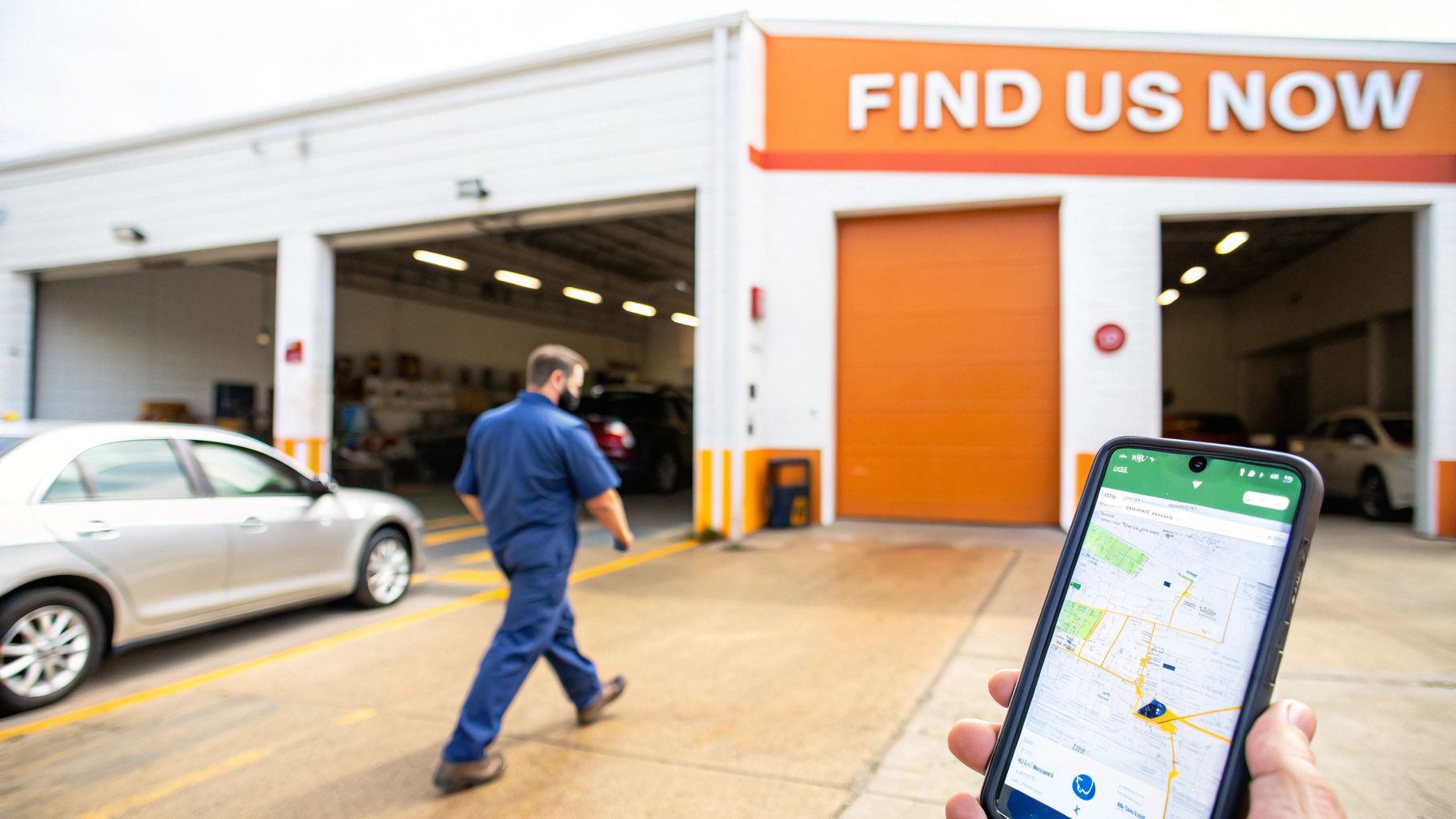
Your Google Business Profile (GBP) is your digital storefront. Optimizing it is the most important step in any automotive shop marketing plan.
Google’s Proximity–Relevance–Prominence Model Explained:
- Proximity: How close is your shop to the searcher? You can't change your location, but you can ensure your service areas are correctly listed.
- Relevance: How well do your services match the search? If someone searches "transmission shop in [City]," Google looks for signals like "Transmission Repair" listed as a service, mentioned in reviews, and in your Q&A section.
- Prominence: How well-known is your business? Google measures this through your review count and quality, the consistency of your business information online (Name, Address, Phone or NAP), and links from other credible local websites.
GBP Optimization Checklist:
- Claim & Verify: Ensure you have full ownership of your listing.
- Complete All Sections: Fill out every field—services, hours, attributes (e.g., "ASE-Certified"), payment options, and accessibility details.
- Use Specific Categories: Start with "Auto Repair Shop," then add secondary categories like "Brake Shop," "Tire Shop," or "Oil Change Station."
- Upload High-Quality Photos: Add at least 20 clear photos of your bays, team, equipment, and building exterior. Add new ones quarterly.
- Enable Messaging & Booking: Let customers contact you directly from Google.
- Use Google Posts Weekly: Share specials, tips, or customer testimonials to show you're active.
- Pre-load the Q&A: Add and answer common questions like "Do you offer loaner cars?" or "What is your warranty on brake work?" before customers have to ask.
Step 2: Build Trust with a 5-Star Reputation
In the auto repair business, trust is your most valuable currency. A systematic approach to getting reviews is non-negotiable.
A structured reputation management program turns happy customers into powerful social proof. The best time to ask is immediately after a customer has paid their invoice and received their keys.
Step 3: Drive Immediate Leads with Paid Ads
While SEO builds long-term authority, paid advertising on platforms like Google Ads is your tool for immediate results. Focus your budget on high-intent keywords from searchers who need help now.
- Target "Money" Keywords: Bid on specific services like
[City] transmission repair,brake service near me, orcheck engine light diagnostics [Neighborhood]. - Set a Tight Radius: Target your ads to a 5-10 mile radius around your shop to avoid paying for clicks from people who are too far away.
- Use Ad Copy That Converts: Mention your key differentiators ("ASE-Certified Technicians," "24-Month/24k-Mile Warranty") and a clear call-to-action ("Call for a Free Estimate").
Step 4: Turn One-Time Fixes into Lifetime Customers
It costs 5x more to acquire a new customer than to keep an old one. Use your shop management system to set up automated email and SMS service reminders.
- Oil Change Reminders: Send 3-5 months after the last service.
- Inspection Alerts: Send 30 days before their tag or sticker expires.
- Seasonal Campaigns: Promote A/C checks in the spring and winter tire packages in the fall.
Templates & Scripts for Your Auto Shop
Use these field-tested templates to build a consistent process for generating and managing reviews.
7-Day Review Program Launch Checklist
| Day | Action Item | Objective |
|---|---|---|
| Day 1 | Finalize SMS and email review request scripts. | Create clear, friendly messaging that sounds authentic to your shop. |
| Day 2 | Train service advisors on when and how to ask for a review. | Get team buy-in and ensure consistency at the front counter. |
| Day 3 | Generate and save your direct Google review link. | Make it a one-click process for customers to leave feedback. |
| Day 4 | Send your first 5 SMS requests to happy customers. | Test the process in a real-world setting and gather initial feedback. |
| Day 5 | Draft and save response templates for positive and negative reviews. | Prepare to respond quickly and professionally to all feedback. |
| Day 6 | Assign one person to monitor and respond to all reviews daily. | Establish clear ownership for managing your online reputation. |
| Day 7 | Review the first week’s results and adjust scripts as needed. | Optimize your process based on response rates and customer interactions. |
Review Request Scripts
SMS Review Request Script (Highest Success Rate)
"Hi [Customer Name], thanks for trusting [Your Shop Name] today! If we earned your 5-star rating, could you take 30 seconds to share your experience on Google? It really helps local drivers find us. [Direct Review Link]"
Email Review Request Script
Subject: How was your visit to [Your Shop Name]?
"Hi [Customer Name],
Thanks again for choosing us to service your [Vehicle Make/Model]. We hope everything is running great.
When you have a moment, we'd greatly appreciate it if you could leave us a review on Google. Your feedback helps us improve and helps other drivers in [City] make confident decisions.
[Direct Review Link Button]
Thank you,
The Team at [Your Shop Name]"
Review Response Templates
Positive Review (5-Star) Response Template
"Hi [Customer Name], thank you so much for the kind words! We're thrilled to hear the team took great care of you and your [Vehicle Make]. We look forward to seeing you for your next service. Drive safely!"
Negative Review (1- or 2-Star) Response Template
"[Customer Name], we are very sorry to hear your experience did not meet expectations. This is not the standard we aim for. Please call our manager, [Manager's Name], directly at [Phone Number] so we can learn more and work to make this right."
How to Measure Your Marketing Success
Tracking the right Key Performance Indicators (KPIs) is the only way to know if your marketing is working. Focus on metrics that connect directly to revenue.
Key Metrics and Target Goals
- Review Volume: Aim for 8-12 new reviews per month per location.
- Recency: Ensure you have new reviews posted every week.
- Response Time: Respond to 100% of reviews within 24 hours.
- Average Star Rating: Maintain a 4.5-star rating or higher.
- GBP Views & Calls: Track the monthly number of calls, direction requests, and website clicks from your Google Business Profile. These are your highest-quality leads.
- Lead-to-Sale Conversion Rate: Target a 60% or higher conversion rate from qualified phone calls and form submissions to booked appointments.
Tracking Your Return on Investment (ROI)
Use UTM parameters (Urchin Tracking Module) to tag your links and see exactly where your leads come from. A UTM is a small code added to a URL that tells Google Analytics how a visitor found you.
For example, you can create a specific UTM link for your GBP website button. This allows you to track how many people came to your site from your Google profile, what they did, and whether they converted. This data lets you prove which channels—GBP, Google Ads, Facebook Ads—are driving the most valuable business, so you can invest your budget wisely.
Frequently Asked Questions (FAQs)
1. How much should an auto repair shop spend on marketing?
A good rule of thumb is 5-10% of your gross revenue. New or highly competitive shops in areas like [City] should aim for the higher end (10%), while established shops with a strong customer base can often succeed at the lower end (5%).
2. How long does it take for automotive SEO to work?
You can expect to see improvements in your local Google Maps rankings within 30-60 days of fully optimizing your Google Business Profile and starting a consistent review generation program. Ranking for highly competitive terms like "auto repair in [City]" typically takes 4-6 months of sustained effort.
3. What is the single most important first step in marketing my auto shop?
Claim and completely optimize your Google Business Profile (GBP). This is your digital front door and the fastest, most cost-effective way to generate local calls and direction requests from customers searching "mechanic near me."
4. Should I use Google Ads or Facebook Ads first?
Start with Google Ads. It captures intent—people who are actively searching for a solution to a problem right now. Facebook Ads are for building brand awareness and creating future demand, making them a good second step after you've maximized your presence on Google.
5. What is NAP consistency and why does it matter?
NAP stands for Name, Address, and Phone number. Ensuring this information is identical across all online directories (Google, Yelp, Facebook, etc.) is a critical trust signal for Google's local algorithm. Inconsistencies can hurt your search rankings.
6. What's the best way to ask a customer for a review?
The most effective method is an automated SMS (text) message sent within one hour of the customer paying their bill. The request is timely, and text messages have a much higher open rate (over 95%) than emails.
7. How do I handle a negative online review?
Respond publicly within 24 hours. Acknowledge the customer's frustration, apologize that their experience did not meet standards, and provide a direct, offline contact (like a manager's phone number) to resolve the issue. This shows prospective customers that you take feedback seriously.
A winning automotive shop marketing plan isn't about a single tactic; it's about building a consistent system that leverages your shop's reputation to drive measurable growth. If you’re ready to optimize your Google Business Profile and turn customer feedback into your best marketing asset, we can help. To learn more about our simple, month-to-month support, book a strategy call with our team today.