When you're trying to figure out where to focus your energy, the Yelp vs. Google Reviews debate really boils down to reach versus influence. On one hand, you've got Google Reviews, an absolute giant in visibility that dominates local search. It's pretty much essential for every business out there.
On the other hand, Yelp has cultivated a more specific, dedicated community. Its users tend to leave incredibly detailed feedback, which carries a lot of weight in industries where experience is everything, like restaurants or home services.
Understanding the Core Differences
Deciding where to funnel your reputation management efforts means getting a handle on how each platform works for your online presence. While you can't ignore either, their audiences, impact on SEO, and overall philosophies on reviews are worlds apart. Nailing these distinctions is the first step to creating a smart strategy that pulls in customers from both sides.
Google's power is its seamless connection to search. When someone looks up a local business, Google Reviews are right there in their face, playing a huge role in whether they click or call. The numbers really drive this point home.
According to a 2025 BrightLocal survey on local business reviews, 87% of consumers turned to Google to check out local businesses. What's more, a massive 76% of consumers make a habit of reading online reviews before they buy.
This makes having a strong Google profile an absolute must-have for getting noticed.
Yelp, however, feels more like a tight-knit community. Its users are often more particular, writing long, in-depth reviews that can truly make or break a business in certain fields. Yelp is also known for its aggressive review filter, which tries to get rid of spammy or fake feedback. This creates a perception among its loyal users that the content is more trustworthy and of higher quality.
This infographic lays out the key differences in audience, SEO impact, and influence.
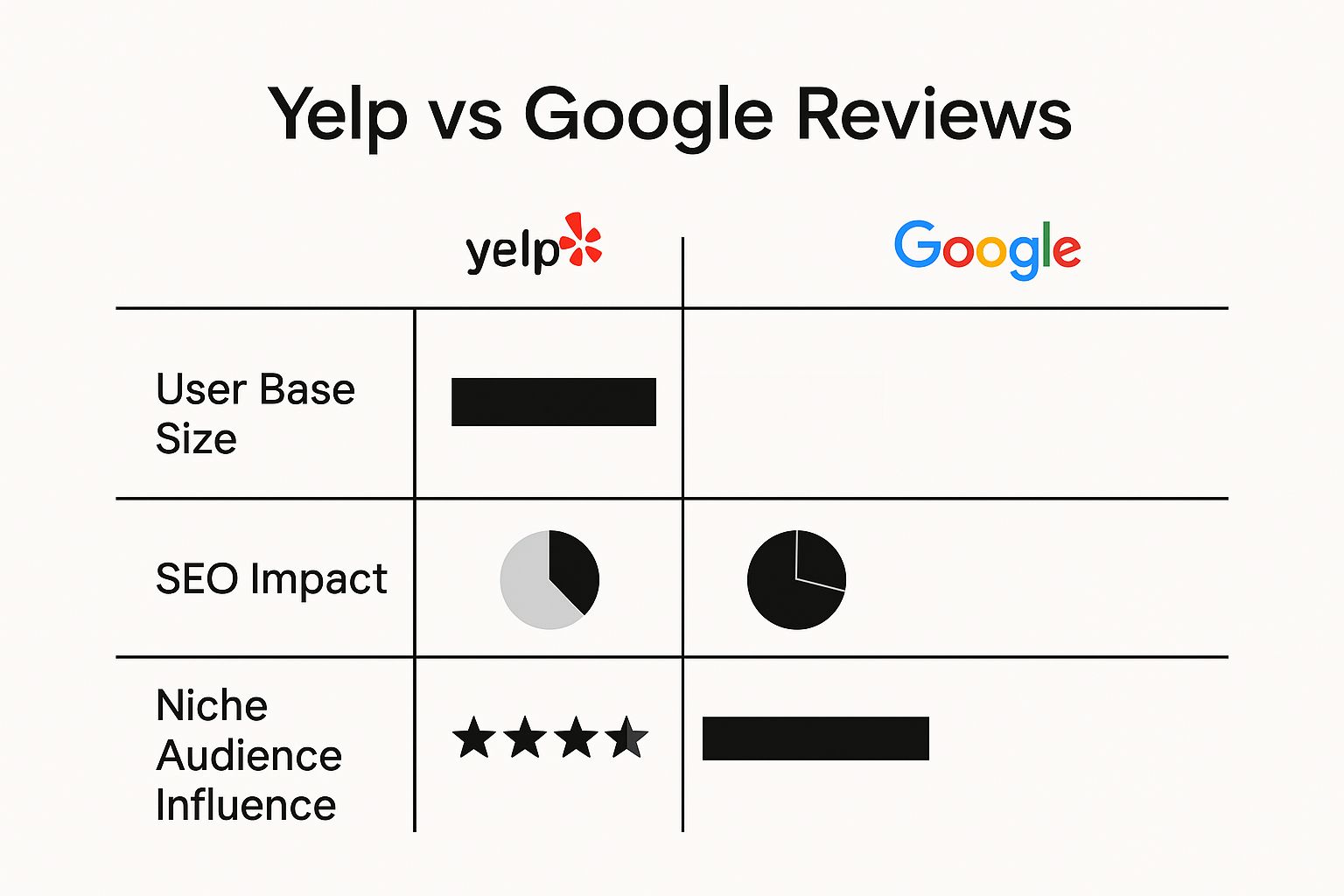
The data speaks for itself. Google clearly wins on sheer numbers and direct SEO benefits, but it also highlights Yelp’s strength in providing quality feedback from a focused, influential audience.
Quick Comparison Yelp vs Google Reviews
To make things a bit clearer, here’s a straightforward table that breaks down the fundamental differences between Yelp and Google Reviews. It’s a great way to quickly see where each platform really shines.
| Feature | Google Reviews | Yelp |
|---|---|---|
| Primary Strength | Broad visibility and local SEO | Niche authority and detailed feedback |
| Audience | Massive, diverse user base | Dedicated, community-focused users |
| Review Style | Often short, quantitative ratings | Longer, more descriptive reviews |
| Review Filtering | Automated, less aggressive | Strict algorithm, more aggressive |
Ultimately, this comparison shows that you're not just choosing between two platforms; you're choosing between two different types of customer engagement and visibility.
Decoding the Audience on Each Platform

To really get a handle on the Yelp vs Google Reviews discussion, you have to start with the people writing them. It’s not just about what’s being said; it’s about who is saying it. Each platform has cultivated a totally different kind of user, and their motivations for leaving a review couldn't be more distinct.
Yelp has built a tight-knit community of what they call "Yelpers." Think of them as dedicated food critics, boutique shoppers, and service connoisseurs. For many of them, writing reviews is more than just a quick comment—it’s a hobby. They're known for crafting detailed, almost story-like narratives that dive deep into the experience.
This kind of in-depth feedback is pure gold for businesses where the little things make all the difference—a high-end restaurant, a specialized mechanic, or a bespoke tailor. These reviewers paint a picture that goes way beyond a simple star rating, giving future customers a genuine feel for the atmosphere, the service, and the quality.
The Google Reviewer: A Broader Spectrum
Google Reviews, on the other hand, casts a much wider net. Because Google is so integrated into our daily lives, its reviewer base is essentially everyone. The person leaving a Google review is your average consumer who just wants to share a quick thought. Convenience is king here, which results in a massive volume of reviews that are typically short, sweet, and to the point.
This constant stream of star ratings and brief comments is exactly what fuels Google's local search algorithm. While you might not get the novel-length review you'd find on Yelp, the sheer number of reviews sends a powerful signal to Google—and your potential customers—that you're a popular and trusted choice.
The core difference comes down to moderation. Yelp’s aggressive filtering is all about curating high-quality, trustworthy content. Google’s automated system, however, prioritizes volume, which can shape how users perceive the authenticity of the reviews they read.
Review Authenticity and User Trust
This difference in audience is made even starker by how each platform tackles review authenticity. Yelp uses a heavy-handed mix of AI and human moderation to weed out what it deems to be fake or low-quality reviews. This leads to reviews that often feel more trustworthy, but it’s a double-edged sword—sometimes, perfectly legitimate feedback gets caught in the filter.
Google's system is much more reliant on automation. While it's getting smarter, it can be slower to catch fake reviews. This has created a bit of a trust issue; consumer perception has held steady since 2021, with about half of users feeling confident they've spotted fake reviews on the platform. You can discover more insights about review platform differences to see how this plays out.
Ultimately, this means your strategy can't be one-size-fits-all. With Yelp, your goal should be to build real relationships that encourage those rich, detailed reviews. For Google, the name of the game is volume—you need a steady flow of recent reviews to stay visible and relevant.
How Each Platform Impacts Your SEO and Visibility

When you're weighing Yelp vs Google Reviews, one of the biggest things to consider is how each one affects your search engine optimization (SEO). Both platforms have a huge impact on how customers find you, but they work in completely different ways. Getting a handle on this difference is crucial for building a smart strategy to get more eyes on your business.
Google Reviews are like high-octane fuel for your local SEO. Since they live right inside Google's world, they're a massive ranking factor. A consistent flow of good reviews sends a strong signal to Google's algorithm that your business is active, relevant, and trustworthy.
The result? You climb higher in local search results, especially in the all-important Google Maps "Local Pack." That's the prime real estate at the top of the page showing the top three local businesses.
The Direct Power of Google Reviews for SEO
Google's algorithm looks at more than just your star rating when it decides where to rank you. It's a bit more nuanced than that.
There are three big signals it pays attention to:
- Review Quantity: The more reviews you have, the more popular and established you appear.
- Review Velocity: How often you get new reviews shows that your business is still current and relevant.
- Review Diversity: A natural mix of feedback and ratings gives a more authentic picture of your business.
Keeping a steady stream of new reviews coming into your Google Business Profile is hands-down one of the best things you can do to boost your local rank. We get into the nitty-gritty of this relationship in our guide on how Google Reviews help SEO.
A strong Google review profile does more than just help you rank—it builds instant trust. Seeing a high star rating and a bunch of recent reviews right in the search results makes a potential customer far more likely to click on your business instead of the competition.
Yelp’s Indirect but Influential SEO Role
Yelp plays a totally different game. Reviews on Yelp do not directly boost your ranking on Google. But don't make the mistake of thinking that makes Yelp irrelevant for your visibility. It's actually a powerhouse in its own right.
Here's why: Yelp's website has massive domain authority. That means Yelp pages themselves often rank on the first page of Google for very specific searches, like "best pizza in Brooklyn" or "top-rated plumbers near me."
When that happens, Yelp's list often shows up right at the top of the results. If your business is sitting pretty on that list, you get a powerful, third-party endorsement that sends highly motivated customers straight to you. It's an indirect SEO win, but a massive one.
Of course, managing reviews is just one piece of the puzzle. Great content marketing can give your online presence a major lift. Brushing up on some Top Content Marketing Tips for Small Businesses can give you even more ideas to improve your digital footprint. Think of it this way: Google gives you direct ranking power, while Yelp lets you "borrow" its authority to get seen.
Navigating Review Filters and Building Trust

One of the most maddening parts of the Yelp vs Google Reviews battle is watching perfectly good reviews vanish into thin air. You have to understand how each platform polices its content to build a reputation that customers actually trust. Their methods are night and day, and that difference directly affects your star rating and how the public sees you.
Yelp's Aggressive Curation
Yelp is infamous for its aggressive, proprietary filter. The entire point of their system is to feature what it deems the most "helpful" and "reliable" reviews, which usually means content from seasoned Yelp users.
This approach often buries reviews from brand-new users, people who don't post often, or any review that smells even slightly solicited. While the goal is to weed out fakes, it's incredibly frustrating for business owners when they see a legitimate, glowing review get banished to the "Not Recommended" section, where it has zero impact on their star rating. For Yelp's die-hard users, this builds trust; for businesses, it can feel like a penalty.
Google's Open-Door Policy
Google, on the other hand, is much more hands-off. Its moderation is largely automated, prioritizing volume and accessibility, so most reviews go live almost instantly. This is a huge advantage for piling up reviews quickly, which is a massive boost for local SEO.
But there's a catch to this open-door policy: it's a magnet for spam and fake reviews. While Google does have systems in place to flag and remove fraudulent content, its initial screening isn't nearly as strict as Yelp's. This puts the onus on you, the business owner, to keep a close eye on your profile and report anything that violates their policies.
Trust is built on transparency. Yelp's filter aims for curated quality, while Google's volume-based system reflects a broader, unfiltered public opinion. Your strategy must account for both realities.
This filtering difference is everything when it comes to customer trust. A spotless Yelp profile signals high quality to a discerning crowd, while a Google profile with tons of reviews signals popularity and social proof. To build that trust and manage the fallout from bad feedback, every business needs effective strategies for handling customer dissatisfaction. Responding professionally on both platforms shows you value all feedback, a critical move for your credibility no matter which filter you're dealing with.
Choosing Your Focus with a Situational Strategy
So, Yelp or Google? The real answer isn’t about picking one winner. It’s about knowing where your specific customers hang out and aligning your energy with your business type. A blanket approach just spreads you too thin; you need a smart, situational strategy to get the best bang for your buck.
For some businesses, the choice is pretty obvious. Think about a new, trendy cafe or a high-end boutique. Their entire brand is built on atmosphere and the customer experience. These are the places that absolutely thrive on the detailed, story-like reviews you see on Yelp. Its user base is full of people actively hunting for unique experiences, and they get sucked in by descriptive feedback and great photos.
On the other hand, you’ve got local contractors, IT support guys, or emergency plumbers. Their customers have an immediate, often urgent, problem. These folks are jumping straight to Google Search or Maps to find a fast, reliable solution. For them, a ton of recent Google Reviews and a prime spot in the "Local Pack" are what seal the deal.
Scenarios Where One Platform Edges Out the Other
Let’s get practical and look at how this works in the real world. Figuring out these nuances is the key to spending your time and effort wisely.
Prioritize Yelp If Your Business Is:
- Experience-Driven: We're talking restaurants, salons, cool bars, and unique shops where the vibe and quality of service are everything.
- In a Competitive Urban Market: Yelp’s pull is usually strongest in dense city centers where its community is most vibrant and engaged.
- Targeting Discerning Customers: If your ideal client reads through long, detailed reviews instead of just glancing at star ratings, Yelp is where you need to shine.
It all comes down to customer intent. Is your ideal customer casually browsing for the perfect weekend brunch spot, or are they frantically searching for someone to fix a burst pipe at 2 a.m.?
Prioritize Google Reviews If Your Business Is:
- Service-Based with Immediate Need: Plumbers, electricians, locksmiths, and auto repair shops live and die by their visibility in local search results.
- Seeking Broad Local Reach: From dentists to dry cleaners, any business trying to attract the widest possible local audience needs a strong presence on Google.
- Focused on Building SEO Authority: A steady stream of fresh reviews is a direct signal to Google’s local algorithm, helping you climb the rankings.
The Inescapable Power of Google
While a niche strategy is smart, you can't ignore the data. Google's grip on the review market is massive—recent numbers show it commands somewhere between 73% to 83% of all online reviews consumers read.
Meanwhile, Yelp usage, while still significant, has slipped from 53% in 2022 to 44% in 2025, according to the latest online review statistics.
What does this mean for you? Even if a Yelp-first approach makes perfect sense for your industry, completely ignoring your Google Business Profile is a huge mistake. The best plan is often a dual-platform one, but the secret is knowing where to actively push for new reviews. For some great pointers on this, check out our guide on how to ask for reviews without sounding pushy.
Creating a Unified Reputation Management Plan
Thinking of your online presence as a Yelp vs Google Reviews showdown is the wrong way to look at it. The real winning strategy is to build a single, unified plan that plays to the strengths of both platforms. It's about moving away from just reacting to bad reviews and instead, proactively building a reputation that basically runs itself.
The bedrock of this whole approach is consistency. Your business name, address, phone number, and hours have to be exactly the same everywhere. If they don't match, you're not just confusing potential customers; you're actively hurting your local search rankings. This isn't optional—it's essential.
Weaving Reviews into Your Daily Workflow
Next, you need to make managing your reviews a daily habit, not just something you do when you have a spare moment. It goes way beyond just glancing at new feedback. A solid strategy looks more like this:
- Claim and Polish Your Profiles: Make sure you've officially claimed both your Google Business Profile and your Yelp for Business page. Then, fill them out completely with great photos, detailed descriptions of what you do, and the right business categories.
- Respond Quickly and Professionally: Set a goal to reply to every single review—good or bad—within 24-48 hours. This signals to everyone watching that you're paying attention and you care about what your customers have to say.
- Generate Reviews Ethically: You have to ask for feedback consistently. It can be as simple as a note on a receipt, a link in a follow-up email, or a QR code customers can scan at your business. This keeps a fresh stream of reviews coming in.
A unified strategy doesn't treat both platforms the same. It means having one smart system that understands their unique differences, so you can adjust your approach for each one.
When you weave these practices into your daily routine, you create a powerful feedback loop. It pulls in new customers while strengthening your bond with the ones you already have. Your online profiles stop being static pages and start becoming real engines for growth.
If you want to go deeper, our complete reputation management guide gives you the full playbook. Taking this kind of proactive approach will turn your online reputation into one of your most valuable business assets.
Common Questions About Yelp vs. Google Reviews
When it comes to the Yelp vs. Google Reviews debate, a few questions always seem to pop up. Let's tackle the ones we hear most often from business owners who are trying to get their online reputation right.
Which One is Better for Service Businesses?
For service businesses that solve an immediate problem—think plumbers, locksmiths, or emergency electricians—Google Reviews is almost always the winner. When someone's pipe bursts, they're grabbing their phone and searching on Google, and your visibility in that "Local Pack" is everything.
But it's not always that simple. For services where the experience is the main event, like a high-end salon or an interior design firm, Yelp can be incredibly powerful. Its community is known for writing detailed, thoughtful reviews that can attract exactly the right kind of discerning customer.
How Should I Respond to a Negative Review on Each Platform?
Your approach to a bad review needs to be tailored to the platform.
On Google, keep it quick, professional, and focused on a solution. A massive audience will see your reply, so the goal is to show you're responsive and professional. Short and sweet works best.
On Yelp, you have a bit more room to elaborate. The Yelp community values thoroughness, so a more detailed, personal response that shows you've really taken their feedback to heart can go a long way. They appreciate seeing the effort you put into making things right.
The real difference comes down to what the audience expects. A Google user wants to see the problem was handled, period. A Yelp user is often looking for a more meaningful conversation, which makes sense given the platform's community-first vibe.
What's the Process for Reporting a Fake Review?
The steps are similar, but the experience is different.
-
For Google: Go to the review on your Business Profile, click the three-dot menu, and hit "Report review." You'll pick a reason and send it off. Be prepared to wait, as Google’s process is mostly automated and can feel slow.
-
For Yelp: Log into your Yelp for Business account, find the review, click the three dots, and select "Report Review." Yelp's moderators tend to give these reports a closer look, but they also have a very high standard for what actually gets removed.
Is Yelp's Paid Advertising Worth the Money?
Yelp Ads can definitely give you a shot in the arm, especially if you're in a crowded market like restaurants or home services. Paying puts you right at the top of the search results, which is a huge advantage.
That said, it’s not cheap. You have to be diligent about tracking your return on investment (ROI) to make sure it's actually paying off. For many businesses, it makes more sense to first nail down a solid strategy for getting organic reviews on both platforms. That often provides a more lasting benefit before you start spending on ads.
Ready to stop guessing and start mastering your online reputation on both platforms? Reviews To The Top gives you the system you need to get more positive reviews, handle feedback like a pro, and watch your business climb the rankings. Visit us to learn more.